Tirtha Yatra: The Wandering Archer
Arjuna's exile transforms into a journey of alliances
A broken rule sends Arjuna into twelve years of exile. What begins as punishment becomes a pilgrimage of love and power, marriages to Ulupi in underwater realms, Chitrangada in Manipura, and the dramatic abduction of Subhadra from Dwaraka. Through his wanderings, Arjuna weaves a web of alliances that will prove decisive in the great war to come.
Tirtha Yatra: The Wandering Archer
The Broken Rule
The five brothers had established a strict protocol for their shared marriage with Draupadi. When any one husband was with her in her chambers, the others must not intrude. The penalty for violation was severe, twelve years of exile in the forest. This rule ensured harmony and preserved Draupadi's dignity.
One fateful day, a brahmin rushed to the court in distress. Cattle thieves had stolen his herd, and he desperately needed protection. Arjuna, ever dutiful as a kshatriya, immediately prepared to help. But there was a problem, his weapons lay in Draupadi's chambers, where Yudhishthira was spending time with her.
Arjuna faced an impossible choice. If he failed to protect the brahmin, he would violate his kshatriya dharma. If he entered the chambers, he would break the brotherhood's sacred agreement. After deep contemplation, he chose his warrior's duty over personal convenience.
He entered, retrieved his weapons, successfully recovered the cattle, and returned the grateful brahmin's property. Then he appeared before Yudhishthira, ready to accept the consequence.
"I have violated our rule," Arjuna said simply. "I accept the exile."
Yudhishthira was troubled. "The scriptures say that when an elder is with his wife, a younger brother's intrusion is no offense. You need not go."
But Arjuna was firm. "The rule we made admitted no exceptions. If I escape punishment through technicalities, what message does that send? I must go."
His adherence to principle over convenience revealed why Arjuna was truly great, not just in archery, but in character. A warrior who holds himself to the highest standards, even when escape is possible, demonstrates the essence of dharma.
The Naga's Underwater Realm
Arjuna's tirtha yatra, pilgrimage to sacred sites, took him first to the banks of the Ganga. There, while performing morning ablutions, he was suddenly pulled underwater by an irresistible force.
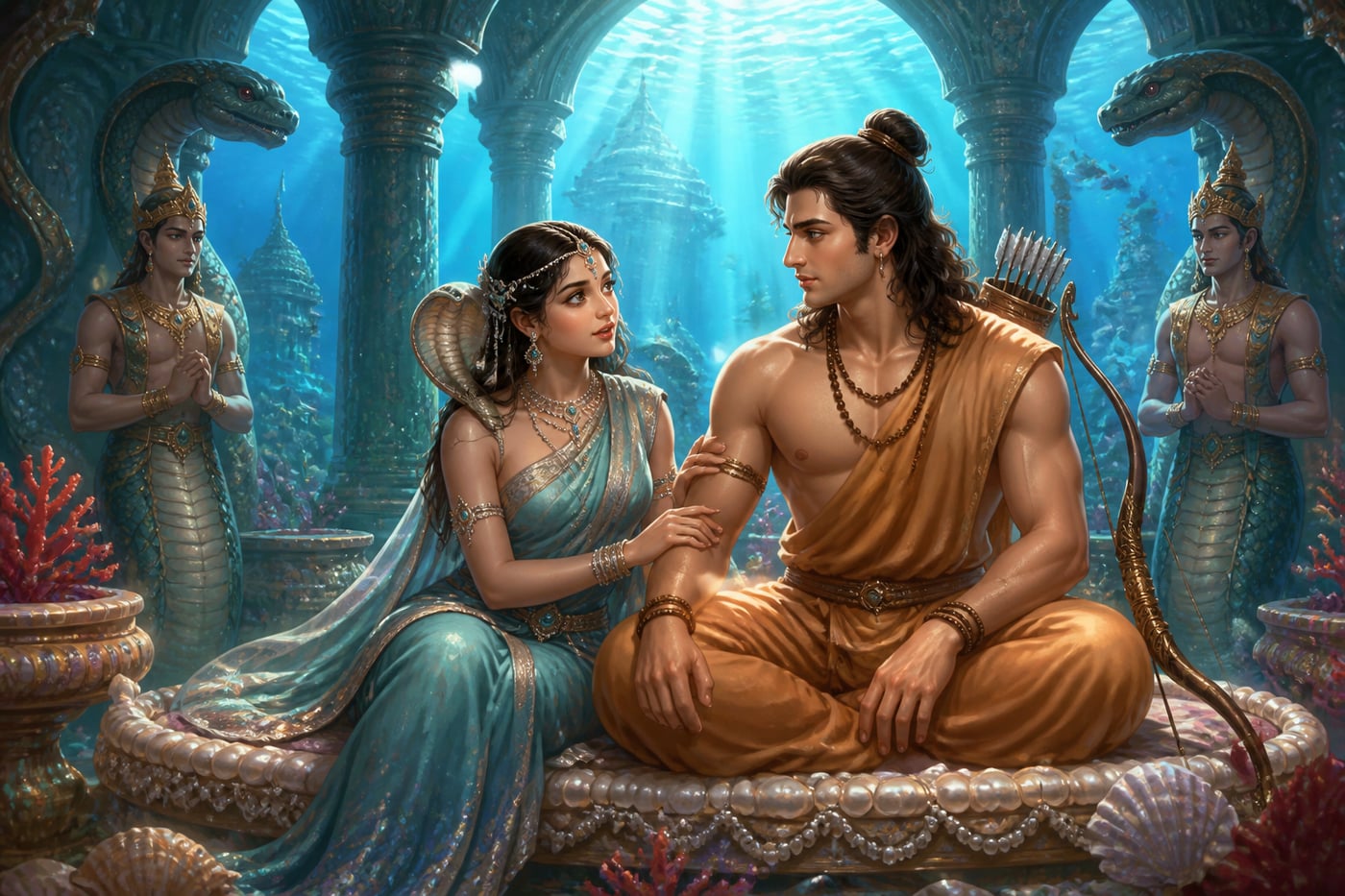
Rather than drowning, he found himself in a magnificent underwater palace. Before him stood Ulupi, princess of the Nagas, serpent beings who inhabited elaborate realms beneath rivers and oceans. Daughter of the Naga king Kauravya, she had watched Arjuna from beneath the waters and fallen deeply in love.
"Mighty Arjuna," she pleaded, "I am consumed by desire for you. If you reject me, I shall surely perish. Is it not adharma to cause a woman's death?"
Arjuna hesitated. "But I am on a brahmacharya vrata, a vow of celibacy during my pilgrimage."
Ulupi responded wisely: "Your vow was regarding Draupadi, that you would not approach her while she was with another brother. It does not extend to all women. Moreover, saving a life takes precedence over ceremonial vows."
Convinced by her reasoning and moved by her devotion, Arjuna married Ulupi in the Naga realm. From their union was born Iravan, a son who would later fight and die heroically in the Kurukshetra war. Ulupi also granted Arjuna a boon, invincibility against all creatures dwelling in water.
The next morning, Arjuna emerged from the Ganga, enriched by new family bonds and divine protection. His exile had begun transforming punishment into opportunity.
The Princess of Manipura
Continuing his pilgrimage eastward, Arjuna reached Manipura, a kingdom in the far northeast. There, King Chitravahana ruled with his beautiful daughter Chitrangada, a princess trained in warfare and statecraft.

Arjuna, struck by her beauty and accomplishments, sought her hand. But the king had a condition.
"Chitrangada is my only child," Chitravahana explained. "I have raised her as my heir under the principle of putrika, a daughter who provides sons to continue her father's lineage. Any son born to her must remain here as my grandson and successor. He cannot go with you."
Arjuna agreed readily. He spent three years in Manipura, and from his marriage to Chitrangada was born Babhruvahana, a prince who would one day rule Manipura and, in a tragic twist of fate, unknowingly kill his own father in battle, only to revive him through Ulupi's grace.
Through these marriages, Arjuna was not merely satisfying romantic impulses. Each union connected the Pandavas to powerful kingdoms, the Nagas who controlled underwater realms and mystical powers, and Manipura which commanded the eastern frontiers. A web of alliances was being woven.
The Divine Encounter in Dwaraka
Arjuna's pilgrimage eventually brought him to Prabhasa, a sacred tirtha on the western coast. There he received word that Krishna had come to visit him. The reunion of the dearest friends was joyful.
"Come to Dwaraka," Krishna urged. "Rest from your travels. The Yadava kingdom awaits."
In Dwaraka, Arjuna encountered Subhadra, Krishna's sister, Vasudeva's daughter, and a woman of remarkable beauty and virtue. Love bloomed between them almost immediately.
But there was a complication. Balarama, Krishna's elder brother, favored Duryodhana and wished to marry Subhadra to him. A formal proposal from Arjuna might be rejected, creating conflict between the Yadavas and Pandavas.
Krishna, ever the strategist, suggested a bold solution: "The kshatriya tradition allows marriage by abduction, it is considered heroic rather than shameful when a warrior claims his bride by valor. Take Subhadra. I will manage the consequences."
Arjuna, disguised as a yati (ascetic), had already won Subhadra's heart during his stay. When she drove out in her chariot to pay respects at a temple, Arjuna revealed himself, and she willingly climbed aboard as he drove furiously toward Indraprastha.

Balarama was enraged and prepared to pursue with an army. But Krishna calmed him:
"Consider, brother, Arjuna is the greatest warrior of our age, beloved of the Pandavas who are our natural allies. Subhadra clearly loves him, see how willingly she went! Is it not better to have such a son-in-law than to create enmity? Send wedding gifts, not warriors."
Balarama's anger cooled. The Yadavas dispatched a bridal procession with magnificent gifts, legitimizing the abduction as a celebrated wedding.
The Birth of Abhimanyu
One delicate matter remained, how would Draupadi receive this new wife? Subhadra approached her not as a rival queen but as a humble sister. Dressed as a simple cowherd woman, she fell at Draupadi's feet.
"I am your servant," Subhadra said. "I come not to compete but to serve."
Draupadi, moved by such humility and by Krishna's sister's grace, embraced her warmly. The two women became close friends, their children raised together as brothers.
From Arjuna and Subhadra's love was born Abhimanyu, a warrior who would inherit his father's unmatched skill and his mother's Yadava fire. Raised in both Indraprastha and Dwaraka, Abhimanyu would become the hope of the Pandava army, his short life burning with heroic brilliance before its tragic end in the chakravyuha.
Arjuna's twelve years of exile had yielded three marriages, three sons, alliances with the Nagas, Manipura, and the Yadavas, and the deepening of his friendship with Krishna. What was meant as punishment had become preparation, for the trials and triumphs that awaited.
The Return and Reconciliation
When Arjuna finally returned to Indraprastha, he was welcomed with celebration. His brothers embraced him, Draupadi received Subhadra as a sister, and the kingdom rejoiced at the reunion.
But Arjuna returned more than a husband and father, he returned as a key node in a network of alliances spanning the subcontinent. The Nagas would come to the Pandavas' aid in desperate times. Manipura's warriors would fight in the great war. And the Yadavas, Krishna's people, would prove the most crucial allies of all.
Dharmaraja Yudhishthira saw the wisdom in what had transpired. Sometimes exile becomes opportunity. Sometimes punishment becomes preparation. The Pandavas were now connected to powers seen and unseen, mortal and divine, preparing them for the conflicts ahead.
In the next lesson, we shall witness the transformation of the Khandava wilderness into Indraprastha, a city built by the demon architect Maya, a marvel of illusion and wonder that would become the seat of Pandava power and the object of Duryodhana's consuming envy.
Living traditions
The story of Arjuna's exile demonstrates how setbacks can become opportunities, a teaching that resonates with modern concepts of resilience and growth mindset. The multi-cultural marriages also represent ancient India's diversity and interconnection, themes relevant to contemporary discussions of unity in diversity.
- Nadī Snāna (Sacred River Bathing): Tirtha yatra remains a core Hindu practice, millions visit Varanasi, Prayagraj, Haridwar, and other sacred sites annually, bathing in holy rivers as Arjuna did during his exile
- Vivāha Samskāra (Marriage Rituals): The tradition of arranged marriages considering family alliances while also valuing mutual attraction echoes the multi-dimensional nature of Arjuna's marriages
- Putrikā Dharma (Daughter-Heir Tradition): Putrika traditions, where daughters provide heirs for their father's lineage, evolved into various inheritance practices recognizing daughters' rights across Hindu law
- Kuttantavar Temple, Koovagam: This temple dedicated to Iravan (Arjuna's son by Ulupi) hosts the famous 18-day Koovagam Festival where the transgender community ritually marries and mourns Iravan, commemorating his sacrifice in the Kurukshetra war.
- Kangla Fort and Govindaji Temple: The ancient seat of Manipuri kings who trace their lineage to Babhruvahana (Arjuna's son by Chitrangada). The Govindaji Temple nearby is the state's most sacred site, built by rulers claiming Pandava descent.
- Bet Dwarka (Shankhodhar): An island believed to be the original Dwarka where Krishna lived. Tradition holds this is where Arjuna met Krishna and Subhadra during his pilgrimage, leading to his marriage with Subhadra.
- Kuttantavar Temple, Koovagam: The Kuttantavar Temple in Koovagam enshrines Iravan (also called Kuttantavar) as a village deity with year-round worship
- Shri Govindaji Temple: Manipur's Govindaji Temple, built by the royal family claiming descent from Babhruvahana, remains the state's most sacred site
- Somnath Temple (Prabhasa Tirtha): Temples at Prabhasa tirtha (Somnath region) commemorate Arjuna's pilgrimage and meeting with Krishna
Reflection
- Arjuna had a valid technical excuse to avoid exile but chose to go anyway. When have you faced a situation where you could have technically avoided a consequence but chose to accept it anyway? What guided that choice?
- Each of Arjuna's marriages served both love and political purpose. Is it possible to combine personal happiness with strategic benefit in relationships, or does one inevitably compromise the other?
- Krishna advised Arjuna to abduct Subhadra rather than ask formally, prioritizing outcome over conventional propriety. When might the unconventional approach be more righteous than following expected procedures?