Janma: Divine Origins
Birth of Pandavas and Kauravas
In the mountain hermitages of the Himalayas and the palace chambers of Hastinapura, two sets of princes are born whose rivalry will reshape the world. Five sons born of divine fathers to Kunti and Madri, and one hundred sons born from Gandhari's iron will, the Mahabharata's central conflict takes human form.
Janma: Divine Origins
In the serene heights of the Shatashrunga mountain, far from the intrigues of Hastinapura, King Pandu lived in forest exile with his two queens. The curse of Kindama hung over him like a sword, any intimate contact with his wives would mean instant death. For a king whose entire purpose was to continue his dynasty, this was a fate worse than death itself.
But Kunti held a secret that would change everything.
The Revelation of Divine Power
One day, watching the sages perform their rituals to the gods, Pandu fell into deep despair. "What use is a king without heirs?" he lamented. "The Kuru line, which has endured for generations, will end with me. My ancestors will receive no offerings, no descendants to remember them."
Kunti saw her husband's anguish and made a decision. She would reveal the secret she had kept since girlhood, the mantra given by Sage Durvasa that could invoke any god. She had used it once, in innocent curiosity, and had borne Karna, a son she was forced to abandon. Now, she could use it to save her husband's lineage.
When Kunti told Pandu of her boon, hope blazed in his eyes. "The gods themselves shall father my sons!" he declared. "Which deity could be more worthy?"
The First Three Sons
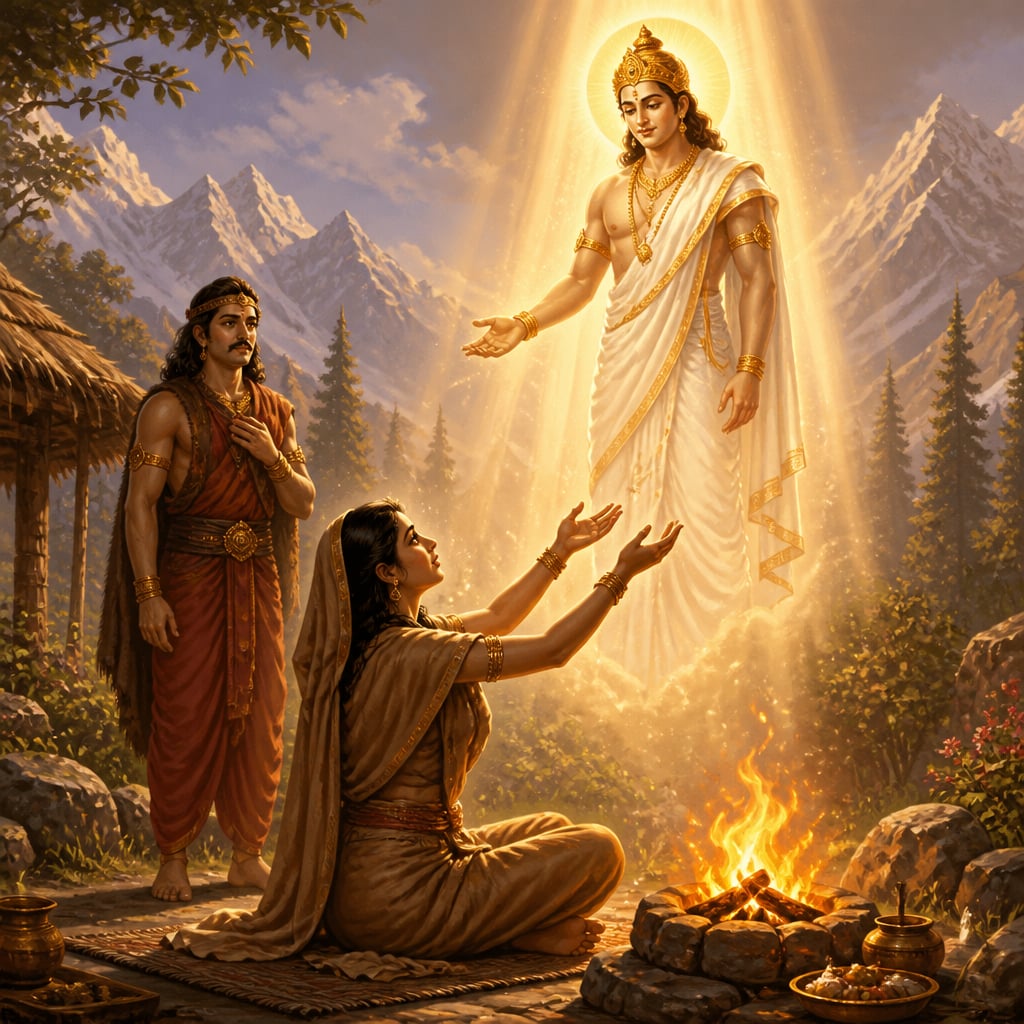
Pandu asked Kunti to invoke Dharma, the god of righteousness, first. "A son born of Dharma will uphold truth above all else," he reasoned. "Such a son should be the eldest."
Kunti spoke the sacred mantra, and Dharma himself descended. From this divine union was born Yudhishthira, he whose steadfastness in battle (yuddha-sthira) would never waver. At the moment of his birth, a celestial voice proclaimed: "This child shall be the most righteous of all, and he shall one day perform the greatest sacrifice the world has ever seen."
A year later, Pandu desired a son of supreme strength. "Invoke Vayu, the wind god," he instructed Kunti. "His son will have the power of storms."
Vayu came as a gentle breeze that grew into a mighty gale. Bhima was born, bhima meaning "the terrible" or "the tremendous." Even as an infant, his strength was extraordinary. Once, when Kunti accidentally dropped him, the baby's fall shattered the mountain rock beneath him, while he remained unhurt.
For the third son, Pandu had the highest ambition. "Now invoke Indra, king of the gods," he said. "Let our third son be the greatest warrior the world has ever known."
Kunti hesitated. Indra was proud, and the lord of heaven rarely descended to mortal summons. But she spoke the mantra, and after great austerities, Indra appeared in all his splendor. Arjuna was born amidst thunder and celestial music. Again came the divine proclamation: "This son shall be equal to Kartavirya Arjuna and Shiva himself in battle. He shall be invincible."
Madri's Divine Sons
Queen Madri, the silent wife, watched these births with mingled joy and sorrow. She had married Pandu with dreams of motherhood, yet the curse condemned her to barrenness. She spoke nothing, but Kunti, with a woman's intuition, understood her sister-wife's silent grief.
"My lord," Kunti approached Pandu, "would you permit me to share the mantra with Madri? She too deserves the joy of motherhood."
Pandu agreed, and Kunti taught her co-wife the sacred words. But she gave Madri only one use of the mantra. Madri, clever and decisive, chose to invoke the Ashvini Kumaras, the twin physicians of the gods, forever young and beautiful. From one invocation came two sons: Nakula and Sahadeva.
Nakula, whose name means "color of the mongoose," inherited the Ashvins' surpassing beauty, it was said that no man or woman could match his handsomeness. Sahadeva, "he with the gods," received their wisdom and knowledge of the past, present, and future.
Madri requested another use of the mantra, hoping for more children, but Kunti refused. "You received two sons from one invocation," she said. "If you gain more than I, it will seem I have been foolish." This small rivalry between the queens, though managed with restraint, would echo in their sons' relationships forever.
The Hundred Sons of Dhritarashtra
While divine children were being born in the mountains, something far stranger was happening in Hastinapura. Queen Gandhari, who had tied a blindfold over her eyes to share her blind husband's darkness, had been pregnant for two years with no sign of delivery. The pregnancy had hardened into a mass of iron-like flesh.
In despair and frustration, Gandhari struck her own belly. What emerged was not a child, but a hard, grey ball of flesh. She was about to cast it away when Sage Vyasa appeared.
"What have you done?" he asked. "Did I not promise you a hundred sons?"

Following Vyasa's instructions, the ball of flesh was divided into one hundred and one pieces and placed in jars of clarified butter (ghee). From these jars, over time, emerged one hundred sons and one daughter. The first to emerge was Duryodhana, whose name means "hard to conquer" or "unconquerable in war."
At the moment of Duryodhana's birth, jackals howled, donkeys brayed, and ill winds blew from all directions. The priests and ministers approached Dhritarashtra with a difficult truth: "Your Majesty, all omens indicate this child will destroy your family. For the good of the world, he should be abandoned."
But what father can abandon his firstborn son? Dhritarashtra, already pained by blindness and the loss of kingship, refused to give up his heir. This decision, made from a father's love, would cost millions of lives.
Tragedy in Paradise
For sixteen years, the Pandavas grew up in the mountain forests, educated by great sages, trained in the ways of dharma and kshatriya duty. They were happy years, but they could not last.
One spring day, when nature itself seemed to celebrate, Madri walked alone through flowering trees. Pandu, following her, was overcome by her beauty. For one fatal moment, he forgot the curse. He reached for his wife, and Kindama's words came true. Pandu fell dead instantly.

Madri's grief was absolute. "I am the cause of his death," she declared. "I shall follow him." Despite Kunti's protests, Madri ascended the funeral pyre with her husband, the practice known as sahagamana, going together.
Kunti was left alone with five young boys. "Why should you go?" Madri had asked her before the end. "You must stay for all five sons, yours and mine. Care for Nakula and Sahadeva as your own."
The Return to Hastinapura
The mountain sages could not keep widowed Kunti and her orphaned sons forever. They journeyed to Hastinapura, where Bhishma welcomed them with genuine joy. "These are Pandu's sons," he proclaimed to the court. "They are princes of the Kuru line."
Dhritarashtra, though outwardly gracious, felt the first stirrings of anxiety. Five sons of divine origin, five potential claimants to the throne his own sons desired. Yudhishthira, the eldest Pandava, was born before Duryodhana, the eldest Kaurava, making him the rightful heir.
The seeds of the great conflict had been planted. In one palace, two sets of princes would now grow up together, five children of gods, and a hundred children of ambition.
The Weight of Birth
The births of the Pandavas and Kauravas illustrate the Hindu understanding of janma, that birth is not accident but destiny. Each child came marked by their origin: Yudhishthira's unshakeable righteousness from Dharma, Bhima's volcanic strength from Vayu, Arjuna's warrior perfection from Indra, the twins' beauty and wisdom from the Ashvins, and Duryodhana's ominous nature announced by ill omens.
Yet birth is only the beginning. What matters is what each person does with their inheritance. Yudhishthira will struggle with righteousness. Arjuna will question his warrior destiny. Even Duryodhana, born to bad omens, had the choice to prove the prophecies wrong.
As these princes grow, their divine and mortal natures will clash, merge, and ultimately determine the fate of an entire age.
Living traditions
The names of all five Pandavas remain among the most popular names in India today. Arjun consistently ranks among the top baby names across multiple Indian states. The phrase 'Dharma ka poth' (son of Dharma) is used colloquially to describe someone exceptionally honest and righteous, a direct reference to Yudhishthira.
- Jātakarma Samskāra (Birth Rituals): Jatakarma samskara (birth rituals) in Hindu tradition include ceremonies similar to those performed for the Pandavas, mantras for protection, naming ceremonies based on birth circumstances, and establishing the child's horoscope to understand their destiny.
- Garbha Samskāra (Prenatal Influence): The concept of 'garbha sanskar' (prenatal influence) is practiced by many Hindu families, based on the belief that a mother's thoughts, prayers, and actions during pregnancy influence the child, as Gandhari's sacrifice and Kunti's divine invocations influenced their sons.
- Mana Village, Uttarakhand: The last Indian village before the Tibetan border, Mana is associated with the Pandavas' birth and childhood in the Himalayas. The Bhim Pul (bridge made by Bhima) and Vyasa Cave are nearby pilgrimage sites.
- Hastinapura Archaeological Site: Excavations at Hastinapura in Uttar Pradesh have revealed ancient settlement layers dating to the period traditionally associated with the Mahabharata. The site connects visitors to the city where the Pandavas and Kauravas grew up together.
- Pandava Caves Temple: Temples in Mana village near Badrinath claim to be near the Shatashrunga mountain where the Pandavas were born. Pilgrims visit believing they walk where divine births occurred.
- Pandava Caves, Pachmarhi: The Pandava caves in Pachmarhi, Madhya Pradesh, are believed to be where the Pandavas lived during their exile, connecting to their forest childhood.
Reflection
- If you were Dhritarashtra, would you have abandoned your firstborn son based on bad omens? What does this choice reveal about the tension between love and wisdom?
- Madri chose to die with Pandu rather than live to raise her sons. Was this a noble sacrifice or an abandonment of her responsibilities as a mother?
- The Pandavas were born of gods, yet they would face suffering, exile, and loss. What does this suggest about the relationship between divine favor and human happiness?