Smriti: The Ring of Remembrance
Shakuntala proves her marriage
When Shakuntala arrives at Dushyanta's court pregnant and alone, the king denies ever knowing her. In one of the most powerful scenes in the Mahabharata, Shakuntala must defend her honor not with evidence but with the truth itself, and the heavens will speak on her behalf. From this trial by fire emerges Bharata, the emperor who will give India its ancient name.
The Sage Returns
Months passed in Kanva's ashram after Dushyanta's departure. Shakuntala waited, as wives wait, watching the path through the forest for the royal escort that never came. Her belly grew round with the child she carried, the heir Dushyanta had promised would be crown prince. But no messengers arrived. No palanquin appeared at the ashram's edge.
When the great sage Kanva returned from his pilgrimage, he already knew what had transpired. Through his yogic vision, he had witnessed everything, the meeting, the marriage, the departure, and the promise.
"Do not grieve, my daughter. You have done nothing wrong. The Gandharva marriage is dharma for a Kshatriya. Your husband is a righteous king, and your son will be a great emperor."
Kanva blessed the union and prepared to send Shakuntala to her husband's palace. Though the king had not sent for her as promised, the sage believed that a wife's place was with her husband, especially when she carried his child.
The Journey to Hastinapura
With heavy heart, Shakuntala bid farewell to the only home she had ever known. The ashram's trees seemed to droop in sorrow; the deer she had raised followed her to the forest's edge; even the river Malini seemed to slow its course, reluctant to let her go.
Kanva sent her with an escort of his disciples, bearing fruits and gifts from the hermitage. On her finger, Shakuntala wore the royal signet ring, the token Dushyanta had given her, engraved with the two fish of the Puru dynasty.
The journey took many days. As she traveled, Shakuntala rehearsed what she would say to her husband. He will be happy to see me, she told herself. He will welcome me as his queen. He gave his word.
But fate had other plans. While crossing a river, Shakuntala stopped to drink water. As she cupped the water in her hands, the ring slipped from her finger and disappeared into the depths. She searched frantically but could not find it. The token of her marriage, her only proof, was gone.
No matter, she thought, trembling. He will know me. He will remember his promise.
The King's Court
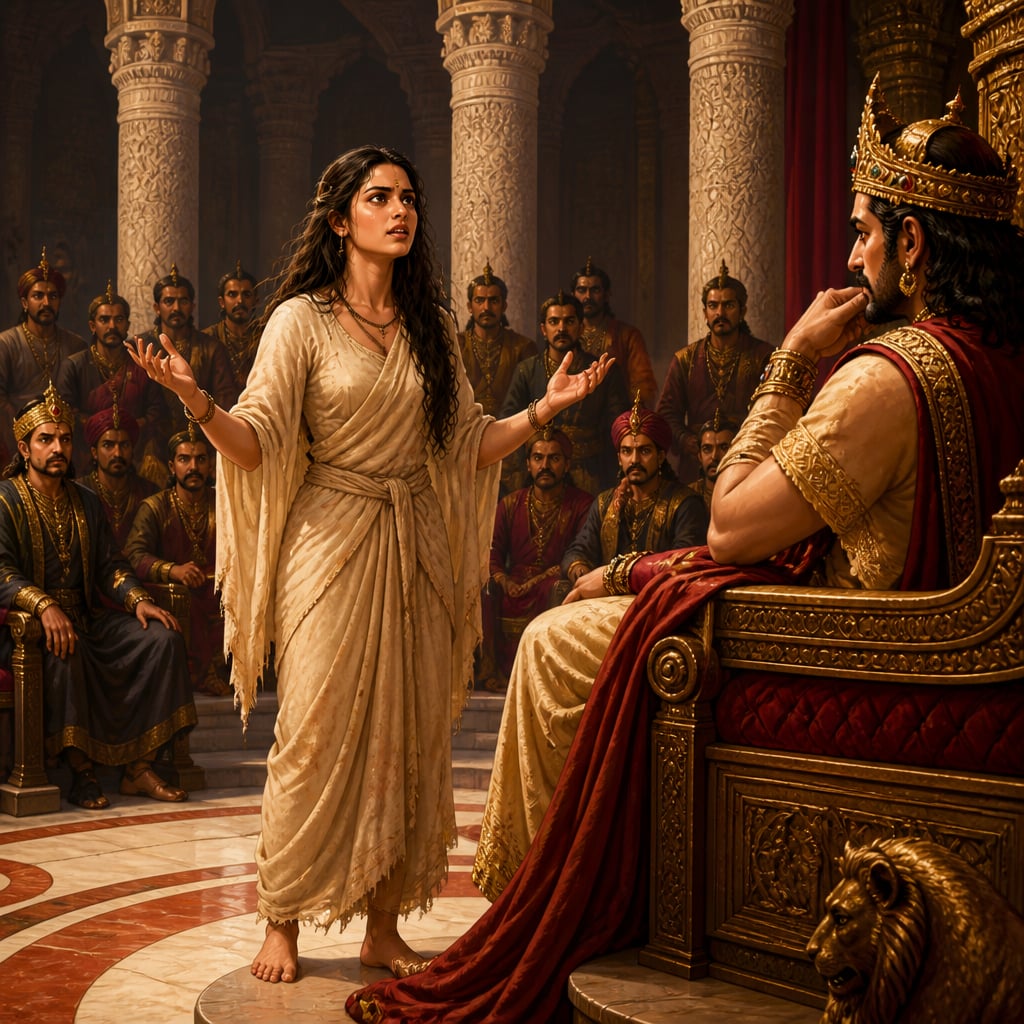
The court of Hastinapura was magnificent, a vast assembly hall filled with ministers, priests, warriors, and nobles. When Shakuntala was announced, all eyes turned to this woman from the forest, visibly pregnant, dressed in the simple garments of an ashram-dweller.
Dushyanta sat on his throne, surrounded by the splendor of his kingdom. When he saw Shakuntala, something flickered across his face, recognition, perhaps, or fear. But when he spoke, his words were cold as winter stone.
"Who are you, woman? I do not know you. Why do you come to my court with these wild claims?"
Shakuntala's world collapsed. She stood in the center of that great hall, feeling the eyes of hundreds upon her, hearing whispers and snickers from the assembled courtiers. The man who had held her in his arms, who had sworn eternal love beneath the forest canopy, looked at her as if she were a stranger.
"My lord," she said, her voice steady despite her breaking heart, "I am Shakuntala, daughter of Vishwamitra and Menaka, raised by the sage Kanva. You came to my father's ashram. You married me by the Gandharva rite. You gave me this child I carry and promised he would be your heir."
"I remember no such thing," Dushyanta replied. "Perhaps you have confused me with another. Or perhaps you seek to trap a king with false claims."
Shakuntala's Speech
What happened next is one of the most powerful moments in the Mahabharata. Shakuntala, abandoned and humiliated, did not weep or beg. She rose to her full height and spoke with the fire of truth.
"A wife is not a servant to be discarded. A wife is half of her husband's self. Through her, he becomes complete. Through her, he gains dharma, artha, and kama. Through her, he achieves immortality in his children."
Her voice rang through the hall, silencing the whispers:
"O king, the witness to our marriage was Agni, the sacred fire. The witness was Vayu, the wind that carried our vows. The witness was Surya, the sun that blessed us. These gods do not lie. These gods do not forget."
She continued, her words cutting deeper than any sword:
"A man may hide his deeds from others, but he cannot hide them from himself. The Self within is the eternal witness. He sees all, knows all, records all. You may deny me before this court, but can you deny me before your own conscience?"
The courtiers sat in stunned silence. Even the most cynical among them felt the weight of her words. This was no scheming woman seeking advancement, this was truth itself, standing before them unadorned.
The Heavenly Voice
As Shakuntala finished speaking, the impossible happened. The sky seemed to open, and a voice descended from the heavens, clear, resonant, undeniable:

"Dushyanta, this woman speaks the truth. She is your wife, married lawfully by the Gandharva rite. The child she carries is your son. Accept them both, O king, and do not earn the sin of abandonment."
The court erupted in amazement. A divine voice had spoken! The gods themselves had intervened to confirm what Shakuntala claimed. There could be no further doubt.
Dushyanta rose from his throne. His face, which had been a mask of denial, now softened. He descended the steps and approached Shakuntala.
"Forgive me," he said, though whether he truly had forgotten or had merely been testing her, or had feared scandal and sought divine validation, the text leaves tantalizingly unclear. "I accept you as my wife and the child as my heir. But I could not acknowledge you on your word alone, the court would have doubted. Now that the heavens have spoken, all will honor you."
The Birth of Bharata
Shakuntala was installed as queen with all proper ceremonies. When her time came, she gave birth to a son of extraordinary strength and beauty. From his earliest days, the child showed signs of greatness, he would play with lion cubs as other children played with toys, earning him the name Sarvadamana, "he who subdues all."
When the boy came of age, Dushyanta performed the sacred ceremony and crowned him heir. He gave him a new name, Bharata, meaning "one who is cherished" or "one who bears the world."
This Bharata would become one of the greatest emperors in history. His rule extended across the entire subcontinent, and his descendants formed the dynasty that gives the Mahabharata its name. The very name "Bharat", by which India knows itself to this day, comes from this son of Shakuntala and Dushyanta, born from a love tested by abandonment and proven by truth.
The Weight of What Happened
The story raises questions the text does not fully answer. Did Dushyanta truly forget, as later retellings suggest? Or did he remember but deny, fearing scandal? The Mahabharata seems to suggest the latter, that his denial was a moral failure, not a magical curse.
If so, what does that say about power and its temptations? Dushyanta was a righteous king in all other respects. Yet when acknowledging his forest wife threatened his reputation, he chose denial. Only divine intervention forced him to do what he had promised.
Shakuntala, by contrast, held firm to truth even when truth brought only suffering. She did not bend, did not fabricate, did not negotiate. She simply stood in the light of what had happened and let that light expose everything.
The truth needs no ring to prove itself. The truth carries its own evidence.
This is why the story endures. Not because it has a happy ending, though it does, but because it shows us what happens when truth meets power, when a woman without status confronts a king with nothing but her word and her dignity. The heavens spoke for Shakuntala because she spoke for herself first.
Living traditions
The Shakuntala story has been adapted into over a dozen Indian films, multiple TV serials, and countless dance productions. Raja Ravi Varma's paintings of Shakuntala are among the most iconic images in Indian art. The story continues to resonate because it speaks to universal themes: love, betrayal, the power of truth, and the vindication of the innocent.
- Shakuntalam Theatre Productions: Kalidasa's Abhijnana Shakuntalam remains one of the most performed Sanskrit plays in the world. Modern productions range from traditional Sanskrit performances to contemporary adaptations in regional languages, keeping the story alive across generations.
- Hastinapura Archaeological Site: Excavated ruins of the ancient Kuru capital where Shakuntala presented herself to Dushyanta's court. Archaeological surveys have uncovered Painted Grey Ware pottery dating to the epic period.
- Bharateshwar Mahadev Temple: Ancient Shiva temple associated with Emperor Bharata, son of Shakuntala and Dushyanta. The temple marks sites where Bharata is said to have performed sacred rites.
- Bharata Temple: While Emperor Bharata (son of Dushyanta) is sometimes confused with Bharata (brother of Rama), several temples and sites commemorate the ancestral Bharata as the founder of the dynasty.
Reflection
- Shakuntala forgave Dushyanta after his acceptance. Was this forgiveness wisdom or weakness? What would you have done in her place?
- The text is ambiguous about whether Dushyanta truly forgot or deliberately denied. Which interpretation do you find more compelling, and why does it matter for understanding the story's moral?
- What does it mean that India (Bharat) takes its name from the child of this troubled union? Does the origin story of a nation matter?