Swayamvara: The Fish's Eye

Arjuna wins Draupadi at the contest

In Panchala, the daughter of fire awaits her husband. Kings from across Bharatavarsha gather for an impossible contest, to string a legendary bow and pierce a rotating fish's eye while looking only at its reflection. One by one, the mightiest warriors fail. Then a young brahmin rises from the crowd. The world is about to learn that the Pandavas still live.

Swayamvara: The Fish's Eye

King Drupada of Panchala had never forgotten his humiliation. Dragged before Drona by his own students, forced to surrender half his kingdom, the shame burned in him daily. He had performed great sacrifices seeking revenge, and from the sacred fire had come two gifts: a son named Dhrishtadyumna, destined to kill Drona, and a daughter of surpassing beauty named Draupadi.

Draupadi was no ordinary princess. She had emerged from the sacrificial flames fully grown, dark-skinned and radiant, her eyes like lotus petals, her hair fragrant with celestial perfume. A divine voice had proclaimed at her birth: "This dark one shall accomplish the purpose of the gods. Through her, the kshatriyas shall face destruction."

Now it was time for her to choose a husband.

The Impossible Test

Drupada designed the swayamvara to ensure that only the greatest warrior could win his daughter. In the center of the arena stood a massive bow, so heavy that ordinary men could not lift it, so stiff that elephants could not string it. Above the arena hung a mechanical device: a rotating pole with a metal fish at its top. Below the fish was a pool of oil that reflected its image.

The rules were announced: "Look only at the reflection. String the bow. With five arrows, pierce the eye of the fish."
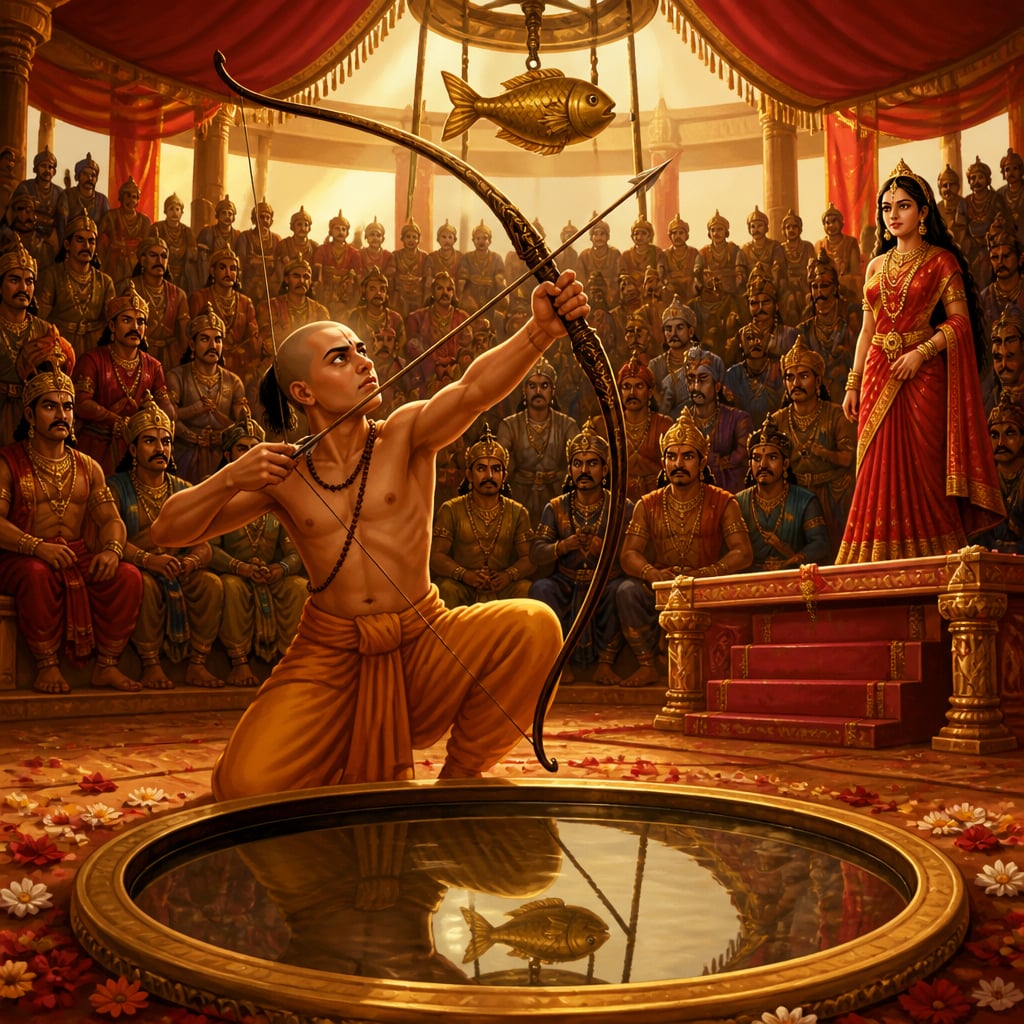
Arjuna disguised as a brahmin kneels at the Panchala swayamvara, gaze fixed on the oil pool reflecting the rotating fish target above.

It seemed impossible. The fish rotated constantly. The archer could not look up at the target. He had to shoot at a reflection while the target moved. Only someone with perfect concentration and divine skill could succeed.

Kings came from every corner of Bharatavarsha. There was Jarasandha of Magadha, Shishupala of Chedi, Shalya of Madra, and dozens more. Karna arrived in his golden armor, confident as always. Duryodhana and his brothers came, certain that one of them would prevail.

And in the crowd, dressed as brahmins, sat the Pandavas, officially dead, secretly watching.

The Failures

One by one, the kings attempted the challenge. Strong arms strained against the bow. Powerful hands tried to bend its curve. King after king failed even to string it. They could not even reach the stage of shooting at the fish.

Jarasandha tried and failed. Shishupala could not bend the bow. Duryodhana and his brothers were defeated by the bow's resistance. Each failure increased the murmuring in the crowd. Was this test meant to be won at all?

Then Karna rose.

He strode to the center of the arena, his golden kavacha gleaming. Here was a warrior who could match Arjuna himself. Surely he would succeed where others had failed.

Karna lifted the bow easily. He began to string it, and Draupadi's voice rang out.

Karna rejected at Draupadi's swayamvara

"I will not wed a suta-putra."

The words struck like arrows. Karna froze. The son of a charioteer was being rejected not for lack of skill, but for lack of birth. The same humiliation he had faced at the rangabhumi now repeated before all the kings of Bharatavarsha.

Different versions of the story offer different accounts. Some say Karna was rejected by Draupadi before he could attempt the challenge. Others say he strung the bow but missed the target by a hair's breadth. Still others say he lowered the bow himself when Draupadi spoke. What all versions agree on: Karna did not win Draupadi, and the rejection added another coal to the fire of his hatred for the Pandavas and all who supported them.

A Brahmin Steps Forward

With every king defeated, a strange silence fell over the arena. Had Drupada made the test too difficult? Would his daughter remain unmarried?

Then a young man rose from the section where brahmins sat observing. He was tall, well-built, with the bearing of a warrior despite his simple clothes. He walked toward the bow.

The crowd murmured. A brahmin attempting a contest meant for warriors? Some in the assembly were taken aback. But something in the young man's confidence made them watch rather than object.

He approached the bow with respect, offering silent prayers. Then he lifted it, and the bow that had resisted kings bent easily in his hands. He strung it in one fluid motion, as if he had done it a thousand times before.

The arena fell silent.

The young brahmin took the five arrows, nocked the first, and looked down at the oil pool. In the reflection, the metal fish rotated. He drew back the bowstring, the arrow gleaming in the light.

In rapid succession, five arrows flew. Each one struck the rotating fish's eye, not just hitting it, but piercing through the exact center. The fifth arrow knocked the fish from its pole entirely.

The crowd erupted. Who was this brahmin who could outshoot every king in Bharatavarsha?

Draupadi descended from her platform, garland in hand. She placed it around the young man's neck. According to the rules of swayamvara, she had chosen her husband.

The Revelation

The assembled kings' surprise quickly turned to outrage. A brahmin had won what they could not? Many considered it a breach of contest decorum. They reached for their weapons.

As the crowd surged forward, the young brahmin threw off his disguise. Arjuna, son of Indra, stood revealed, and beside him rose Bhima, son of Vayu, armed with a tree he had uprooted.

"The Pandavas!" someone shouted. "They live!"

Chaos erupted. Some kings wanted to fight. Others pulled back, uncertain. In the confusion, a new figure made his presence known, Krishna, prince of Dwaraka, who had come to witness the swayamvara.

Krishna recognizing the disguised Pandavas

Krishna approached the Pandavas with evident familiarity. "Cousins," he said, embracing them. "I knew you could not be dead. The fire could not kill those destined for greater things."

Krishna's recognition changed everything. As a respected prince and ally of many kingdoms, his acknowledgment of the Pandavas legitimized their presence. The hostile kings reconsidered, fighting the Pandavas would mean fighting Krishna and his powerful Yadava clan.

With Krishna's guidance, the Pandavas withdrew from the arena, taking Draupadi with them. They had come as fugitives. They left as the victors of the most celebrated contest in years.

The Walk Home

The Pandavas led Draupadi through the streets of Panchala toward the potter's house where they had been staying. Draupadi walked behind Arjuna, uncertain what life now awaited her. She had chosen a husband who had been presumed dead. She was leaving her father's palace for a stranger's humble lodging.

But she said nothing. She had made her choice when she placed the garland around his neck. Whatever came next, she would face it.

At the potter's house, the brothers called to their mother before entering. "Mother! We bring home something special today!"

Kunti, inside and not looking, responded with the words that would change everything: "Whatever you have brought, share it equally among yourselves."

A mother's casual words, a moment's assumption that her sons had brought alms or food. But a mother's word was sacred, and Kunti had spoken.

The Pandavas stood frozen. Draupadi looked from one brother to the next. Arjuna had won her, but now their mother had commanded that she be shared among all five.

What impossible situation had they created? And how could dharma possibly be maintained?

The Meaning of This Moment

Draupadi's swayamvara marks a turning point in the Mahabharata. The Pandavas emerged from hiding. They gained a wife who would become the emotional center of their alliance. They met Krishna, who would become their greatest ally and advisor.

But the moment also set in motion new conflicts. Karna's humiliation deepened his hatred. The kings who had failed the test nursed wounded pride. And the impossible situation created by Kunti's words would require unprecedented solutions.

The fish's eye had been pierced. Now the true challenges began.

Living traditions

The phrase 'matsya yantra' or 'fish's eye' is commonly used in Hindi to describe laser-focused attention on a goal. Students and professionals invoke the image when discussing concentration. Draupadi's character has been reinterpreted in numerous modern novels, including The Palace of Illusions by Chitra Banerjee Divakaruni, which retells the Mahabharata from her perspective.

Reflection

More in Adi Parva

All lessons in Adi Parva · The Mahabharata course