Samriddhi: The Rise of the Pandavas
From exiled princes to prosperous kings
The Adi Parva concludes with the Pandavas triumphant. Indraprastha flourishes under Yudhishthira's dharmic rule, the five brothers establish families, and alliances span the subcontinent. Yet as prosperity rises, so does envy. The seeds planted in childhood, Duryodhana's jealousy, Shakuni's vengeance, Karna's resentment, await only opportunity to bloom into catastrophe. This lesson summarizes the Pandavas' rise and prepares us for the Sabha Parva's dramatic fall.
Samriddhi: The Rise of the Pandavas
A Kingdom Transformed
The transformation was remarkable by any measure. Where Dhritarashtra had given a wilderness meant to humble his nephews, there now stood Indraprastha, a capital that rivaled Hastinapura in magnificence and exceeded it in wonder. The Maya Sabha drew visitors from across Bharatavarsha, the cleared lands of Khandava yielded fertile fields, and trade routes flourished where once only animals had paths.
Yudhishthira's rule embodied dharma in action. He held court fairly, hearing cases from the lowest to highest. His ministers were chosen for competence, not connection. Taxes were reasonable, justice was swift, and the treasury grew not through exploitation but through prosperity shared. Scholars and artisans flocked to a kingdom where talent was recognized and rewarded.
Under his governance, Indraprastha became what every kingdom aspired to be, a place where brahmins could study in peace, kshatriyas could train for honor, vaishyas could trade with trust, and shudras could work with dignity. The four varnas functioned as they were meant to, each contributing to the whole.
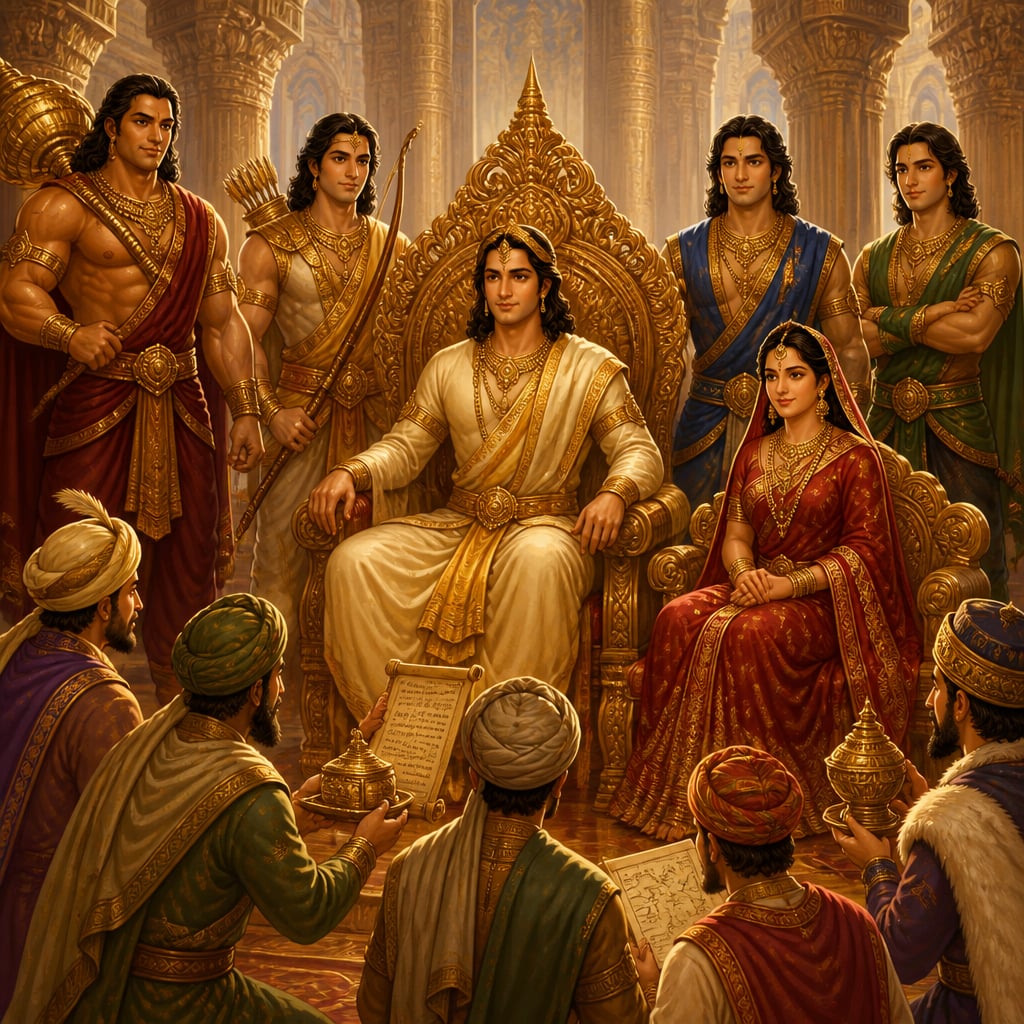
The Brothers in Their Roles
Each Pandava found his dharma within the prospering kingdom.
Bhima commanded the military forces with his characteristic directness. Criminals learned that the wolf-bellied prince did not tolerate lawlessness. His mere presence at the borders deterred bandits and hostile neighbors. But he was also known for unexpected gentleness, children delighted in his stories, and he protected the weak with fierce dedication.
Arjuna served as the premier warrior-diplomat, his reputation from the Khandava burning and swayamvara victory opening doors across the subcontinent. His exile-marriages had created alliances with the Nagas, Manipura, and the Yadavas. Now returned, he trained the next generation of Indraprastha's soldiers and represented the kingdom in matters requiring martial authority.
Nakula, handsome and skilled with horses, established the kingdom's cavalry and stables. His expertise in ashvashastra, the science of horses, made Indraprastha's mounted forces among the finest in the land. He also developed a reputation for diplomacy, his charm smoothing negotiations that others might have bungled.
Sahadeva, wise beyond his years and learned in astrology, served as Yudhishthira's chief counselor on matters requiring deep knowledge. His understanding of cattle-craft improved the kingdom's herds, and his astrological calculations guided auspicious timings for important ventures. Quiet where Nakula was charismatic, he provided the analytical depth that balanced his twin's social gifts.
The Queens of Indraprastha
Draupadi presided over the palace with grace and intelligence. Her arrangement with the five brothers, rotating residence with each husband, maintaining harmony among them, functioned remarkably well. She bore five sons, one to each husband:
Prativindhya, son of Yudhishthira, inherited his father's dharmic temperament. Sutasoma, son of Bhima, grew strong though never matching his father's legendary might. Shrutakarma, son of Arjuna, showed his father's skill with weapons. Shatanika, son of Nakula, possessed his father's beauty. Shrutasena, son of Sahadeva, displayed his father's quiet wisdom.
These five sons, collectively called the Upapandavas, would grow to fight alongside their fathers in the great war, and all five would perish in Ashwatthama's night massacre.
Subhadra, Krishna's sister and Arjuna's wife from his exile, had already borne Abhimanyu, the child who would inherit his father's prowess and demonstrate it fatally in the chakravyuha. She lived harmoniously with Draupadi, the two women bonded by their shared connection to Krishna and genuine friendship.
In the forests still, Hidimba raised Ghatotkacha, Bhima's rakshasa son who would grow to tremendous size and power, eventually sacrificing himself against Karna's Shakti weapon to save Arjuna.
The Web of Alliances
The Pandavas' network of connections now spanned the known world.
Through Draupadi came the Panchalas, Drupada's kingdom with its vast resources and Dhrishtadyumna's destined role as Drona's killer. The Panchala alliance represented the most significant military force aligned with the Pandavas.
Through Subhadra came the Yadavas, Krishna's people, wealthy from trade and powerful in numbers. Though the Yadavas would not formally fight in the great war due to complex neutrality arrangements, Krishna himself would serve as Arjuna's charioteer and guide.
Through Ulupi came the Nagas, serpent beings with mystical powers and underwater realms. Their support would prove crucial in reviving Arjuna after his inadvertent death at Babhruvahana's hands.
Through Chitrangada came Manipura, a northeastern kingdom that would send warriors to fight for the Pandavas when the time came.
Through Hidimba came rakshasa allies, beings of tremendous power who owed allegiance to Bhima's bloodline.
And overarching all these connections was Krishna himself, not bound by marriage but by bonds deeper than blood. His friendship with Arjuna, his guidance of the Pandavas, his role as Draupadi's protector during her worst humiliation, Krishna's presence wove through every aspect of Pandava fortune.
Shadows Gathering
Yet as Indraprastha prospered, Hastinapura watched with growing unease.

Duryodhana heard reports of his cousins' success with each telling more painful than the last. The wilderness meant to diminish them had become their glory. The marriage to Draupadi that should have gone to him had brought the Panchalas to their side. Every achievement felt like a personal rebuke.
His resentment had never truly abated since childhood, the jealousy at Bhima's strength, the humiliation at Arjuna's skill, the frustration that these sons of Pandu seemed blessed by fortune itself. Now they possessed a palace that made Hastinapura seem provincial and a kingdom that rivaled the senior line.
Shakuni, Duryodhana's maternal uncle, fed these flames with calculated precision. The dice master had never forgiven Bhishma for the way his sister Gandhari was married to blind Dhritarashtra. His vengeance required the Kuru dynasty's destruction, and Duryodhana's jealousy provided the perfect instrument.
Karna nursed his own grievances. Rejected at Draupadi's swayamvara, insulted as a suta-putra despite his obvious prowess, he had sworn loyalty to Duryodhana, the only one who had shown him honor. His hatred of Arjuna had become defining.
And Dhritarashtra, the blind king, remained divided between affection for his nephews and obsession with his son's inheritance. His weakness, the inability to restrain Duryodhana or support the Pandavas fully, would prove as destructive as active malice.
The Stage Set
As the Adi Parva concludes, all pieces are in position for the tragedy to come.
Yudhishthira, ever dharmic, will soon perform the Rajasuya sacrifice, establishing himself as samrat, emperor over all kings. This ceremony will bring Duryodhana to Indraprastha, where his humiliation in the Maya Sabha will crystalize his hatred into action.
The gambling match will follow, Shakuni's dice ensuring Yudhishthira's defeat, Draupadi's humiliation in open court, the Pandavas' exile for thirteen years. The prosperity celebrated in this lesson will shatter into forest wandering and anonymous servitude.
But that is the story of Sabha Parva and beyond.
For now, the Adi Parva ends with the Pandavas ascendant, their origins established, their characters revealed, their alliances forged, and their doom set in motion. The Book of Beginnings has told us where this great story comes from. The subsequent books will tell us where it goes.
Reflections on the Adi Parva
Looking back across the lessons of this parva, patterns emerge:
Dharma's Complexity: From Shakuntala's abandonment to Bhishma's vow to Draupadi's polyandry, dharma rarely offered simple answers. Characters wrestled with competing duties, and even righteous choices carried costs.
The Weight of Origins: Every character was shaped by birth, legitimate or questionable, divine or mortal, honored or marginalized. Karna's entire tragedy flows from circumstances of his conception and abandonment.
Choices Echo Forward: Devavrata's vow became Bhishma's cage. Pandu's arrow created Dhritarashtra's blind kingship. Shakuni's grudge would destroy a dynasty. Actions in this parva set in motion consequences that reverberate through all eighteen books.
Providence Works Through People: Divine purposes manifested through human choices, Vyasa appearing to continue lineages, Kunti's mantras producing divine children, Krishna's guidance shaping events. The gods worked through mortals, not instead of them.
The Adi Parva gave us beginnings. The story now continues toward its devastating middle and its transcendent end.
Living traditions
The Pandavas' transformation of Khandavaprastha into Indraprastha has become a metaphor for nation-building, entrepreneurship, and development. Their collaborative governance model, each brother contributing unique strengths, influences modern thinking about team leadership and organizational design.
- Rāja Dharma (Principles of Royal Duty): Raj dharma concepts from the Mahabharata influenced governance principles throughout Indian history, from ancient kingdoms to modern democratic ideals of just administration
- Puruṣārtha (Four Goals of Life): The concept of the four purusharthas guides Hindu life philosophy, balancing worldly responsibilities with spiritual development
- Saṃyukta Kutumba (Joint Family System): Joint family systems and cooperative governance among siblings draw from ideals of the Pandavas working together, each contributing unique strengths
- Purana Qila (Indraprastha Site): Archaeological excavations have confirmed ancient habitation at this site, traditionally identified as Indraprastha. The fort complex preserves the legendary location of the Pandavas' capital, from which they ruled prosperously before the events leading to the great war.
- Pandava Caves, Pachmarhi: Five rock-cut caves in the Satpura Range, each named after one of the Pandava brothers. Local tradition holds the brothers took shelter here during their exile. The caves offer panoramic views and connect to the forest-dwelling episodes of the Mahabharata.
- Kurukshetra Panorama and Science Centre: A modern museum complex featuring a cylindrical panorama depicting the Kurukshetra war, along with exhibits on the Mahabharata's cultural impact. The nearby Sri Krishna Museum displays artifacts and dioramas related to the epic.
- Pandava Temple, Kurukshetra: Pandava temples across India commemorate the five brothers and their families, often depicting scenes of their prosperous rule
- Draupadi Amman Temple, Pondicherry: Draupadi temples (particularly in South India) honor the shared queen and her role in Pandava fortunes
- Indraprastha Temple, Purana Qila: Temples at Indraprastha site (Purana Qila area) maintain traditions connecting to Pandava governance
Reflection
- Each Pandava brother found his role in the kingdom, warrior, diplomat, administrator, counselor. How do you discover which role suits you in collaborative endeavors? What happens when you're in the wrong role?
- The Pandavas transformed a wilderness into a prosperous kingdom through right action. Yet this very success triggered the jealousy that would destroy them. Should they have been less successful to avoid provoking Duryodhana? Is there such a thing as too much excellence?
- The Adi Parva ends with prosperity about to collapse into disaster. Looking at your own life, can you identify seeds of future problems hidden within current successes? How might wisdom help address them proactively?