Rakshasa Vivaha: Marriage in the Forest
Bhima weds Hidimba, kills Bakasura
The Pandavas wander through demon-haunted forests, fugitives presumed dead. But the wilderness holds unexpected encounters, a rakshasi falls in love with Bhima, her man-eating brother demands a fight, and a terrorized village offers shelter in exchange for an impossible service. In the shadows of exile, Bhima finds a wife, fathers a son, and proves that dharma can be upheld even far from civilization.
Rakshasa Vivaha: Marriage in the Forest
The Pandavas plunged deep into the forest, putting as much distance as possible between themselves and the ruins of the House of Lac. They traveled by night and hid by day, eating roots and wild fruit, always alert for pursuit. The five princes and their mother were fugitives now, royalty reduced to survival.
After days of exhausting travel, they came to a dense forest known to harbor rakshasas, man-eating demons who ruled the wilderness beyond human civilization. Kunti and the brothers, too weary to continue, stopped to rest. While the others slept, Bhima stood guard.
The Rakshasi's Choice
In this forest lived a rakshasa named Hidimba, a fearsome demon with supernatural strength and a taste for human flesh. He sensed the presence of the Pandavas and called to his sister, also named Hidimba (or Hidimbi).
"Go see who has entered our territory," he commanded. "If they are humans, bring them to me. I hunger."
Hidimba transformed herself into a beautiful woman, as rakshasas could do, and approached the Pandavas' camp. But when she saw Bhima standing guard, something stirred in her that she had never felt before. His massive frame, his fierce alertness, his obvious strength, she was captivated.
"I have been sent to bring you to my brother for his meal," she thought. "But I cannot. This man I want for myself."
She revealed herself to Bhima, confessing both the danger he faced and her unexpected feelings. "My brother will come soon," she warned. "He will try to kill you and eat your family. But I do not wish it. Take me as your wife. I will carry you all to safety through the sky, for rakshasas can fly. Flee with me now."
Bhima's response was characteristic: he smiled.
"You expect me to run from your brother? Let him come. I will not abandon my sleeping family, and I will certainly not flee from a demon. But if you speak truly about your feelings, wait and watch. When I have killed your brother, we will see what comes next."
Brother Against Suitor
Hidimba the rakshasa grew impatient. When his sister did not return, he came himself, and found her gazing adoringly at a human.
"Traitor!" he roared. "You choose these cattle over your own blood? I will kill them all, and you besides!"
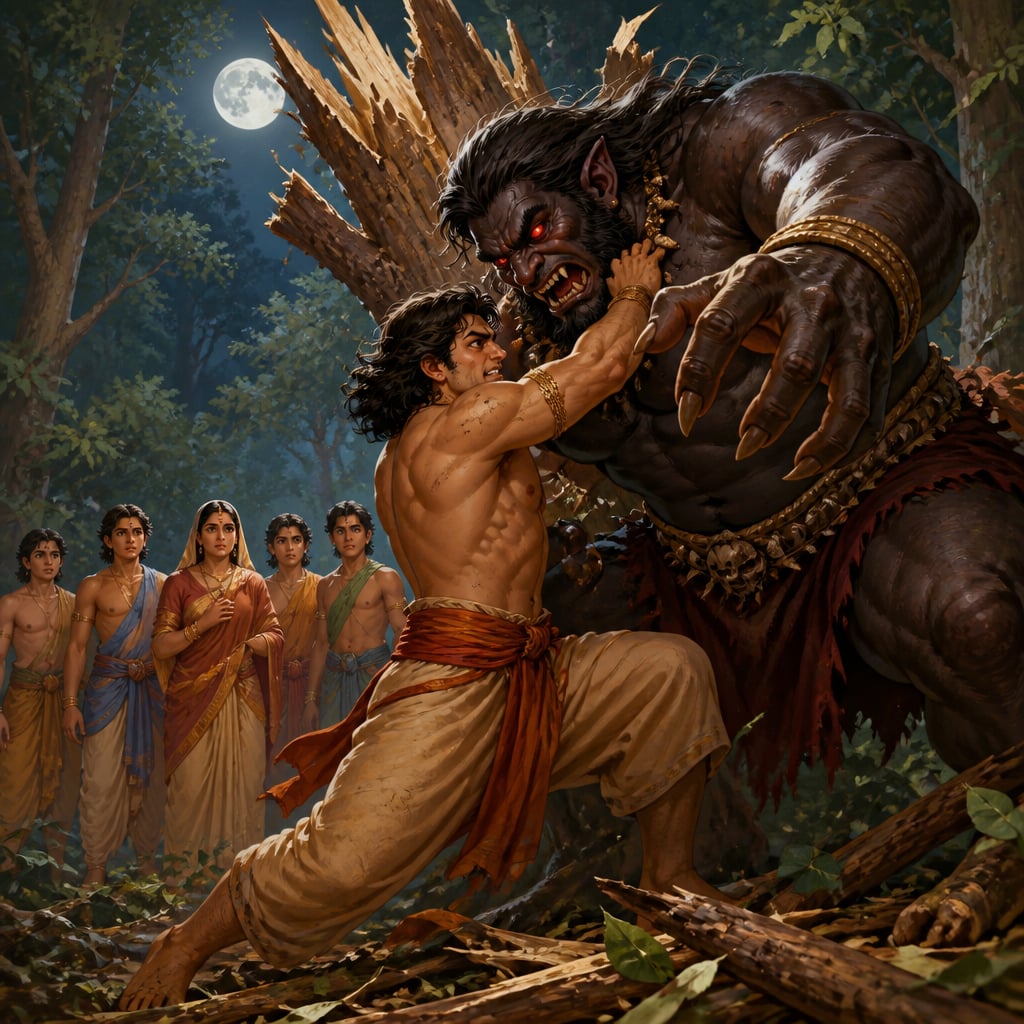
The battle that followed shook the forest. Hidimba was a powerful demon who had terrorized this region for generations. But Bhima, son of Vayu the wind god, was no ordinary human. They grappled, they threw each other into trees that shattered on impact, they wrestled with a fury that seemed endless.
The noise woke the other Pandavas. Arjuna reached for his bow, but Bhima shouted for them to stay back. "This is my fight! Watch and rest, I will finish it."
And finish it he did. After a prolonged struggle, Bhima seized Hidimba and broke his back over his knee. The rakshasa's reign of terror ended in the arms of a man who had been his intended meal.
Hidimba the rakshasi fell at Bhima's feet. "You have killed my brother," she said, "but I feel no grief. He was cruel, and you are magnificent. I asked you before and I ask again, take me as your wife."
A Mother's Permission
Yudhishthira was troubled. Marriage to a rakshasi? This was unprecedented. Rakshasas were demons, enemies of dharma, creatures of the wild places. How could a Pandava prince wed such a being?
But Kunti saw something else. She saw a woman who had chosen love over blood loyalty, who had risked her brother's wrath to protect strangers. And she saw in Hidimba's devotion an echo of her own love for her sons.
"You protected my sons when you could have helped kill them," Kunti told the rakshasi. "You chose dharma over your own kind. Bhima, marry her, but only for a time, until she bears you a son. Then you must return to your duties."

Thus began one of the Mahabharata's strangest marriages. It was a Gandharva vivaha, a marriage of mutual consent, combined with elements of Rakshasa vivaha, the capture marriage sometimes practiced by kshatriyas. Bhima and Hidimba lived together in the forest, moving from mountain peak to lovely grove by her power of flight.
In time, a son was born, Ghatotkacha, whose name meant "pot-headed" for his bald skull. He inherited his mother's rakshasa powers and his father's immense strength. Even as an infant, he was formidable.
"Keep him with you in the forest," Bhima told Hidimba when the time came to leave. "Raise him in the way of the rakshasas. But know this, whenever I or my brothers call, he will come. His loyalty is to the Pandavas."
Hidimba agreed, knowing she could not keep Bhima forever. She had loved him knowing he would leave. It was enough that she had borne his son, enough that Ghatotkacha would carry both their bloodlines into the future.
The Town of Ekachakra
The Pandavas continued their wanderings until they reached a town called Ekachakra (some texts call it Vetrakiya). Still disguised as brahmins, for they could not reveal their identity, they sought shelter with a poor brahmin family.
The family welcomed them, but there was a shadow over the household. The town lived under the terror of a rakshasa named Bakasura, a demon of enormous appetite who had made a pact with the townspeople. Each week, a different household had to send a cartload of food, two buffaloes, and one human being to be devoured. In exchange, Bakasura did not destroy the entire town.
The lot had fallen on their host family. The brahmin father, mother, son, and daughter were debating who should be sent to die. Each argued to sacrifice themselves to save the others.
Kunti overheard their anguish. She called her sons together.
"These people have sheltered us," she said. "We cannot let them die while we eat their food and sleep under their roof."
"What do you propose?" Yudhishthira asked.
"Bhima will go in their place. He will carry the food cart to the demon's forest. And there he will do what he does best."
Bhima's Feast
Bakasura expected his weekly tribute. Instead, he found Bhima sitting beside the cartload of food, calmly eating everything himself, rice, vegetables, meat, all of it.

"You dare to eat my food?" the demon bellowed. "I will devour you slowly for this insult!"
"Your food?" Bhima laughed through a mouthful of rice. "This is the food of the people you terrorize. Today it feeds a Pandava, not a monster."
The battle was shorter than the one with Hidimba's brother, Bhima had grown stronger from the Naga rasayana, and Bakasura, though enormous, was more gluttonous than skilled. Bhima beat him down, broke his limbs, and finally snapped his spine.
He dragged the demon's corpse back to the town gates, leaving it there for the people to find.
"Bakasura is dead," the townspeople whispered in disbelief. "Who killed him? Which hero freed us?"
No one knew. The brahmin family kept the Pandavas' secret. The disguised princes slipped away before questions could be answered, leaving behind only gratitude and mystery.
The Ethics of the Wild
The forest episodes reveal a different dimension of dharma. Away from cities and courts, the Pandavas encountered beings who lived by different rules, rakshasas who hunted humans, demons who demanded tribute, a natural world where strength determined survival.
Yet even here, they found dharma could be practiced. Hidimba chose love over predatory instinct. Bhima used his strength to protect the weak rather than to dominate. The Pandavas maintained their honor as guests, repaying hospitality with life-saving service.
The marriage to Hidimba posed special questions. Was it proper for a prince to wed a demon? The Mahabharata's answer seems to be that the categories themselves matter less than the conduct of the individuals. Hidimba, though born a rakshasi, acted with devotion and honor. She was more noble than many humans in the epic.
Ghatotkacha, the son of this union, would prove the wisdom of acceptance. Years later, on the battlefield of Kurukshetra, he would sacrifice himself to save his father's side from Karna's invincible weapon. The child of a forest marriage would become a war's turning point.
Moving On
After Bakasura's death, the Pandavas knew they could not stay in Ekachakra. Their exploits might draw attention, and Duryodhana's agents were always searching. They had to keep moving, keep hiding, keep waiting for their moment.
News reached them of a great event in the kingdom of Panchala. King Drupada, the same Drupada who had been humiliated by Drona, was holding a swayamvara for his daughter Draupadi. Princes from across the land would compete for her hand.
"This could be our chance," Yudhishthira mused. "A swayamvara attracts crowds. We could blend in, see what transpires."
"And if the contest is one of skill?" Arjuna asked, his eyes bright.
"Then perhaps it is time for the world to remember that the Pandavas still live."
They set out for Panchala, leaving behind the forest that had sheltered them, the rakshasi who had loved them, and the son who would one day die for them. The wilderness had forged them into something harder, more resilient, more determined.
Now they would return to the world of kings and contests. And nothing would ever be the same.
Living traditions
Hidimba's story has been reclaimed in feminist readings of the Mahabharata as an example of female agency, a woman who chose her own husband, defied her family, and lived on her own terms. The phrase 'Bakasura ka pet' (Bakasura's belly) is used in Hindi to describe insatiable greed, keeping the demon's memory alive in everyday speech.
- Ghaṭotkaca Pūjā (Protective Deity Worship): In some Indian communities, Ghatotkacha is worshipped as a protective deity. Temples dedicated to him exist in parts of Karnataka and Andhra Pradesh, where he is invoked for protection against enemies.
- Atithi Satkāra (Sacred Guest Hospitality): The concept of atithi-devo-bhava (the guest is god) shown in the Ekachakra episode remains a core principle of Indian hospitality, with ancient roots visible in this story of guests who repaid kindness with heroism.
- Hadimba Temple, Manali: A four-story pagoda temple dedicated to Hidimba, set in a cedar forest. The temple marks the traditional site where Hidimba performed penance after Bhima left her, and where she is said to have lived with Ghatotkacha.
- Ghatotkacha Temple: Temples dedicated to Ghatotkacha exist in several locations, including sites in Karnataka believed to mark his activities during the Mahabharata war.
- Hadimba Devi Temple: The Hadimba Temple (also spelled Hidimba) in Manali, Himachal Pradesh, is dedicated to Hidimba and is one of the most famous temples in the region. It was built in 1553 CE and remains an active pilgrimage site.
- Ghatotkacha Temple, Kullu: Ghatotkacha temples exist in several states, particularly in areas with Bhil and other tribal populations who identify with his mixed heritage.
Reflection
- Kunti allowed the marriage to Hidimba but only temporarily, until a son was born. Was this fair to Hidimba? What does it reveal about how the Pandavas viewed her?
- Hidimba betrayed her brother for a man she had just met. Was this love, or selfishness disguised as love? What makes betrayal of family acceptable, if anything?
- The Pandavas killed Bakasura anonymously, never claiming credit. Why might they have chosen anonymity? Was it pure caution, or something more?