Kaitava: The House of Lac

Pandavas escape the burning palace

Duryodhana's poisoning failed. His humiliation at the rangabhumi festered. Now he turns to his most elaborate murder plot yet, a beautiful palace built entirely of lac and other inflammable materials, designed to become a funeral pyre. But Vidura's cryptic warning and a secret tunnel offer the Pandavas a desperate chance at survival. The world will believe them dead, and in that death, their true journey begins.

Kaitava: The House of Lac

After the tournament at the rangabhumi, the rivalry between the cousins could no longer be concealed. Yudhishthira's popularity among the citizens grew daily, they saw in him a righteous king, a worthy successor to the great Bharata. Duryodhana watched this admiration with mounting fury.

"Father," he pleaded with Dhritarashtra, "the people love Yudhishthira. If he is crowned, we will be reduced to nothing. Do you want your own sons to become beggars in their own kingdom?"

Dhritarashtra, torn between duty and love for his sons, made no decision, which was itself a decision. His silence gave Duryodhana permission to act.

The Plot Takes Shape

With Shakuni's counsel and Karna's support, Duryodhana devised his most ambitious scheme yet. In the town of Varanavata, a grand festival was to be held. The Pandavas would be sent to attend, ostensibly as royal representatives, actually as sacrificial lambs.

Duryodhana summoned Purochana, a skilled architect utterly loyal to him. "Build a palace in Varanavata for my cousins," he instructed. "Make it magnificent, the most beautiful structure anyone has seen. But build it of lac, hemp, straw, and other materials that burn easily. Soak the walls in oil and ghee. Let it smell of sandalwood and seem like paradise."

"And when the time comes?" Purochana asked.
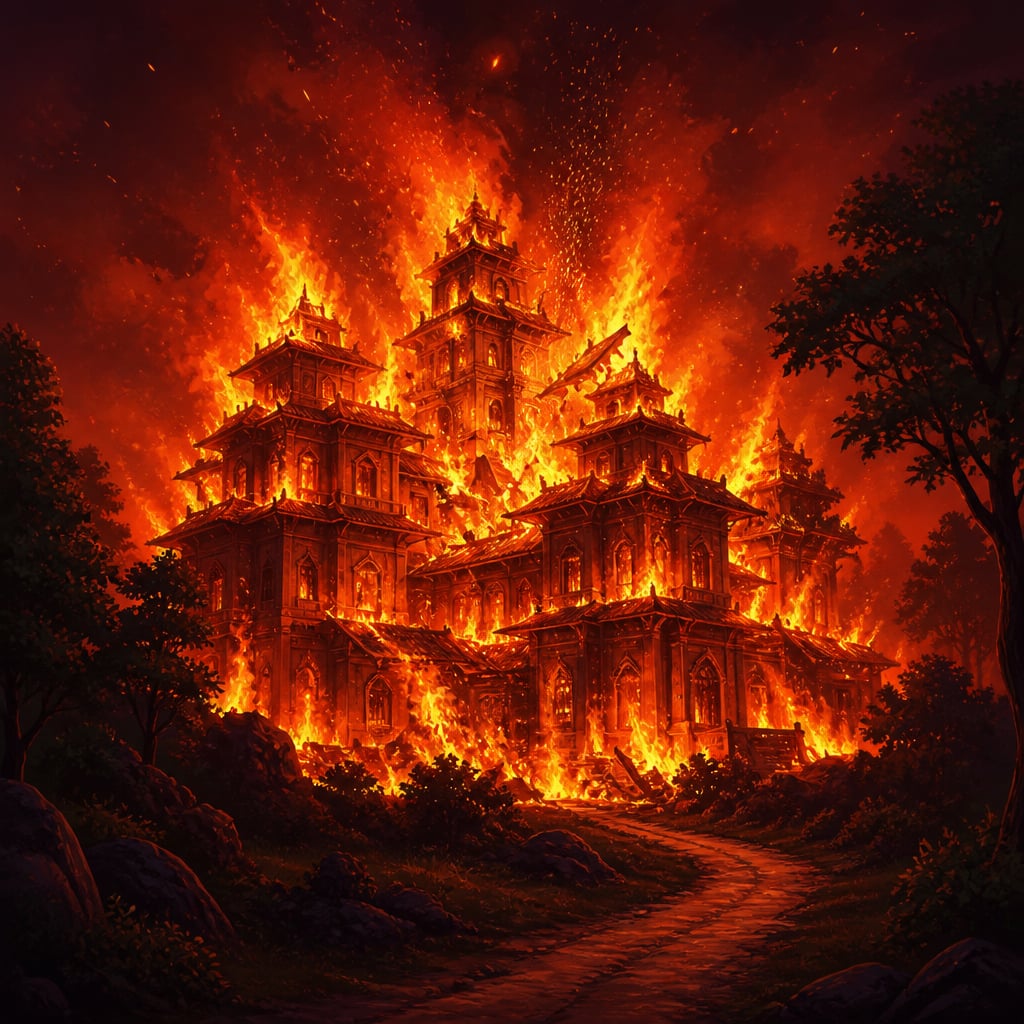
The grand House of Lac at Varanavata is consumed entirely in roaring orange flames at midnight.

"Set it ablaze. Let my cousins sleep their last sleep within those fragrant walls. When the fire dies, tell the world it was an accident, a lamp overturned, a spark from the kitchen. Who will question a tragedy?"

Purochana traveled to Varanavata to begin construction. The Pandavas, meanwhile, received an invitation that was really a command. Dhritarashtra, speaking words that Duryodhana had composed, suggested that the Pandavas attend the Varanavata festival.

"The people there wish to see Pandu's sons," the blind king said. "It would please me if you went."

Kunti and her sons understood immediately. This was no invitation, it was exile dressed in courtesy. They could not refuse without appearing disloyal. They would have to walk into whatever trap awaited them.

Vidura's Warning

Before the Pandavas departed, Vidura came to Yudhishthira in private. He spoke in riddles, for he knew spies were everywhere, but his meaning was unmistakable.

Vidura's coded warning to Yudhishthira

"There is a creature that lives in holes," Vidura said. "Fire cannot touch it, for it knows the paths beneath the earth. The wise man who understands this creature cannot be burned, even when surrounded by flames."

Yudhishthira's eyes met Vidura's. He understood: they would need an escape route underground.

Vidura continued: "The wanderer who knows the stars never loses his way in the forest. He who can recognize the five elements in their subtle forms will not be consumed by any of them. Remember, nephew, sharp weapons can be concealed in ways that the enemy cannot detect."

Yudhishthira grasped Vidura's hand. "Uncle, I understand. I will remember."

Vidura had done all he could. Now he arranged for a miner, a man skilled in digging, to travel to Varanavata ahead of the Pandavas.

The Palace of Death

The Pandavas arrived at Varanavata to a hero's welcome. The citizens thronged the streets, showering flowers on Kunti and her sons. They had no idea that the palace being prepared for their guests was a death trap.

The House of Lac was indeed magnificent. Its pillars were carved intricately. Its floors were polished to mirror brightness. Sweet fragrances filled every room. But Yudhishthira, running his fingers along the walls, felt the waxy residue of lac. He smelled the oil that had soaked into the foundation. He understood exactly what this beautiful prison was meant to become.

"Say nothing," he warned his brothers. "Smile at Purochana. Accept his hospitality. But stay alert."

Purochana hovered around them constantly, the very image of devoted service. He ensured they had the finest food, the softest beds, every comfort, all while waiting for the right moment to strike.

Meanwhile, Vidura's miner arrived in secret. He made contact with Yudhishthira and began his work. Night after night, he dug beneath the palace, creating a tunnel that led to the forest beyond the town walls. The earth he removed was scattered in the nearby river. The entrance was concealed beneath a stone slab in the Pandavas' own chamber.

The Year of Waiting

For a full year, the Pandavas lived in the House of Lac. They could not escape immediately, Purochana was watching too closely, and flight would have alerted Duryodhana to their knowledge of the plot. They had to wait until Purochana's guard dropped, until the trap was fully set, until their escape would look like death.

During this year, the brothers took to hunting in the forests around Varanavata. They learned every path, every stream, every hiding place. They were preparing for a life on the run.

Finally, the moment came. Purochana sent word to Hastinapura that the trap was ready. He planned to set the fire on a night when Kunti would hold a feast, her guests would provide additional cover for the "accident," and the Pandavas would certainly be present.

The Night of Fire

Kunti held her feast as planned, but with a terrible addition. Among her guests was a Nishada woman with her five sons, poor travelers who had come seeking food and shelter. Kunti fed them generously, and they slept in the palace that night, overcome by the rich food and drink.

What happened next is one of the Mahabharata's morally darkest moments. When the Pandavas escaped through the tunnel, the Nishada woman and her sons remained behind. Bhima himself set fire to the palace, both to ensure their escape appeared convincing and to eliminate Purochana, who slept near the entrance.

The fire roared through the House of Lac with terrifying speed. The oil-soaked walls, the lac-painted pillars, the hemp-stuffed mattresses, everything ignited at once. By morning, nothing remained but ash and charred bones.

When Purochana's body was found, and the remains of a woman with five young men, the people of Varanavata wept. "The princes are dead! Kunti and her sons have perished!" The news raced to Hastinapura.

The World Mourns

In Hastinapura, Dhritarashtra ordered mourning. He performed death rites for his nephews, weeping what may have been genuine tears, for he had not ordered this murder, only failed to prevent it. Bhishma grieved openly, cursing the fate that had taken Pandu's sons.

Duryodhana and his brothers wore white garments of mourning, but their eyes were bright with triumph. The obstacles to their rule had been removed. The kingdom was theirs.

Vidura alone knew the truth. He performed the death rites alongside the others, offering prayers for those who were very much alive. He kept his face composed in grief while his heart sang with relief.

The Pandavas escaping through the tunnel

Meanwhile, in the darkness beneath Varanavata, the Pandavas ran through the tunnel toward the forest. They emerged far from the burning palace, covered in soot and earth, but alive. A boat waited for them on the river, Vidura's final gift. They crossed the water and vanished into the wilderness.

Fugitives in Their Own Kingdom

The Pandavas were now officially dead. They could claim no kingdom, demand no justice, expect no help. They were fugitives who did not officially exist.

But they were alive. And they were together.

Kunti looked at her five sons in the moonlight, their faces grim, their royal garments ruined, their futures uncertain. "We begin again," she said simply. "We have survived. That is enough for now."

Bhima carried his mother on his shoulders as they walked into the forest. Arjuna and the twins followed, swords drawn against the darkness. Yudhishthira walked last, looking back at the distant glow of the fire they had left behind.

Somewhere in those flames, six innocent people had died so that six royals might live. The Mahabharata does not explain this away or justify it. It simply records it, a moral weight the Pandavas would carry with them always.

The Meaning of Kaitava

Kaitava means deception, trickery, gambling with loaded dice. This lesson is named for Duryodhana's treachery, but the Pandavas also practiced deception, letting others die in their place, faking their own deaths, living as lies made flesh.

The Mahabharata shows us that survival sometimes requires becoming what you hate. The Pandavas were victims of a murder plot, yet they escaped by allowing others to burn. They were righteous princes, yet they lived as impostors.

This is the epic's constant teaching: dharma is not a simple path. Sometimes every option carries a cost. The choice is not between good and evil, but between different kinds of compromise.

In the forest darkness, the Pandavas walked toward an unknown future. Behind them, their old lives burned to ash. Ahead lay trials they could not imagine, rakshasa demons, divine marriages, a contest that would change everything.

But first, they had to survive the night.

Living traditions

The concept of 'lakshagriha', a beautiful trap, a deadly kindness, has become a powerful metaphor in Indian political and social commentary, used to describe situations where apparent benefits conceal exploitation. Vidura's character has inspired the ideal of the principled civil servant, someone who serves the system while protecting justice, working within constraints to prevent harm.

Reflection

More in Adi Parva

All lessons in Adi Parva · The Mahabharata course