Shaapa: The Hunter's Arrow

Pandu cursed, Kunti's secret boon

King Pandu, greatest warrior of his age, makes a fatal error while hunting, his arrow strikes a sage in the form of a deer, earning him a curse that will change everything. Forbidden from ever touching his wives, Pandu must watch his dynasty crumble unless an ancient secret held by Queen Kunti can save them. This lesson reveals the hidden histories that will shape the Pandavas' divine origins.

The Pale King's Rise

When the time came to choose a king from among Vyasa's three sons, the decision was clear, and heartbreaking. Dhritarashtra, the eldest, was powerful and intelligent, but his blindness disqualified him in the eyes of tradition. A king must see his kingdom; how could a blind man lead armies or judge disputes? Vidura, the wisest, was born of a servant, he could never sit on the throne.

And so Pandu, the pale one, was crowned King of Hastinapura. His pallid complexion had not prevented him from becoming a fearsome warrior. Under Bhishma's guidance, he learned the arts of war and statecraft. Now he would prove himself worthy of the throne.

Pandu's early reign was glorious. He led his armies on a campaign of conquest that expanded the kingdom's borders in every direction. Kings trembled at his approach; kingdoms submitted without battle. He returned to Hastinapura laden with tribute, his fame spread across the earth. For a time, it seemed the dynasty's troubles were over.

Two Queens

A king needs heirs, and Pandu needed wives. Bhishma arranged two marriages that would secure alliances and ensure succession.

The first bride was Kunti, princess of the Yadava clan, also known as Pritha. She was the adopted daughter of King Kuntibhoja, but her birth father was Shurasena, making her the aunt of a child not yet born who would be called Krishna. Kunti was beautiful, accomplished, and carried a secret that would change the course of history.

The second bride was Madri, princess of the Madra kingdom, renowned as one of the most beautiful women of the age. Her brother, King Shalya, gave her to Pandu to cement an alliance. She was gentle, devoted, and would prove loyal beyond death itself.
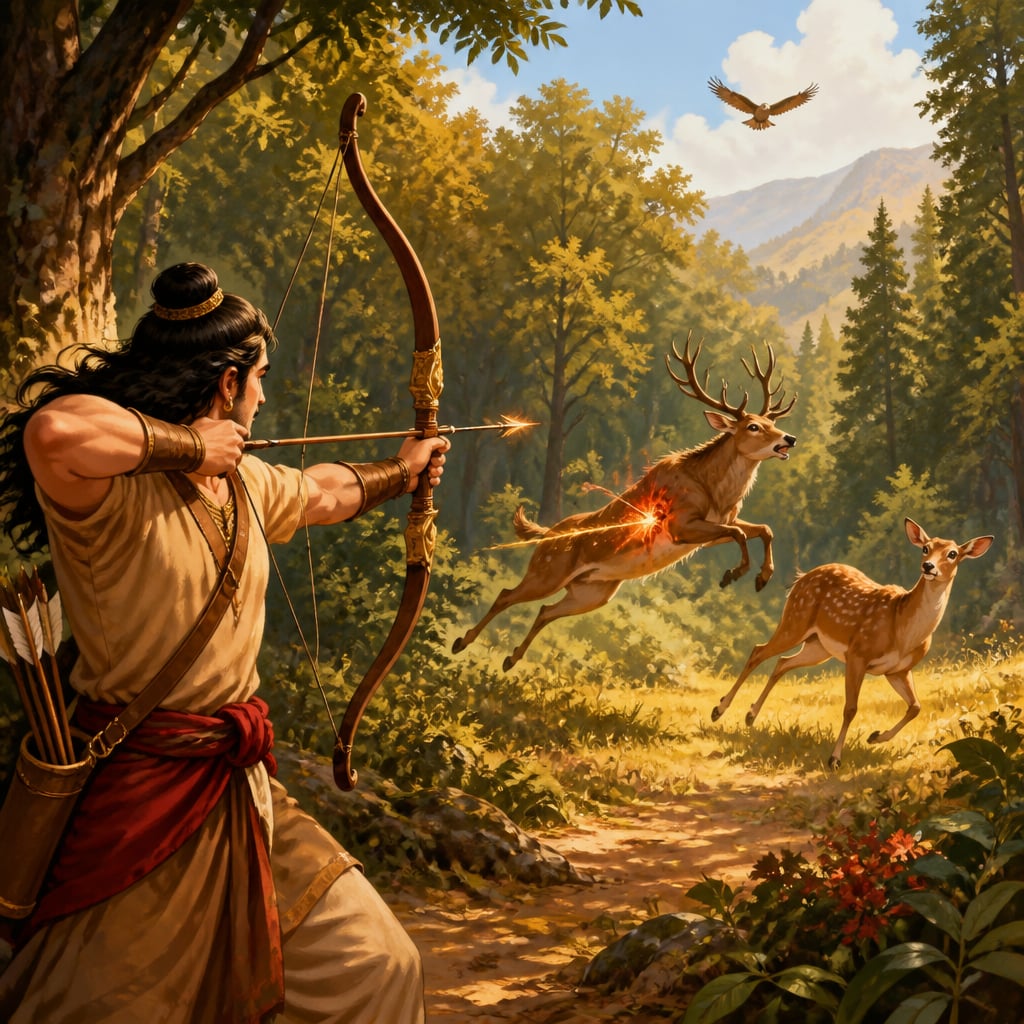
King Pandu releases an arrow at two coupling deer on a sunlit forest path in the deep wilderness.

With two queens and a kingdom at peace, Pandu seemed blessed by the gods. But fate had not finished with him.

Kunti's Secret

Years before her marriage, when Kunti was still a young girl in her father's house, she had served as hostess to the visiting sage Durvasa. This sage was notorious for his terrible temper, the slightest offense could provoke a devastating curse. For an entire year, Kunti attended to his every need with such perfect devotion that Durvasa was pleased.

"Child, your service has been flawless. I will grant you a boon. I shall teach you a mantra of great power, with it, you may summon any god you choose, and he will give you a son."

Young Kunti receiving Durvasa's mantra

Kunti accepted the mantra, hardly understanding its significance. She was young, unmarried, curious. Could it really work? One day, gazing at the rising sun, she decided to test the mantra. She invoked Surya, the Sun God.

Instantly, the god appeared before her, radiant, magnificent, irresistible. Before Kunti could explain that she had only been testing the mantra, Surya told her that a god, once summoned, must fulfill his purpose. Their union was inevitable.

Kunti conceived and bore a son, a child born with golden armor fused to his skin and divine earrings in his ears. He was beautiful, powerful, clearly marked for greatness. But Kunti was an unmarried princess. A child would mean disgrace, exile, ruin.

Weeping, she placed the infant in a basket and set him adrift on the river. The basket floated downstream until it was found by a charioteer named Adhiratha and his wife Radha. They named the child Karna and raised him as their own.

Kunti told no one. She carried the secret like a stone in her heart. When she married Pandu, she prayed the past would stay buried. But the mantra remained with her, unused, waiting.

The Fatal Hunt

Pandu loved hunting above all other pleasures. The forest called to him, the thrill of the chase, the test of skill, the primal contest between hunter and hunted. One spring, he ventured deep into the wilderness with his entourage, pursuing game through valleys and over mountains.

Deep in the forest, Pandu spotted something extraordinary: two deer, a buck and doe, coupling in a secluded glade. The buck was magnificent, large, proud, unaware of danger. Pandu raised his bow and let fly.

The arrow struck true. The buck fell. But as Pandu approached his kill, a horrifying transformation occurred. The dying deer became a man, a sage, mortally wounded, his mate transforming beside him into a weeping woman.

This was Kindama, a rishi of great spiritual power who had taken deer form to enjoy intimacy with his wife in the forest's privacy. Now he lay dying, pierced by Pandu's arrow.

The Curse

Kindama's eyes blazed with the fury of the dying.

"Cruel king! Even hunters spare animals in the act of mating. Even the lowest beast respects this moment. But you, a king, supposedly dharmic, you have killed me in my moment of greatest vulnerability and joy."

Pandu fell to his knees, horrified by what he had done. He had not known. He would never have, But Kindama cut off his pleas.

"You have stolen from me the pleasure I was experiencing. Therefore, hear my curse: The moment you approach any woman with desire, the moment you seek to experience what you have stolen from me, you will die. Your death will mirror mine, sudden, in the midst of passion, with no chance to prepare."

With those words, Kindama died. His wife, consumed by grief, threw herself onto his funeral pyre.

Pandu stood alone in the forest, a king with two beautiful wives whom he could never touch again.

Renunciation

Pandu returned to Hastinapura a broken man. He could not bring himself to tell the full truth, but he announced his decision: he would renounce the throne and retire to the forest as a hermit. The blind Dhritarashtra would rule as regent.

"I have committed a sin that bars me from kingship," he declared. "I must spend my remaining years in penance."

Kunti and Madri refused to stay behind. Whatever had happened, wherever he went, they would go with him. They were his wives, his fate was their fate.

"If you cannot be a husband to us," Kunti said, "you can still be our lord and companion. We will live as ascetics together."

Pandu's Himalayan hermitage with his queens

And so Pandu, once the greatest king of his age, retreated to a hermitage in the Himalayan foothills with his two devoted queens. He put aside his weapons, his crown, his royal robes. He lived on fruits and roots, performing penances, trying to atone for the sin he had committed.

But one question haunted him: Who would continue his line?

Dhritarashtra was already married to Gandhari, and she was bearing children, many children, it was rumored. If Pandu had no heirs, Dhritarashtra's sons would inherit everything. The throne, the kingdom, all that Pandu had built would pass to his brother's line.

The Hidden Hope

One evening, as they sat by their hermitage fire, Pandu spoke his anguish aloud.

"I am cursed to die if I touch you. I am forbidden the one act by which a man continues his line. The dynasty I was meant to preserve will end with me. My brother's sons will rule, and my name will be forgotten."

Kunti listened. The secret she had carried for so long stirred within her. The mantra. The power to summon gods. She had used it once, in ignorance, and abandoned the result. Could she use it now, deliberately, for a sacred purpose?

"My lord," she said slowly, "there may be a way. Long ago, the sage Durvasa gave me a boon..."

And she told him everything, the mantra, its power, even the son she had borne and abandoned. Pandu listened in amazement. Here, hidden in his wife's past, was the solution to his impossible situation.

"Then use it," he said, hope rekindling in his eyes. "Summon the gods. Bear sons who will be divine in origin, mighty in power, worthy to rule. What I cannot give you, let the gods provide."

Kunti agreed. She would invoke the mantra, not once, but several times. She would bear sons for Pandu who would carry his name, inherit his kingdom, and fulfill his destiny.

The curse had closed one door. But another, older magic was about to open another.

In the shadow of death, the seeds of destiny were about to be planted.

Living traditions

Pandu's curse is referenced in discussions of karma and unintended consequences. The phrase 'Pandu's dilemma' sometimes describes situations where one cannot access what one possesses by right. His story raises questions about genetic versus legal parentage that resonate in modern debates about fatherhood, adoption, and reproductive technology.

Reflection

More in Adi Parva

All lessons in Adi Parva · The Mahabharata course