Matsarya: Seeds of Hatred
Duryodhana poisons young Bhima
Under one palace roof, 105 princes grow up together, and the seeds of history's greatest war are planted in childhood games. As Bhima's supernatural strength humiliates the Kauravas daily and Arjuna's skill outshines all rivals, Duryodhana's jealousy curdles into something darker. The first assassination attempt reveals the true nature of the coming conflict.
Matsarya: Seeds of Hatred
The palace of Hastinapura had never known such chaos. One hundred and five princes, one hundred sons of Dhritarashtra and five sons of Pandu, filled its halls with laughter, shouts, and the constant sounds of competition. They trained together, ate together, and played together. But beneath the surface of childhood games, darker currents were forming.
The Daily Humiliations
From the moment they could walk, the difference between the cousins was evident. The Pandavas, born of gods, possessed abilities that no amount of training could match. And none was more obvious than Bhima, son of the wind god Vayu.
Bhima was not merely strong, he was a force of nature contained in human form. When the princes wrestled, Bhima would grab ten Kauravas at once and toss them about like dolls. When they raced, he would reach the finish before the others had covered half the distance. When they swam, he would hold the Kaurava princes underwater until they begged for mercy, laughing at their spluttering faces.
"It was just play," the elders said. But for Duryodhana, eldest of the Kauravas, each game was a fresh wound to his pride.
One incident burned itself into Duryodhana's memory. The princes had climbed a great banyan tree to collect fruit. As the Kauravas carefully made their way through the branches, Bhima simply shook the trunk. The tree swayed like a reed in a storm, and the Kaurava princes fell like ripe mangoes, tumbling to the ground in a heap of tangled limbs and bruised dignity.
Bhima's laughter echoed across the palace gardens. "Fruits and princes, both fall when Bhima shakes the tree!"
Duryodhana, his royal robes soiled and his knee bleeding, looked up at his cousin's grinning face. In that moment, something hardened in his heart.
The Poison of Jealousy
Duryodhana was not without his own strengths. He was skilled with the mace, clever in palace politics, and possessed an iron will. But none of this mattered against Bhima's divine might. Every victory Bhima won reminded Duryodhana of what he was not.
Worse still was the succession question. Yudhishthira, eldest of the Pandavas, had been born before Duryodhana. By the laws of primogeniture, Yudhishthira had the stronger claim to the throne. Dhritarashtra had only ruled as regent because of his blindness; the throne had always been meant for Pandu's line.
Duryodhana watched his blind father listen to court reports, saw how the ministers spoke of "the late King Pandu's sons" with respect, noticed how Bhishma's eyes lit up when watching the Pandavas train. The kingdom his father held was slipping away, and these five cousins stood between Duryodhana and his destiny.
"Why should they rule?" Duryodhana asked his uncle Shakuni one night. "Their father is dead. My father is the king. We are one hundred; they are only five. Yet everyone acts as if they are the rightful heirs."
Shakuni, Gandhari's brother from Gandhara, had his own reasons to hate the Kurus. He saw in his nephew's resentment a tool for his vengeance. "Dear nephew," he whispered, "there are ways to remove obstacles. Not everything must be settled in fair contest."
The Plot at Pramanakoti
Shakuni helped Duryodhana devise a plan. They would organize a pleasure excursion to Pramanakoti, a beautiful spot on the banks of the Ganga. There, away from the watchful eyes of Bhishma and Vidura, they would eliminate Bhima.
The poison was called Kalakuta, a venom so deadly that a single drop could kill an elephant. Duryodhana obtained it from a merchant who traded in such things, paying in gold and silence.
The excursion was announced as a celebration. Tents were erected, feasts prepared, and games organized. The young princes were delighted, a holiday from their studies and training. Even Kunti, though she felt an inexplicable unease, allowed her sons to go.
On the banks of the Ganga, the princes played and swam. Bhima, as always, was the most vigorous, diving deep into the river and swimming against the strongest currents. He exhausted himself gloriously, and when the feast was laid out, he ate with his characteristic appetite.
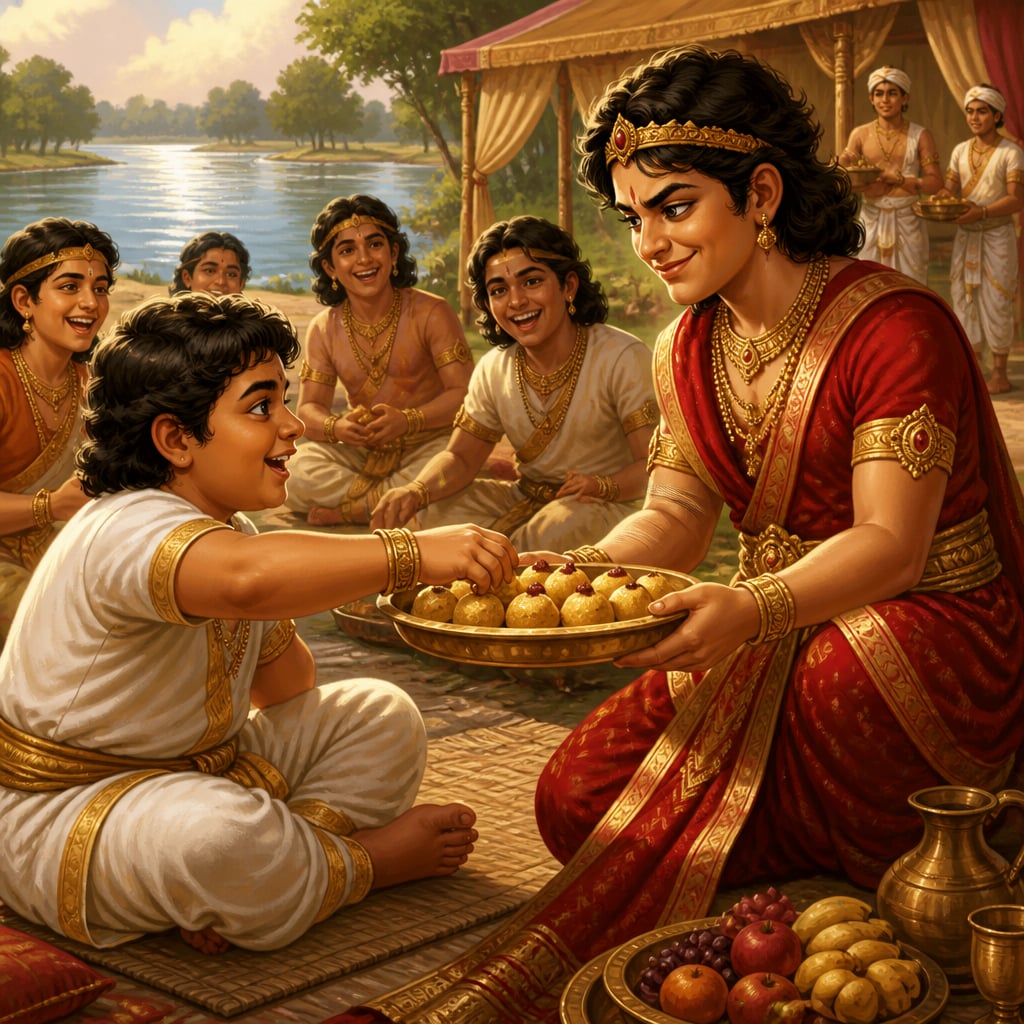
Duryodhana personally served his cousin. "Here, Bhima, try these sweets. They are made especially for you, the largest portion for the strongest prince."
The sweets were laced with Kalakuta.
Bhima, trusting and hungry, ate everything set before him. The poison worked quickly. His vision blurred, his limbs grew heavy, and darkness crept in from the edges of his consciousness. He tried to speak, to call for help, but his tongue would not obey.

As Bhima collapsed, Duryodhana bound him with vines and ropes. Then, with the help of Dushasana and others, he threw his unconscious cousin into the Ganga.
"The current will carry him away," Duryodhana said, watching the body sink beneath the dark waters. "By morning, he will be food for the fish, and we will say he drowned while swimming."
The Kingdom of Serpents
But Bhima did not die.
The Ganga carried his body down to the realm of the Nagas, the serpent beings who dwelt in an underwater kingdom. There, the venomous snakes bit the unconscious prince, again and again. But something miraculous happened: instead of adding to the poison in his system, the snake venom neutralized the Kalakuta.

Bhima awoke in a palace of pearl and coral, surrounded by hooded serpents. The Naga king, Vasuki, recognized him immediately.
"This is Kunti's son," Vasuki declared. "His ancestor Yayati married a Naga princess. He is kin to us."
The Nagas treated Bhima as an honored guest. They fed him vats of their celestial nectar, rasayana that would give him the strength of ten thousand elephants. For eight days, Bhima rested in the serpent kingdom, growing stronger with each passing hour.
When he finally emerged from the Ganga, walking calmly back to the Kaurava camp as if returning from a swim, the effect was electric. The Kauravas, who had been celebrating their success, turned pale with terror. Bhima, wet, powerful, and very much alive, stood before them with a knowing smile.
"I had a pleasant swim," he said simply. "The river took me to visit some relatives."
He said nothing of the poisoning. He made no accusations. But from that day, Bhima's eyes held a new awareness when they looked at Duryodhana, the knowledge that his cousin had tried to kill him, and would try again.
A Mother's Fear
Kunti had spent eight days in agony. When Bhima disappeared, the Kauravas claimed he had drowned. But Kunti refused to believe it. She knew her son's strength, knew the wind god's blessing protected him.
When Bhima returned, she wept with relief. And when she heard the whispered truth, for such secrets cannot be kept in a palace of a hundred gossiping princes, her blood ran cold.
She said nothing publicly. What could she say? Her sons were orphans in the house of their rivals. Dhritarashtra would never punish his own son on the word of Pandu's widow. Bhishma, though good, was bound by his vow to serve whoever sat on the throne. There was no justice to be had.
Instead, Kunti held her sons close and began to plan. They would need allies, they would need training, and above all, they would need to survive long enough to claim what was rightfully theirs.
The Nature of Matsarya
The Sanskrit word matsarya means jealousy or envy, but it is more than simple covetousness. Matsarya is the inability to tolerate another's success, the pain that comes from seeing others possess what you desire. In Hindu philosophy, it is considered one of the six enemies of the mind (shadripu), a poison that corrodes the soul.
Duryodhana's matsarya was not born in a moment. It grew through years of perceived humiliation, fed by Shakuni's whispers and his own frustrated ambition. The poisoning of Bhima was merely its first eruption, there would be many more.
What the Mahabharata shows us is that matsarya, unchecked, leads to progressively greater crimes. First comes the secret murder attempt. Then comes public humiliation. Finally comes war itself. The jealousy that began with childhood games would end with eighteen akshauhinis of soldiers dead on the field of Kurukshetra.
But in the days after Bhima's return, none knew the full horror that awaited. The princes continued their training, the palace continued its routines, and two sets of cousins continued to grow, one toward dharma, one toward destruction.
Living traditions
The phrase 'matsarya se mukti' (freedom from jealousy) appears in modern Hindi self-help literature, drawing on the Mahabharata's warnings about envy as a destructive force. The story of Bhima's survival is often cited in discussions of karma and divine protection, the belief that dharmic individuals receive unexpected help in times of crisis.
- Ṣaḍripu Vijaya (Conquering Six Enemies of Mind): The concept of shadripu (six enemies of the mind), kama (lust), krodha (anger), lobha (greed), moha (delusion), mada (pride), and matsarya (jealousy), remains central to Hindu spiritual practice. Many temples display these as obstacles to overcome.
- Rasāyana Chikitsā (Ayurvedic Rejuvenation): Rasayana therapy in Ayurveda is named after the life-giving elixir the Nagas gave Bhima. Modern Ayurvedic rasayana treatments aim to rejuvenate the body and promote longevity, though without supernatural effects.
- Prayagraj (Pramanakoti region): The confluence of the Ganga, Yamuna, and mythical Saraswati near Prayagraj includes areas associated with the Pramanakoti where Duryodhana's plot unfolded. The region's sacred geography features in many Mahabharata narratives.
- Mannarasala Nagaraja Temple: One of the oldest Naga temples in India, Mannarasala houses over 30,000 serpent images. The temple maintains traditions connecting to the Naga kingdoms described in the epics, where beings like Vasuki ruled.
- Nagchandreshwar Temple: Nagchandreshwar Temple at Ujjain opens only on Nag Panchami and houses ancient Naga sculptures. Devotees believe the Nagas like Vasuki still receive prayers here.
- Kukke Subramanya Temple: Kukke Subramanya Temple in Karnataka is dedicated to both Subramanya and the Naga king. The temple's Ashlesha Bali ritual is performed to neutralize negative effects, much as the Nagas neutralized Bhima's poison.
Reflection
- Duryodhana's jealousy grew from childhood humiliations that Bhima likely didn't intend cruelly. Does understanding the origin of someone's hatred make it more forgivable?
- Bhima never publicly accused Duryodhana of the poisoning, even after surviving. Why might he have chosen silence? Was this wisdom or weakness?
- The Nagas saved Bhima because of an ancestral connection he knew nothing about. What does this suggest about the effects of our actions across generations?