Itihasa: The Eternal Story Begins
Sauti narrates to the sages
At the sacred forest of Naimisharanya, a wandering storyteller named Sauti arrives bearing the greatest tale ever told. As sages pause their thousand-year ritual to listen, we discover how the Mahabharata came to be, a story within a story, preserved through generations of narration.
The Sacred Forest
In the ancient forest of Naimisharanya, where the wheel of time was said to have slowed to a crawl, thousands of sages had gathered for a ritual of unprecedented scope. For twelve long years, they would perform the Satra, a grand sacrifice meant to invoke the blessings of the gods upon the world. The forest hummed with the sound of mantras, the crackle of sacred fires, and the rustle of ascetic robes.
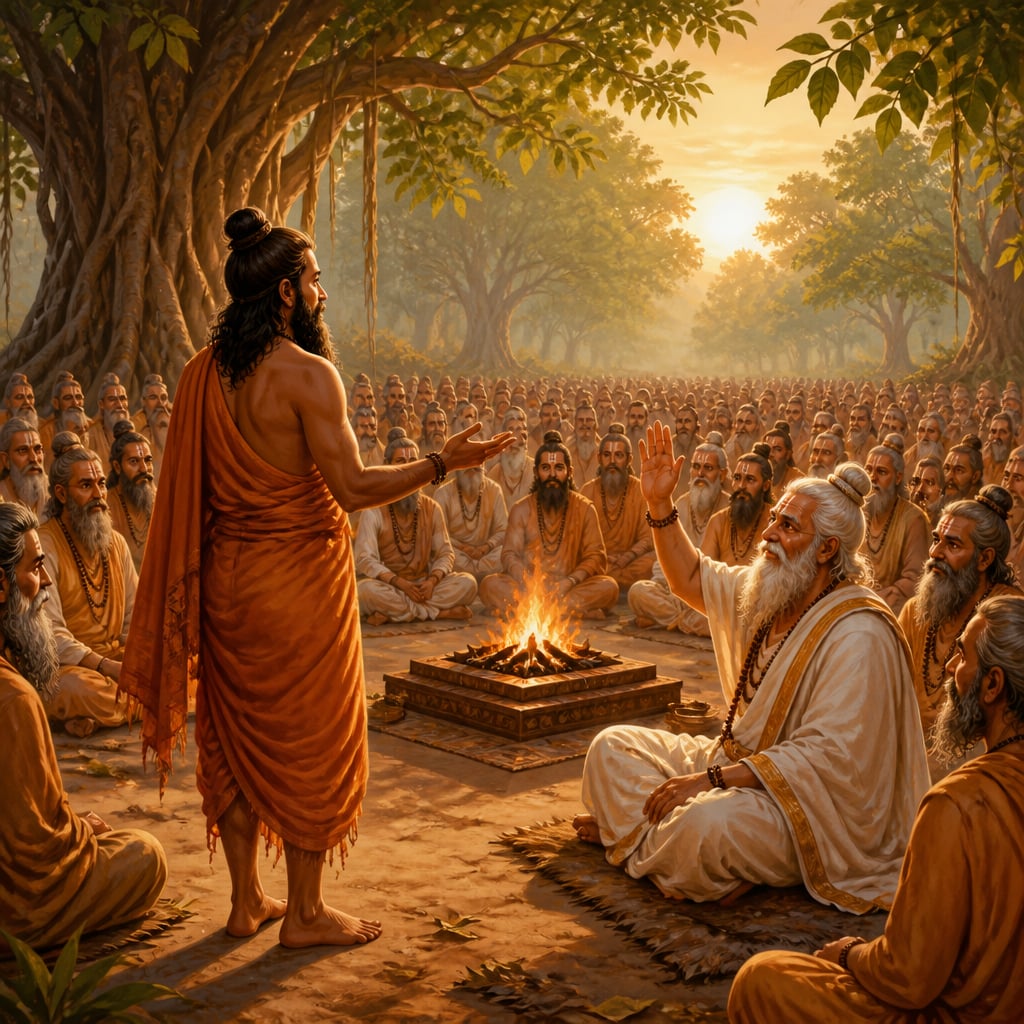
Into this assembly of the wise came a traveler, Ugrasrava, son of the great Lomaharshana, a Suta by birth. The Sutas were renowned as the keepers of history, the living libraries of ancient India who preserved the stories of kings and gods through the power of memory alone. Ugrasrava, better known as Sauti, carried within him a treasure greater than any material wealth: the complete Mahabharata, as he had heard it from the sage Vaishampayana himself.
The Story of Stories
The sages, led by the venerable Shaunaka, welcomed Sauti with the honor due to a bearer of sacred knowledge. They had heard whispers of a great tale, a story so vast that it was said to contain everything worth knowing about dharma, artha, kama, and moksha. Now, here was someone who had heard it from one who had heard it from Vyasa himself.
"O Sauti, we have heard that you were present at the Sarpa Satra of King Janamejaya, where Vaishampayana recited the entire Mahabharata. Tell us this great Itihasa, for we long to hear every word."
Sauti smiled. He had traveled far and wide, across mountains and rivers, through kingdoms and forests, carrying this story like a flame that must never be extinguished. Now, at Naimisharanya, he would pass it on once more.
The Chain of Narration
Before beginning, Sauti explained the sacred lineage of the tale. The Mahabharata was not merely a story, it was Itihasa, meaning "thus indeed it was." Unlike the Puranas, which dealt with cosmic cycles and divine play, Itihasa recorded events that had actually happened in human history, preserved with meticulous care.
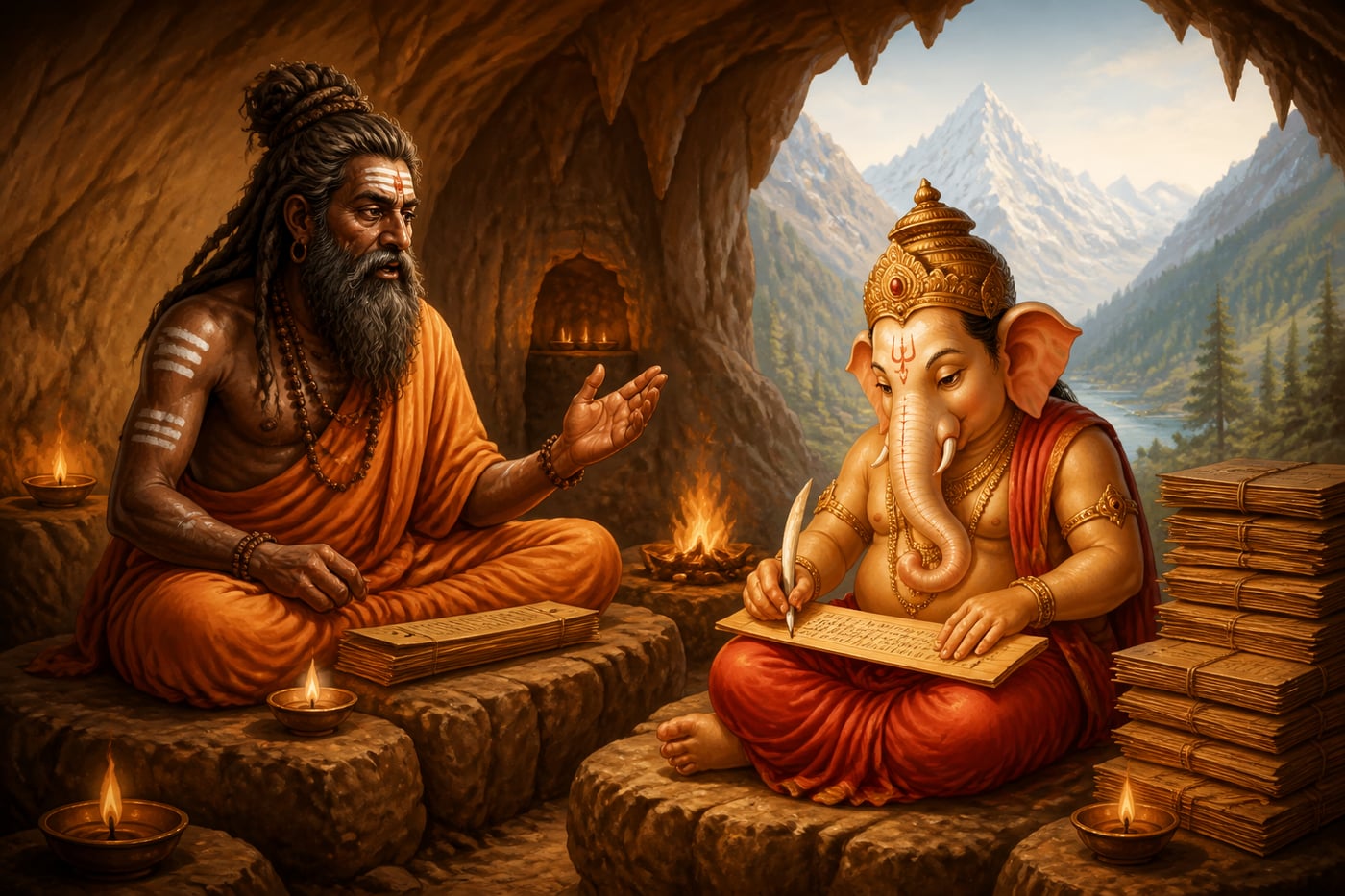
The great sage Krishna Dvaipayana Vyasa had composed the epic, having witnessed many of its events himself. Vyasa was no ordinary mortal, born to the sage Parashara and the fisherwoman Satyavati, he had been present at the birth of the Kuru dynasty's troubles and would live to see its terrible conclusion. He taught the Mahabharata to his disciple Vaishampayana.

Vaishampayana then recited the entire epic at the Sarpa Satra, the snake sacrifice, of King Janamejaya. This was the great-grandson of Arjuna, who had performed the ritual to avenge his father Parikshit's death by snakebite. During the twelve-year ceremony, as snakes fell into the sacred fire, Vaishampayana narrated the history of Janamejaya's ancestors. Sauti had been present at that momentous occasion.
Why "Mahabharata"?
The sages asked Sauti about the name of the epic. Why was it called "Mahabharata" and not simply "Bharata"?
The answer lies in its scope, Sauti explained. The word "maha" means great, and this was no ordinary chronicle of the Bharata dynasty. It was called Mahabharata for three reasons: its great weight of meaning, its great length, and its great importance. Vyasa himself had declared that what is found in this epic may be found elsewhere, but what is not found here exists nowhere.
The Mahabharata contained within it the essence of all the Vedas, all the Dharmashastras, all the wisdom ever conceived by human minds. It was an ocean into which all rivers of knowledge flowed. To understand the Mahabharata was to understand the very nature of existence.
The Purpose of the Tale
But why tell such a story? Why preserve it with such devotion across generations?
Sauti's eyes grew solemn. The Mahabharata was not entertainment, it was a mirror held up to humanity. In its pages, one would find every human emotion, every moral dilemma, every triumph and tragedy that flesh is heir to. Kings and beggars, saints and sinners, gods and demons, all walked through its verses.
"This sacred history of the Bharatas dispels all fear of sin. Whatever is here may be found elsewhere; what is not here exists nowhere. It is a tale that grants dharma, artha, kama, and ultimately moksha to those who truly understand it."
The purpose was instruction through narrative. Where dry philosophy might fail, story succeeds. When we see Yudhishthira wrestle with the burden of kingship, we learn about leadership. When we witness Karna's loyalty despite his suffering, we understand the complexity of dharma. When we watch Draupadi question the assembly that failed to protect her, we confront the limits of law without justice.
The Frame Within Frames
The Mahabharata is unique in its narrative architecture. We listen to Sauti, who heard from Vaishampayana, who learned from Vyasa, who witnessed the events. But within the epic itself, stories branch endlessly, characters tell tales to other characters, and those tales contain yet more tales.
This structure serves a profound purpose. By framing the story through multiple narrators, the epic acknowledges that truth is perceived differently by different observers. By embedding stories within stories, it shows how all human experience is interconnected. The tale of a gambler's downfall in one generation echoes in the choices of the next.
As Sauti prepared to begin, the sages settled into stillness. The sacrificial fires burned steadily. The forest itself seemed to lean in to listen. For in the telling and the hearing of sacred stories, something magical happens, the boundaries between past and present dissolve, and we become witnesses to events that shaped the world.
The Story Begins
And so, with due reverence to Ganesha who served as Vyasa's scribe, to Vyasa who composed the verses, to Vaishampayana who recited them, and to all the sages assembled, Sauti began:
"I bow to the primordial being, Narayana, and to Nara, the foremost of men, and to the goddess Saraswati. May jaya be proclaimed..."
With these words, the greatest story ever told commenced once more. For the Mahabharata is not merely heard, it is experienced. Not merely read, it is lived. Across thousands of years and countless retellings, it continues to speak to each generation anew, as fresh and urgent as when Sauti first spoke to the sages in that sacred forest where time stood still.
Living traditions
The Mahabharata's narrative frame influenced later Indian storytelling, including the frame narrative of the Panchatantra and the Kathasaritsagara. Modern adaptations, from Peter Brook's 9-hour play to Star Plus's TV serial, continue the tradition of retelling this eternal story for new generations.
- Mahabharata Katha Traditions: Professional storytellers (Kathavachaks) still recite the Mahabharata in week-long or month-long events across India, maintaining the tradition Sauti began thousands of years ago.
- Naimisharanya: The sacred forest where Sauti narrated the Mahabharata to the sages. Still a pilgrimage site with numerous temples and the Chakratirtha lake where the sages performed their sacrifice.
Reflection
- What stories from your own family or culture have been passed down through generations? How has the act of retelling shaped or preserved these narratives?
- Why do you think the Mahabharata uses multiple layers of narration (Sauti tells what Vaishampayana told about what Vyasa composed)? What does this structure add to the story?
- The epic claims that 'what is not here is nowhere.' Do you think any single text can truly contain all wisdom? What does this claim reveal about how the composers viewed their work?