Agni: The Forest Burns

Divine fire consumes Khandava as Krishna and Arjuna battle the gods

The fire god Agni, weakened by an illness that only the Khandava forest's consumption can cure, seeks help from Krishna and Arjuna. What follows is one of the most spectacular events in the Adi Parva, a battle against Indra himself, the acquisition of divine weapons, and a conflagration that clears the way for Indraprastha while sowing seeds of vengeance that will echo across generations.

Agni: The Forest Burns

The Hungry God

In ages past, King Shvetaki performed a twelve-year sacrifice of such magnitude that the smoke and clarified butter offerings sickened the fire god Agni himself. Forced to consume vast quantities of ghee day after day, Agni developed an ailment that dimmed his flames and weakened his power.

Brahma, the creator, prescribed a cure: Agni must consume the Khandava forest, whose medicinal herbs and ancient vegetation would restore his digestive fire and heal his affliction. The prescription seemed simple enough, Agni was fire itself, and burning a forest should pose no difficulty.

But Khandava was no ordinary forest. Ancient and dense, it sheltered creatures of every kind, including the powerful Naga king Takshaka and his people. Takshaka was a dear friend of Indra, king of the gods. Each time Agni approached Khandava, Indra sent thunderstorms to extinguish the flames. Seven times Agni attempted the burning; seven times Indra's rains defeated him.

The god of fire grew desperate. His illness worsened, his flames flickered, and his divine purpose faltered. He needed champions who could hold back even the king of heaven.

The Divine Request

One day, as Krishna and Arjuna relaxed on the banks of the Yamuna near Khandavaprastha, a brahmin approached them. His form was radiant, his presence commanding, this was no ordinary supplicant.
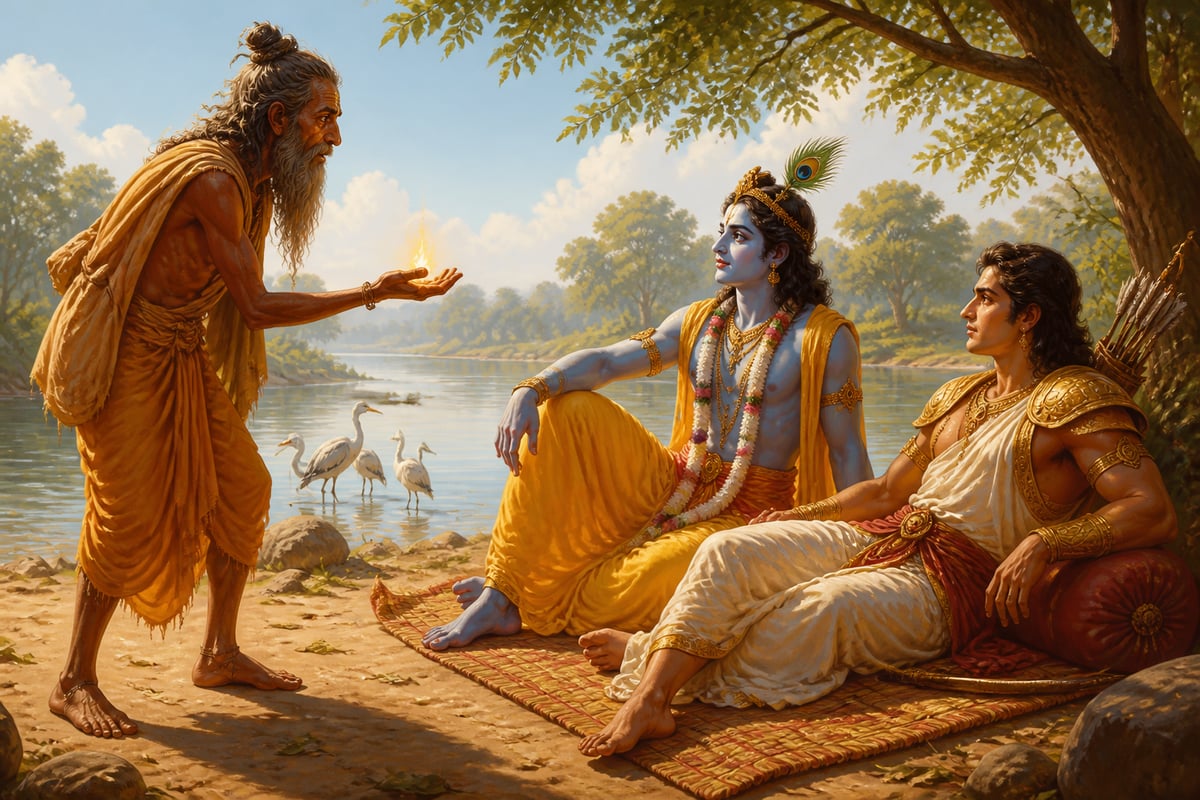
Agni in brahmin form asking Krishna and Arjuna

"I am Agni," the brahmin revealed, transforming into his divine form. "I am starving, weakened by an illness only Khandava can cure. But Indra protects the forest for his friend Takshaka. I need warriors who can match the king of the gods while I consume my medicine. Will you help me?"

Krishna and Arjuna exchanged glances. To battle Indra himself, Arjuna's divine father, was no small matter. But they recognized the righteousness of Agni's need. A god of such importance to all creation could not be left to suffer.

"We will help," they agreed. "But our weapons are insufficient against celestial forces."

Agni smiled and summoned Varuna, god of the waters. From Varuna's treasury came weapons worthy of the task: the Gandiva bow for Arjuna, a divine weapon that would never fail, strung with a string no mortal could break, accompanied by two inexhaustible quivers that would never empty no matter how many arrows were shot. For Krishna came the Sudarshana Chakra, the discus that would become his signature weapon, and the Kaumodaki mace.

Armed with celestial weapons, the two friends were ready to face heaven itself.

The Conflagration Begins

Agni expanded into his full cosmic form and fell upon Khandava like a tidal wave of flame. The ancient forest, home to thousands of creatures, sanctuary of the Nagas, refuge of countless beings, began to burn.

The flames rose so high they seemed to touch the sky. Smoke billowed in clouds visible for hundreds of miles. Animals screamed and fled in every direction, only to find the fire had encircled them completely. Agni's divine flames consumed everything they touched with supernatural efficiency.

Takshaka was away from Khandava that day, a fact that would save his life and doom countless others. But his wife, his kinsmen, and his son Ashvasena were trapped within the inferno.

Cries arose to heaven. Indra, seeing his friend's home ablaze, gathered his army of gods and marched to Khandava's defense. Storm clouds materialized, thunder rolled, and divine rain began to fall.

Battle Against Heaven

Arjuna raised his Gandiva and did what no mortal had ever done, he created a canopy of arrows so dense that Indra's rain could not penetrate. Shaft after shaft flew from the inexhaustible quivers, weaving a ceiling of wood and steel above the burning forest. The rain fell upon arrows instead of flames.

Arjuna on a chariot driven by Krishna draws his Gandiva bow to weave a canopy of arrows above the burning Khandava forest.

Indra was astonished. His own son, born of Kunti through his divine blessing, now stood against him with such skill that heaven's storms were rendered impotent. Pride mixed with anger in the god-king's heart.

The gods attacked directly. Celestial warriors descended, raining weapons upon the two champions. Krishna's Sudarshana Chakra whirled and spun, deflecting divine missiles, while Arjuna's arrows answered every assault with perfect precision.

For fifteen days, some accounts say longer, the battle raged. Indra summoned wind gods, rain gods, storm deities, and celestial warriors. Every attack was repelled. Arjuna fought his own father with skill learned from Drona, with divine weapons from Agni, with courage that matched any immortal.

Finally, a divine voice spoke from the heavens: "Indra, desist. These two are destined for greater purposes. Agni's need is legitimate, and these warriors are instruments of cosmic design. You cannot defeat them today."

Indra, recognizing the voice of Brahma or perhaps Vishnu, withdrew. The gods retreated, and Khandava burned unimpeded.

The Survivors

Not all perished in the flames. Four beings emerged from Khandava's destruction:

Ashvasena, son of Takshaka, escaped by hiding within his mother's body as she flew toward safety. When Arjuna's arrows struck her down, Ashvasena slithered free and fled. He would carry hatred for Arjuna through the ages, eventually becoming an arrow that Karna fires in the final battle, a serpent-shaft that Arjuna narrowly dodges through Krishna's divine intervention.

Maya, the asura architect, fled toward Arjuna seeking protection. Agni was prepared to consume him, but Arjuna intervened. "He seeks my shelter, I cannot let him burn." Maya's gratitude would manifest in the construction of the Maya Sabha.

The Sharnga nestlings sheltered by their parents

The Sharnga birds, four young nestlings whose parents sacrificed themselves to shield them from the flames, survived through parental love stronger than divine fire. Agni, moved by their parents' sacrifice, spared the orphaned birds.

And one serpent, the noble Ashwasena's father's friend Mandapala's offspring, survived through their mother's desperate protection.

The Price of Healing

When the flames finally died, Agni stood restored. The ancient forest was ash, but the god's illness had lifted. His flames burned bright again, his divine function renewed.

But the cost was staggering. Countless creatures had perished, animals, birds, serpents, insects, plants that had grown for millennia. The ecosystem that had thrived for ages was erased in days. Takshaka returned to find his wife dead, his home destroyed, his people scattered.

His grief transformed into rage. The Naga king would nurse his hatred through generations, eventually killing Arjuna's grandson Parikshit through a poisonous bite. That assassination would trigger Janamejaya's Sarpa Satra, the snake sacrifice that threatened to exterminate all serpents, which is the very occasion when Vaishampayana narrates the Mahabharata for the first time.

Thus, the burning of Khandava connects directly to the epic's frame narrative. The story we read exists because Takshaka sought vengeance for what happened in these flames.

Cosmic Significance

The Khandava burning raises profound questions that Hindu philosophy has contemplated for millennia. Was Agni's need sufficient justification for such destruction? Were Krishna and Arjuna righteous in helping? Can cosmic order require devastating cost?

The text presents no simple answers. Agni was indeed ill, and his function, enabling sacrifice, warmth, purification, served all creation. Krishna and Arjuna acted to help a suffering deity with legitimate need. The forest's creatures had committed no wrong, yet they perished by the thousands.

Vedantic interpreters see the burning as illustrating several truths: that change requires destruction, that cosmic purposes transcend individual fates, that actions have consequences rippling across time. The Khandava burning made Indraprastha possible but also seeded the enmities that would lead to the Kurukshetra war and beyond.

Some scholars see ecological warnings, the destruction of ancient ecosystems carries costs that echo through generations. Others emphasize karma, Takshaka's vengeance and Ashvasena's hatred demonstrate that violence, even when sanctioned, creates chains of retribution.

Legacy of Fire

The cleared land became the foundation for Indraprastha. The weapons received became instruments of the great war, Gandiva sang through Kurukshetra, Sudarshana Chakra decided crucial moments. Maya's gratitude produced the Sabha that would humiliate Duryodhana and accelerate conflict.

Most profoundly, the Khandava burning demonstrates the partnership of Krishna and Arjuna in its fullest form. Together they achieved what neither could alone, matching heaven's power through perfect coordination. This partnership would define the Mahabharata's climax, when Krishna guides Arjuna through the Gita's teachings and the war's impossible choices.

The fire that consumed Khandava also forged the bond that would save dharma itself.

In the next lesson, we shall see the fruits of these events as the Pandavas' kingdom prospers, Yudhishthira performs the Rajasuya sacrifice, and the Adi Parva reaches its conclusion with the stage set for the next chapter of the great epic.

Living traditions

The Khandava burning raises questions increasingly relevant to modern environmental ethics. Ancient wisdom recognized that development requires transformation of wilderness, but also preserved memory of the costs. Contemporary discussions of climate change, deforestation, and ecological destruction find resonance in this ancient story of divine necessity meeting environmental devastation.

Reflection

More in Adi Parva

All lessons in Adi Parva · The Mahabharata course