Shakuntala: The Forgotten Promise
Dushyanta meets the forest maiden
While hunting in the foothills of the Himalayas, King Dushyanta of the Puru dynasty discovers the peaceful ashram of sage Kanva and encounters Shakuntala, a maiden of extraordinary beauty born from the union of a great sage and a celestial nymph. Their fateful meeting and Gandharva marriage will set in motion the birth of Emperor Bharata, from whom India itself takes its name.
The King's Hunt
Dushyanta, ruler of the Puru dynasty, was everything a king should be, valorous in battle, just in court, and beloved by his subjects. His kingdom stretched across the fertile plains of northern India, and his fame had spread to the very halls of Indra. Yet for all his glory, he found his greatest joy not in the palace but in the wild forests where he hunted deer and boar.
One day, Dushyanta rode out with his retinue into the forested foothills near the Himalayas. The hunt was magnificent, his arrows flew true, his horses galloped swift, and the forest echoed with the sounds of the chase. But as the sun climbed higher, the king found himself separated from his companions, drawn deeper into the wilderness by a deer he could not catch.
"The deer led me where my destiny awaited, though I knew it not."
Exhausted and thirsty, Dushyanta came upon a clearing unlike any he had seen. The air itself seemed different here, cooler, sweeter, filled with the scent of flowers and the sound of sacred chanting. Before him lay a tapovana, a hermitage where sages dwelt in meditation and study.
The Hermitage of Kanva
This was the ashram of the great sage Kanva, renowned throughout the three worlds for his piety and wisdom. As Dushyanta dismounted and walked through the sacred grove, he felt the weight of his kingship fall away. Here, surrounded by trees heavy with fruit, deer that showed no fear of humans, and disciples absorbed in their devotions, he was simply another seeker entering a place of peace.
The king removed his royal ornaments and weapons at the entrance, for one does not bring the instruments of violence into a sanctuary of learning. He called out the traditional greeting:
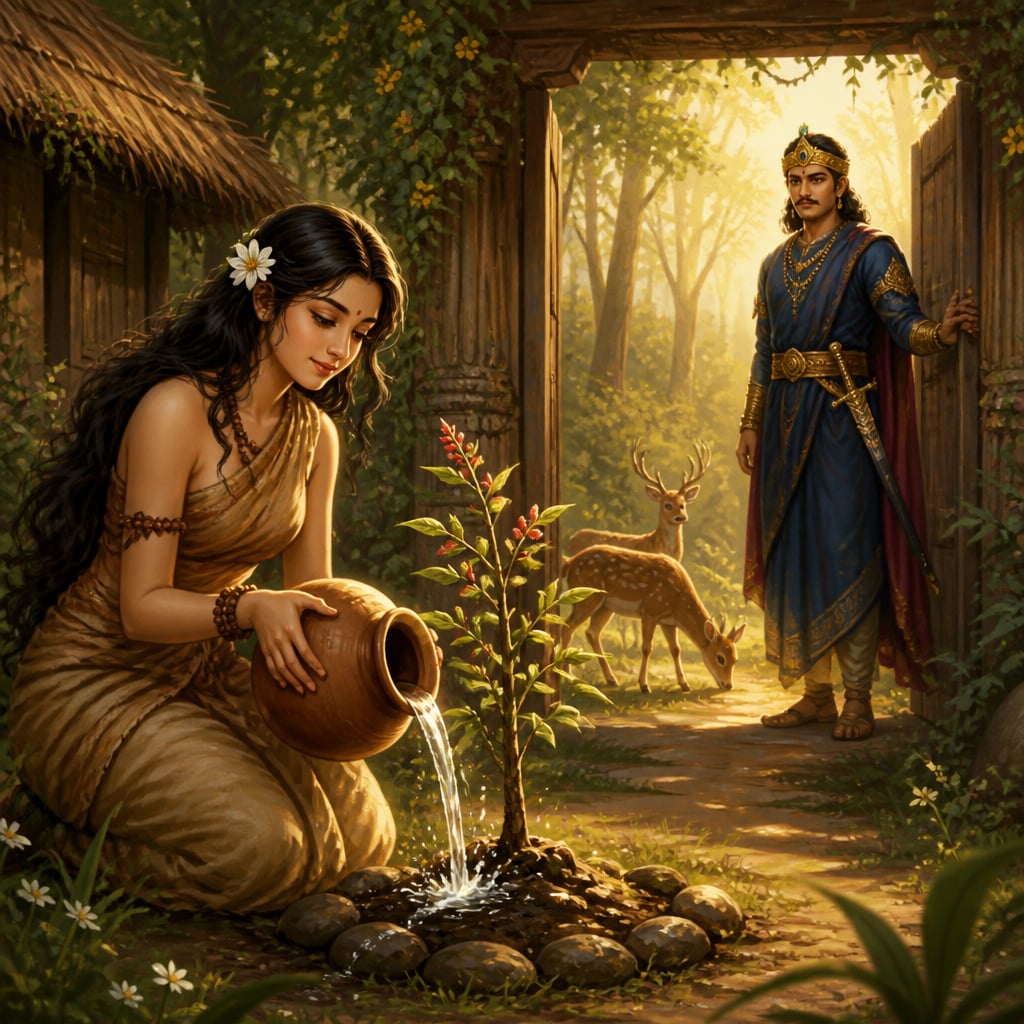
"Is anyone here? I am a traveler seeking water and rest."
No sage appeared to greet him. The ashram seemed empty save for the animals and birds that made it their home. Dushyanta walked deeper into the grove, past the sacrificial altar with its eternal flame, past the hermits' huts with their walls of bark and roofs of leaves.
And then he saw her.
The Forest Maiden
Shakuntala stood watering the young ashoka trees, her simple bark garments doing nothing to diminish a beauty that seemed to belong to another world entirely. She moved with unconscious grace, speaking softly to the plants as though they were dear friends. Her companions, two other young women of the ashram, helped her carry water from the nearby stream.
Dushyanta stood transfixed. In all his years as king, surrounded by the most beautiful women of the realm, he had never seen anyone like her. Yet it was not merely her physical beauty that arrested him, it was something in her manner, a quality of naturalness and purity that made the sophisticated women of his court seem artificial by comparison.
Who is she? the king wondered. Surely no ordinary mortal could possess such radiance. Is she a goddess in disguise? An apsara descended from heaven?
Gathering his courage, Dushyanta approached and spoke:
"Beautiful one, who are you? Whose daughter? How does a maiden of such evident nobility come to live in this forest hermitage?"
Shakuntala looked up, startled. Her eyes, dark and deep as forest pools, met his, and she too felt something stir within her that she had never known. But she composed herself and answered with the modesty befitting a sage's ward.
The Story of Her Birth
Shakuntala invited the king to sit and offered him the hospitality of the ashram, water, fruits, and a place to rest. As they sat beneath a flowering kadamba tree, she told him the extraordinary story of her origin.
"I am the daughter of the sage Vishwamitra and the apsara Menaka," she began. "But I was not raised by either of them."
The tale she told was one of passion, abandonment, and unexpected grace. Years ago, the great sage Vishwamitra had been performing terrible austerities, accumulating spiritual power that threatened to rival the gods themselves. Indra, king of heaven, grew fearful of this mortal whose tapas burned so bright. He sent Menaka, the most beautiful of the celestial dancers, to break the sage's concentration.

Menaka succeeded all too well. Vishwamitra, distracted from his penance, fell deeply in love with her. For ten years they lived together, and from their union Shakuntala was born. But Vishwamitra eventually realized what had happened, how he had been manipulated, how his years of spiritual accumulation had been spent on earthly passion. Ashamed and angry, he abandoned both mother and child.
Menaka, being an apsara, could not remain on earth to raise a human child. She left the infant Shakuntala on the banks of the Malini river and returned to heaven. There the baby lay, surrounded by shakunta birds who sheltered her with their wings and fed her with the berries they gathered.
"The sage Kanva found me there, protected by the birds. He named me Shakuntala, 'she who was nurtured by the shakunta birds', and raised me as his own daughter."
Love Blooms in the Forest
As Shakuntala finished her story, Dushyanta found his heart completely captured. Here was a woman of divine ancestry yet humble upbringing, beautiful yet unaware of her beauty, learned in the ways of the forest yet innocent of the world beyond it.
"I am Dushyanta, king of the Puru dynasty," he revealed. "And from the moment I saw you, I have been unable to think of anything else. I ask you, noble Shakuntala, will you consent to become my wife?"
Shakuntala's heart raced. She too had felt the arrow of Kamadeva strike true the moment she saw this noble stranger. Yet she was a sage's daughter, bound by dharma and decorum.
"My lord," she replied, "I am honored beyond measure. But I am not my own to give. My father Kanva is away on pilgrimage. You must wait for his return and ask his permission."
But love, once kindled, burns with an urgency that cannot wait. And Dushyanta, wise in the ways of dharma, knew of another path.
The Gandharva Marriage
"There are eight forms of marriage recognized by dharma," the king explained. "Among them is the Gandharva vivaha, the marriage of mutual love, requiring no priests, no ceremonies, no parental consent. It is the marriage of the Gandharvas, the celestial musicians, and it is considered entirely proper for a Kshatriya."
Shakuntala listened, her heart warring with her sense of propriety. Could she marry without her father's blessing? Yet was this not the very form of marriage by which her own parents had joined?
What is dharma in love? she asked herself. To follow the heart or to follow convention?
Finally, she spoke:
"If Gandharva marriage is dharma, and if you swear that the son I bear will be your heir, then I consent to be your wife."
Dushyanta's heart soared. He took her hand in his and made his vow:
"I swear by all that is sacred, by the sun and moon, by fire and water, by my ancestors and my honor, that any son born of our union shall be crown prince of my kingdom. This I promise you, Shakuntala, before the gods who witness all."
And so, beneath the trees of Kanva's ashram, with the sacred fires as their witness and the forest creatures as their guests, Dushyanta and Shakuntala were united in Gandharva marriage. The birds sang, flowers bloomed out of season, and a gentle breeze carried the fragrance of their love through the grove.
The Departure
For several days, the king remained in the ashram, lost in the joy of new love. But duty called, a kingdom cannot rule itself, and already his ministers would be wondering at his absence. The time came for Dushyanta to return.
"I must go," he told Shakuntala, "but only for a short while. I will send a royal escort to bring you to the palace with all the honor due to my queen."
From his finger, he removed a signet ring engraved with his royal seal, two fish joined together, the ancient symbol of the Puru dynasty.

"Keep this ring as my token," he said, pressing it into her palm. "When I send for you, show this to my messengers, and they will know you are my wife. And if I should delay, come to the palace yourself and present this ring. All will honor you as their queen."
Shakuntala held the ring tightly, as though it were her husband's hand itself. She watched as Dushyanta mounted his horse and rode away, turning back again and again to look at her until the forest swallowed him from sight.
She did not know, could not know, that dark clouds were gathering. That her happiness, so newly found, would soon be tested by forces beyond her control. That the ring she clutched so tightly would become both her salvation and her sorrow.
For fate, which had brought them together so sweetly, had other plans yet in store.
Living traditions
Shakuntala remains one of the most beloved figures in Indian literature. Her story has been adapted into countless plays, films, and television serials. The 1961 film 'Shakuntala' was a major success. Her image appears in traditional paintings (especially Ravi Varma's iconic portrayal) and continues to inspire artists and writers who see in her story the eternal themes of love, loss, and recognition.
- Shakuntala in Classical Dance: The story of Shakuntala is performed in all major Indian classical dance forms, Bharatanatyam, Odissi, Kathak, and Kuchipudi. Dancers portray her emotions: the wonder of first love, the sorrow of separation, and the dignity of confronting doubt.
- Kanva Ashram Site (Shakuntala's Hermitage): Traditional location of Sage Kanva's ashram where Shakuntala was raised and where she met King Dushyanta. The forested foothills here match the epic's description of the tapovana.
- Shakuntala Temple, Ujjain: Ancient temple dedicated to Shakuntala near the Shipra River. The temple complex includes shrines commemorating her story and the Gandharva marriage tradition.
- Kanva Ashram (Malini River): Traditional site of Kanva's hermitage where Shakuntala was raised. The area along the Malini river is still forested and peaceful, matching the descriptions in the Mahabharata.
Reflection
- Dushyanta left a ring as a token of his promise. What 'rings' do we leave in our own relationships, symbols or tokens that represent our commitments? What happens when these tokens fail?
- The Gandharva marriage was based purely on love and consent, without parental approval or religious ceremony. What do you think are the advantages and risks of such an approach to marriage?
- Vishwamitra abandoned Shakuntala and Menaka out of shame when he realized he had been manipulated away from his spiritual path. Can we sympathize with his choice, or was his abandonment unforgivable?