Rangabhumi: The Arena of Destiny
Karna challenges Arjuna
The princes' education is complete, and all of Hastinapura gathers to witness their skills. Arjuna's arrows paint fire across the sky, establishing him as the supreme warrior. But as the crowd roars its approval, an unknown youth strides into the arena and matches him feat for feat. 'Who is this man?' they demand. The answer, and the question of who has the right to ask, will shape the greatest war in history.
Rangabhumi: The Arena of Destiny
The training was complete. Years of instruction under Dronacharya had transformed the princes of Hastinapura into warriors, and now it was time to display their skills before the kingdom. A great tournament, a rangabhumi, was announced. Every citizen, from brahmin to merchant to laborer, was invited to witness the graduation of their future rulers.
The Arena Assembled
The arena rose on the outskirts of Hastinapura like a colosseum of dreams. Craftsmen built tiered galleries that could seat thousands. Canopies of silk shaded the royal pavilions where Dhritarashtra sat with Gandhari, Bhishma with Vidura, and Kunti with her women. The blind king would experience the tournament through Vidura's narration, every arrow flight, every sword clash described in his ear.
Drona sat in the place of honor, his revenge on Drupada already accomplished, his reputation cemented. His son Ashwatthama would also demonstrate his skills, though all knew this day belonged primarily to the princes he had trained.
The citizens packed every available space. They came to see their future, which prince would protect them, which would lead them to glory, which would sit on the throne of the Kurus. They did not know they were about to witness the formation of alliances that would destroy a generation.
The Kauravas Display
The tournament began with the Kauravas. One hundred princes demonstrated their training, a seemingly endless parade of martial competence. Duryodhana excelled with the mace, his powerful strokes shattering practice targets. Dushasana showed skill with the sword. The crowd applauded dutifully, these were their princes, after all.
But the applause was measured. One hundred princes blurred together in the audience's mind. Competent, yes. Impressive, perhaps. But not extraordinary.
Then came the Pandavas.
The Five Sons of Pandu
Yudhishthira entered first, demonstrating the dignified bearing befitting a future king. His weapon work was skilled but restrained, he had no need to show off. The crowd nodded approvingly; here was a prince who would rule with wisdom rather than flash.
Bhima's entrance was like a storm breaking. He wielded his mace with such force that the air itself seemed to tremble. He challenged Duryodhana to a bout, and for a moment, the arena held its breath as the two rivals circled each other. Drona separated them before blood was spilled, this was a demonstration, not a duel to the death. But everyone saw the hatred crackling between them.
Nakula displayed swordsmanship of liquid grace, his blade dancing patterns too fast for the eye to follow. Sahadeva showed his skill with multiple weapons, adapting his style moment by moment. The crowd grew more animated, these were princes worth cheering.
But everyone waited for Arjuna.
The Archer Supreme
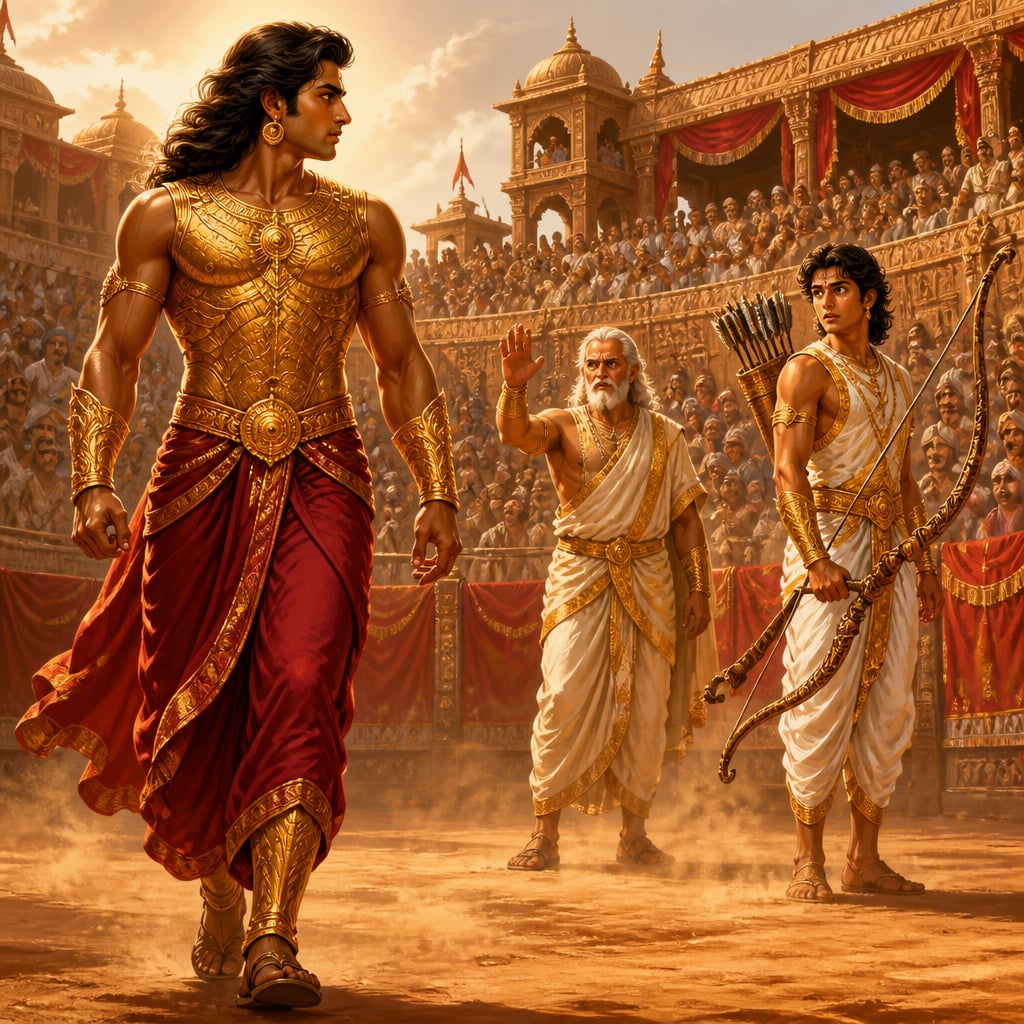
Arjuna entered the arena and the crowd fell silent. Even before he raised his bow, something in his bearing commanded attention. This was no mere prince, this was a warrior touched by destiny.
What followed was less a demonstration than a display of divine artistry. Arjuna shot arrows that created fire, arrows that summoned water, arrows that multiplied in flight into dozens of shafts. He hit targets while blindfolded. He hit targets reflected in mirrors. He shot multiple arrows simultaneously, each finding a different mark.

For his finale, Arjuna created with his arrows an illusion of a wild boar, then shot it down with a cascade of shafts that formed the shape of a lion. The crowd erupted. Women threw flowers. Men stamped their feet until the galleries shook. "Arjuna! Arjuna!" The name became a chant, a prayer, a prophecy.
In the royal gallery, Kunti wept with pride. Drona smiled the smile of a teacher whose student has exceeded all hopes. Even Duryodhana, consumed by jealousy, could not deny what he had witnessed.
This was the supreme archer. This was the future.
And then a voice rang out across the arena.
The Challenger
"Whatever feats Arjuna has performed, I shall match them all, and exceed them."
The crowd fell silent. Every head turned toward the entrance, where a young man stood in golden armor that seemed to glow with its own light. He was tall, powerfully built, with a bearing that radiated warrior confidence. On his ears were earrings that caught the sun like captured flames. His face, though none recognized it, bore an unmistakable resemblance to someone, though the crowd could not say whom.
"Who are you?" Kripa demanded. "By what right do you enter this arena?"
The stranger did not answer. Instead, he walked to the center of the rangabhumi, raised his bow, and proceeded to duplicate every feat Arjuna had performed. Fire arrows. Water arrows. Blindfolded shooting. And when he finished, he turned to face Arjuna directly.
"I challenge you," he declared, "to single combat. Let us see who is truly the greatest archer."
The crowd buzzed with excitement and confusion. Arjuna's face had gone rigid. This stranger had appeared from nowhere and matched him perfectly, and now challenged him before all of Hastinapura.
"I accept," Arjuna said, stepping forward.
But Kripa intervened. "Wait. Before princes can engage in formal combat, protocols must be observed. You, stranger, name yourself. Name your father, your lineage, your kingdom. Only kshatriyas of recognized birth may challenge the princes of Hastinapura."
The Question of Birth
The stranger's face darkened. For a moment, something like shame flickered across his features, then hardened into defiance.
He could not answer. He did not know his true parentage. He had been raised by Adhiratha, a charioteer, a suta, one who served kshatriyas but was not of their caste. To admit this before all of Hastinapura would mean humiliation. To challenge Arjuna without answering would mean disqualification.
The crowd began to murmur. Some laughed. A charioteer's son, challenging a prince? The social order was being mocked.
In the royal gallery, Kunti had gone pale. She alone knew who this golden-armored stranger truly was. The earrings, she recognized them. The kavacha (armor) that seemed to grow from his very skin, she remembered the blessing. This was Karna, her firstborn son, the child she had abandoned in the river so many years ago, born of the sun god Surya before her marriage.
Her son stood before her other sons, seeking to fight them. And she could say nothing.
Duryodhana's Gambit
Duryodhana watched the scene unfold and saw an opportunity that would reshape his fortunes. Here was a warrior equal to Arjuna, perhaps superior, being denied the chance to prove himself because of an accident of birth. Here was a weapon against the Pandavas, if only he could secure it.
He strode into the arena.
"What determines a warrior?" Duryodhana shouted to the crowd. "Is it blood alone? Or is it courage, skill, and valor? This man has demonstrated prowess equal to any prince. If he cannot fight Arjuna because he lacks a kingdom, then I shall give him one!"
Duryodhana turned to the stranger. "I, Duryodhana, crown prince of Hastinapura, hereby grant you the kingdom of Anga. From this moment, you are Karna, King of Anga. You are my equal, my ally, and my friend. Now, " he turned to the assembly, ", does anyone dare question his right to challenge?"

The priests hurriedly performed an abbreviated coronation. Water was poured on Karna's head. The umbrella of sovereignty was held over him. In moments, the charioteer's son had become a king.
Karna, overwhelmed, asked Duryodhana what he could give in return for such generosity.
"Your friendship," Duryodhana replied. "That is all I ask."
"You have it," Karna swore. "Until death."
The Interrupted Duel
As the newly crowned king turned to resume his challenge, a commotion arose at the arena's edge. An old man pushed through the crowd, Adhiratha, Karna's adoptive father, the charioteer who had found him floating in a basket on the river.
"My son!" Adhiratha called out, tears streaming down his weathered face. "They told me you were here. They said you were made a king!"
Karna's triumph curdled. Before all of Hastinapura, the truth of his humble origins was confirmed. He embraced his father, he loved Adhiratha genuinely, but the embrace also proclaimed his caste to all who watched.
Bhima's cruel laughter rang across the arena. "A king? This suta-putra, this son of a charioteer, dares to challenge Arjuna? He is fit to drive our chariots, not fight us. Go back to your whips and reins, stable-boy!"
Karna's face went white with rage. He had been humiliated before thousands, his skill dismissed because of the circumstances of his birth. He looked at Arjuna, at Bhima, at the Pandavas who stood together in their superiority, and something crystallized in his heart.
He would destroy them. Whatever it took, however long it required, he would see them brought low.
But before the challenge could proceed, the sun began to set. Protocol demanded that combat cease at dusk. The tournament was over. The duel that would have settled everything was postponed, indefinitely, as it turned out.
A Mother's Silence
That night, Kunti lay sleepless. She had watched one son challenge another, watched her firstborn be humiliated for the birth she had given him and the abandonment she had chosen. She could have spoken. She could have revealed that Karna was her son, born before her marriage, eldest of all her children.
But what would that revelation bring? Karna's legitimacy would undermine Yudhishthira's claim to the throne. The Pandavas would be thrown into chaos. And Karna himself, would he even want to know the mother who had cast him into the river?
Kunti chose silence. It was a choice she would make again and again, until the eve of the great war itself. And each time she chose it, the knot of tragedy tightened.
The Alliance That Doomed Kingdoms
Duryodhana had gained what he most needed, a warrior who could match Arjuna, bound to him by gratitude and friendship. Karna had gained what he most craved, recognition, status, and a patron who valued him for his abilities rather than his birth.
But both had also gained something else: a grievance against the Pandavas that would fester and grow. Karna would never forget Bhima's mockery, never forgive the Pandavas' assumption of superiority. Duryodhana had found in Karna a friend who understood humiliation, who shared his hatred, who would stand with him no matter the cost.
The rangabhumi had been meant to celebrate the princes' graduation. Instead, it had forged an alliance that would lead to the deaths of millions. The greatest archer had found his match. The greatest rivalry of the age had begun.
And in a palace chamber, a mother wept for a son she could not claim, knowing that her children would one day face each other across a battlefield.
Living traditions
The term 'Karna' has entered Indian languages as a byword for extraordinary generosity. The phrase 'Karna's charity' (Karna ka daan) describes giving even when it costs everything, a reference to his later sacrifice of his divine armor. Debates about merit versus birth from the rangabhumi scene are frequently invoked in modern discussions about caste, reservation policies, and social mobility in India. Karna has become a symbol for those who face discrimination despite demonstrated ability.
- Dhanurveda Training (Martial Arts): The tradition of martial demonstrations before assembled audiences continues in India through sports like kushti (wrestling), kalaripayattu (Kerala martial art), and modern military tattoos. These events serve the same purpose as the rangabhumi, displaying martial prowess and building public confidence in warriors.
- Rājyābhiṣeka (Royal Consecration): The coronation ritual Duryodhana performed (abhisheka) remains the essential element of royal and religious consecration in Hindu tradition. Modified forms are used to install religious leaders, consecrate temple deities, and mark significant transitions.
- Karnal, Haryana: This city's name derives from Karna, and local tradition holds it was founded by him after he became King of Anga. The region maintains several sites associated with his legend.
- Champapuri (ancient Anga capital): The capital of the ancient Anga kingdom that Duryodhana granted to Karna. Archaeological remains and local temples preserve the memory of Karna's brief reign.
- Karna Temple, Karnaprayag: Karna temples exist in several Indian states, particularly in regions associated with the Anga kingdom. Worshippers honor him as a model of generosity and loyalty despite his tragic fate.
- Karnadev Temple, Karnal: The Karnadev Temple in Karnal, Haryana (a city said to be named after Karna) maintains traditions connecting the region to the warrior's legacy.
Reflection
- Should Kunti have revealed Karna's true identity at the rangabhumi? What would have changed if she had spoken?
- Was Duryodhana's crowning of Karna a genuine act of friendship, or a calculated political move? Can an action be both self-serving and truly kind?
- The rules of the tournament required Karna to prove noble birth before fighting Arjuna. Were these rules just? How do we balance social order against individual merit?