Niyoga: The Unbroken Line
Vyasa fathers the royal heirs
When both of Satyavati's sons die without heirs, the Kuru dynasty faces extinction. In desperation, the queen mother summons a son from her secret past, the sage Vyasa. Through the ancient practice of niyoga, Vyasa will father three sons on the royal widows, but the circumstances of their conception will mark each child with a flaw that shapes the destiny of nations.
The Dying Line
Shantanu's death left the kingdom of Hastinapura in the hands of his widow Satyavati and the ever-faithful Bhishma. Though Bhishma was the mightiest warrior and wisest statesman in the realm, his terrible vow prevented him from taking the throne. Instead, he served as regent while Satyavati's eldest son, Chitrangada, was crowned king.
Chitrangada was brave but short-lived. A powerful Gandharva of the same name challenged him to single combat, and after three years of fighting on the banks of the Saraswati, the young king fell. He left no children.
The throne passed to the younger brother, Vichitravirya. But he was barely a boy, too young to marry, too young to father heirs. Satyavati watched anxiously as years passed. The dynasty that Bhishma had sacrificed everything to preserve now hung by a thread.
The Abduction of Princesses
When Vichitravirya came of age, Bhishma took action. He learned that the King of Kashi was holding a swayamvara for his three daughters, Amba, Ambika, and Ambalika. Without waiting for an invitation, Bhishma rode to Kashi alone.
In the great assembly, before the gathered kings and princes, Bhishma made his announcement:
"I am taking these three princesses for my brother Vichitravirya, King of Hastinapura. Let any who object face me in combat."
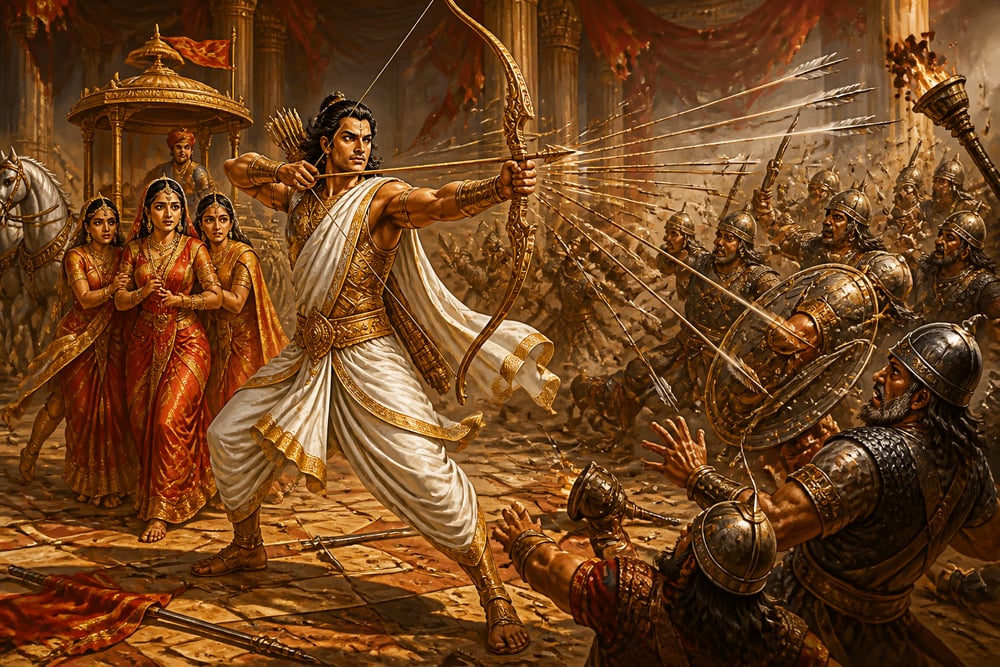
The assembled warriors attacked, and Bhishma defeated them all. He placed the three princesses in his chariot and drove back to Hastinapura, the greatest abduction in the history of the age.
But there was a complication. Amba, the eldest, had already given her heart to King Shalva. She pleaded with Bhishma:
"I cannot marry your brother. I love another. Please release me."
Bhishma, ever righteous, let her go. But when Amba went to Shalva, he rejected her, she had been touched by another man's chariot, claimed by another house. Humiliated and furious, Amba vowed revenge against Bhishma. Her story would return with devastating consequences, but that tale belongs to another lesson.
Ambika and Ambalika were married to Vichitravirya with great ceremony. For seven years, they lived as his queens. But Vichitravirya was weak, some say from disease, others from excessive indulgence. Before he could father a single child, he died.
The Dynasty's End
Satyavati was beside herself with grief and terror. Both her sons were dead. Neither had left an heir. The great dynasty of Bharata, the line she had sacrificed so much to join, would end with her.
She turned to the only man who could help: Bhishma.
"You must father children on the widows," she pleaded. "It is the only way. Your brother's line can continue through you."
Bhishma's face was stone.
"Mother, you know I cannot. My vow was absolute, no wife, no children, ever. I will die before I break it. Ask anything else of me, and I will obey. But not this."
Satyavati fell silent. Then, slowly, she spoke of something she had kept hidden for decades.
The Queen's Secret
Before Satyavati ever met Shantanu, before she became queen, she had been a simple fisherwoman's daughter, ferrying travelers across the Yamuna. One day, the great sage Parashara boarded her boat. Overcome by her beauty, he desired her.
Satyavati was terrified, to refuse a sage risked his curse, but to yield meant ruin for an unmarried girl. Parashara understood her fear. Through his powers, he created a mist that hid them from all eyes. He blessed her with an eternal divine fragrance to replace her fishy smell. And he promised that her virginity would be restored after their union.
From that encounter, a son was born, Krishna Dvaipayana, dark-skinned and born on an island (dvipa) in the river. This was the child who would become Vyasa, composer of the Mahabharata itself. He grew instantly to manhood through his father's blessing and departed for the forest to pursue the ascetic life, promising his mother:
"Whenever you think of me, I will come."
Now, in her hour of desperate need, Satyavati thought of her firstborn son.
The Sage Arrives
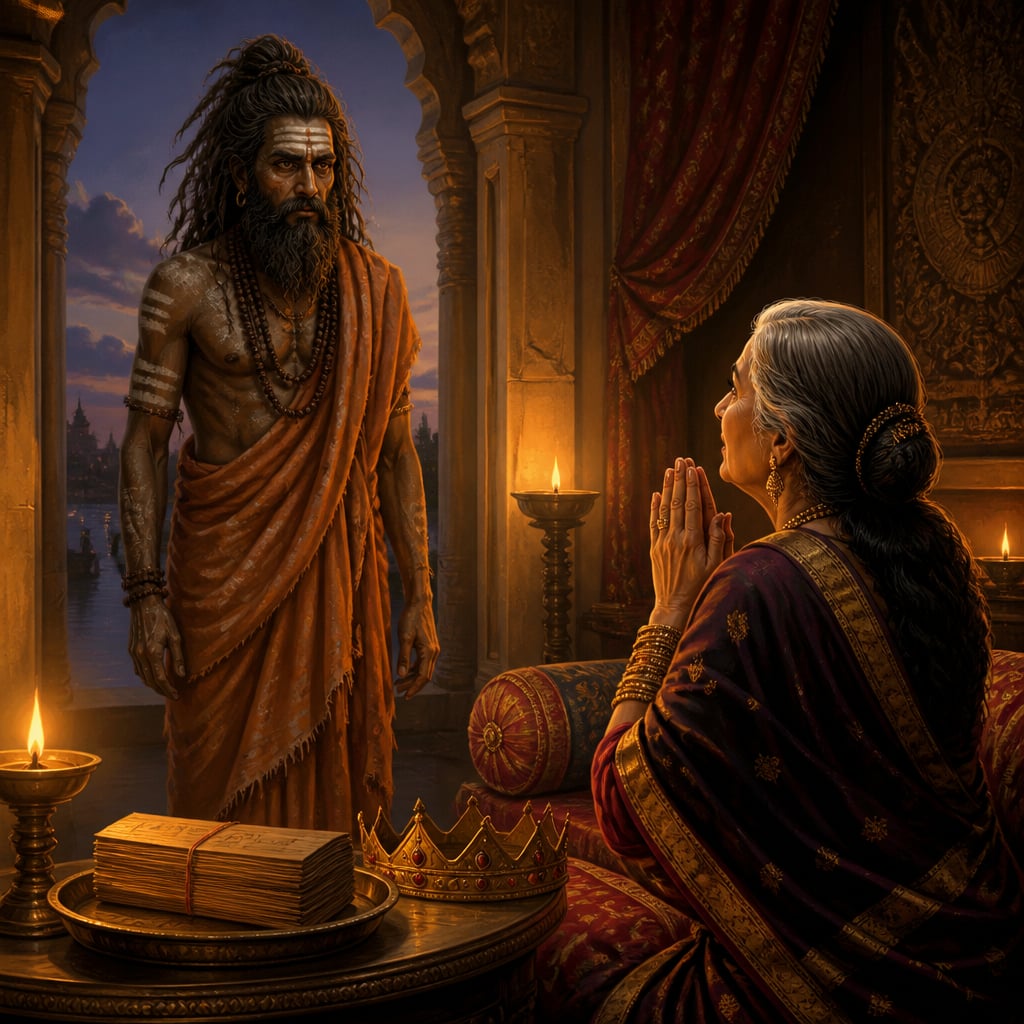
Vyasa appeared before his mother, wild-haired, ash-smeared, terrible in his ascetic power. He had been performing fierce penances in the wilderness. His eyes burned with spiritual fire; his body was gaunt and unwashed; matted locks hung past his shoulders.
Satyavati explained the crisis. Vyasa listened, then nodded.
"I will do as you ask, Mother. Through the practice of niyoga, I will raise up sons for my dead brother. But warn the queens, they must accept me as I am. If they approach me with revulsion, it will mark the children."
Satyavati agreed and went to prepare the widows.
Three Conceptions, Three Flaws
Niyoga was an ancient practice, sanctioned by dharma for exactly this situation, when a man died without heirs, a designated male (often a brother or sage) could father children on his widow. The children were legally and spiritually considered sons of the deceased husband, not the biological father.
But the circumstances of conception mattered. The state of mind of both parents at the moment of union would shape the child's nature and destiny.
Dhritarashtra
First came Ambika. She had been prepared by Satyavati, told that a great sage would visit her to preserve the royal line. But when Vyasa entered her chamber, she saw not a noble Brahmin but a terrifying figure, wild, dark, reeking of the forest.
Ambika was so frightened that she closed her eyes throughout the encounter, unable to bear the sight of him.
Nine months later, she bore a son of extraordinary strength and beauty. But he was blind. The child was named Dhritarashtra, "he who holds the kingdom", though his blindness would always stand between him and the throne.
Pandu
Satyavati was dismayed but not defeated. She sent Vyasa to Ambalika next. This time, she warned her daughter-in-law more carefully.
But Ambalika, though she kept her eyes open, turned pale with fear when she saw the sage. Her terror drained the color from her face.
Her son was born healthy but pallid, his skin unnaturally white, as if bloodless. He was named Pandu, "the pale one." Though he would prove a capable warrior and ruler, his pallor hinted at a constitutional weakness that would shape his fate.
Vidura
Two sons, but both flawed. Satyavati asked Vyasa to try once more with Ambika, hoping the third time would produce a perfect heir.
Ambika could not face the sage again. Instead, she sent her maidservant, a woman of the Shudra class, but intelligent and devoted. The maid approached Vyasa without fear, with calm acceptance of her duty.
The son born of this union was flawless in body and mind, Vidura, who would become the wisest counselor Hastinapura ever knew. But his mother's low birth meant he could never be king. In the rigid hierarchy of the age, a king must be born of a queen.
Three Brothers, Three Destinies

And so the line was preserved, but at what cost?
Dhritarashtra was eldest and strongest, but his blindness disqualified him from kingship in the eyes of many. His frustrated ambition would fester for decades.
Pandu was healthy enough to rule, but his pallor suggested an inner weakness. He would become king, but his reign would be cut short by forces beyond his control.
Vidura was wisest of all, but his birth made him forever a minister, never a master. He would spend his life giving counsel that others were free to ignore.
Each brother carried the mark of his conception, a reminder that even the most necessary acts have consequences, that the circumstances of our birth shape but do not determine our choices.
Vyasa, his duty done, returned to the forest. He would reappear at crucial moments throughout the epic, guiding, warning, witnessing, but never interfering more than necessary. For he knew what others did not: that the flaws he had planted in this generation would bloom into tragedy in the next.
The dynasty was saved. But the seeds of its destruction were already sown.
Living traditions
The practice of niyoga is no longer performed, but questions it raises about biological versus legal parentage remain relevant in the age of surrogacy, sperm donation, and assisted reproduction. Modern law grapples with similar questions: Who is the 'real' parent? What rights does the biological father have? Vyasa's story, millennia old, anticipates debates we're still having today.
- Vyasa Purnima (Guru Purnima): The full moon day in the month of Ashadha is celebrated as Vyasa Purnima, honoring the sage who organized the Vedas and composed the Mahabharata. It has become Guru Purnima, a day to honor all teachers.
- Vyasa Gufa (Vyasa's Cave): Cave where Vyasa is believed to have composed the Mahabharata. As the father of Dhritarashtra, Pandu, and Vidura through niyoga, Vyasa's spiritual retreat holds special significance for this lesson.
- Hastinapura Jain Temples: Ancient temple complex at the site of the Kuru capital where Dhritarashtra, Pandu, and Vidura were raised. The Ashtapad and Jambudweep temples preserve memories of the dynasty.
- Vyasa Gufa (Vyasa Cave): The cave where Vyasa is believed to have composed the Mahabharata, dictating to Ganesha. Located at over 3,000 meters altitude, near the last Indian village before Tibet.
Reflection
- Was niyoga ethical by modern standards? How do we evaluate ancient practices that seem problematic today but served important social functions then?
- Were Ambika and Ambalika wrong to feel fear and revulsion? Should they be blamed for their children's flaws?
- Vidura was the wisest but could never be king. How does this reflect on systems of hereditary power, whether ancient or modern?