Guru Dakshina: The Price of Knowledge
Ekalavya sacrifices his thumb
A humiliated teacher arrives at Hastinapura with a promise and a price, he will forge the princes into the greatest warriors alive, but his fee will be revenge. Meanwhile, in the forest, a tribal boy teaches himself archery before a clay statue, only to learn that some gifts must be surrendered even after they are earned. The story of Drona and Ekalavya raises questions about merit, loyalty, and justice that echo across millennia.
Guru Dakshina: The Price of Knowledge
The princes of Hastinapura needed a teacher. Kripa, their current instructor, had given them the fundamentals, but Bhishma knew they required someone extraordinary, a master who could transform royal children into legendary warriors. That master would arrive in the strangest of ways.
The Humiliation of Drona
Dronacharya was born unusual, he emerged not from a mother's womb but from a pot (drona) where his father, the sage Bharadwaja, had preserved his vital essence. Despite this miraculous origin, Drona grew up in poverty. He mastered the military arts under the great Parashurama, who taught him every weapon and strategy known to gods and men. But knowledge without wealth is a hungry existence.
Drona's childhood friend was Drupada, prince of Panchala. They had studied together, played together, and sworn eternal friendship. "When I am king," Drupada had declared, "half my kingdom shall be yours. We are equals, you and I."
Years passed. Drupada became king. Drona remained poor, unable even to provide milk for his infant son Ashwatthama. When the boy cried with hunger, other children mocked him with flour-water, pretending it was milk. Drona's wife wept. His son went hungry. And Drona remembered his friend's promise.
He traveled to Panchala, entered the royal court, and addressed Drupada as a friend. "Do you remember our vow? I have come to claim what you promised."
Drupada laughed. Not a kind laugh, a cruel one. "Friendship exists between equals," the king declared before his entire court. "You are a wandering beggar. I am a king. What friendship can exist between us? I made those promises as a foolish boy. Go beg elsewhere."
Drona left the court burning with humiliation. In that moment, a single desire crystallized in his heart: revenge. He would not rest until Drupada knelt before him, stripped of pride and power.
But revenge requires resources. A poor teacher cannot defeat a king. Drona needed an army, or better yet, warriors who owed him everything.
The Ball in the Well
Fate provided the opportunity. One day, the young princes of Hastinapura were playing with a ball near a well. The ball fell in, and despite their best efforts, they could not retrieve it. A ring followed the ball into the darkness.
An aging stranger watched their frustration with amusement. "Shame on you, princes," he called out. "You cannot retrieve a simple ball? Watch what skill can accomplish."

Drona took a blade of grass and threw it into the well. It pierced the ball. He threw another blade, which pierced the first. Blade after blade formed a chain, and he drew up the ball. For the ring, he shot a single arrow that brought it back.
The princes stood amazed. They ran to tell Bhishma, who immediately recognized the description. "This is Drona, son of Bharadwaja, master of all weapons. He is the teacher we have been seeking."
Bhishma met Drona and offered him the position of royal preceptor. "Train my grandsons," Bhishma said. "Make them the greatest warriors of their age."
Drona agreed, but he had one condition. "When their training is complete, I will ask for guru dakshina. Whatever I request, they must give."
Bhishma agreed without knowing what the price would be.
The Training of Warriors
Drona proved to be the master Bhishma had hoped for. He trained all the princes, both Pandavas and Kauravas, in every weapon and martial art. He was demanding, brilliant, and utterly dedicated to excellence.
But from the beginning, one student stood apart. Arjuna showed such aptitude for archery that Drona's heart filled with a teacher's deepest joy, the recognition of a successor who would surpass him. He gave Arjuna special instruction, teaching him secrets he shared with no other student.
"I will make you the greatest archer in the world," Drona promised Arjuna. "No one will be your equal."
This promise would cost someone dearly.
Arjuna practiced with obsessive dedication. When the other princes slept, Arjuna trained by torchlight. When they rested, he shot arrows in darkness, learning to aim by sound alone. His devotion to his guru was total, and Drona rewarded it with the most advanced techniques of warfare.
Duryodhana excelled with the mace. Bhima's strength made him formidable in any combat. Nakula became master of the sword. But in archery, the supreme skill of kshatriya warfare, none could approach Arjuna.
Or so Drona believed.
The Boy in the Forest
Far from the royal training grounds, in the forests near Hastinapura, lived a boy named Ekalavya. He was the son of Hiranyadhanus, chief of the Nishadas, a tribal people who lived by hunting. Ekalavya dreamed of becoming an archer, not for royal glory, but because the bow was his people's way of life.
Hearing of the great Drona, Ekalavya traveled to Hastinapura and prostrated before the master. "Accept me as your student," he pleaded. "Teach me the art of archery."
Drona looked at the forest boy and refused. The reasons given vary in different tellings, some say Drona considered it improper to teach forest-dwellers royal warfare arts; others say he feared creating a rival to Arjuna; still others suggest he worried about what a skilled tribal archer might do to the established order. Whatever the reason, he sent Ekalavya away.
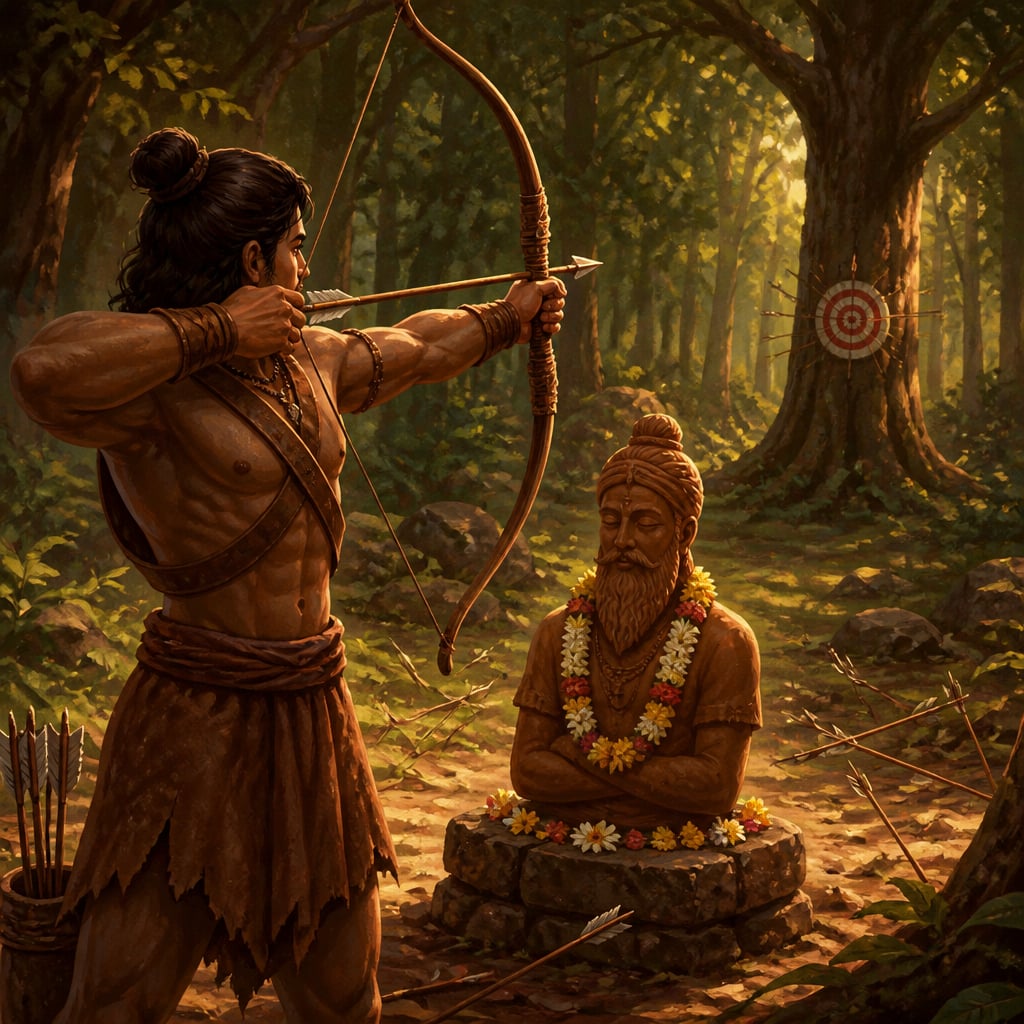
But Ekalavya did not abandon his dream. He returned to the forest, fashioned a clay statue of Drona, and placed it in a clearing. Before this image, he practiced archery every day, treating the statue as his guru, offering it prayers and respect before each session.
Year after year, Ekalavya trained alone. His dedication was absolute. He shot arrows until his fingers bled, until muscle memory replaced conscious thought, until the bow became an extension of his body. Without formal instruction, guided only by his reverence for an absent teacher, he became extraordinary.
The Dog That Could Not Bark
One day, Drona took his students hunting in the very forest where Ekalavya lived. A dog from their party wandered toward Ekalavya's clearing and began barking at the strange figure practicing archery.
Annoyed by the noise, Ekalavya shot seven arrows in rapid succession. They filled the dog's mouth completely, preventing it from barking, but not a single arrow drew blood. The dog ran back to the hunting party, alive but silenced.
The princes stared in astonishment. This was shooting beyond anything they had seen, precise, merciful, and impossibly skilled. Who could perform such a feat?
They followed the dog's trail and found Ekalavya, simply dressed, practicing before a clay statue. Arjuna recognized the statue immediately, it was Drona.
"Who are you?" Arjuna demanded, his voice sharp with something that might have been fear. "Who taught you to shoot like this?"
"I am Ekalavya, son of Hiranyadhanus," the boy replied with a bow. "I am a student of Dronacharya."
Arjuna's face went pale. He turned to Drona. "You promised me I would be the greatest archer in the world. You said no one would be my equal. Yet here stands someone who shoots better than I do, and he claims you as his guru."
Drona was troubled. He had made a promise to Arjuna, a promise he valued above almost everything. He approached Ekalavya.
"You call yourself my student?"
"Yes, Gurudev." Ekalavya prostrated at Drona's feet. "I learned at your feet, " he gestured at the clay statue, ", in the only way I could."
"Then you owe me guru dakshina."
Ekalavya's face lit up. To be acknowledged by Drona, to have his devotion recognized, this was everything he had dreamed. "Ask anything, Gurudev. Whatever you desire, I will give."
"Give me your right thumb."
The Price of Excellence
The forest fell silent. Without his thumb, Ekalavya could never draw a bowstring properly again. His archery, the skill he had spent years developing, the gift that defined his existence, would be crippled forever.
![]()
Ekalavya did not hesitate. He drew his knife, severed his thumb, and placed it at Drona's feet.
"Gurudev's dakshina," he said simply.
Arjuna watched, his face a mixture of relief and something harder to name. Drona took the thumb without expression. The party returned to Hastinapura. Ekalavya remained in the forest, forever marked by his sacrifice.
The Weight of This Story
The tale of Ekalavya is one of the most debated passages in the Mahabharata. Was Drona's demand justified, the rightful claim of a guru? Or was it a cruel act designed to protect privilege and eliminate competition?
Drona had made a promise to Arjuna, and in the dharma of that age, a guru's word was sacred. But he had also refused to teach Ekalavya, yet claimed guru dakshina from him anyway. Can one demand payment from a student one never accepted?
Ekalavya's willing sacrifice raises its own questions. He gave his thumb without protest, demonstrating devotion that exceeded even Arjuna's. In one interpretation, this makes him the truest student, one who honored the guru despite receiving no formal instruction. In another, his submission to an unjust demand represents the tragedy of an order that denied talent based on birth circumstances.
The Mahabharata does not resolve these tensions. It presents them for us to wrestle with, generation after generation.
The Guru Dakshina of the Princes
Years later, when the princes' training was complete, Drona called in his own debt. His guru dakshina was exactly what he had planned from the beginning: "Bring me Drupada, defeated and humiliated."
The Kauravas attacked Panchala first and were routed. Then Arjuna led the Pandavas. His arrows darkened the sky. He captured Drupada alive and dragged him before Drona.
"Now we are equals again," Drona told his former friend. "I will return half your kingdom, I need only half to prove my point. From this day, the northern half of Panchala is mine."
Drupada, humiliated before his own court as he had once humiliated Drona, burned with rage. He would spend years seeking revenge, eventually performing a sacrifice that would produce both Dhrishtadyumna, who would kill Drona, and Draupadi, who would marry the Pandavas and bind their fates to his.
Thus Drona's vengeance created the conditions for his own death, and the cycle of humiliation and revenge expanded to consume kingdoms.
Living traditions
The Dronacharya Award, one of India's highest honors for sports coaches, is named after the legendary teacher, though some have noted the irony given his treatment of Ekalavya. Ekalavya has become a powerful symbol in Dalit and tribal movements, representing both the injustice of caste-based discrimination and the resilience of those denied opportunity. His statue stands in several Indian universities as a reminder of excluded excellence.
- Guru-Śiṣya Paramparā (Teacher-Student Tradition): Guru Purnima (the full moon day honoring teachers) remains one of India's most observed traditions. Students visit their teachers, offer gifts and gratitude, and renew their commitment to learning, echoing the guru dakshina tradition, though typically without the sacrifice demanded of Ekalavya. The practice of learning before a guru's image when the guru is absent also continues in many traditions. Musicians learning classical ragas, dancers studying bharatanatyam, and martial artists in traditional schools often practice before portraits of their masters, a direct continuation of Ekalavya's approach.
- Guru Dronacharya Temple, Gurugram: Located in the village of Gurgaon (now a major city), this temple marks the traditional site where Dronacharya trained the Kuru princes. The entire city's name derives from 'Guru-gram', village of the guru.
- Ekalavya's Shrine, Khandava Forest Region: Several locations in the Delhi-Haryana region claim connection to Ekalavya's story. Tribal communities maintain these sites as places of pilgrimage and cultural memory.
- Dronacharya Temple: The Dronacharya Temple in Gurugram (Guru-gram, 'village of the guru') is believed to mark where Drona taught the princes. The city itself is named after him.
- Ekalavya Statue and Memorial: Various tribal communities maintain shrines to Ekalavya as a folk hero who represents their own struggles for recognition and dignity.
Reflection
- Should Ekalavya have refused Drona's demand? What would have been the consequences of refusal versus compliance?
- The story shows talent blocked by social barriers. How does this ancient dilemma connect to modern questions about access to education and opportunity?
- Was Drona justified in asking for Ekalavya's thumb? Consider that he had made a sacred promise to Arjuna, but had never agreed to teach Ekalavya.