Relevance in 2026 and Beyond
Family, Identity, and Choice in an Age of Disruption
How the Adi Parva's teachings on family dynamics, identity formation, moral complexity, and consequential choices apply to navigating modern life, from workplace rivalries to AI disruption to the weight of inherited legacies.
Relevance in 2026 and Beyond
The Modern Hook
You're in a meeting where a colleague takes credit for your work. Your boss seems to favor them. Do you confront them publicly and risk being seen as petty? Do you stay silent and seethe? Do you compete harder and match their tactics?
Or consider: You've inherited a family business, but your vision clashes with your siblings'. Every holiday dinner is a negotiation. Every text carries subtext. Your parents' choices created the situation; your choices will determine its resolution.
These scenarios, workplace rivalry, family conflict, the weight of inherited circumstances, feel intensely modern. Yet they're precisely what the Adi Parva explored many millenia ago. The Mahabharata's opening book isn't ancient history; it's a field guide for navigating the complexity that defines contemporary life.

The Modern Challenge
We live in an age of unprecedented disruption. AI systems like ChatGPT and Claude are reshaping careers that seemed secure months ago. The 2024 tech layoffs demonstrated that even the most skilled professionals face sudden displacement. Family structures are evolving, multigenerational households, blended families, and long-distance caregiving create new tensions without clear scripts.
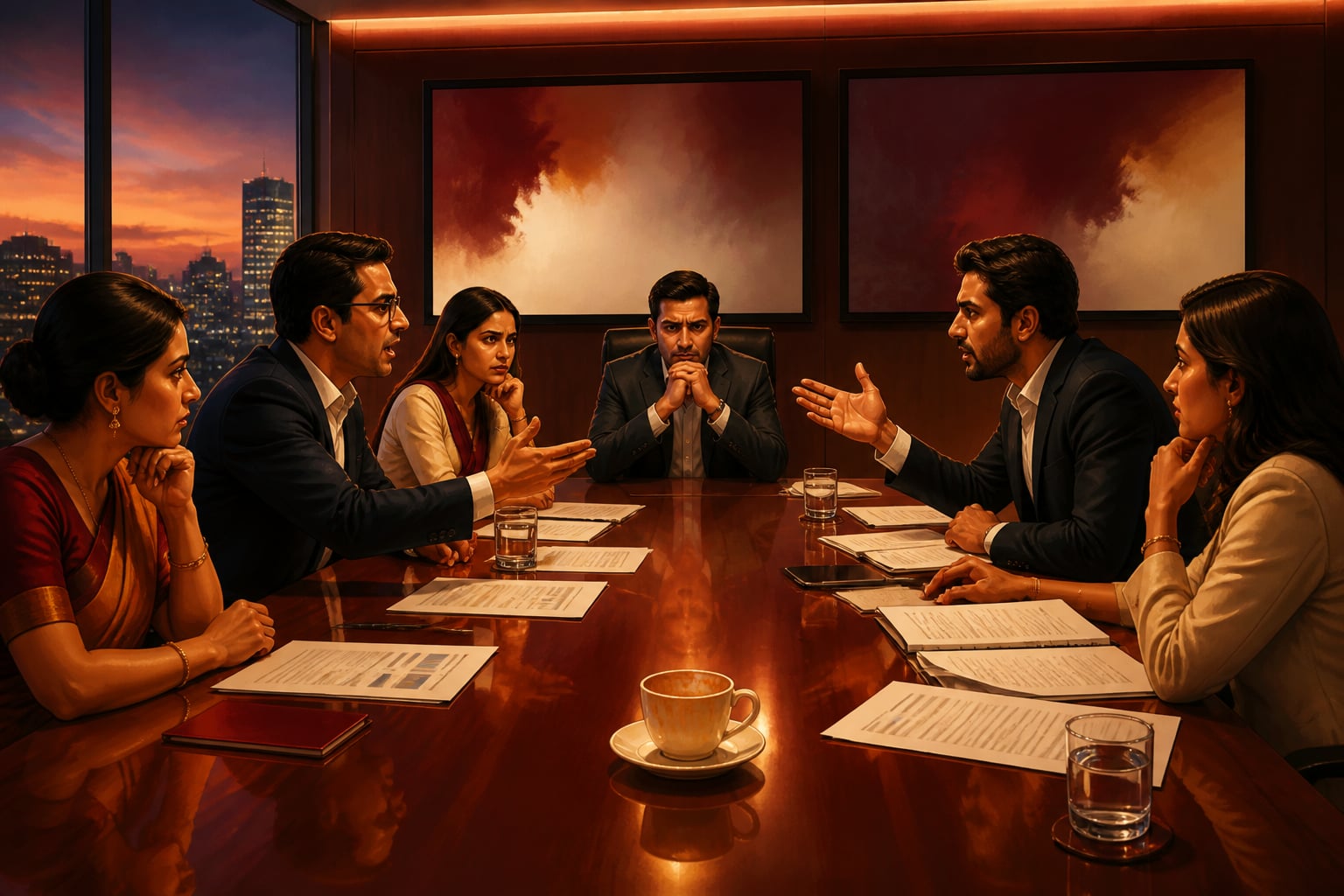
Consider the OpenAI board crisis of November 2023: a company at the forefront of AI was nearly destroyed by competing visions, personality conflicts, and governance failures that could have been lifted directly from Hastinapura's court. Sam Altman's firing and reinstatement within five days showed how quickly alliances shift, how personal grudges shape institutional outcomes, and how the question "Who has legitimate authority?" rarely has simple answers.
In India, the Adani-Hindenburg confrontation of 2023 revealed how family business empires face sudden credibility crises, and how response to challenge can define legacy more than decades of building. The Tata succession from Ratan Tata to Chandrasekaran demonstrated that even the most respected dynasties must navigate the tension between continuity and change.
We face the Kaurava problem daily: situations where everyone believes they're justified, where the "villain" has legitimate grievances, where dharma offers no easy answers.
The Ancient Insight
The Adi Parva refuses to simplify. Its characters aren't heroes and villains but people shaped by circumstances making the best choices they can, often poorly.
Duryodhana's jealousy was born from legitimate grievance: a father who couldn't love him enough, a system that favored his cousins, the constant message that he was somehow less. Karna's tragedy flows from circumstances of birth and a mother's desperate choice. Even Shakuni, the arch-manipulator, acts from wounds that demand sympathy.
The parva teaches that origins shape but don't determine. Bhishma's noble vow became his prison. Kunti's secret became Karna's doom. Yet Arjuna's exile became opportunity. Hidimba's "wrong" marriage became Ghatotkacha's gift.
Most crucially: choices cascade. Devavrata's oath ripples through generations. Dhritarashtra's blindness, moral as much as physical, enables catastrophe. Every character acts within constraints they didn't create, making choices that constrain those who follow.
The Bridge
In Personal Psychology:
The Adi Parva anticipates what psychologists now call "adverse childhood experiences" (ACEs). Duryodhana's early insecurity, Karna's abandonment, Ekalavya's systemic exclusion, each shapes adult behavior in ways the characters barely understand. Modern trauma research confirms what the epic dramatizes: early wounds don't heal automatically; they require conscious recognition and sustained work.
But the epic also shows resilience. The Pandavas survive poisoning, fire, exile, and humiliation. Draupadi transforms trauma into steel. The teaching isn't "childhood determines everything" but "circumstances shape; responses decide."
In Leadership and Organizations:
Every toxic workplace has a Dhritarashtra, a leader who sees problems but won't act, who privileges personal attachment over institutional health. Every organization has a Duryodhana, someone whose grievances are partly valid, whose methods are destructive, whose energy could be redirected.
The Adi Parva shows that succession crises destroy value. Hastinapura's failure wasn't lack of talent but inability to manage competing claims. Modern family businesses face identical challenges: the statistics showing most don't survive to the third generation echo the Kuru dynasty's collapse.
In Family Dynamics:
The polyandrous marriage of Draupadi scandalized readers for millennia, yet it worked. The Pandavas established rules, maintained harmony, and created a structure that served their unique circumstances. The teaching: functional families aren't defined by conforming to templates but by creating agreements that work for their specific members.
Kunti's secret about Karna haunts the epic. Modern families carry similar secrets, adoptions undisclosed, affairs unacknowledged, estrangements unexplained. The Adi Parva shows these secrets extracting costs across generations. Transparency has risks; concealment has greater ones.
In Ethics and Choice:
The burning of Khandava raises questions we face with climate change: Can cosmic necessity justify devastating cost? The epic doesn't pretend this is easy. Agni needed healing; creatures died by thousands; consequences echoed for generations. Our choices about development, resources, and environment carry similar weight.
Addressing Skepticism
The reasonable skeptic asks: "Isn't this just reading modern psychology into ancient texts? The Mahabharata was entertainment, not therapy."
The response: The epic was never just entertainment. The frame narrative, Janamejaya's snake sacrifice interrupted by storytelling, establishes that the Mahabharata exists to transform understanding. Vaishampayana doesn't tell the story for amusement; he tells it because understanding changes action.
But the skeptic is right that we shouldn't over-claim. The Adi Parva doesn't teach cognitive behavioral therapy or family systems theory. It dramatizes patterns that these modern frameworks also illuminate, using different vocabulary and cultural assumptions.
The value isn't that ancient text predicted modern science. The value is that human challenges persist across millennia, and accumulated wisdom from multiple traditions enriches our response. We don't read the Adi Parva instead of modern psychology; we read it alongside, letting each illuminate the other.
Call to Practice
The Adi Parva invites specific practices:
First, examine your origins without being imprisoned by them. What circumstances shaped you that you didn't choose? What patterns are you repeating unconsciously? The Pandavas couldn't change being born in the forest during exile; they could choose how to respond.
Second, trace consequence chains. Your choices today constrain choices tomorrow, for yourself and others. Bhishma's vow seemed noble in isolation; its ripples created catastrophe. Before major decisions, ask: "What am I making impossible for those who follow?"
Third, hold complexity. The Adi Parva resists easy judgments. Can you hold that Karna was both abandoned child and Arjuna's enemy? That Duryodhana was both wronged and wrong? Modern life demands similar nuance. The colleague who frustrates you carries wounds you don't see.
The stories don't end with the Adi Parva. Eighteen books follow, each deepening the questions this one raises. But the beginning teaches something the rest depends on: we are shaped by what came before, and we shape what comes after. Dharma isn't a rulebook but an ongoing negotiation with complexity.
The ancient origins illuminate modern wisdom. The question is whether we have the courage to apply it.