Dharma Vyavastha: One Wife, Five Husbands
Draupadi becomes wife to all five
A mother's word cannot be broken, but how can one woman marry five men? When Kunti's casual command creates an impossible situation, the sages, the gods, and dharma itself must find a path forward. Vyasa reveals an ancient secret, Drupada struggles with propriety, and an unprecedented marriage arrangement is born that will bind five brothers and one woman in a bond as strong as it is strange.
Dharma Vyavastha: One Wife, Five Husbands
The Pandavas stood frozen at the threshold of the potter's house. Behind them stood Draupadi, garland still fresh around Arjuna's neck. Before them, inside, their mother Kunti had just spoken the words that would reshape dharma itself: "Whatever you have brought, share it equally among yourselves."
Kunti emerged from the house and stopped cold. She had expected food, perhaps alms. Instead, she saw a princess of surpassing beauty, her eyes meeting Kunti's with confusion and dawning understanding.
"What have I done?" Kunti whispered.
The Impossible Dilemma
A mother's word was sacred, especially Kunti's word to her sons. They had never disobeyed her. She had said "share equally," and her words, once spoken, could not be recalled.
But marriage to five husbands? This was unprecedented in dharmic tradition. Polyandry, one woman with multiple husbands, was unknown among kshatriyas, unknown among royal families, unheard of among those who followed Vedic dharma.
Yudhishthira, the son of Dharma himself, was deeply troubled. "Mother, your word is our law. But how can this be dharma? One woman cannot marry five men. Society will condemn us. Our enemies will mock us. And most importantly, what of Draupadi herself? Has anyone asked what she desires?"
All eyes turned to Draupadi. She stood calm despite everything, the fireborn princess who had chosen Arjuna and now faced marriage to four additional men she had not chosen.
"I placed my garland on Arjuna," she said simply. "But if dharma requires otherwise, I will hear what dharma says."
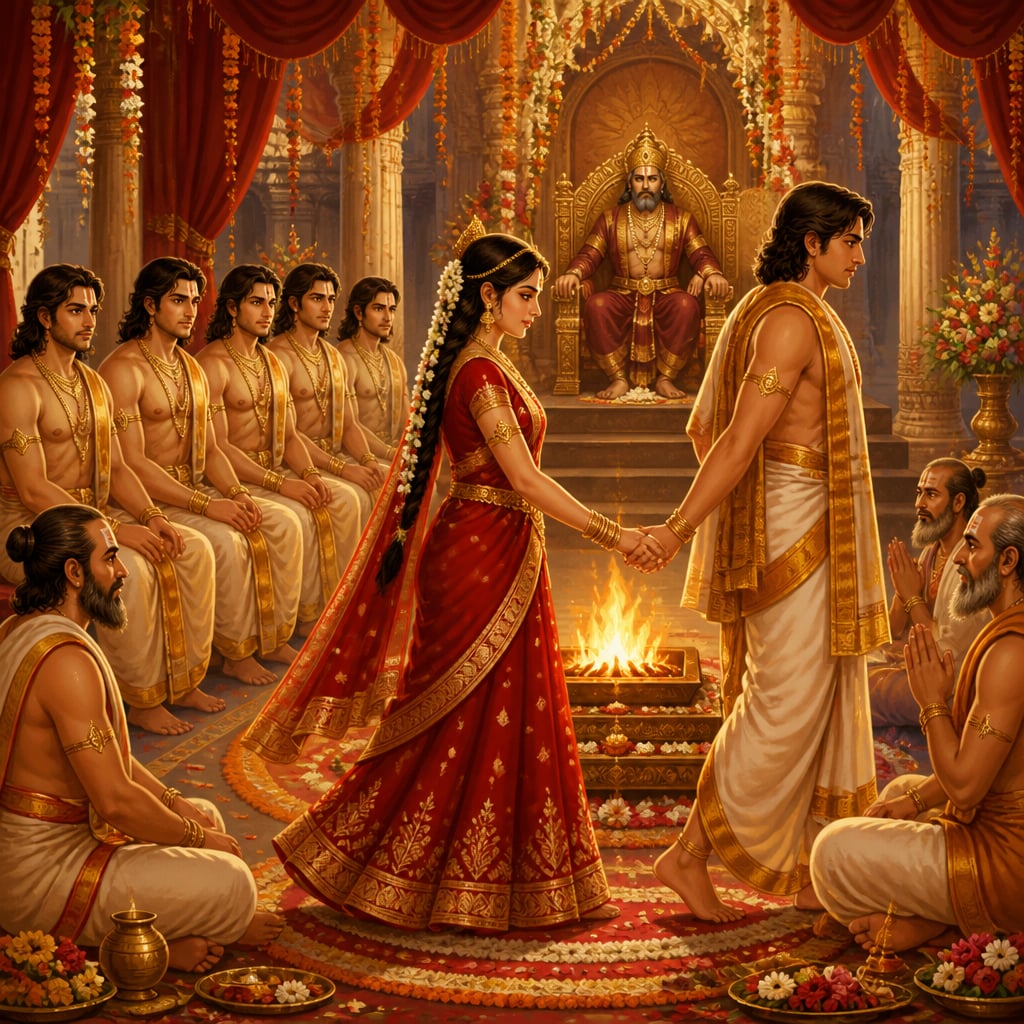
Drupada's Outrage
Word reached King Drupada quickly. His daughter, the jewel of Panchala, was to marry not one man but five? He rushed to the potter's house, his face dark with anger.
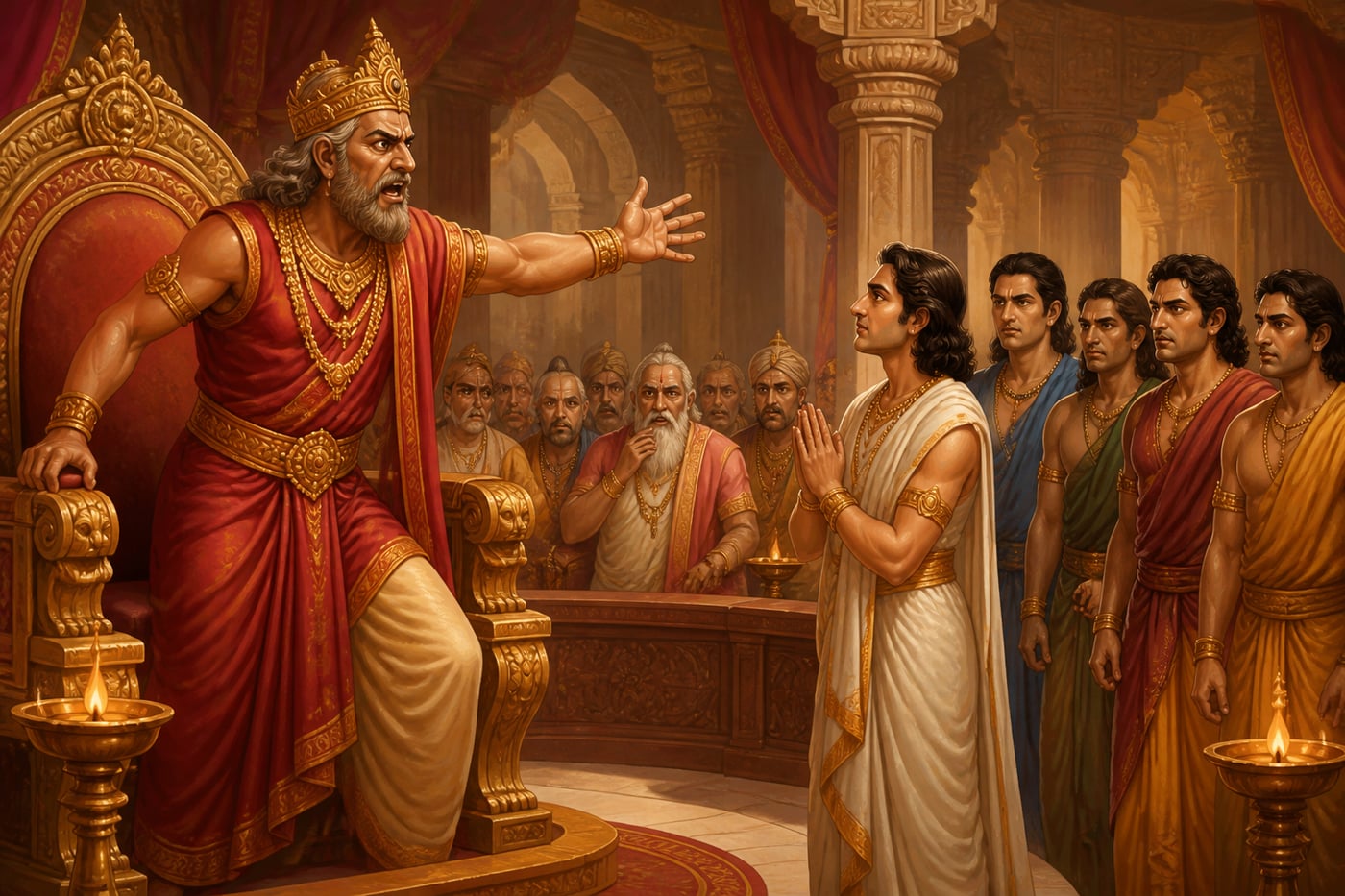
"This is adharma!" he shouted. "My daughter is a princess, born of sacred fire. She was meant for one husband, the greatest archer, the noblest prince. Now you tell me she must be shared like... like property?"
Yudhishthira met the king's fury with calm. "Your Majesty, we did not plan this. Our mother spoke without seeing. But her word cannot be broken. We are seeking dharmic guidance."
"What guidance? This has never been done. No scripture permits it. No tradition sanctions it. I will not allow it!"
But even as Drupada raged, a figure appeared whom no one could dismiss, Vyasa, the sage who had authored the Vedas, who knew past, present, and future, who had fathered Dhritarashtra and Pandu themselves.
Vyasa's Revelation
"Calm yourself, Drupada," Vyasa said. "This marriage is not adharma. It is destined, foretold long before any of you were born."
Vyasa then revealed a secret story. In a previous life, Draupadi had been a woman who performed great austerities, seeking a husband. Pleased with her devotion, Lord Shiva appeared and offered her a boon.

"I want a husband," she said, and in her excitement, she said it five times.
"Then you shall have five husbands," Shiva replied. "In your next birth, five noble men will be your lords."
The woman protested, she had meant only one husband, spoken five times. But Shiva's boon was given. It could not be revoked.
"Draupadi was that woman reborn," Vyasa explained. "And the five Pandavas were, in their previous lives, the five Indras of different cosmic cycles, now born together to share one wife. This is not accident, it is the fulfillment of divine decree."
Vyasa went further, speaking to Drupada alone of mysteries meant only for his ears. When he emerged, the king's face had changed. Whatever Vyasa had told him, some say he revealed the Pandavas' divine parentage, others say he showed the king visions of future glory, Drupada no longer objected.
The Marriage That Changed Everything
The wedding was performed according to proper rites, but with unprecedented arrangements. Draupadi married each brother on a different day, beginning with Yudhishthira the eldest and ending with Sahadeva the youngest. Each marriage was complete and legitimate.
Rules were established for the arrangement to function. Draupadi would live with each husband for one year in rotation. During that year, the other four brothers would not enter her private chambers. Any brother who violated another's time would face exile.
These rules would prove crucial, and would be broken, with major consequences.
Draupadi herself accepted the arrangement with the same composure she had shown throughout. Did she have a choice? The question echoes through interpretations of her story. She could have refused, but then Kunti's word would be broken, and the Pandavas would be dishonored. She could have protested, but the sage Vyasa himself had declared it destined.
Whatever her private feelings, Draupadi became wife to five men and queen to none. She would never have her own household, never rule her own domain. Her identity would always be plural, wife of the Pandavas, not wife of any single man.
The Political Transformation
The marriage did more than unite Draupadi with five husbands. It transformed the Pandavas' political position entirely.
Drupada, king of Panchala, was now their father-in-law. His kingdom, his army, his wealth, all were aligned with the Pandavas. The princes who had been homeless fugitives now had a royal alliance.
News of the marriage reached Hastinapura. Dhritarashtra learned that his nephews had survived the fire, won a famous swayamvara, and married into one of the most powerful kingdoms in Bharatavarsha. The Pandavas could no longer be ignored or eliminated quietly.
"We must do something," Duryodhana urged his father. "They grow stronger while we debate. Soon they will return and demand their share of the kingdom."
Dhritarashtra's advisors were divided. Some, like Vidura, counseled welcoming the Pandavas back and granting them their rightful inheritance. Others, like Shakuni, suggested various schemes to neutralize the threat.
In the end, Dhritarashtra chose a middle path, or rather, half a path. He invited the Pandavas back to Hastinapura and offered them a portion of the kingdom. Not the prosperous, established portion, but a wild region called Khandavaprastha, the forest of Khandava.
"Build your own kingdom there," Dhritarashtra said. "Rule what you can make of it."
It was a gift and an insult combined. The Pandavas were being given wasteland instead of their patrimony. But they were also being acknowledged as legitimate heirs, entitled to territory.
Yudhishthira, ever the diplomat, accepted graciously. "We thank our uncle for his generosity. We will build in Khandavaprastha and prove worthy of the Kuru name."
The Weight of an Unconventional Bond
The polyandrous marriage of Draupadi remains one of the most discussed elements of the Mahabharata. Was it just? Was it dharmic? These questions have no easy answers.
What the epic shows us is a situation where all standard paths were closed. Kunti's word could not be broken. Arjuna's victory could not be dishonored. The brothers' unity could not be threatened by rivalry over a wife. Vyasa's revelation of destiny could not be ignored.
The marriage was a solution, perhaps the only possible solution, to an impossible situation. It kept the Pandavas united when division would have destroyed them. It gave Draupadi five protectors instead of one. It created bonds that nothing could sever.
But it also created tensions that would never fully resolve. When Draupadi was humiliated in the dice game, five husbands watched helplessly. When she demanded justice, five men had failed her. The very arrangement meant to strengthen them would also become their deepest vulnerability.
Dharma, it seemed, could accommodate the unprecedented. But the unprecedented always carried its own weight.
Living traditions
Draupadi's polyandrous marriage has been extensively analyzed in feminist scholarship, with interpretations ranging from exploitation to empowerment, she was shared, but she also commanded five devoted husbands. The phrase 'Draupadi's dilemma' is sometimes used in discussions of women caught between competing loyalties or impossible choices.
- Bahupati Vivāha (Polyandry Traditions): In some Himalayan communities where fraternal polyandry was practiced, the Draupadi story was sometimes cited as scriptural precedent.
- Parivartana Paddhati (Rotation System): The rotation system (parivartana) described for Draupadi influenced later discussions in dharmashastra literature about managing complex household arrangements.
- Draupadi Amman Temple, Gingee: One of the most important Draupadi temples, where annual festivals celebrate her complete story including the unusual marriage. The temple emphasizes her divine origin and sacred status.
- Porur Draupadi Temple: An ancient temple where Draupadi's marriage to the five Pandavas is celebrated with particular devotion, including processions and dramatic reenactments.
- Draupadi Amman Temple, Udappankudi: Draupadi Amman temples particularly emphasize her role as wife of five, pancha pandava pathni, and celebrate this as divine rather than scandalous.
- Dharmaraja Temple, Sowcarpet: The Dharmaraja Temple festivals in Tamil Nadu include elaborate wedding reenactments that conclude with Draupadi's five-fold marriage.
Reflection
- Draupadi was never asked if she wanted five husbands. Does Vyasa's revelation of divine destiny make her consent unnecessary? What does this suggest about free will in the epic?
- The marriage kept the Pandavas united but divided Draupadi among them. Who benefited more from this arrangement? Was it just?
- Vyasa cited a previous life to justify the marriage. Does karma from past lives obligate us in ways we cannot understand or consent to?