Pratigya: The Terrible Vow

Bhishma's oath for his father

When King Shantanu falls in love with a fisherwoman, his son Devavrata makes a sacrifice so extreme that heaven itself trembles. By vowing lifelong celibacy to secure his father's happiness, he earns the name Bhishma, 'the terrible.' This single act of devotion will echo through generations, shaping the destiny of the entire Bharata dynasty and sowing the seeds of the great war to come.

The Goddess and the King

Many generations after Bharata, the throne of Hastinapura passed to Shantanu, a king of extraordinary virtue and handsomeness. One day, while walking along the banks of the Ganga, he encountered a woman of such unearthly beauty that he stood transfixed, unable to speak or move.

She was Ganga herself, the sacred river in human form. Her skin glowed like moonlight on water; her eyes held the depth of all the world's sorrows and joys. Shantanu, forgetting all kingly reserve, fell at her feet and begged her to become his queen.

Ganga smiled, a smile that held secrets older than the mountains.

"I will marry you, O king, but on one condition. You must never question anything I do, no matter how strange or terrible it may seem. The moment you question me, I will leave you forever."
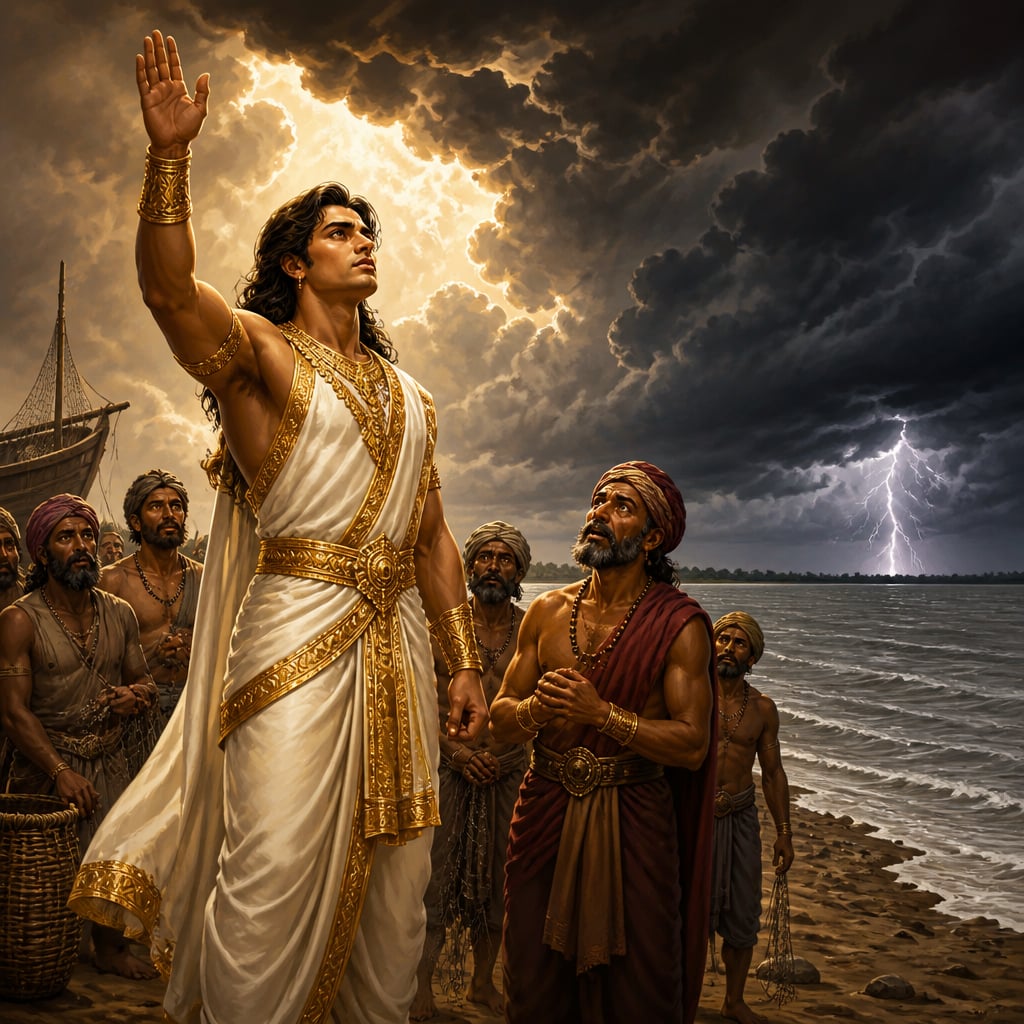
Young Devavrata raises his palm on the bank of the Yamuna to swear his terrible vow of celibacy and renunciation.

Mad with love, Shantanu agreed without hesitation. What could this radiant goddess possibly do that he could not accept?

The Drowned Sons

The first year of their marriage was bliss itself. Ganga was everything Shantanu had dreamed, beautiful, wise, devoted. When she became pregnant, his joy knew no bounds. At last, an heir for the kingdom!

But when the child was born, Ganga did something unspeakable. She carried the infant to the river and drowned him in its waters. Then she returned to the palace, serene as ever, as if nothing had happened.

Shantanu was horror-struck. His son! His heir! But he had given his word. He could not question her.

The next year, the same tragedy repeated. And the next. And the next. Seven sons were born to Ganga, and seven sons she drowned in the sacred river. Seven times Shantanu watched in agony, biting his tongue until it bled, bound by his promise.

When the eighth son was born, Shantanu could bear it no longer. As Ganga walked toward the river with the infant in her arms, he cried out:

"Stop! Who are you? What monster drowns her own children? I will not let you kill this one!"

Ganga turned, and her face was neither angry nor sad, only resigned.

"You have broken your word, O king. Now I must leave you. But first, let me tell you the truth."

The Curse of the Vasus

Long ago, Ganga explained, eight divine beings called the Vasus had committed a grievous sin. Led by Prabhasa, they had stolen the sacred cow of the sage Vasishtha to please a woman. The enraged sage cursed them to be born as mortals.

The Vasus begged for mercy. Vasishtha relented partially, seven of them could be freed almost immediately after birth, returning to heaven. But Prabhasa, who had led the theft, must live a full mortal life, never knowing the joy of marriage or children.

Ganga agreed to be their mother and release them quickly through drowning, a death that, for divine beings, was simply a return home. The seven sons she drowned were not murdered; they were liberated.

"This eighth child is Prabhasa. He cannot be freed so easily. He must live as a mortal, bearing the weight of his curse. I will take him now and raise him. When he is grown, I will return him to you."

Ganga taking her infant son into the river

With those words, Ganga walked into the river and vanished, taking the infant with her. Shantanu was left alone on the bank, his kingdom intact but his heart shattered.

The Return of Devavrata

Years passed. Shantanu ruled wisely but joylessly, a widower king without an heir. Then one day, walking again by the Ganga, he saw a remarkable sight: a young man of godlike beauty was single-handedly damming the river with arrows, each shaft touching the next in an unbroken wall.

Ganga appeared beside him.

"This is your son, O king. I have named him Devavrata, 'one devoted to the gods.' He has been trained by Brihaspati in statecraft, by Vasishtha in scripture, and by Parashurama himself in the arts of war. There is no warrior his equal in all the three worlds. Take him. He is ready to be your heir."

Shantanu embraced the son he had never known, weeping with joy. Devavrata was installed as crown prince, and the kingdom rejoiced. For years, father and son ruled together in perfect harmony.

But fate had one more trial in store.

The Fisherwoman's Price

Shantanu meeting Satyavati at the Yamuna

One day, Shantanu was hunting near the Yamuna when a fragrance reached him, a perfume so intoxicating that he followed it like a man possessed. The source was a young woman ferrying passengers across the river: Satyavati, adopted daughter of the fisherman chief Dashraj.

Satyavati was beautiful, but more than that, she carried an aura of destiny about her. Shantanu fell in love instantly, as deeply as he had once loved Ganga. He went to Dashraj and asked for her hand.

The fisherman was shrewd. A king wanted his daughter? Very well, but there was a price.

"My daughter's sons must inherit the throne. Not the son you already have. Her children must be kings."

Shantanu was devastated. He could not disinherit Devavrata, his beloved son, the pride of the kingdom, the greatest warrior alive. Yet he could not have Satyavati otherwise. He returned to Hastinapura in despair, unable to eat or sleep, wasting away with unfulfilled longing.

The Terrible Vow

Devavrata noticed his father's decline. When he learned the cause, he did not hesitate. Without telling Shantanu, he went directly to Dashraj.

"I renounce the throne," he declared. "Satyavati's sons will rule after my father. I will never be king."

But Dashraj was not satisfied.

"You may renounce, prince, but what of your sons? They might claim the throne after you."

Devavrata understood. There was only one way to remove all doubt, to secure his father's happiness absolutely and forever. He raised his hands to heaven and spoke words that would echo through eternity:

"I vow before all the gods: I shall never marry. I shall never father children. I shall remain celibate for all my days. The throne of Hastinapura will pass only through Satyavati's line. This I swear, and may all creation be witness!"

The moment he spoke, the earth trembled. The sky darkened, then blazed with light. The gods themselves rained flowers from heaven, crying out in amazement:

"Bhishma! Bhishma! This is a terrible vow!"

From that day forward, Devavrata was known as Bhishma, "the terrible," "the awe-inspiring", for only a will of iron could sustain such a sacrifice.

The Father's Blessing

When Shantanu learned what his son had done, his emotions overwhelmed him, gratitude, grief, pride, and sorrow all at once. He embraced Bhishma with tears streaming down his face.

"My son, you have given up everything, throne, wife, children, a normal life, all for my happiness. No father in history has received such a gift. And no father can let such sacrifice go unrewarded."

Shantanu placed his hands on Bhishma's head and granted him a boon of extraordinary power:

"Death shall have no power over you until you choose it. You shall die only when you will it, ichcha mrityu. For one who has sacrificed so much should at least have power over his own end."

Bhishma bowed, accepting the blessing. He did not know then that this gift would become a curse, that he would live to see generation after generation of his family destroy themselves, unable to die, unable to stop the tragedy, bound by his own vow to serve whoever sat on the throne.

The Seeds of War

Satyavati came to Hastinapura as queen, and in time bore Shantanu two sons: Chitrangada and Vichitravirya. The succession seemed secure. But Bhishma's vow had created a fatal dependency. The throne now rested on sons who were weaker than the prince who had renounced it.

Chitrangada died young in battle. Vichitravirya died of illness before fathering heirs. Suddenly, the line that Bhishma had sacrificed everything to establish was extinct. And Bhishma himself, the mightiest warrior, the wisest counselor, could do nothing. He could not marry, could not produce heirs, could not become king.

The dynasty he had tried to protect would now require increasingly desperate measures to continue. And every such measure would plant seeds of conflict that would eventually bloom into the bloodiest war the world had ever seen.

The road to destruction, the sages say, is often paved with the noblest intentions.

Living traditions

Bhishma remains one of the most analyzed characters in Indian literature. His vow has become a byword for extreme sacrifice, 'Bhishma pratigya' is used colloquially to mean an unbreakable commitment. Management books cite him as an example of institutional loyalty taken to destructive extremes. His character raises questions that remain relevant: When does loyalty become enabling? When does sacrifice become self-destruction?

Reflection

More in Adi Parva

All lessons in Adi Parva · The Mahabharata course