Talapatram

Sita's Counsel on Dharma

When Compassion Questions the Warrior's Path

As Rama and his companions wander through the Dandaka forest visiting hermitages, Sita delivers a profound philosophical discourse on violence and ahimsa. Concerned that Rama may be seeking out demons rather than merely defending, she explores the tension between kshatriya dharma and the spiritual danger of violence becoming habit. Rama's thoughtful response reveals the complexity of righteous action.

The Wandering Years

Time moves differently in the forest. Rama, Sita, and Lakshmana have been wandering for years now, moving from ashram to ashram throughout the Dandaka. At each hermitage, they receive the sages' gratitude and Rama's promise of protection.
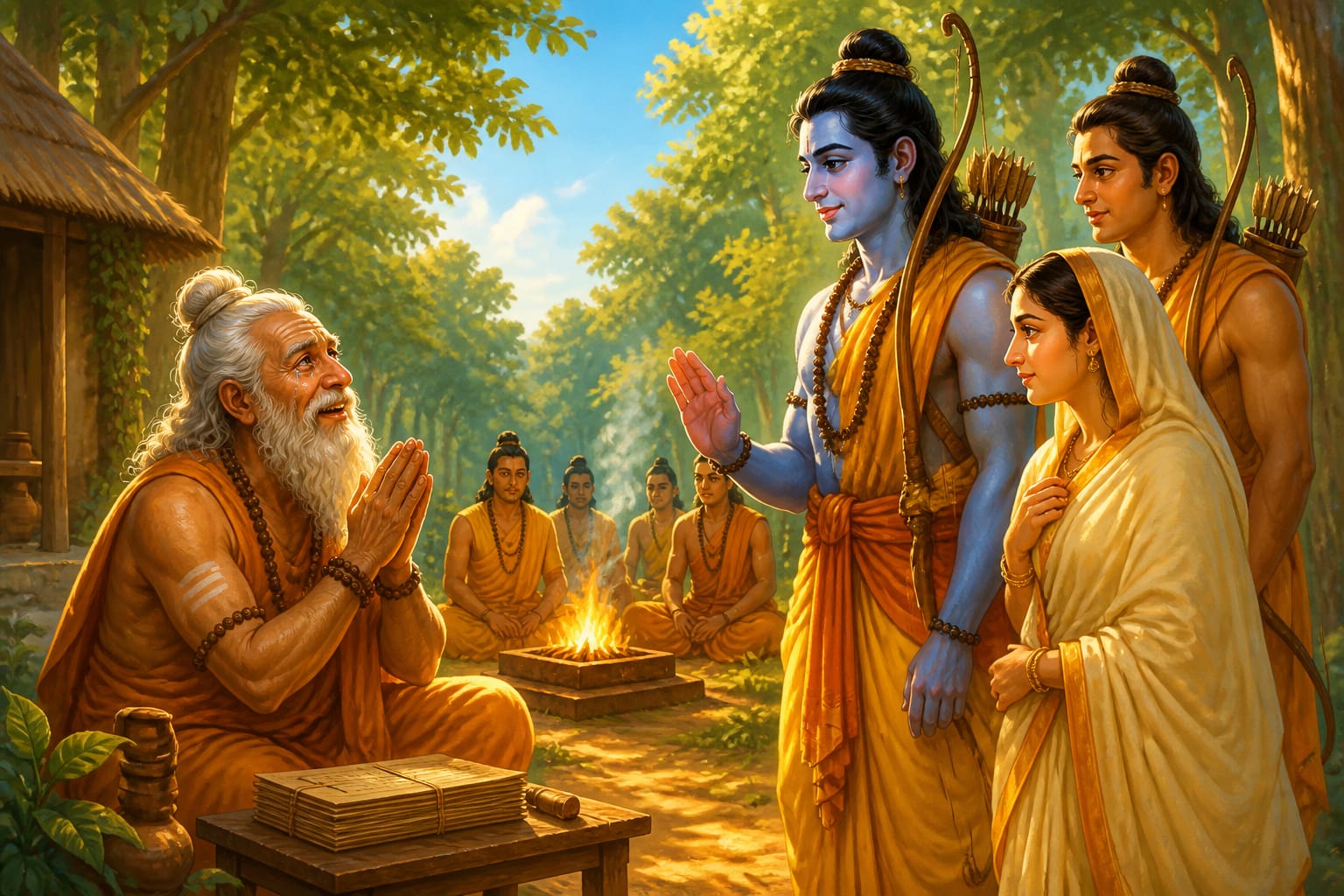
Suteekshna welcoming Rama, Sita, and Lakshmana

They visit Sage Suteekshna's hermitage, where the ancient rishi welcomes them with tears of joy.

"O son of Dasharatha, your presence here is not accident but providence. The dharma of this forest has been bleeding for years. You are the tourniquet that will stanch the flow."

At each ashram, the pattern repeats: gratitude, stories of suffering, promises of protection. Word spreads through the forest. The demons learn that a warrior prince has sworn to defend the defenseless.

But during these wandering years, something begins to trouble Sita.

A Wife's Observation

Sita has been watching her husband - not with the eyes of a devotee who sees only perfection, but with the discerning gaze of a wife who knows the man she married.

She sees Rama's hand resting more frequently on his bow. His eyes scan the forest with the tactical awareness of a warrior assessing terrain. Conversations with sages have shifted from philosophy to strategic briefings about rakshasa movements.

Most troubling: she senses a subtle shift from reactive protection to active pursuit.

One evening, as they rest beside a forest stream, Sita speaks.

"My lord, may I share a concern growing in my heart?"

Rama gives her immediate attention. In all their years of exile, Sita has never complained or questioned his decisions.

"Always. Your counsel has guided me more truly than any minister's advice ever did in Ayodhya."

The Discourse on Violence

"When we first entered this forest," Sita begins, "the sages sought your protection. You promised to defend them. This was righteous and necessary."

"But recently, I have observed a change. We no longer simply respond to attacks. We seek information about rakshasa strongholds - their numbers, locations, leaders. Are we still defending... or have we begun hunting?"

Rama is silent. Sita continues:

"I do not question your courage. What concerns me is more subtle - the effect that seeking violence, even righteous violence, may have upon the soul."

She looks at his bow. "A kshatriya bears weapons to protect. But there is a difference between a sword drawn in defense and a sword drawn in pursuit. The first responds to adharma. The second actively seeks it out. And I fear the second can become habit, then nature, then identity."

"Consider the rishis we have met. They possess spiritual powers that could reduce rakshasas to ash. Yet they choose not to wield such force. Because they understand that violence, once employed, shapes the wielder."

She pauses. "You are a kshatriya, yes. But you are also Rama - known in Ayodhya not just for prowess in battle but for wisdom and compassion. I fear that years of hunting demons might diminish these aspects of your nature."

Sita beside Rama on a rock at the edge of a forest stream, counseling him at evening.

Rama's Response

Rama listens in thoughtful silence, then speaks.

"Your words arise from wisdom and love. Everything you say about ahimsa is true. Violence does mark the soul. The ideal would be a world where this bow never needs to be drawn."

"But we live in this world - the Dandaka forest where gentle sages are being slaughtered for devotion to dharma."

He explains his dilemma: "If I simply wait in one ashram for rakshasas to attack, I can defend that location. But what of the hundred other hermitages? While I protect one, ninety-nine remain vulnerable."

"The rakshasas operate from Janasthana, commanded by Khara with fourteen thousand demons. From there they launch raids throughout the forest. I can spend fourteen years in reactive defense, always too late to prevent suffering. Or I can address the source."

Sita presses: "But if you go to Janasthana and confront Khara, you initiate the conflict. How is this different from unprovoked war?"

"Because Khara has already declared war - not on me, but on dharma itself. His demons have committed atrocities for years. A tiger that has killed before and will kill again does not become innocent simply because it is napping."

The Weight of the Vow

Rama's voice grows intense:

"I gave my word to the sages. Not a partial promise. I gave them complete assurance: 'You will be safe.' That vow binds me to do whatever is necessary."

"You are right that violence shapes the wielder. But I am a kshatriya. My dharma is not to preserve my own spiritual purity at the cost of others' lives. If fulfilling my duty requires that I bear karmic weight, I will bear it. Better that I carry the burden of necessary violence than innocent sages carry the burden of death."

He takes her hand. "The day will come when I can live in complete ahimsa. But that day is not today. There are demons preying upon devotees. I have the power to stop it."

Sita's Acceptance

Sita looks at her husband with complex emotions. She recognizes several truths:

Rama's intentions are pure - he seeks to protect, not to gain glory. Dharma is rarely simple. And sometimes the most dharmic choice is not the one that keeps us spiritually pure but the one that serves those who depend on us.

"I do not claim to have answers," she says quietly. "I raised these questions not to obstruct you but to ensure we remain conscious of the complexities."

"What gives me peace is this: you are not a man who delights in violence. Your path as a warrior is chosen from duty, not anger. You will do what must be done without losing yourself in it."

"Still, I will continue to be the voice that questions, the perspective that reminds you of other considerations. This too is my dharma - to be your conscience as well as your companion."

Rama smiles with gratitude. "And this is why I am blessed to have you. In Ayodhya, I had ministers for statecraft. Here, I have you to counsel me on dharma."

The confrontation with Khara looms closer with each passing day. But for tonight, there is peace.

The Deeper Meaning

This episode reveals dharmic complexity rarely explored in simplified retellings. Sita emerges as a philosophical equal to Rama - capable of challenging even the righteous choices of a great soul.

Her concerns about violence becoming habit reflect sophisticated understanding of how actions shape character. Rama's response shows equal sophistication - he acknowledges the complexity while explaining that dharma sometimes requires accepting karmic burden to protect others.

This tension between ahimsa and necessary violence remains one of dharmic philosophy's greatest challenges. The Bhagavad Gita would later explore the same dilemma. The answer is never simple.

Both Sita and Rama are right. Violence carries spiritual cost. But protection of the vulnerable is a sacred duty that cannot be abandoned. The wisdom lies in holding both truths - acting decisively while remaining conscious of the weight such action carries.

Living traditions

Agastya's dialogue with Sita about the ethics of violence versus non-violence anticipates the Bhagavad Gita's teaching and continues to inform discussions about dharmic warfare, just war theory, and the ethics of protective violence. His role in bringing Sanskrit and Vedic culture south established the foundation for Tamil Sangam literature's synthesis of northern and southern traditions. The debate between Sita's concern for non-violence and Rama's duty to protect remains relevant to modern discussions of pacifism versus necessary force.

  • Agastya Ashram: Peak named after Sage Agastya who directed Rama to Panchavati. Traditional site of Agastya's hermitage, now a pilgrimage destination with a temple at the summit.
  • Agastya Muni Temple: Temple dedicated to Sage Agastya, commemorating his role in spreading Vedic culture to South India and guiding Rama during his exile
  • Agastyeshwara Temples: Temples established by Agastya featuring Shiva lingams, representing his role in bringing Vedic worship south of the Vindhyas

Reflection

  • Think of a time when you made a promise that later became much more costly to fulfill than you anticipated. How did you navigate the tension between the burden of the commitment and your desire to be released from it?
  • Sita suggests that seeking out violence, even righteous violence, can shape one's character and make combat become habit, then nature, then identity. Do you think this is true? Can someone engage in necessary fighting without it changing their fundamental nature?
  • Rama distinguishes between reactive defense (responding when attacked) and proactive protection (seeking out threats before they materialize). Is this a meaningful moral distinction, or is the outcome (protecting innocents) what matters regardless of the approach?

More in Aranya Kanda

All lessons in Aranya Kanda ยท The Ramayana course