The Sage Atri & Divine Anasuya
Wisdom for a Princess in the Wilderness
At the hermitage of the ancient sage Atri, Sita meets Anasuya - a woman whose devotion and virtue have earned her divine powers. The aged sage-wife shares profound wisdom about a woman's dharma and bestows celestial gifts upon Sita that will never fade. In this sacred meeting of two ideal women, eternal truths are passed from one generation to the next.
A Hermitage of Extraordinary Age
Continuing through the Dandaka forest, Rama, Sita, and Lakshmana come upon a hermitage unlike any they have seen. The trees seem impossibly ancient. The air feels charged with the power of ages of unbroken tapas.
This is the ashram of Atri Maharshi, one of the seven legendary Saptarishis whose wisdom forms the foundation of Vedic knowledge. But it is not Atri alone who makes this hermitage extraordinary - it is also home to his wife, Anasuya, whose fame for virtue has spread across all the worlds.
The Welcome of the Wise
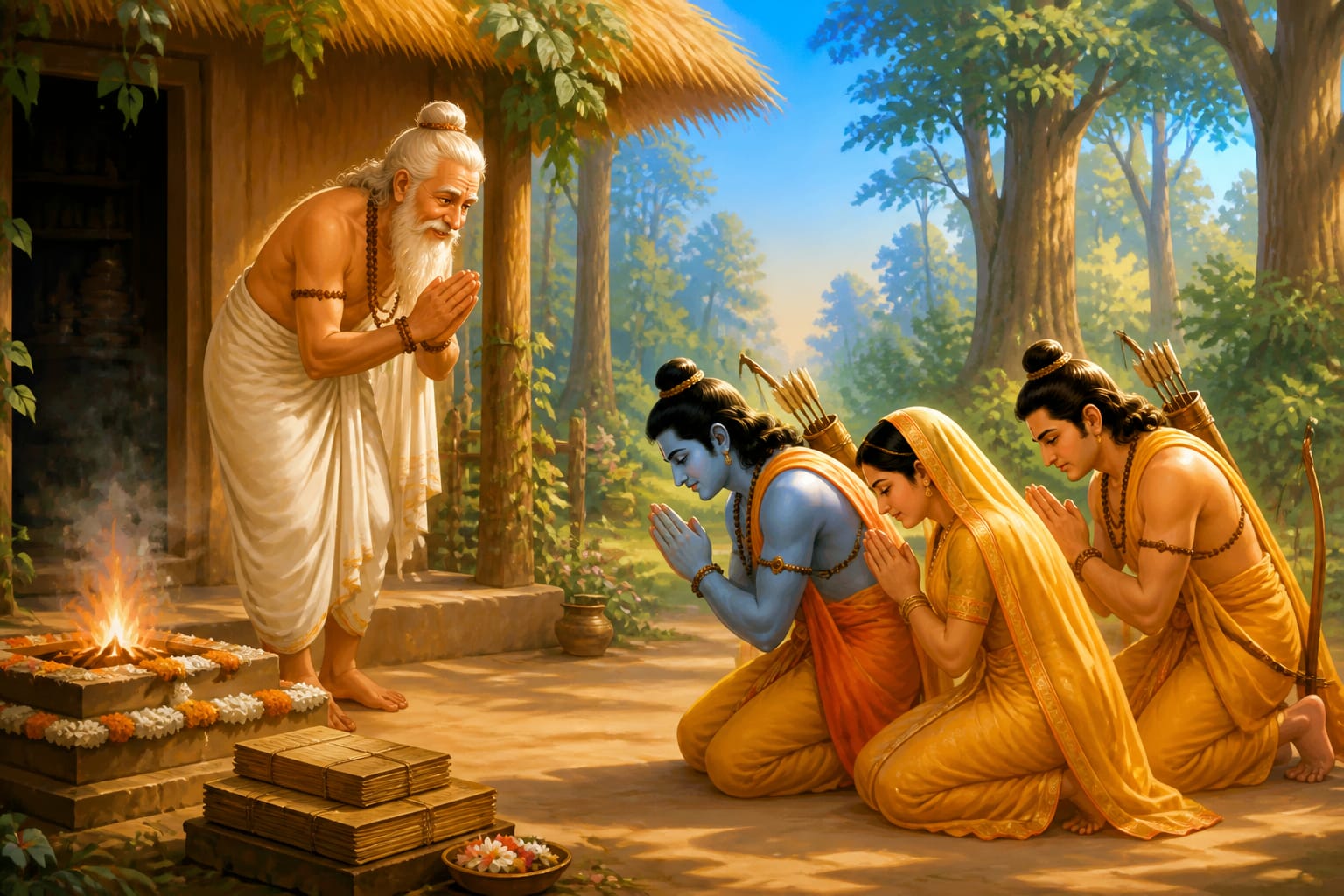
As Rama approaches, the aged Atri rises to greet him. Despite his great age, his eyes sparkle with undimmed wisdom.
"O Rama, your coming brings blessing to our hermitage. We have heard of your nobility, your adherence to dharma, your acceptance of exile to honor your father's word."
Atri continues: "The path you walk is difficult, but it is the path of the righteous. Know that your exile serves a purpose greater than you yet understand. What seems like punishment will prove to be preparation."
Turning to Sita, the sage says: "You who chose to follow your husband into exile - your virtue shines as brightly as his. My wife Anasuya has long wished to meet you."
Anasuya: The Woman Without Envy
Sita follows the sage's gesture toward a modest dwelling. There sits a woman of remarkable presence - her body showing immense age, yet her face radiating peace that transcends earthly beauty.
This is Anasuya, whose name proclaims her nature: "ana-asuya" - one without envy, without jealousy, without ill-will toward any being.
Sita prostrates before her. Anasuya raises her with surprising strength and embraces her.
"Child, I have waited long to meet you. Sit beside me. We have much to discuss."
The Legend of Anasuya's Power
Anasuya shares her extraordinary story.
"Long ago, a terrible drought struck the world. For ten years, no rain fell. Through severe austerities, I was able to bring the Ganga to flow through our region, to make trees bear fruit out of season, to restore fertility to the barren earth."
"But there is more. Once, the wives of the Trimurti - Saraswati, Lakshmi, and Parvati - wished to test me. They sent their husbands, disguised as ascetics, with a strange condition: they would accept food only if I served them without wearing clothes."
Sita gasps at this impossible insult.
"Through the power of my tapas, I transformed the three great gods into infants. To infants, a mother may appear in any state without impropriety. When their wives came searching, they had to beg me to restore their husbands."
"Through my devotion to Atri, I gained power that the gods themselves could not overcome. This is the strength of pativrata dharma - a wife's devoted love. It is not weakness, child. It is the greatest power a woman can possess."
Wisdom for a Young Wife
Anasuya looks into Sita's eyes, seeing both the princess she was and the trials that await.
"A devoted wife does not merely obey her husband. She becomes his partner in dharma. When he strays, she guides him back. When he falters, she strengthens him. She is not his servant but his other half."
"The forest will test you in ways you cannot imagine. But remember: just as I transformed the gods through virtue, so too can you transform any situation through steadfastness and love."
The Divine Gifts
Anasuya brings out items wrapped in silk.
"I have prepared gifts for you, daughter."
The first: a garland of flowers that will never wilt. "Let them remind you that true beauty - beauty of the soul - does not decay."
The second: a celestial garment that will never tear or stain. "Even in harsh conditions, you will be clothed in dignity."
The third: divine ornaments containing the blessings of her tapas. "They will bring you protection."
Sita receives these gifts with tears - not for their material value, but understanding the love with which they were prepared.
"Most importantly," Anasuya adds, placing her hand on Sita's head, "I bless you that your devotion to Rama will never waver, no matter what trials come. And trials will come, child."

Sita's Response
Moved by Anasuya's wisdom, Sita shares her own story - found as an infant in a furrow by King Janaka, raised as princess of Mithila, won by Rama when he alone could lift Shiva's bow.
"From that moment, there was no question of separation. When Rama was exiled, I did not consider remaining behind. As the shadow follows the body, so does a wife follow her husband. This is not burden but blessing."
Anasuya listens with satisfaction. "You speak as one far older in wisdom than your years suggest. Born of the Earth herself, you carry within you the patience of Mother Bhumi."
The Farewell
As evening approaches, Rama calls for Sita. Anasuya walks her back, arm linked as grandmother and granddaughter.
Atri offers final blessings, pointing out the path ahead. "Word of your coming spreads, Rama. Those who mean well rejoice. Those who mean ill... prepare."
As they set forth, Sita looks back. Anasuya stands at the entrance, hand raised in blessing, white hair glowing in the last light. She seems both immeasurably old and somehow timeless.
Sita touches the celestial flowers at her neck and knows she carries more than gifts. She carries wisdom that will sustain her through whatever comes.
The Deeper Meaning
The meeting represents the transmission of feminine wisdom across generations. Anasuya's teaching reveals that a devoted wife possesses power that even the gods respect.
Anasuya's transformation of the Trimurti demonstrates that pativrata dharma generates spiritual power equivalent to the greatest tapas. This power comes not from subservience but from complete integration of one's will with one's partner.
The gifts are symbolic: unfading flowers represent inner beauty that does not decay; unstaining garments represent dignity that cannot be tarnished; divine ornaments represent the protective power of virtue.
Anasuya's final blessing foreshadows the terrible tests Sita will face. The sage-wife prepares her, as an elder woman prepares a younger for the realities of life.
Living traditions
Anasuya's story continues to inspire discussions about women's spiritual power and the nature of true partnership. Her ability to transform the Trimurti demonstrates that devotion generates power equal to the greatest austerities. Marriage counselors and relationship therapists sometimes reference the Atri-Anasuya model as an example of mutual dedication strengthening both partners.
- Pativrata Dharma Observance: Married women visit Anasuya shrines seeking blessings for marital harmony, following the ideal of devoted partnership exemplified by Anasuya and Atri
- Atri-Anasuya Ashram: The hermitage where Sage Atri and Anasuya lived, where Sita received divine gifts. The ashram features ancient temples, the Mandakini River, and a waterfall believed to have been created by Anasuya's tapas.
- Sati Anasuya Temple: A temple dedicated to Anasuya located within the ashram complex, where the story of her transformation of the Trimurti is depicted in murals and sculptures.
Reflection
- Who has been an 'Anasuya' in your life - an elder who took time to share wisdom and prepare you for challenges ahead? What did they teach you, and how has it served you?
- Anasuya was powerful enough to transform the three supreme gods, yet she chose to remain in a simple forest ashram serving her husband. What does this tell us about the relationship between power and humility?
- The Ramayana presents wifely devotion as a source of spiritual power. How do we understand this teaching in an age that emphasizes individual autonomy and equality in relationships?