Sharabhanga's Ascent
When a Sage Defies Heaven for Dharma
Rama arrives at the hermitage of the ancient sage Sharabhanga, just as Indra himself is visiting. The sage has earned Brahmaloka through millennia of tapas, but refuses to ascend until he meets Rama. In a profound demonstration of devotion and free will, Sharabhanga voluntarily enters the sacred fire and ascends to the highest realm. Witnessing this, assembled rishis formally request Rama's protection from the rakshasas terrorizing the forest.
The Journey to Sharabhanga
Having received blessings from several forest hermitages, Rama, Sita, and Lakshmana continue through the Dandaka wilderness. Each ashram tells a similar story - sages living in fear, their tapas disrupted by rakshasa attacks.
But today's destination is different. The sages have spoken in reverent tones about Sharabhanga - a rishi practicing tapas for thousands of years, since an age when gods walked among mortals.
As they approach his hermitage, the forest changes. The atmosphere carries the vibration of long-sustained spiritual practice. But something extraordinary becomes visible - the sky blazes with light. A magnificent vimana hovers in the air, drawn by horses woven from starlight.
"The gods themselves are here," Sita whispers.
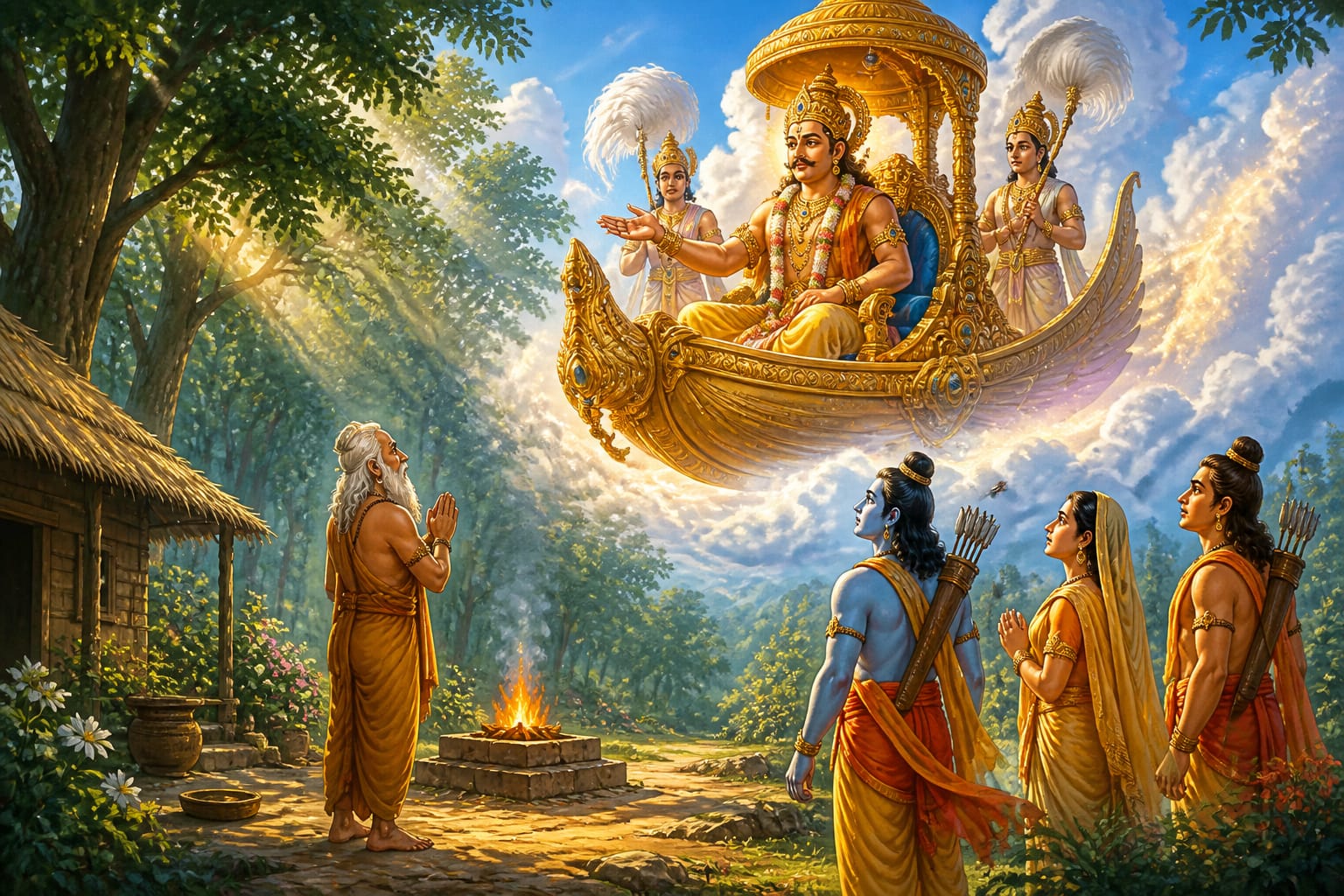
Indeed, Indra, king of the devas, has descended to this forest clearing.
The Offer of Heaven
Through the trees, they hear Indra's voice:
"O Sharabhanga, your tapas has earned you Brahmaloka - the highest heaven. My vimana waits to carry you there. Come, claim your rightful place in eternity."
Brahmaloka represents the culmination of all spiritual striving. The king of gods has come as escort. Yet Sharabhanga's response is calm:
"I must decline. Not yet. There is someone I must meet first."
Indra's surprise is palpable. "What meeting could matter more than ascending to Brahmaloka?"
"Rama is coming," Sharabhanga replies with certainty. "These eyes, refined by millennia of meditation, can see beyond appearances. Rama is dharma incarnate. To meet him is to meet that principle which holds all worlds together. Brahmaloka can wait."
Indra bows - an extraordinary gesture from the king of gods to a mortal sage - and his vimana vanishes into the celestial realm.
The Meeting
As they enter the clearing, they see Sharabhanga for the first time. The sage is ancient beyond reckoning - white hair reaching past his waist, eyes carrying the depth of oceans. When those eyes fall upon Rama, they fill with tears.
"You came. After all these years of waiting, you came."
Rama bows deeply. "O sage, you should not have delayed heaven for my sake. I am merely a prince in exile."
Sharabhanga shakes his head. "You think so because you have taken this mortal form so completely that even you do not fully remember what you are. But I see, Rama. You are the answer to the prayers of the universe itself."
He shares cosmic knowledge: Ravana cannot be killed by gods - he considered humans beneath his concern. This was his error. Only Rama can stop him.
"You will suffer in this journey. But through that suffering, you will accomplish what all the gods combined cannot. This exile is the beginning of the universe's liberation."
The Sacred Departure
Sharabhanga makes an unexpected request:
"I wish to leave this body and ascend to Brahmaloka. But I will go through my own power, through the sacred fire. I ask that you witness this."
Rama is troubled. "Great sage, why this haste? Stay with us. Share your wisdom. Guide our path through this forest."
Sharabhanga smiles with infinite tenderness. "My purpose in this form is complete. I waited only for you. Now that you have come, what else remains? The body is like a garment - when it has served its use, the wise set it aside without regret."
Dozens of rishis gather, drawn by intuitive knowledge. The ancient sage stands before the blazing fire, chanting mantras from the dawn of creation. Then, with eyes fixed on Rama, he walks into the flames.
The fire blazes with colors beyond naming - blue, violet, gold. Sharabhanga's body transforms rather than burns. His atman rises as pure light, ascending higher and higher.
The clouds part. Brahmaloka becomes visible, shining with divine radiance. Celestial beings gather to welcome this great soul. Sharabhanga's luminous form passes through those gates into eternal bliss.

Where the sage stood, only fresh flowers remain - placed by invisible hands as blessing.
The Sages' Petition
The gathered rishis turn to Rama. Sage Suteekshna speaks:
"We cannot complete our spiritual practice. The rakshasas hunt us. Their leader Khara commands fourteen thousand demons from Janasthana. Against such numbers, what can unarmed ascetics do?"
"We ask for protection. Let us complete our tapas in peace. Let us, like Sharabhanga, earn our liberation rather than dying beneath demons' claws."
Rama's response is immediate:
"I give you my solemn word: as long as I dwell in this forest, no rakshasa shall harm you. Whether they number fourteen or fourteen thousand, they shall learn that those who prey upon the righteous will face reckoning. Your protection is now my sacred duty."
The Weight of the Vow
Lakshmana walks beside his brother in thoughtful silence.
"Brother, you have committed us to war with Ravana's forces. Why?"
Rama looks at him. "Because that sage walked into fire rather than board Indra's chariot - all for a chance to meet me. Because these peaceful souls are being hunted for their devotion. Because if I, with all my training, do not stand between evil and innocence, what is the point of being a warrior?"
Sita places her hand on Rama's arm. "Sharabhanga chose to postpone heaven for you. You choose to face an army for these sages. Both choices spring from the same source - dharma calling to dharma."
Somewhere among the stars, Sharabhanga rests in Brahmaloka. And in the forest below, Rama stands watch, having added one more vow to those that define his life.
The Deeper Meaning
Sharabhanga's story illuminates profound truths. True devotion transcends even the highest rewards. The sage considered one moment with Rama more valuable than eternity in heaven. Bhakti seeks not rewards but connection with the beloved.
His voluntary departure through yoga-agni-pravesha demonstrates yogic mastery - conscious transition motivated by completion, not despair. When one's work in a form is finished, why cling to it?
The contrast between Indra's offer and Sharabhanga's choice reveals that the gods themselves recognize divinity walking in mortal form. Indra gives way without argument when he understands Rama is present.
Rama's acceptance of the sages' request marks a point of no return. He has become the active guardian of dharma. This sets in motion events leading to confrontation with Ravana - not through Rama seeking conflict, but through evil forcing the hand of righteousness.
Living traditions
Sharabhanga's choice to refuse Brahmaloka for the chance to meet Rama embodies the bhakti principle that devotion transcends even liberation - a teaching central to modern ISKCON, Ramakrishna Mission, and other bhakti movements. His conscious departure from the body inspires discussions about death with dignity and the yogic ideal of mahasamadhi. Modern psychology's concept of intrinsic vs. extrinsic motivation parallels Sharabhanga's preference for connection over reward.
- Dhuni (Sacred Fire) Maintenance: Continuous sacred fires maintained at ashrams in memory of sages who performed yoga-agni-pravesha, symbolizing the eternal flame of spiritual practice
- Sharabhanga Ashram: Traditional site of Sage Sharabhanga's hermitage where he ascended to Brahmaloka after meeting Rama. Features a temple complex with continuous sacred fire (dhuni).
- Sutikshna Ashram Area: Region associated with the gathering of sages who sought Rama's protection, near the modern Chitrakoot pilgrimage circuit
Reflection
- Think of a time when accepting a responsibility fundamentally changed your path in life. Like Rama accepting the sages' petition, did you know at the time what you were committing to? How did that acceptance shape who you became?
- Sharabhanga sent away Indra and Brahmaloka itself just for a chance to meet Rama. What does this tell us about the relationship between spiritual achievement and devotion? Can one supersede the other?
- Indra, the king of gods, immediately understood and departed when he learned Rama was coming. What does this suggest about the relationship between gods and divine incarnation? If the gods themselves recognize higher divinity in human form, what does that mean for how we should view the sacred in ordinary life?