Ravana's Rage
When Pride Meets Obsession
News of Khara's annihilation reaches Lanka, and the ten-headed demon king learns of the mortal who dared challenge rakshasa supremacy. But Ravana does not merely hear of Rama's prowess - he also learns of Sita's incomparable beauty. In this deadly combination of wounded pride and awakened desire, a terrible plan takes shape that will change everything.
The Messenger's Terror
In the aftermath of the Battle of Fourteen Thousand, not every rakshasa perished. A handful of demons - those who fled at the first signs of impossible defeat - escaped into the depths of the forest. Among them was Akampana, a scout who had witnessed the impossible from a distance and understood, with terrible clarity, what had happened.
Akampana flies across the ocean, his demonic form cutting through clouds and storms, driven by a terror that exceeds even his fear of Ravana's wrath. For he brings news that will shake the foundations of the rakshasa empire.
The golden city of Lanka rises from the sea like a dream made solid - towers of gold, walls studded with gems, gardens floating on clouds. It is the greatest city in the three worlds, built by the divine architect Vishwakarma himself, and now ruled by the most powerful demon in existence.
Akampana lands before the palace gates, his legs trembling. The guards see his expression and let him pass without question. Whatever news he carries, it cannot wait.
The Court of Ten Heads
Ravana sits upon his throne of black stone, and even seated, he dominates the vast assembly hall. His ten heads wear ten different crowns, each face bearing its own expression - some contemplative, some fierce, some calculating. His twenty arms rest upon the throne's arms, each hand bearing a different weapon or symbol of power.
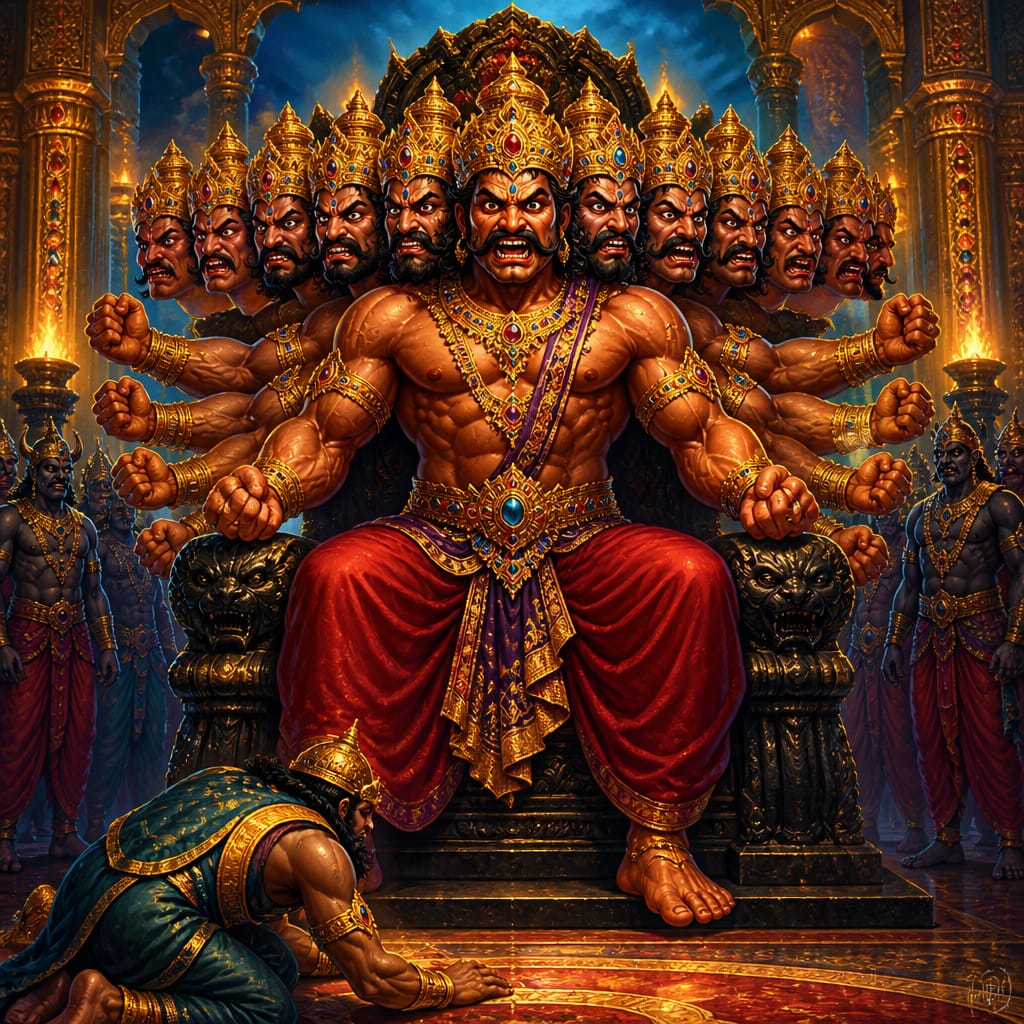
Around him sit his generals, ministers, and kinsmen - the elite of the rakshasa race. Among them is Vibhishana, Ravana's younger brother, whose face alone carries something like wisdom and restraint.
The court falls silent as Akampana enters. The messenger prostrates himself so completely that he seems to be trying to merge with the floor.
"Speak," Ravana commands. His voice is not loud, but it fills every corner of the hall. "You come from Janasthana. What news of my brother Khara?"
Akampana's voice emerges as barely a whisper:
"Lord of Lanka, master of the three worlds... Janasthana has fallen. Khara is dead. Dushana is dead. Trishira is dead. The garrison of fourteen thousand... all slain."
The silence that follows is absolute. Ministers who have survived centuries of Ravana's rule have never seen anything affect him. But now, across his ten faces, different emotions flicker: disbelief, rage, calculation, and something that might be the first stirring of fear.
"An army?" Ravana's voice is dangerously quiet. "Did Indra finally find courage? Did the devas descend?"
"No, my lord." Akampana's voice cracks. "It was one man. A human. A prince of Ayodhya named Rama. He fought alone and... he killed them all in a single afternoon."
The Impossible Truth
Ravana rises from his throne. All twenty arms flex with barely contained fury. The air itself seems to grow heavier, pressing down on everyone in the hall.
"One human?" Each of his ten mouths speaks in turn, creating a chorus of disbelief. "Fourteen thousand of my finest warriors, slain by one mortal? You dare bring me this lie?"
Akampana keeps his face pressed to the floor.
"I saw it, lord. I watched from the hills. His arrows... they multiplied in the air. He invoked celestial weapons - fire that burned without fuel, wind that cut like blades. He moved faster than sight. Nothing could touch him. Khara fought him directly at the end, and even Khara's maya could not deceive him."
Ravana's rage fills the hall like a physical force. Ministers flinch. Warriors grip their weapons instinctively. Only Vibhishana remains still, his expression troubled but thoughtful.
"And Shurpanakha?" Ravana suddenly asks. "My sister was stationed near Janasthana. What of her?"
Akampana hesitates - a hesitation that speaks volumes.
"The princess lives, lord. But... she was the cause of the conflict. She approached this Rama and his brother. When she... when she threatened Rama's wife, the brother Lakshmana..." He cannot continue.
"Speak!"
"He cut off her nose and ears, lord. She came to Khara for vengeance. That is why he attacked."
The Wound to Pride
Ravana's fury now has a focus. His sister - a princess of the rakshasa bloodline - mutilated by humans. His brother - a general of his army - slain by a single mortal. His garrison - fourteen thousand trained warriors - annihilated in hours.
The insult is unbearable. Ravana has conquered the three worlds. He has defeated Indra, humbled the gods, extracted tribute from the celestial realms. And now two human princes in a forest have done what no army has ever done - they have harmed his family and destroyed his forces.
"This Rama," Ravana speaks slowly, controlling his rage with visible effort. "Tell me everything about him. His weapons. His companions. His weaknesses. Leave nothing out."
Akampana describes what he saw - Rama's divine bow, his inexhaustible arrows, his supernatural speed and accuracy. He speaks of Lakshmana, equally skilled though he did not fight in the great battle. And then, because Akampana knows Ravana's tastes, he mentions something else:
"Lord, there is a woman with them. Rama's wife. Her name is Sita. I have seen many beautiful demonesses in your court, but this mortal... her beauty is beyond description. They say she is an incarnation of Lakshmi herself. Rama fights only because of her - she is everything to him."
Something shifts in Ravana's expression. The rage does not diminish, but it is joined by something else - interest, desire, calculation.
"Lakshmi incarnate?" he murmurs. "A woman beautiful enough to inspire a man to impossible feats?"
Akampana's Counsel
Akampana, sensing a possible path away from Ravana's wrath, continues:
"Lord, this Rama cannot be defeated in battle - I saw this with my own eyes. His arrows are guided by forces beyond mortal skill. But... he has a weakness. He loves his wife with an intensity that borders on madness. If she were taken from him, he would be destroyed not in body but in spirit. A man consumed by grief cannot fight. His power comes from his dharma, and if he lost her, his dharma itself would be wounded."

Vibhishana rises from his seat, his face troubled.
"Brother, I counsel caution. This Rama is no ordinary mortal. The signs of divinity are upon him - celestial weapons, impossible victories, a purpose that seems written by fate itself. To move against him directly would be dangerous. To move against him through his wife would be..."
"Would be what?" Ravana's voice cuts like a blade.
"Would be adharma, brother. Abducting another man's wife is a sin that carries consequences across lifetimes. Whatever Rama has done, his wife is innocent. To harm her or take her would invite cosmic retribution."
Ravana laughs - a sound that makes the walls tremble.
"Cosmic retribution? I have conquered the cosmos! I have bound the planets to my will! Indra pays me tribute, and the gods tremble at my name. What 'retribution' could touch me?"
He turns to address the full court:
"This Rama has killed my brother, mutilated my sister, and destroyed my army. He has challenged the supremacy of Lanka. And you speak to me of caution?"
The Dark Design
Ravana dismisses the court but retains a small circle of trusted advisors. The plan that takes shape is cunning in its cruelty.
Direct attack will not work - even Ravana recognizes that Rama's martial prowess is genuine, even if he refuses to admit it publicly. But deception... deception has possibilities.
"This Rama is righteous," Ravana muses. "Righteousness has patterns. It responds to certain stimuli in predictable ways. If we can separate him from his wife, even briefly, she becomes vulnerable."
One advisor suggests: "Lord, what if the woman herself could be made to send Rama away? If she believed him needed elsewhere?"
Another adds: "A distraction. Something that would compel a righteous warrior to investigate. Something that would seem harmless but would draw him far enough away..."
Ravana's ten minds work in concert, processing possibilities. And then he remembers someone - a demon with a particular set of skills, a demon who owes him a life-debt, a demon who once tried to defy him and learned the cost of failure.
"Summon Maricha," Ravana commands. "I have a task for him."
The Demon in Exile
Maricha lives in self-imposed exile on a remote island, far from Lanka, far from the world of rakshasas. Once, he was among the most powerful of demons - it was he who disrupted Vishwamitra's yajna so many years ago, he who was hurled across the ocean by the young Rama's arrow, he who has never forgotten that humiliating defeat.
Years of solitude have changed Maricha. He has taken up a form of ascetic life, not from spiritual aspiration but from fear. He recognized something in that arrow - something that spoke of forces beyond demonic power. Since that day, he has wanted nothing to do with Rama or anything connected to him.
When Ravana's summons arrives, Maricha's blood runs cold. He knows his king well enough to understand that this is no ordinary summons. Whatever Ravana wants, it involves the prince who haunts Maricha's nightmares.
But refusing a summons from Ravana means death - or worse. And so Maricha travels to Lanka, his heart heavy with foreboding.
Ravana's Proposition
The meeting takes place in Ravana's private chambers - no court, no witnesses, just the demon king and the exile. Ravana's approach is initially diplomatic:

"Maricha, old friend. You served my empire well in the days of your strength. I have not forgotten."
Maricha bows, saying nothing. He knows that Ravana's charm always precedes his demands.
"You have heard of the events at Janasthana?" Ravana continues. "My brother Khara, slain by a human. Fourteen thousand of our finest, destroyed in an afternoon. This cannot stand unanswered."
"Lord," Maricha speaks carefully, "I have heard. I have also heard that this human is no ordinary mortal. The power he displayed..."
"Power can be circumvented," Ravana interrupts. "I do not ask you to fight him. I ask you to help me in a different way."
Ravana explains his plan. Maricha will use his power of transformation to become a golden deer - a creature of such impossible beauty that it would catch anyone's attention. He will appear near Rama's ashram, where Sita will see him. Entranced by the deer's beauty, she will ask Rama to capture it for her. And when Rama pursues the deer deep into the forest...
"You will cry out for help in Rama's voice," Ravana concludes. "The woman and the brother will hear it. One or both will come running. And when the ashram is unprotected..."
He does not need to finish. Maricha understands perfectly.
Maricha's Warning
For a long moment, Maricha says nothing. Then, with the courage of someone who has nothing left to lose:
"Lord, I have met this Rama. Twice. The first time, his arrow hurled me across the ocean when I was at full strength. The second time, when I came with Subahu to disrupt Vishwamitra's yajna, his arrow killed Subahu instantly. I survived only because I fled before he could aim at me."
He looks directly at Ravana - something few dare to do.
"This Rama is not human in any ordinary sense. There is something about him - a power that transcends demonic strength. I have lived in fear of him ever since. To draw his attention again, to deliberately make myself his target... lord, you ask me to die."
Ravana's expression hardens.
"And if I ask you to choose between certain death at his hands and certain death at mine?"
Maricha closes his eyes.
"Then I choose his death, lord. At least it will be swift. But hear my warning: if you proceed with this plan, if you take this woman from this man, you will bring destruction upon Lanka itself. I have looked into Rama's eyes. There is no hatred there, no cruelty, no malice. But there is a will that cannot be turned aside. If you give him a reason to come for you, nothing in the three worlds will stop him."
Ravana laughs.
"Then let him come. I have defeated gods. What can one man do?"
The Die is Cast
Maricha knows further argument is futile. Ravana's pride will not allow retreat. The insult to his family, the destruction of his forces - these wounds to his ego demand response, regardless of the cost.
And so Maricha agrees. He will become the golden deer. He will lure Rama away. He will cry out in that false voice. And he will die - this he knows with absolute certainty. But perhaps, in dying, he will find the peace that has eluded him since that first encounter with a boy prince whose arrow carried the weight of dharma itself.
"When do we proceed?" Maricha asks quietly.
"Tomorrow," Ravana replies. "I will follow at a distance. When the ashram is empty of protectors, I will take what I want."
As Maricha leaves to prepare for his final performance, Vibhishana makes one last attempt:
"Brother, please. This path leads only to ruin. Sita is a virtuous woman, devoted to her husband. Even if you take her, she will never accept you. And the karma of this act..."
"Karma is for the weak," Ravana snarls. "I make my own destiny."
Vibhishana falls silent, but in his heart, he feels the first stirring of a terrible choice that will one day face him - loyalty to his brother, or loyalty to righteousness.
The Deeper Meaning
This chapter reveals how the greatest catastrophes often begin with wounded pride. Ravana could have accepted Khara's death as the cost of his own aggression - after all, it was the rakshasas who first attacked the peaceful sages. Instead, his ego transforms a consequence into an insult, demanding response.
Pride blinds wisdom. Ravana has access to vast intelligence - his ten heads symbolize his learning in all branches of knowledge. Yet this same pride prevents him from heeding clear warnings. Maricha explicitly tells him that pursuing this course means destruction. Vibhishana counsels restraint. Ravana dismisses both because admitting the possibility of defeat is intolerable to his self-image.
Desire compounds error. It is not enough that Ravana wants revenge - he also wants Sita. This addition of lust to anger creates a combination that destroys judgment completely. A purely strategic mind might have found other ways to address the challenge Rama represented. But Ravana's desire for Sita transforms a political calculation into a personal obsession.
The trap of adharma is that it always seems rational. Ravana's plan is clever. Use deception rather than direct confrontation. Exploit the enemy's predictable righteousness. Strike where defense is weakest. By any tactical measure, it is sound. But it violates fundamental dharma - and dharma, unlike military strategy, operates on cosmic timescales. The victory gained through adharma carries seeds of ultimate defeat.
Finally, we see that choices have witnesses. Vibhishana watches his brother choose destruction. This witness will become important later. Even in the darkness of Lanka, dharma has its observers, preparing for the moment when they must choose their own path.
Living traditions
Ravana remains one of the most complex figures in world literature, studied in psychology courses for his representation of ego, in comparative mythology for his tragic hero archetype, and in Sanskrit literature for his scholarly accomplishments. His story is told annually in Ramlila performances to millions, serves as the basis for countless books, films, and artistic interpretations, and continues to generate philosophical discussion about the nature of pride, power, and moral blindness.
- Ravana Dahan (Effigy Burning): During Dussehra, massive effigies of Ravana are burned across India, symbolizing the destruction of ego and evil. This annual ritual commemorates the consequences that began with Ravana's prideful decision to abduct Sita, teaching that arrogance leads to downfall.
- Ravana's Lanka (Ancient Sigiriya): While the exact location of ancient Lanka is debated, Sigiriya and various sites in Sri Lanka are associated with Ravana's kingdom. The island preserves numerous Ramayana-related sites including caves, gardens, and ancient structures connected to the epic.
- Koneswaram Temple (Ravana's Shiva Temple): An ancient Hindu temple believed to have been originally established by Ravana, a great devotee of Shiva. The temple sits on a cliff overlooking the ocean and is one of the Pancha Ishwarams (five abodes of Shiva) in Sri Lanka.
- Ravana Temple, Kakinada: One of the few temples dedicated to Ravana in India, this temple honors him as a great scholar and devotee of Shiva. The temple reflects the tradition of acknowledging Ravana's positive qualities while teaching the lesson of his tragic downfall.
Reflection
- Think of a time when wounded pride led you to make a decision you later regretted. What warning signs did you ignore? How might you recognize similar patterns in the future?
- Maricha clearly sees that Ravana's plan will lead to Lanka's destruction, yet he participates anyway. Was his choice understandable, given that refusal meant death? How do we evaluate choices made under coercion?
- Ravana dismisses karma and its consequences, believing his power makes him exempt from cosmic law. What does this reveal about the relationship between power and moral accountability?