Shurpanakha's Desire
When Lust Meets Loyalty
Shurpanakha, the fierce sister of Ravana, encounters Rama in the forest and is overwhelmed by desire. Her propositions to both Rama and Lakshmana are met with refusal and mockery. Enraged, she attacks Sita, leading Lakshmana to disfigure her as punishment. This humiliation sets in motion the catastrophic events that will shake the three worlds.
The Watcher in the Wilderness
The Panchavati forest has become a sanctuary for Rama, Sita, and Lakshmana. Their cottage by the Godavari stands as a small island of dharma in the vast wilderness.
But they are not alone.
Deep in the shadows, other eyes are watching. Shurpanakha - literally 'she who has nails like winnowing fans' - roams these forests as she pleases. She is the sister of Ravana, king of Lanka, and of Khara and Dushana, who command the rakshasa army at nearby Janasthana.
In her true form, she is massive - skin the color of storm clouds, eyes glowing like coals, fangs protruding, nails curved and sharp like iron winnowing fans. But she can assume any form through her powers of maya.
On this day, wandering near the Godavari, she sees something that stops her in her tracks.
Desire Ignites
She sees Rama.
He stands by the river, having completed his morning ablutions. Water glistens on his dark blue skin. Even in simple bark garments, he radiates nobility.
Shurpanakha has lived for centuries, taken lovers when it pleased her, discarded them when bored. Yet seeing Rama, she experiences something new - an obsessive, consuming desire. She must possess him.
Then her eyes fall upon Sita, arranging flowers outside the cottage, occasionally glancing toward Rama with pure contentment.
Hatred surges through Shurpanakha. This frail creature - what right does she have to possess such a magnificent male?
She transforms. The storm-cloud skin lightens to polished copper. Fangs disappear behind full lips. Talons become delicate fingers. A woman of extraordinary beauty stands where the demon was.
She walks toward Rama's cottage with seductive grace.
The Proposition and Rejection
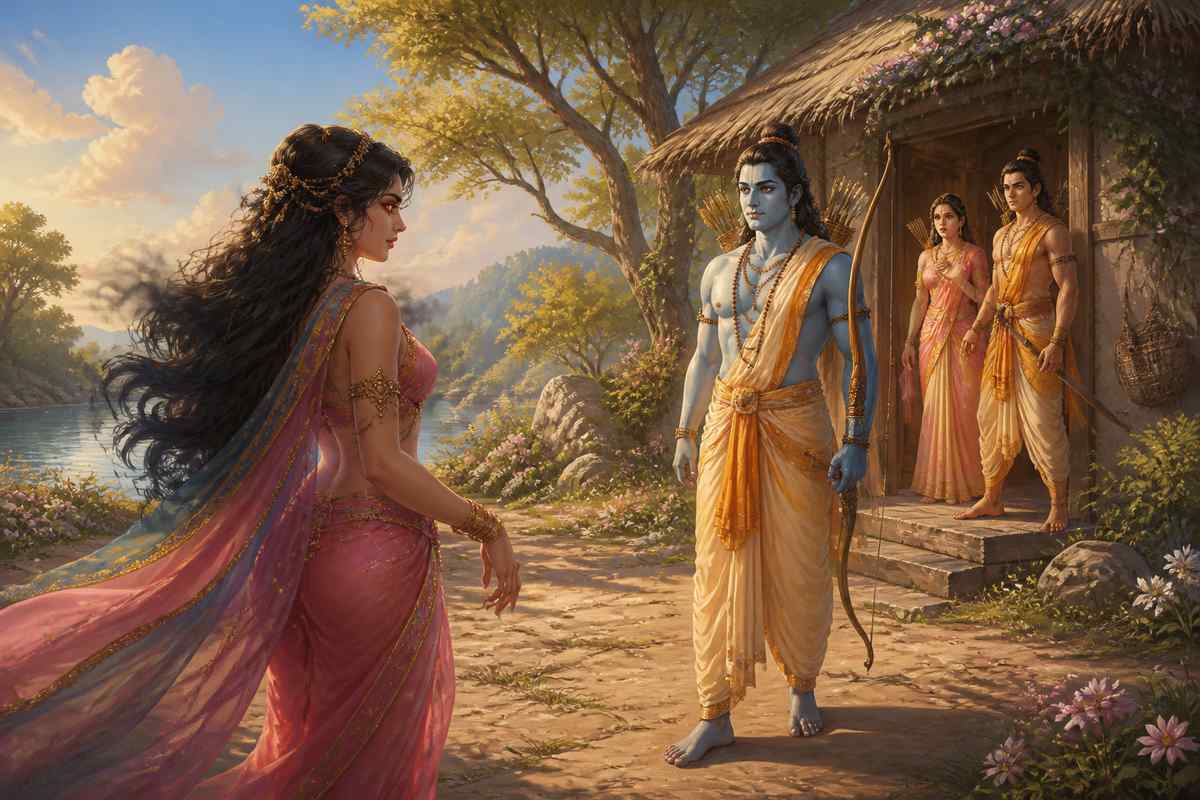
"O great warrior," Shurpanakha calls in a voice like honey, "you seem like Kamadeva himself descended to earth."
Rama's expression remains courteous but unmoved. "I am Rama, prince of Ayodhya, living in exile. Who are you?"
"I am Shurpanakha, sister of the great Ravana. Since I saw you, I am overcome. Why waste yourself with that weak woman? Take me instead. I am powerful beyond measure."
Sita has emerged and stands frozen at this brazen proposal. Rama decides to handle this with humor.
"Alas, I am devoted to my wife. But my younger brother Lakshmana - he has no wife. Surely he would welcome a companion as lovely as yourself."
Shurpanakha approaches Lakshmana with the same seductive manner.
"Your brother suggests you might welcome my companionship. Accept me, and we shall live in pleasure beyond imagination."
Lakshmana's answer comes sharp: "I am merely the servant of my brother - like a shadow following its object. Why settle for the shadow when you can have the substance? Go back to him."
Shurpanakha turns back toward Rama, confused and growing angry. Are they mocking her?
The Game Turns Dangerous
Rama becomes more direct. "I am bound by sacred vows to my wife. This is my dharma. Your beauty is evident, but my heart belongs to Sita alone."
Shurpanakha's illusion flickers as rage builds. "It is because of her, isn't it? That pathetic creature. What does she have that I lack?"
Her eyes fall on Sita with something dark and terrible. "She is the obstacle. What if she... ceased to be an obligation?"
Rama's expression hardens. "Careful, rakshasi. I know what you are beneath that illusion. Threaten my wife, and courtesy ends."
Shurpanakha's illusion drops. Her true form erupts through the beautiful facade - massive muscular bulk, iron talons extended.
"If I cannot have you, let us see how devoted you remain when I devour your precious Sita!"
The Attack and Punishment
Shurpanakha charges toward Sita with terrifying speed, talons extended, roaring like thunder.
Lakshmana is faster than Rama to intercept. He draws his sword and places himself between the charging rakshasi and Sita.
"Brother! Protect Sita! This beast is mine."
What follows is brief but brutal. Lakshmana does not aim to kill - she is female and unarmed. But he has no qualms about punishment.
His sword flashes twice. The first strike severs Shurpanakha's nose. The second takes both her ears.
Shurpanakha's shriek of agony echoes through the forest. She clutches her mutilated face, blood pouring between her fingers.

"You have no idea what you have done," she hisses. "You have mutilated the sister of Ravana. My brothers command fourteen thousand rakshasas. They will tear you to pieces. And if they fail, Ravana himself will come."
She flees into the forest, screams fading into the distance.
The Aftermath
Silence descends. Sita is shaking. Rama holds her gently.
"The hatred in her eyes when she looked at me..." Sita whispers.
Lakshmana's expression is troubled. "Brother, she spoke of brothers, of armies. Do you think she will simply flee?"
"No," Rama admits. "We have started something that will not end with her departure. She mentioned Ravana - the king of Lanka, whose tyranny has made even the gods uneasy."
That evening, Sita suggests they leave. But Rama shakes his head.
"We cannot. This is where the forest sages need protection. If we flee from the first real threat, what protection do we offer? Better the demons come here, to warriors who can face them."
Lakshmana nods. "We stay."
Sita looks at these two warriors who could have lived in palace luxury. Instead, they sit in bark garments, awaiting an army of demons, because they will not abandon those who depend on them.
Her eyes fill with tears - not of fear, but of pride.
The Deeper Meaning
Shurpanakha's arrival marks a crucial turning point. For the first time, desire itself becomes a destructive force.
Shurpanakha represents kama in its most possessive form. She believes her desire creates entitlement. When refused, desire transforms to rage - the fundamental rakshasa pattern.
Rama's response demonstrates perfect brahmacharya (fidelity). Despite being propositioned by an apparently beautiful woman, he doesn't waver. His commitment to Sita is absolute.
The disfigurement follows the principle of karmaphala. She attempted to kill Sita; the punishment was proportionate.
Most importantly, this episode reveals how small actions trigger enormous consequences. Shurpanakha's desire, Rama's refusal, Lakshmana's punishment - these personal moments will cascade into war, abduction, and ultimately the fall of Lanka.
Nothing happens in isolation. Our choices ripple outward in ways we cannot foresee.
Living traditions
The Shurpanakha episode is extensively portrayed in Ramlila performances across North India, classical dance traditions like Kathakali and Kuchipudi, and modern theatrical adaptations. The story serves as a teaching on the consequences of unchecked desire and the importance of fidelity. In contemporary discourse, the episode is also discussed in feminist retellings that explore Shurpanakha's perspective and agency.
- Ekapatni Vrata Observance: Rama's declaration of ekapatnivrata (vow of monogamy) in this episode has influenced Hindu marriage traditions. Many Hindu wedding ceremonies include explicit vows of fidelity modeled on Rama's example, and couples invoke Rama and Sita as the ideal of marital devotion.
- Tapovan: The forested area near Panchavati where Shurpanakha is believed to have first encountered Rama. The site includes the Kapileshwar Temple and sacred spots associated with various Ramayana events. The name 'Tapovan' (grove of austerities) reflects its history as a place of spiritual practice.
- Shurpanakha Kund: A water tank traditionally identified as the spot where Shurpanakha approached the hermitage and where the confrontation took place. The site is visited by those tracing the complete Ramayana pilgrimage circuit in Nashik.
- Sundar Narayan Temple: An ancient Vishnu temple in Nashik that commemorates Rama's presence in the region. The temple's iconography includes depictions of various Ramayana episodes including the encounter with Shurpanakha.
Reflection
- Recall a time when you had to reject someone's desire or request - romantic, professional, or otherwise. How did you handle it? Looking back, can you identify ways your manner of refusal either helped or hurt the situation?
- Rama and Lakshmana respond to Shurpanakha's proposition with humor and mockery, sending her back and forth between them before she becomes enraged. Could they have handled the situation differently to avoid the catastrophic consequences? Or was conflict inevitable once she fixated on Rama?
- Lakshmana disfigures Shurpanakha rather than killing her, as punishment for attacking Sita. This follows the principle of proportionate punishment, but it also ensures she lives to seek revenge. Is justice that creates future danger still justice? How do we balance appropriate response with long-term consequences?