The Path to Pampa
Following Sacred Directions
With Shabari's blessings lighting their way and Kabandha's directions guiding them, Rama and Lakshmana journey westward through flowering forests toward Lake Pampa. The landscape transforms as they travel - dense wilderness gives way to groves heavy with fruit, streams lined with blossoming trees, and finally glimpses of sacred waters ahead. Each step brings them closer to where help awaits.
Departure from the Hermitage
The morning after Shabari's liberation, Rama and Lakshmana stand at the edge of her empty ashram. The simple hermitage that held such extraordinary devotion now lies quiet, its keeper gone to higher realms. The funeral rites are complete, the sacred fire has consumed what remained of her earthly form.
Rama looks back one final time at the place where pure love transcended all boundaries.
"She waited her entire life for this meeting," he says to Lakshmana. "And having received what she waited for, she released everything without hesitation. There is a teaching in this."
Lakshmana nods. "She held on until the purpose was fulfilled, then let go completely. Perhaps that is what faith looks like when it reaches its goal."
They turn westward, following the directions that both Kabandha and Shabari provided. Lake Pampa awaits, and beyond it, the mountain where Sugriva dwells in exile.
The Westward Journey
Kabandha's guidance proves reliable. The path leads through forests unlike any they have traveled before.
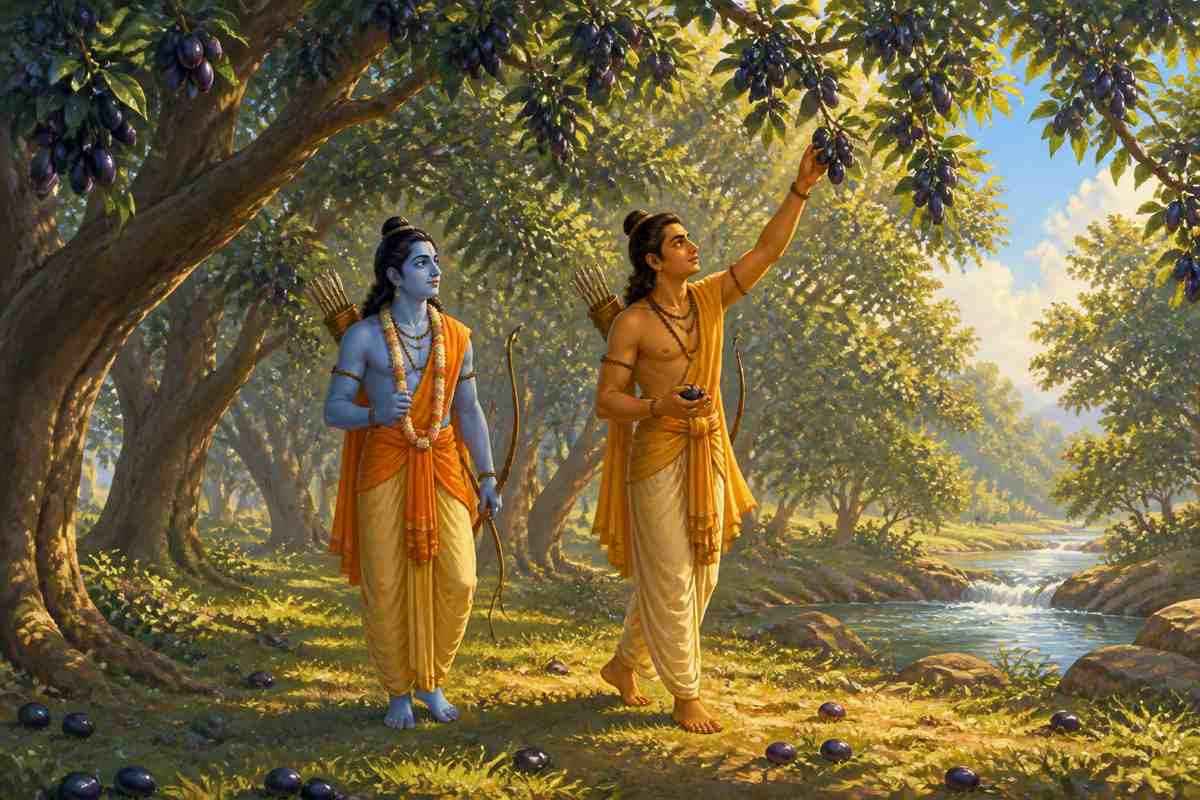
Groves of jambu trees spread before them, their purple fruits hanging heavy on branches. Panasa (jackfruit) trees tower overhead, their massive fruits promising sustenance for travelers. Rose-apple orchards fill the air with fragrance, and mango trees - some in flower, some in fruit - line the forest paths.
"This forest feeds those who pass through it," Rama observes. "Every tree offers something. Kabandha spoke truly when he said we would find fruits like ambrosia here."
They gather what they need as they walk - not from hunger alone but from appreciation. The forest seems to offer itself freely, as if nature itself supports their quest.
Banyan trees provide shade for rest. Ashoka trees - those trees of no-sorrow - bloom red and orange along their path. The forest grows increasingly beautiful as they travel, as if preparing them for what lies ahead.
Signs of the Sacred Lake
The air changes first. A coolness enters the breeze, carrying hints of water and lotus. Birds become more numerous - water birds they have not seen since leaving the Godavari. Cranes call in the distance.
"We are close," Lakshmana says.
The trees thin, and suddenly, through a gap in the foliage, they catch their first glimpse of Lake Pampa.
It spreads before them like a mirror of the sky - vast, serene, its surface dotted with lotus flowers in white and blue and pink. The western sun paints everything in gold. Mountains rise in the distance beyond the far shore, and on one of those heights - Rishyamuka, where Sugriva waits.

Rama stops, taking in the sight.
"Kabandha said this lake is sacred - that sages have performed tapas on its shores for ages beyond counting. I can feel why. There is peace here."
But even as he speaks, something shifts in his expression. The beauty of the lake, instead of bringing joy, seems to intensify something else - a pain that never fully leaves him.
The Weight of Beauty
They descend toward the lakeshore, and with each step, Rama grows quieter. The lotus flowers remind him of Sita's eyes. The graceful birds remind him of her movements. The cool breeze reminds him of her touch.
Beauty, he discovers, can be a kind of wound when the one you love is absent.
"Brother?" Lakshmana notices the change.
"She would have loved this place," Rama says simply. "Every beautiful thing I see becomes her absence. The world is full of her not being here."
They reach the shore as twilight settles. Tomorrow they will circle the lake toward the mountain. Tonight, they rest at the water's edge, the first travelers' pause before the final approach.
The journey through Aranya is nearly complete. The forest that has been their home, their trial, their teacher - it ends here at this sacred water. What began with exile approaches something like destiny.
The Deeper Meaning
Nature provides for those on dharmic paths. The fruit-laden forests that fed Rama and Lakshmana represent how the universe supports those who follow righteous purpose. When we align with dharma, sustenance appears.
Sacred geography guides the journey. Kabandha's directions were not merely practical but spiritual - leading through increasingly beautiful territory toward increasingly sacred destinations. Our own journeys often follow similar patterns, with each stage preparing us for the next.
Beauty and grief are intertwined in separation. Rama's response to Pampa's loveliness reveals how love transforms perception. For those who have lost someone beloved, beauty becomes bittersweet - a reminder of what is shared and what is absent.
Living traditions
The fruit-laden forests that Kabandha described to Rama - jambu, panasa, and other trees - are now studied by botanists tracing the Ramayana's geography. Conservation efforts in the Karnataka forest regions sometimes invoke the epic's ecological descriptions to protect traditional forest biodiversity, connecting environmental preservation with cultural heritage.
- Ramayana Pada Yatra (Pilgrimage Walk): Devotees undertake walking pilgrimages that trace Rama's forest journey, including the path from Shabari's ashram to Lake Pampa. These pada yatras recreate the physical journey as spiritual practice, with pilgrims walking through the same landscapes Rama traversed.
- Pampa Sarovar: The sacred lake identified with the Ramayana's Pampa, where Rama grieved for Sita while traveling toward Rishyamuka. The Tungabhadra River flows through this region, and the boulder-strewn landscape matches epic descriptions. Pilgrims have visited for over two millennia.
- Matanga Hill and Ashram Site: The hill associated with Sage Matanga, Shabari's guru. According to tradition, Matanga's ashram was near Lake Pampa, and this hill bears his name. Offers panoramic views of the sacred landscape and is an important pilgrimage point for those tracing Rama's journey.
- Kodandarama Temple, Hampi
Reflection
- Rama notices that the forest seems to provide for those on dharmic paths - trees heavy with fruit, clear water, safe passages. Have you experienced times when pursuing a worthy goal, resources and support seemed to appear? What do such experiences suggest about the relationship between purpose and provision?
- Lakshmana observes that Shabari 'held on until purpose was fulfilled, then released completely.' What does healthy holding and healthy releasing look like in your own life? How do you know when to persist and when to let go?
- The beauty of Pampa Lake intensifies Rama's grief rather than relieving it. Have you experienced beauty that heightened rather than healed your pain? What does this connection between beauty and grief teach about the nature of love and loss?