Where Beauty Wounds

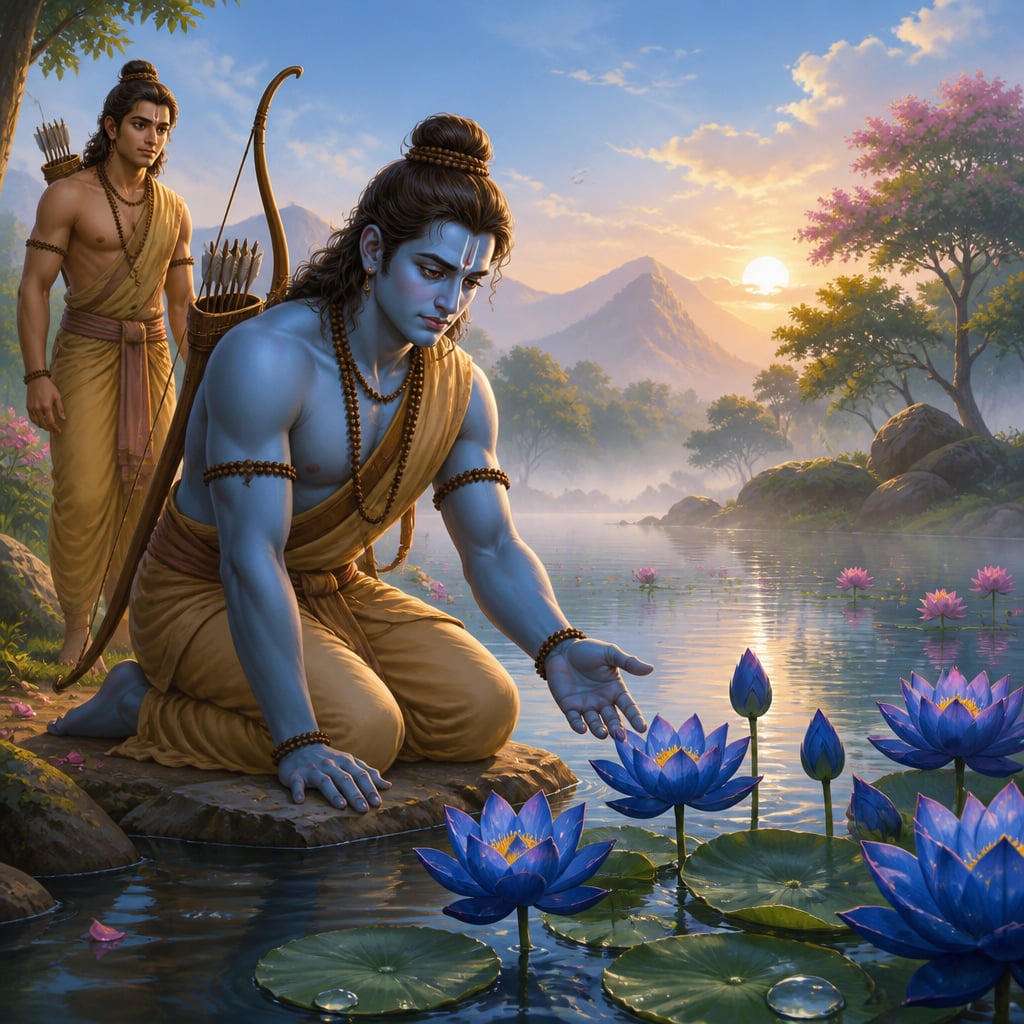
Grief at the Lake of Lotuses

At Lake Pampa, Rama encounters nature at its most beautiful - crystal waters, countless lotuses, singing birds, flowering trees. But every beautiful thing reminds him of Sita. The lotuses are her eyes, the birdsong her voice, the gentle breeze her touch. As spring intensifies nature's beauty, it also intensifies his grief. Lakshmana must remind his brother of purpose while honoring his pain.

The Cave of Council

Hanuman leads Rama and Lakshmana to Sugriva's refuge - a spacious cave high on Rishyamuka Mountain. The view stretches across forests and lakes, but Sugriva sees none of it. His eyes are fixed on the two humans who have come seeking alliance.

Inside the cave, a small fire burns - maintained by the exiled king not for warmth but for the sense of civilization it provides. Animal skins serve as seats. Simple fruits and roots indicate the sparse diet of fugitives.

Sugriva gestures for his guests to sit.

"Prince Rama," he begins, "Hanuman tells me you seek an alliance. Before we discuss terms, tell me your story. Who are you, and what brings you to these forests seeking the aid of vanaras?"

Rama speaks simply and directly. He tells of his birth, his training, his marriage to Sita. He describes the exile - Kaikeyi's demand, his father's helplessness, his own choice to honor dharma regardless of injustice. He speaks of the years in the forest, the sages' protection, the Battle of Fourteen Thousand.

Then his voice darkens.

He describes the golden deer, the trap, Sita's abduction. He speaks of Jatayu's sacrifice, Kabandha's guidance, Shabari's blessing. He names Ravana as the enemy, Lanka as the destination, war as the necessary path.

"I do not know where Sita is held," Rama concludes. "I cannot search the whole world alone. I have been told that you, Sugriva, command vanara armies that can cover distances humans cannot imagine. If you will help me find her, I will do whatever I can to help you in return."

Sugriva's Tale

Sugriva listens with growing recognition. This human's story mirrors his own in painful ways.

"You have suffered what I have suffered," Sugriva says slowly. "Your wife was taken by a more powerful enemy. So was mine. You were exiled unjustly. So was I. Listen now to my story, and judge whether we might help each other."

He tells of his brother Vali - mighty, fearless, blessed by the gods with strength that increases in combat. As long as Vali lived, Sugriva served as his loyal minister, content to support his brother's rule.

Then came Mayavi, a demon who challenged Vali to single combat. Vali pursued the demon into a cave, ordering Sugriva to wait at the entrance. A year passed. Blood flowed from the cave's mouth. Sugriva heard death-screams that sounded like his brother's voice.

"I believed Vali dead," Sugriva explains, his voice heavy with old pain. "I sealed the cave entrance with a boulder to contain whatever demon had killed him. I returned to Kishkindha. The kingdom needed a king. Vali's wife Tara needed protection. I... I did what seemed necessary."

But Vali was not dead. He had killed Mayavi and was merely wounded, resting in the cave's depths. When he finally emerged and found the entrance sealed, found his kingdom ruled by his brother, found his wife under Sugriva's roof...

"He would not listen," Sugriva says. "I tried to explain. I thought he was dead! The blood, the screams - what was I supposed to think? But Vali believed I had betrayed him deliberately, sealing the cave to ensure his death, taking his throne and wife through treachery."

Vali's rage was terrible. He beat Sugriva nearly to death, exiled him from Kishkindha, and claimed his wife Ruma in retaliation. Only Rishyamuka's protection - the curse that prevents Vali from entering - has kept Sugriva alive.

"I have no army," Sugriva admits. "What forces I had are scattered, afraid to oppose Vali openly. But if Vali were defeated, if I could reclaim Kishkindha... then I would have the resources to help you. The vanara armies could search every corner of the world. We could find your Sita."

The Terms of Alliance

The exchange that shapes history is clear: Rama will help Sugriva defeat Vali and regain his kingdom. In return, Sugriva will commit the vanara armies to searching for Sita.

But Lakshmana has questions.

"This Vali," he asks, "is he truly unjust? From your own telling, your brother found his throne usurped, his wife in another's house. His rage, however excessive, had some basis."

Sugriva winces at the fair point.

"Vali is not evil," he admits. "He is proud, powerful, and prone to rage. But his injustice lies in his refusal to hear truth, his theft of my wife in retaliation, his hunting of me like an animal rather than a brother. Whatever my errors in judgment - and I made them - they did not warrant this response."

"And the curse?" Lakshmana presses. "If Vali cannot enter Rishyamuka, why can you not simply stay here in safety?"

"What life is safety without freedom?" Sugriva responds with sudden passion. "I am trapped here, Lakshmana. I cannot leave without Vali hunting me down. My wife Ruma suffers in Kishkindha - I cannot rescue her. My honor lies in ruins - I cannot restore it. I breathe, but I do not live. Prison is prison whether the bars are visible or not."

Rama has been silent through this exchange, weighing what he hears.

"Sugriva," he finally speaks, "I will help you. Not because your cause is perfectly clear - few situations are - but because I see injustice in Vali's response, and because our alliance serves dharma. You did not deliberately betray your brother; you made a reasonable judgment based on terrible evidence. His punishment far exceeds any offense."

He pauses.

"But I will need to see Vali's injustice for myself before I act. Show me evidence. Let me witness his behavior. Then I will decide how to proceed."

The Sacred Fire

With terms agreed in principle, the alliance must be formalized. Hanuman gathers wood and kindles a proper sacrificial fire. The four vanaras present - Sugriva, Hanuman, Nila, and Nala - join Rama and Lakshmana around the flames.

Sugriva produces a garland of forest flowers and places it around Rama's neck. Rama does the same for Sugriva. They clasp hands over the fire.

"I, Sugriva, swear by this sacred fire: when my kingdom is restored, I will commit every resource to finding Sita. The vanara armies will search the four directions. We will not rest until she is found. This is my bond."

"I, Rama, swear by this sacred fire: I will defeat Vali and restore Sugriva to his rightful throne. His enemies become my enemies. His cause becomes my cause. This is my bond."

The fire leaps as if in witness. Hanuman watches with tears in his eyes. Something has begun here that he senses will reshape the world.

Rama and Sugriva facing each other across a small sacred fire inside Sugriva's mountain cave, hands raised in oath.

The Proof of Strength

But Sugriva, despite his hope, has doubts. He has seen Vali's strength - strength that seems beyond any mortal's capacity to match. Before he fully commits his hopes to this human prince, he needs proof.

"Forgive me, Rama," Sugriva says carefully, "but I must ask for a demonstration. Vali is not merely strong - he is supernaturally powerful. The gods themselves blessed him. I have seen him defeat enemies that entire armies could not touch."

He gestures toward the cave entrance.

"Outside, in the valley, lie the bones of Dundubhi - a demon whom Vali killed with his bare hands. The carcass was so massive that Vali threw it a full yojana to clear it from Kishkindha. If you can move those bones, I will know you have strength enough to face him."

Rama walks to the cave entrance. In the valley below, the enormous skeleton of Dundubhi lies bleaching in the sun - bones the size of tree trunks, a skull that could serve as a small house.

Rama kicking Dundubhi's skeleton across the valley

Without apparent effort, Rama kicks the skeleton. It flies across the valley, landing miles away, scattering into pieces from the impact.

Sugriva stares. What Vali did with full effort, Rama has exceeded with casual motion.

"There is more," Sugriva says, his voice shaking with new hope. "Do you see those seven tal trees on the far ridge? They stand in a row, each trunk as thick as an elephant's body. Vali once shot an arrow that pierced one tree and emerged from the other side. If you can pierce more than one..."

Rama strings his bow. He draws a single arrow, aims at the row of trees, and releases.

Rama's arrow piercing the seven sal trees

The arrow passes through all seven trees, continues through a mountain behind them, enters the netherworld, and returns to Rama's quiver.

Silence in the cave.

Then Sugriva falls at Rama's feet, all doubt dissolved.

"Lord," he says, and the word carries new meaning. "I was a fool to doubt. You are not merely a prince - you are something more. With you as my ally, Vali is already defeated. Lanka is already doomed."

Rama lifts him gently.

"Do not worship me, Sugriva. We are friends and allies, equals in our suffering and our purpose. But yes - Vali will fall, and your kingdom will be restored. Trust in dharma, for it has brought us together for this purpose."

The Plan

With alliance sealed and strength proven, practical planning begins. Sugriva explains Vali's patterns - when he emerges from Kishkindha, where he goes, what provokes him to combat.

"He cannot resist a challenge," Sugriva says. "If I challenge him to single combat, he will come. His pride demands it. But I cannot defeat him alone - his divine boon makes him stronger than any opponent he faces. In combat, he absorbs half his enemy's strength."

"Then he should not know he faces two opponents," Rama says thoughtfully. "If you engage him while I remain hidden, I can strike when the moment is right. His boon does not protect against arrows from ambush."

Lakshmana frowns slightly at this plan. There is something that troubles him about striking from hiding - it seems less than honorable. But he holds his peace. Rama has reasons for his choices.

"We will go to Kishkindha," Rama decides. "Show me this brother of yours. Let me judge his character for myself. Then, when the moment is right, we will act."

The alliance is forged. The plan is laid. Tomorrow, they descend from Rishyamuka Mountain toward Kishkindha.

The Aranya Kanda ends here, on the threshold of new action. The forest book closes with its protagonists no longer isolated but allied, no longer searching blindly but directed toward clear goals.

Ahead lies Kishkindha Kanda - the book of the monkey kingdom, where Vali will fall, Sugriva will rise, and the great search for Sita will begin in earnest.


The Deeper Meaning

The alliance between Rama and Sugriva raises profound questions about justice, intervention, and the complexity of dharma in real situations:

Perfect clarity is rare in real conflicts. Sugriva's story shows how circumstances can create apparently guilty behavior from innocent intent. He thought Vali dead; his assumption was reasonable. Yet from Vali's perspective, he found his throne usurped and his wife compromised. Both brothers have legitimate grievances. Dharma must navigate this ambiguity.

Punishment must be proportional. Whatever Sugriva's errors, Vali's response - attempted murder, wife-theft, endless hunting - exceeds any reasonable retaliation. Rama's willingness to intervene rests partly on this disproportion. Justice requires not merely identifying wrong but assessing appropriate response.

Alliance creates obligation. By swearing before sacred fire, Rama commits himself to Sugriva's cause. This is not a casual promise but a binding dharmic obligation. The alliance's terms - specific and mutual - create a structure of accountability that will drive the remaining narrative.

Strength must serve purpose. Rama's demonstration of power - kicking Dundubhi's bones, piercing the seven trees - is not mere display. It establishes that he has the capability to fulfill his promises. Power without purpose is dangerous; purpose without power is futile. Rama brings both.

Living traditions

Rama's experience at Pampa has influenced how grief is understood and expressed in Indian culture. The principle that 'grief and purpose can coexist' - articulated by Lakshmana - appears in modern psychological approaches to loss. Grief counselors sometimes reference this teaching: one need not stop grieving before acting; the heart can ache while the feet walk forward.

Reflection

More in Aranya Kanda

All lessons in Aranya Kanda ยท The Ramayana course