The Golden Deer

When Beauty Becomes a Trap

A deer of impossible beauty appears near Panchavati - golden hide shimmering, eyes like gems, movements like dancing light. Sita is entranced and asks Rama to capture it for her. Though Lakshmana senses deception, Rama pursues the deer deep into the forest. When he finally strikes it down, the dying creature cries out in Rama's own voice - a cry that will change everything.

The Morning of Destiny

The day begins like any other at Panchavati. Morning mist rises from the Godavari, birdsong fills the air, and the sacred fires burn steadily at Rama's ashram. In the weeks since the Battle of Fourteen Thousand, peace has settled over the forest. The sages perform their rituals without fear. The brothers maintain their vigilant watch but without immediate threat.

Sita tends to the morning duties - gathering flowers for worship, preparing simple forest meals, creating a home out of wilderness. She has transformed exile into something almost beautiful, finding joy in the small rituals of daily life with her husband.

Rama sits outside the hut, checking his weapons - a daily practice that keeps mind and body sharp. Lakshmana patrols the perimeter, his instincts telling him that the silence since Khara's defeat is not peace but preparation.

None of them know that this is the last morning of their life together. None sense that destiny has already been set in motion, that even now, Maricha approaches in a form designed to destroy their world.

The Impossible Creature

Sita sees it first.

She is walking near the edge of the clearing when movement catches her eye - a flash of gold among the green. She stops, thinking perhaps it is sunlight playing tricks. But then the creature steps into full view, and Sita's breath catches in her throat.

It is a deer, but like no deer that has ever existed. Its hide is pure gold - not golden-colored, but actual gold, gleaming and lustrous as if forged by divine craftsmen. Its eyes are sapphires set in silver, impossibly bright, seeming to hold intelligence beyond any animal. Its horns branch like coral made of pearl. Its hooves flash like polished gems as it moves.
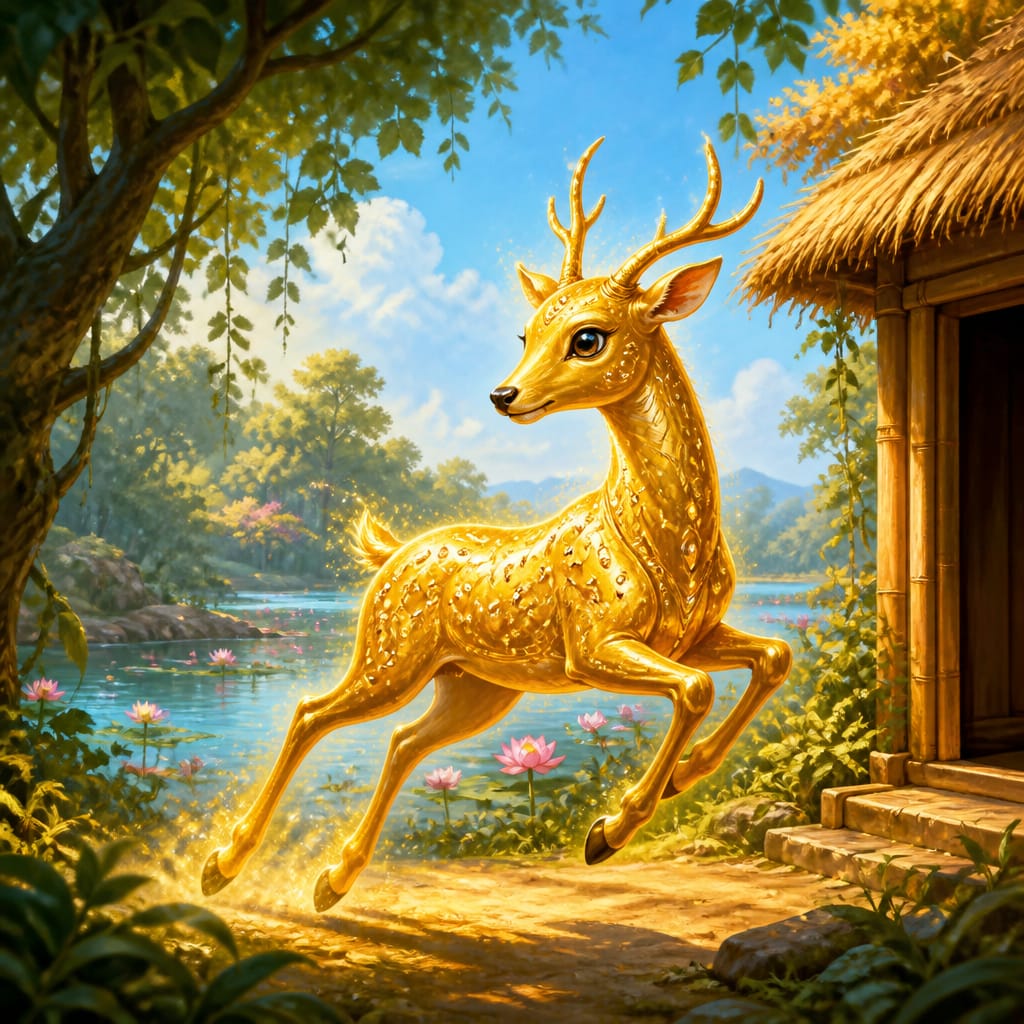
The shimmering golden deer poised at the edge of the Panchavati clearing in morning sunlight.

And its movements! The deer does not merely walk - it dances. Each step is choreographed grace, each turn a work of art. It seems aware of its own beauty, displaying itself as if performing for an audience.

Sita stands transfixed. In all her years - growing up in Mithila's palace, living in Ayodhya's splendor - she has never seen anything so beautiful. The creature seems to belong not to the forest but to some celestial realm, a jewel that has somehow wandered into mortal lands.

"Rama!" she calls, her voice filled with wonder. "Come quickly! You must see this!"

Enchantment and Warning

Rama and Lakshmana arrive to find Sita pointing toward the forest's edge, where the golden deer continues its mesmerizing display. The creature seems completely unafraid, grazing and dancing as if unaware of the humans watching.

Rama studies the deer with a hunter's eye. It is indeed extraordinary - perhaps the most beautiful animal he has ever seen. But something about it troubles him, a nagging sense that beauty this perfect rarely occurs in nature.

"See how it moves," Sita breathes. "As if it knows we're watching. As if it wants us to watch."

Lakshmana's face has grown dark. Unlike Sita's enchantment or Rama's uncertainty, his reaction is immediate suspicion.

"Brother," he says quietly, pulling Rama aside, "this is wrong. No natural creature looks like this. The timing is too convenient - weeks of silence after Khara's death, and now this impossible thing appears at our very doorstep? It must be a rakshasa using maya."

Rama considers this seriously. Lakshmana's instincts have saved them before. The demons are known for their powers of illusion.

"You may be right," Rama acknowledges. "And yet... what if it is real? What if it is a divine creature, perhaps sent by the gods? Such beings do exist."

Sita has approached them, her eyes still fixed on the deer.

"My lord," she says to Rama, and her voice carries a longing that goes deeper than mere desire for a pet. "Could you capture it for me? If it is real, its hide would make a seat for you worthy of a king. If it is an illusion... then at least we will know. Please - I have asked for so little in this exile. Let me have this one beautiful thing."

The Request That Changes Everything

This is the moment on which the entire epic turns. Sita's request seems innocent - a wife asking her husband for a gift, a queen without a kingdom wanting something precious, a woman finding beauty in an otherwise harsh existence.

But Lakshmana sees the trap.

"Sister," he says urgently, "please listen to me. I have lived in forests with Rama for years. I know deer - their movements, their habits, their nature. This creature defies everything I know. Its hide gleams like metal worked in forges. Its eyes show calculation, not animal instinct. It is performing for us. Deer do not perform."

He turns to Rama.

"Brother, if you pursue this creature and it is indeed a rakshasa, you will be playing into their hands. They could not defeat you in open battle - fourteen thousand tried and failed. So now they use deception. They dangle something beautiful to separate you from those you protect. Do not fall for this."

Rama stands between his brother's logic and his wife's longing. Both arguments have merit. The deer could indeed be a trap - but it could also be genuine. To refuse Sita's request based only on suspicion seems harsh. She has sacrificed so much to follow him into exile.

"Lakshmana," Rama finally speaks, "your caution is well-founded. But consider this: if the deer is a demon, I will kill it and we will be rid of another rakshasa. If it is real, we will have gained something beautiful. Either way, no harm comes."

He pauses, then adds the crucial instruction:

"But you will stay here with Sita. Guard her with your life. Do not leave her side for any reason. If the deer is a trap, it is designed to separate us. We will not let that happen. I will pursue alone, but the ashram will remain protected."

The Hunt Begins

Rama pursuing the golden deer through the forest

Rama takes up his bow - the divine weapon that has slain demons and won impossible battles - and enters the forest in pursuit of the golden deer.

Maricha, for the creature is indeed he, begins the most important performance of his life. He has no illusions about survival. From the moment he saw Rama string his bow, he knew he would die today. But he can still serve Ravana's purpose - he can lead Rama far enough from the ashram to create opportunity.

The chase is extraordinary. The deer displays speed that matches Rama's pursuit, always staying just out of reach. It runs in a wide circle, gradually drawing Rama deeper and deeper into the forest. Sometimes it allows him to approach closely, raising his hopes of capture. Then it bounds away with supernatural agility.

Maricha remembers the last time he faced Rama - a terrified flight across the ocean, an arrow's impact that should have killed him. That memory fuels his performance now. Every leap takes Rama farther from Sita. Every bound purchases seconds for Ravana's approach.

But the chase cannot last forever. Rama is the greatest archer in the world, and even a demon's maya cannot indefinitely evade his sight. After ranging several yojanas from the ashram, Rama decides to end the hunt.

He stops, draws his bow, and releases an arrow blessed with sacred mantras.

The Death Cry

The arrow strikes true. Maricha's illusion shatters as the shaft pierces his heart. The golden hide dissolves, revealing his true demonic form - massive, terrible, the face of nightmare replacing the face of beauty.

But Maricha has one final act to perform. As death claims him, he gathers his remaining strength and screams - not in his own voice, but in a perfect imitation of Rama's:

"Ha Sita! Ha Lakshmana!"

The cry echoes through the forest, carrying supernaturally far. Miles away at the ashram, Sita and Lakshmana hear what sounds exactly like Rama's voice calling out in distress.

Maricha dies with a strange peace. He has done what Ravana commanded. He has also done what he knew would happen - he has died by Rama's arrow, a death he had fled from for years but could never ultimately escape. And in some corner of his demonic soul, he wonders if this death at dharma's hands might bring him something better in the next life than the existence he endured in this one.

Terror at the Ashram

The cry reaches Sita's ears like a blade through her heart. She knows Rama's voice better than any sound in existence - every tone, every inflection. And what she hears is her husband in mortal danger.

"Lakshmana!" she screams. "That was Rama! He is in trouble! You must go to him immediately!"

Lakshmana's face is pale but composed. He heard the cry too, and he recognizes it for what it is - the final act of the demon he had warned against.

"Sister," he says firmly, "that was not Rama. No being in the three worlds can threaten him. What you heard was the death cry of the rakshasa, using maya one last time. The deer was indeed a demon, as I suspected. Rama has killed it, and it screamed in his voice to create exactly this panic."

"How can you know that?" Sita's terror makes her voice sharp. "How can you possibly know?"

"Because I know Rama. I have fought beside him in every battle. I have seen him face fourteen thousand demons alone and emerge without a scratch. No creature in that forest - real or demonic - could put such fear in his voice. This is deception, sister. A trap."

"And if you're wrong?" Sita demands. "If Rama lies wounded or dying while you stand here lecturing me about traps?"

"I am not wrong."

"Then prove it! Go to him! See for yourself!"

Lakshmana shakes his head.

"Rama's last command was to guard you with my life. He ordered me not to leave your side for any reason. This is the reason he anticipated. I will not abandon my post because a dying demon screamed."

Words That Wound

What follows is one of the most painful exchanges in the Ramayana. Sita, consumed by fear for her husband, says things she will forever regret:

"I see now," she says coldly. "You refuse to help your own brother. Why? Is it because you want him dead? Do you desire his wife so much that you would let him die to claim her?"

The accusation strikes Lakshmana like a physical blow. He, who has served Rama with perfect devotion, who followed him into exile when he could have stayed, who has never even looked at Sita with anything but the respect due a mother - accused of the basest possible motive.

"Or perhaps," Sita continues, her fear transforming into cruelty, "you serve Bharata. Is that it? Were you sent to ensure Rama never returns from exile? Are you waiting for him to fall so your other brother can keep the throne?"

Lakshmana's eyes fill with tears. In all the hardships of exile - the hunger, the danger, the homesickness - nothing has wounded him like these words from someone he has protected with absolute loyalty.

"Mother," he uses the formal address, his voice breaking, "you do not know what you say. Fear speaks through you, not wisdom. But I cannot bear these accusations. I will go - not because I believe Rama is in danger, but because remaining means hearing more words that destroy the honor I have tried to maintain."

He moves toward the door, then stops.

"When I am gone, do not step outside this hut for any reason. Do not speak to any stranger. Do not trust any appearance, however holy it may seem. The trap is not yet complete, and you are its target."

Lakshmana drawing the Lakshman Rekha

He raises his hand and invokes a protective mantra, drawing an invisible line around the hut - a boundary that nothing evil can cross.

"This is the Lakshman Rekha. Stay within it. If you step beyond, I cannot protect you."

Then he runs into the forest, following the direction of the cry, knowing in his heart that he is leaving Sita vulnerable to exactly the danger he had foreseen.

Alone

Sita stands in the empty ashram, her anger already fading into regret. The words she spoke to Lakshmana - how could she have said such things? He who has been nothing but devoted, nothing but respectful, nothing but protective?

But the fear remains. Somewhere in that forest, her husband may be hurt. And now both brothers are gone, leaving her alone for the first time since the exile began.

The silence feels different now. The bird songs seem muted. The rustling leaves sound like footsteps. The beautiful clearing that felt like home now feels like exposure.

Sita looks at the invisible line Lakshmana drew - the Lakshman Rekha. She cannot see it, but she can feel it somehow, a boundary between safety and danger.

She does not know that even now, Ravana approaches in the guise of a holy man. She does not know that the trap has worked perfectly - the golden deer, the death cry, her own fear-driven words, all combining to leave her exactly where the demon king needs her.

Alone. Unprotected. Within reach.


The Deeper Meaning

The Golden Deer episode operates on multiple levels, each revealing profound truths about human nature and the workings of adharma.

Beauty as weapon. The deer is literally irresistible - designed to be so beautiful that it compels pursuit. This is not mere ornamentation to the story but a teaching about how temptation works. Evil rarely appears evil. It comes wrapped in beauty, pleasure, apparent goodness. The most dangerous traps are the most attractive ones.

The exploitation of virtue. Ravana's plan works because Rama is good. A selfish man would have ignored Sita's request. A cowardly man would not have pursued alone. A suspicious man would have killed the deer from a distance without chase. Rama's virtues - his desire to please Sita, his courage in facing danger alone, his willingness to investigate rather than assume - are precisely what the trap exploits. This is how sophisticated evil operates: it studies its target's strengths and turns them into vulnerabilities.

Fear's distortion. Sita's cruel words to Lakshmana come from fear, not malice. Terror makes us say and do things alien to our true nature. Her accusations are so outrageous precisely because they have no basis in reality - she is not thinking, she is reacting. The teaching is clear: decisions made in panic are almost always wrong. Fear is a poor counselor.

The tragedy of misplaced trust. Throughout this episode, trust is given to the wrong things and withheld from the right ones. Sita trusts her eyes (the beautiful deer) over Lakshmana's wisdom. She trusts her ears (the false cry) over her knowledge of Rama's invincibility. She will soon trust appearance (Ravana's disguise) over Lakshmana's explicit warning. Discernment - the ability to see past appearance to reality - is perhaps the most important spiritual faculty, and its absence enables catastrophe.

Living traditions

The golden deer episode has become a universal metaphor for deceptive temptation - anything that appears too beautiful or perfect should be examined carefully. The phrase 'chasing a golden deer' is used in Indian languages to describe pursuing illusions. The Lakshman Rekha concept has entered legal and ethical discourse, with India's Supreme Court using it in judgments about boundaries and limits. The episode continues to be performed in Ramlila, depicted in visual arts, and analyzed in psychology courses studying decision-making under deception.

Reflection

More in Aranya Kanda

All lessons in Aranya Kanda ยท The Ramayana course