The Abduction of Sita

When Evil Wears a Holy Mask

With Rama pursuing the golden deer and Lakshmana gone to help him, Sita stands alone. A holy man approaches seeking alms - but beneath the sacred disguise hides Ravana himself. When Sita steps beyond the protective boundary to offer food, the demon king reveals his true form. Her defiance, her curse, and her abduction mark the darkest moment of the Ramayana and set the stage for the greatest war.

The Predator's Approach

Ravana has been waiting. Hidden in the forest, watching through magical sight, he tracked every moment of his carefully laid plan. He saw the golden deer appear, saw Sita's enchantment, saw Rama pursue. He heard Maricha's death cry and watched Lakshmana struggle with his duty before finally departing.

Now, Sita stands alone.

The demon king of Lanka, conqueror of the three worlds, prepares the final phase of his deception. He will not approach as himself - even alone, Sita might have some protection, some alarm she could raise. Instead, he transforms.

The ten heads merge into one. The twenty arms become two. The massive demonic form shrinks into that of an elderly brahmin - saffron robes, wooden sandals, matted hair, a begging bowl. The face is serene, the eyes downcast, the entire bearing radiating peaceful holiness.

This is perhaps Ravana's greatest blasphemy: not merely disguising himself, but disguising himself as the most sacred category of person in Vedic society. A brahmin seeking alms cannot be refused. A holy man at the door must be honored. Ravana weaponizes dharma itself.

The Approach
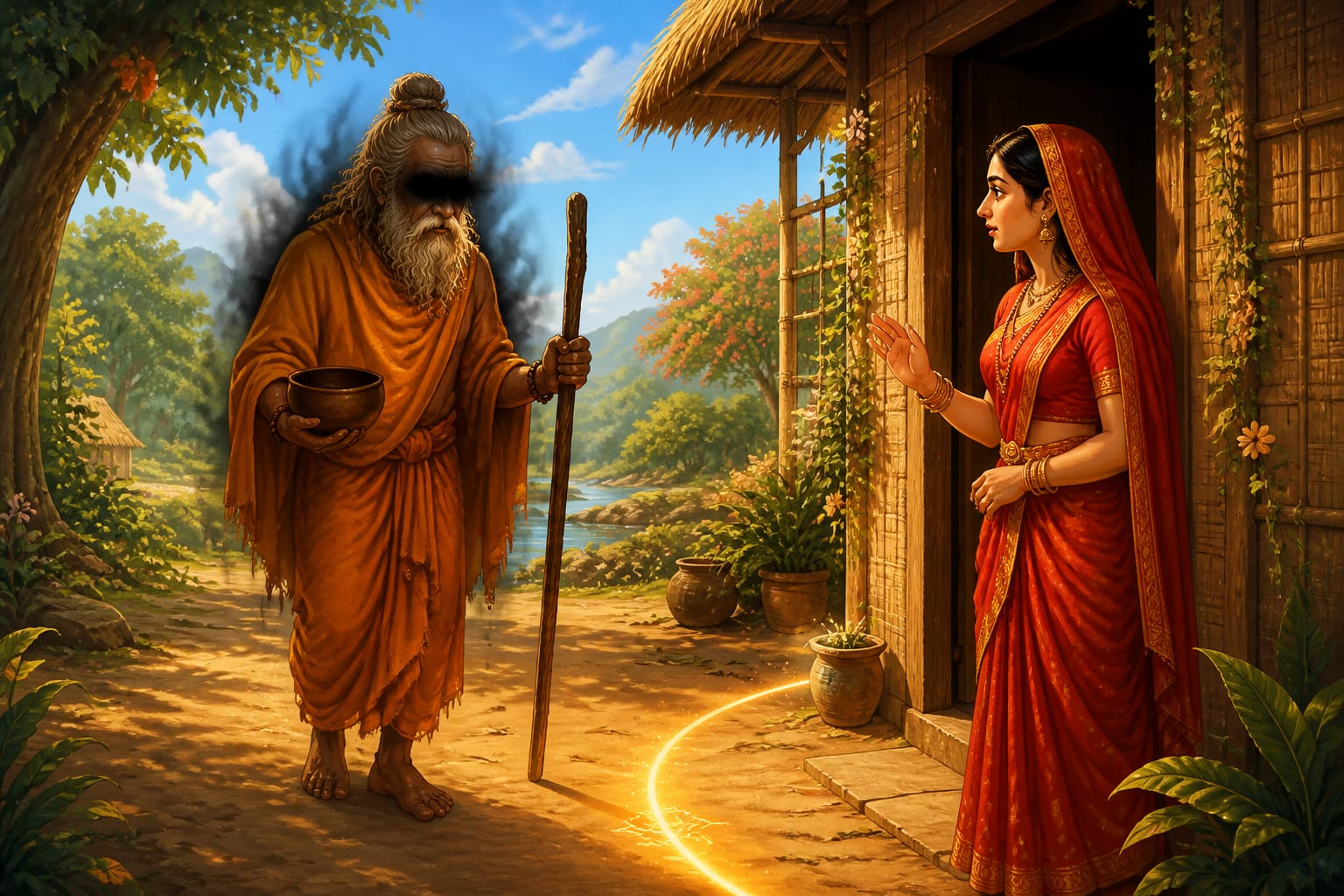
Ravana disguised as a holy man at the Lakshman Rekha

Sita hears footsteps and looks up to see an elderly sage approaching the ashram. Relief washes over her - a holy presence in this moment of anxiety. Perhaps the gods have sent this brahmin as protection until her husband returns.

"Om namo Narayanaya," the disguised Ravana greets her with a traditional salutation. His voice is gentle, aged, reassuring. "I am a wandering seeker, daughter. The forest is vast and my journey long. Might a weary traveler rest here briefly and receive some water and food?"

Sita looks at the sage with natural trust. Everything about his appearance speaks of holiness - the ochre robes, the sacred marks, the peaceful demeanor. This is exactly what a brahmin seeking alms should look like.

But something makes her hesitate. Perhaps some divine intuition, perhaps the echo of Lakshmana's warning. She does not step out of the hut to greet him.

"Noble sage," she replies respectfully, "please wait there. My husband and his brother have gone into the forest but will return soon. I will bring you food and water where you stand."

This is not the response Ravana expected. He needs her to cross the boundary - the protective line that Lakshmana drew. His demonic senses can feel that barrier, invisible but potent. As long as she remains within it, he cannot touch her.

The Manipulation

Ravana begins a subtle manipulation, playing on Sita's devotion to dharma.

"Daughter," his voice carries hurt, "am I so fearsome that you will not approach? I am an old man, weak with fasting and travel. Is this the hospitality that Princess Sita, famed throughout the worlds for her virtue, offers to holy men?"

He knows her name. In her isolation, Sita does not question how a random wandering sage would know who she is.

"In my ashram days," Ravana continues, his voice taking on a nostalgic quality, "the queens of Ayodhya were known for their generosity. They would come out personally to serve holy men, touching their feet, offering the best of their household. Has exile changed the customs of the Raghu dynasty?"

The words cut deep. Sita's identity is bound to her role as Rama's wife, as a daughter of the Raghu clan through marriage. To be accused of failing that dharma - especially now, when she has sacrificed everything for her husband's honor - is unbearable.

"Forgive me, sage," she says, stepping forward. "I meant no disrespect. Please, let me serve you properly."

She crosses the Lakshman Rekha.

The Revelation

The moment Sita's foot touches the ground beyond the protective boundary, Ravana drops his disguise.

The transformation is instant and terrifying. Where an elderly brahmin stood, now towers a demon of impossible proportions. Ten heads crowned with gold, twenty arms bristling with weapons, eyes blazing with triumph and desire. The saffron robes become royal armor. The begging bowl becomes a sword.

"Foolish woman," Ravana laughs, his ten voices creating a chorus of menace. "Did you think any brahmin would come to this forest, where my brother's army lay until your husband slaughtered them? I am Ravana, king of Lanka, lord of the three worlds. And you, beautiful Sita, will be my queen."

Sita's scream dies in her throat. Terror beyond anything she has known freezes her limbs. This is the demon king himself - the being whose very name makes gods tremble. And she, foolish in her trust, has walked directly into his grasp.

But terror, in Sita, gives way to something else: fury.

Sita's Defiance

Even in this moment of absolute vulnerability, Sita does not cower. The daughter of Janaka, the wife of Rama, draws herself up and faces the demon king with contempt that makes his ten faces darken.

"Ravana," she speaks his name as if it were a curse. "You call yourself lord of three worlds, yet you come disguised as a beggar. You call yourself a king, yet you prey on a woman alone. You call yourself mighty, yet you dare not face my husband in open battle. What greatness is this? What glory?"

Ravana's twenty hands clench. No one speaks to him this way. Indra himself does not dare such words.

"Your husband?" Ravana snarls. "The mortal who plays at being a warrior? He who wanders in forests wearing bark while I sit on thrones of gold? You compare me to him?"

"I compare a mountain to a mustard seed," Sita replies, her voice steady despite her fear. "Rama's smallest virtue outweighs all your power. His dharma will destroy your adharma. His love will survive your hatred. And his arrow will find your heart, Ravana - this I promise you."

She speaks not as a victim but as a prophetess, and even Ravana feels a chill at her certainty.

"Take me if you must," Sita continues. "But know this: you seal your own destruction. You think you are the hunter? You are the prey. This act - this adharma of stealing another man's wife - will bring Rama to Lanka with a force that will erase your empire from existence. You will lose everything: your kingdom, your family, your life. And my husband will take me back from your corpse."

The Taking

Ravana's patience ends. He seizes Sita with violent force, ignoring her struggles. His celestial chariot - the Pushpaka Vimana - materializes at his command, a vehicle of the gods that he long ago stole from his half-brother Kubera.

"Scream all you want," Ravana sneers as he drags her aboard. "Your protectors chase shadows in the forest. By the time they return, you will be in Lanka, and all your brave words will be tears."

Ravana in his ten-headed form lifting Sita into his black aerial chariot above Panchavati.

Sita does scream - not for herself but to the universe:

"O trees of Panchavati, tell my Rama what has happened! O Godavari, carry my message! O creatures of the forest, witness this crime!"

As the chariot rises into the air, Sita tears off her jewelry and wraps it in a piece of her garment. She hurls this bundle toward the ground, hoping against hope that it might serve as a trail, a sign, a message.

The bundle falls toward a mountain peak where, unknown to Sita, a group of vanaras (monkey-beings) sit watching. They catch the glittering package, puzzled by the weeping woman in the sky-chariot and the demon who carries her. They will hold these jewels for many days, not knowing their significance - until a certain prince comes searching.

The Witness in the Sky

But Sita's abduction does not go entirely unwitnessed.

High in the mountains near Panchavati lives Jatayu - the great eagle, king of vultures, ancient friend of King Dasharatha. This mighty bird, old beyond measure but still powerful, has been watching over the forest since Rama's arrival, honoring the friendship he held with Rama's father.

Jatayu sees the chariot rising. His aged eyes, still sharp, recognize the struggling figure of Sita. And he sees who carries her - Ravana, the demon king, whose very existence is an insult to dharma.

Old as he is, tired as he is, Jatayu does not hesitate. He launches himself into the sky, his massive wings beating toward the fleeing chariot. He is no match for Ravana in strength - he knows this. He is too old to fight a demon king - he knows this too.

But some duties transcend calculation. Some bonds demand action regardless of consequence. Dasharatha's son's wife is being stolen. Jatayu will not watch it happen without response.

"Ravana!" the great bird screams, his voice echoing across the sky. "Halt, defiler of dharma! Release the princess or face the wrath of Jatayu!"

Ravana looks at the approaching eagle with contempt. What can one old bird do against the lord of Lanka?

He is about to find out.


The Deeper Meaning

The abduction of Sita is the central tragedy of the Ramayana, and it operates on multiple levels of meaning.

The violation of sacred trust. Ravana's disguise as a brahmin is not merely clever tactics - it is profound blasphemy. By wearing the robes of holiness to commit evil, he corrupts the very institution of sacred begging. His crime is not just against Sita but against dharma itself. When holy appearances can mask demonic intent, the foundations of social trust collapse.

The power and limits of righteousness. Sita's dharma - her duty to serve holy men - becomes the vector of her capture. Does this mean dharma failed her? The teaching is subtler: dharma itself is not at fault, but discernment must accompany it. Sita's error was not in wanting to serve a brahmin but in crossing a protective boundary that had been explicitly established. Dharma and viveka (discrimination) must work together.

Sita as prophetess. In her defiance, Sita speaks truth that Ravana refuses to hear. Her prediction of his destruction is not hopeful wishing but certain knowledge. The righteous, even in their darkest moments, can see outcomes that the powerful in their arrogance cannot. Sita knows - with absolute clarity - that this act will destroy Ravana. Her only uncertainty is the suffering in between.

The beginning of the end for Ravana. Ravana thinks he has won. He has the woman he desired. He has humiliated his enemy. He has proven that nothing can resist his will. But in this moment of apparent triumph, he has actually sealed his doom. Every step of his flight to Lanka carries him closer to destruction. The seeds of the war that will end his empire were planted the moment he touched Sita.

Living traditions

Sita's response to her abduction - prophecy rather than pleading, defiance rather than despair - has made her an icon of dignified resistance. Her story is taught in women's empowerment programs, analyzed in feminist discourse, and portrayed in dance, theater, and film as an example of maintaining agency even in captivity. The abduction scene remains one of the most frequently depicted episodes in Ramayana art, from ancient temple carvings to modern graphic novels, teaching that true dignity cannot be taken by force.

Reflection

More in Aranya Kanda

All lessons in Aranya Kanda ยท The Ramayana course