Viradha the Cursed Demon

Liberation Through Combat

Deep in the Dandaka forest, a terrifying rakshasa named Viradha seizes Sita and threatens to devour Rama and Lakshmana. But this monster was not always a demon - he was once Tumburu, a celestial gandharva cursed to this hideous form. Through combat with Rama, he finds not death but liberation, freed at last to return to his divine nature.

Terror in the Forest

The blessings of Atri and Anasuya still warm in their hearts, Rama, Sita, and Lakshmana journey deeper into the Dandaka. The forest grows denser, the canopy blocking more of the sky. Ancient trees twist in strange shapes, their roots rising from the ground like frozen serpents. The sounds of normal wildlife fade, replaced by an oppressive silence.

Suddenly, a roar splits the air - so terrible that birds flee and trees seem to tremble.

Viradha emerges - a rakshasa of horrifying aspect. His body towers above the tallest trees. His face is sunken like a cave, eyes burning like funeral pyres, mouth filled with fangs like spears. His limbs are decorated not with ornaments but with the bones of his victims - sages and hermits he has devoured over centuries.
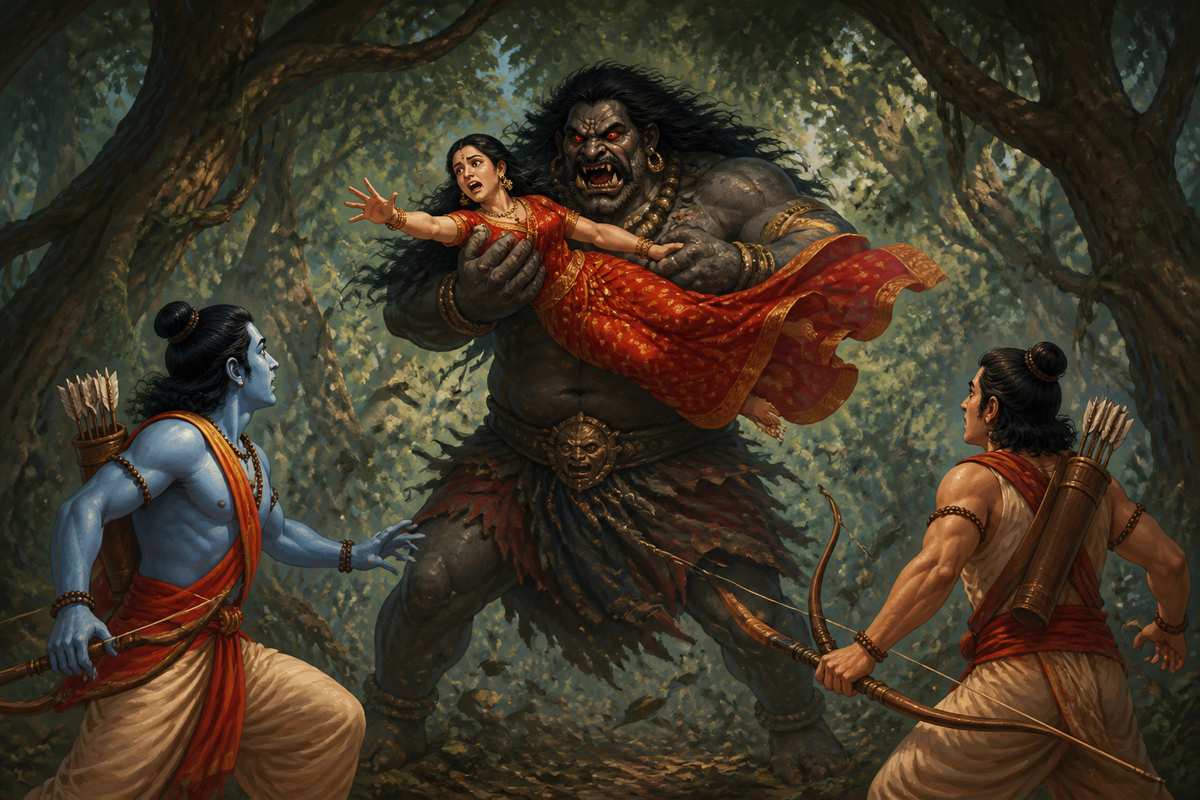
Viradha seizing Sita in the Dandaka forest

Sita Seized

Before Rama or Lakshmana can react, Viradha moves with supernatural speed, snatching Sita from between them.

"What fortune!" the demon bellows, his voice shaking leaves from trees. "This beautiful woman shall be my wife. These two men shall be my dinner!"

Sita, held against the demon's foul body, does not scream or weep. Her face is pale, but her eyes seek Rama's with complete faith. She knows he will not abandon her.

"Rama! Destroy him as you have destroyed others who oppose dharma! Do not fear for me - fear only that adharma might triumph."

Viradha laughs - a sound like thunder mixed with grinding bones. "She speaks of dharma! I am Viradha, terror of the Dandaka. No weapon can pierce my body. I have been granted a boon by Brahma himself - I cannot be slain by any weapon. Your would-be rescuers will die, and you will learn to forget them."

The Battle Begins

Rama's face transforms with cold fury - not the wild anger of an ordinary man, but the focused wrath of dharma confronting adharma.

"Demon, you have made three mistakes. You have touched my wife. You have threatened my brother. You have called yourself invincible. Now learn the consequences."

Lakshmana needs no command. The brothers move as one, their bows singing as arrow after arrow flies toward Viradha. The shafts strike true, penetrating his flesh. Viradha staggers. Black blood flows from dozens of wounds. His grip on Sita loosens. She falls free, immediately running to position herself behind her husband.

"How?" Viradha gasps, staring at the arrows protruding from his body. "No weapon can kill me! Brahma's boon protects me!"

But he does not fall. The wounds cause pain but not death. He pulls the arrows from his flesh, roaring with rage, and charges with arms spread wide to crush both brothers.

Rama's Strategy

Rama sees in an instant what must be done. Brahma's boon protects Viradha from weapons - but says nothing about other means of death. He drops his bow and meets the demon bare-handed.

The impact is tremendous. Viradha's massive arms close around Rama, expecting to crush him. But Rama's strength is not merely human. He holds firm, then strikes with bare hands.

Lakshmana joins the fight. Together, the brothers break Viradha's arms at the joints, disabling his terrible embrace. The demon screams as his own limbs are turned against him.

"You cannot kill me!" Viradha shrieks. "The boon protects me!"

"We are not killing you with weapons," Rama responds. "We are granting you what you truly seek - though you may not know it yet."

They drag him toward a great pit in the forest floor - a deep crevasse descending into the earth.

"Bury me!" Viradha suddenly screams, his voice changing from rage to desperate hope. "Bury me in the earth! This is how I can be freed!"

The Truth Revealed

As the brothers pause at the pit's edge, Viradha's form begins to shimmer. His voice takes on a musical quality.

"O Rama, you are not who you appear to be, and neither am I. Listen to my story before you complete my liberation."

The demon's eyes show relief, gratitude, and ancient sorrow.

"I was not born a rakshasa. My true name is Tumburu, a gandharva - a celestial musician in Kubera's court. I was beautiful once, my music praised by the gods themselves."

"In my arrogance, I offended the great Kubera. He cursed me: 'You shall become a hideous rakshasa until Rama, son of Dasharatha, liberates you through combat.'"

"For countless years I have suffered in this form. The curse compelled me to do terrible things - to devour sages, to terrorize the innocent. But deep within, I remembered who I truly was. I prayed for the day Rama would set me free."

"Today, that day has come. My liberation at your hands is not punishment but grace."

Liberation Granted

Rama's expression softens. He sees not a monster but a suffering soul, trapped in a nightmare not of his own choosing.

"Tumburu, your suffering ends today. Return to your true form. Return to the heavens."

As they lower Viradha into the pit, the hideous rakshasa form dissolves like morning mist. In its place rises a being of extraordinary beauty - a gandharva in shining celestial garments, face radiant with joy.

The radiant gandharva Tumburu rising in golden light from the pit as Viradha's demonic form dissolves.

"Rama, I will remember your grace for eternity. But hear my warning: seek out the sage Agastya. He will guide you for what lies ahead. And know that what lies ahead will test you beyond anything you have faced."

Tumburu rises into the sky, disappearing in a flash of celestial light. Sita emerges from behind her protectors, her face showing wonder.

"That was not merely a battle," she says softly. "That was a liberation. You did not just defeat an enemy - you freed a prisoner."

The Path Forward

The encounter has revealed something profound. Rama's exile is not random wandering - it is a path with purpose. The curse spoke specifically of "Rama, son of Dasharatha" as the liberator.

"Brother," Lakshmana says, "if this demon was cursed specifically to be freed by you, your journey was known to the gods long ago. This exile is not Kaikeyi's doing alone. Something larger is at work."

Rama nods slowly. "The sages we protect, the demons we defeat - none of this is accident. Perhaps all of it serves a purpose we cannot yet see."

Sita takes her husband's hand. "When you faced Viradha, you were not just Rama. Something else was there - something beyond human. I cannot explain it, but I felt it."

These questions will find answers in time. For now, the path leads forward, toward Sharabhanga's ashram and greater mysteries.


The Deeper Meaning

The Viradha episode introduces a crucial theme: liberation through encounter with the divine. Viradha is not merely an obstacle but a soul to be saved. His rakshasa form is not his true nature but a prison - and Rama is the key.

This reflects the understanding that even apparent evil often has complex origins. Viradha did not choose to be a demon; he was cursed. His actions were compelled by forces beyond his control. This opens the possibility of redemption.

The detail that no weapon could kill Viradha carries symbolic weight. Sometimes problems cannot be solved by obvious means. Rama's willingness to set aside his bow shows that wisdom sometimes requires abandoning familiar approaches.

Tumburu's prophecy creates dramatic tension. The forest holds more than demons - it holds destiny. Rama's journey is not wandering but walking a path laid out by cosmic design.

Living traditions

The Viradha story illustrates that those who appear monstrous may be trapped by circumstances beyond their control - a perspective now central to trauma-informed approaches in psychology and criminal justice. The tale's theme of curse and liberation through divine encounter resonates with modern understandings of how transformative relationships can heal deep wounds. Tumburu's continuing veneration as a celestial musician influences the sacred status of music in Hindu worship.

Reflection

More in Aranya Kanda

All lessons in Aranya Kanda ยท The Ramayana course