Into the Dandaka Wilderness

Where Dharma Meets the Wild

Rama, Sita, and Lakshmana cross the Ganga and enter the vast Dandaka forest - a realm of sages and demons. Here they encounter rishis who have suffered under rakshasa tyranny and seek Rama's protection. The prince of Ayodhya accepts his first great responsibility as protector of the innocent.

The Crossing: From Kingdom to Wilderness

The Ayodhya Kanda ended with heartbreak - Rama's exile, Dasharatha's death, and Bharata's grief. Now begins a new chapter in the journey. Having spent time at Chitrakoot and refusing Bharata's plea to return, Rama, Sita, and Lakshmana venture deeper into the unknown.

Rama, Sita, and Lakshmana crossing the Ganga at Prayaga

They cross the sacred Ganga at Prayaga, where the holy rivers Ganga, Yamuna, and the invisible Saraswati merge. Here, at this confluence of waters, they receive the blessings of Sage Bharadwaja, whose ashram stands as an island of peace between the civilized world and the wild frontier.

"O Rama," Bharadwaja says, "the path ahead leads into the Dandaka forest. It is vast beyond measure, filled with both terror and transcendence. Sages perform tapas there, seeking liberation. But demons also roam, seeking destruction. You will find both."

With these words echoing in their hearts, the three travelers bid farewell to the last outpost of familiar ground.

The Dandaka: A Forest of Contrasts

The Dandaka forest stretches across a vast expanse of ancient India - from the Vindhya mountains in the north to the regions we now know as Maharashtra, Madhya Pradesh, and Chhattisgarh. Its name carries an ominous meaning: "the forest of punishment," named after an ancient king named Danda whose sins brought a curse upon his entire kingdom, transforming it into wilderness.

As Rama, Sita, and Lakshmana enter this primordial realm, the change is immediate and profound. The well-trodden paths of human habitation give way to narrow trails barely visible beneath fallen leaves. Massive trees - sal, teak, and banyan - tower overhead, their canopies so dense that sunlight reaches the forest floor only in scattered patches.
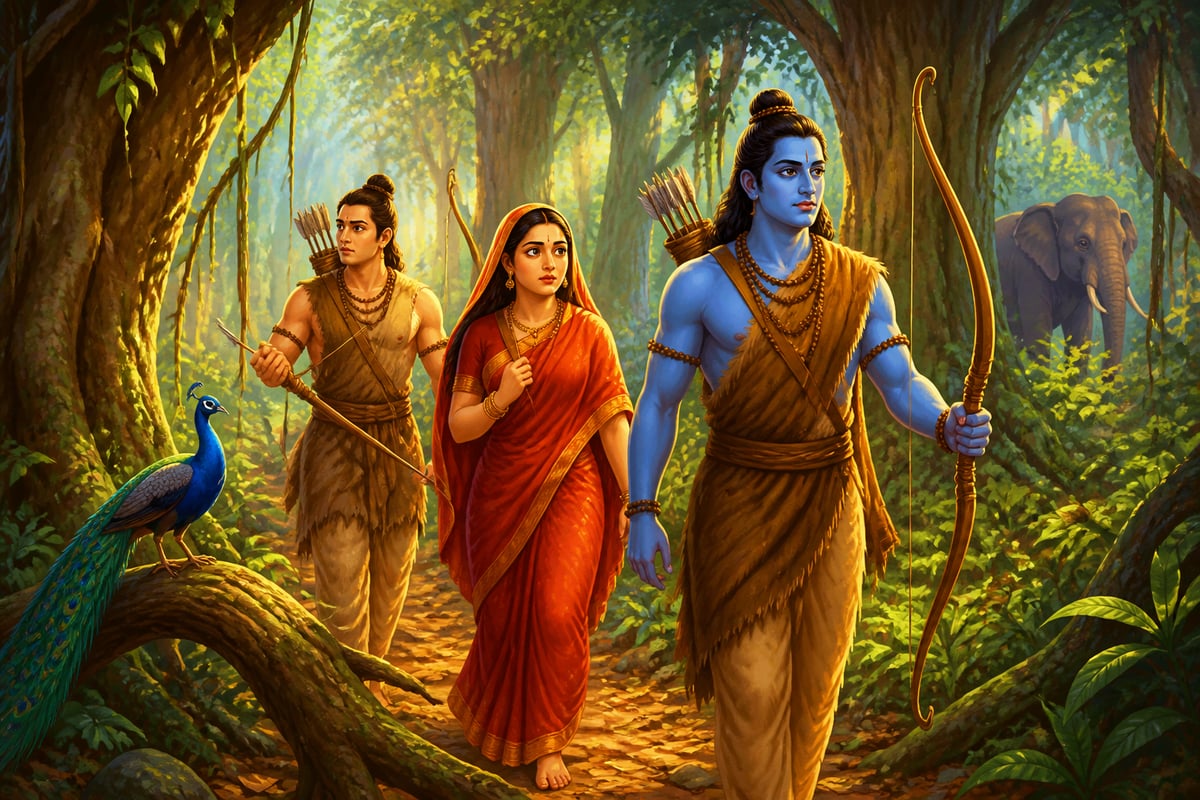
The sounds change too. Gone are the temple bells and market chatter of human settlements. Here, the forest speaks its own language: the trumpeting of elephants, the roar of lions, the calls of peacocks, and beneath it all, an ancient silence that seems to hold secrets older than time.

Sita walks between her husband and brother-in-law, her eyes wide with wonder and wariness. She has left behind the marble palaces of Mithila and Ayodhya, the gardens tended by hundreds of servants, the safety of city walls. Now her home is wherever they make camp, her protection the strong arms of Rama and Lakshmana.

Yet she does not complain. Not once does she speak of hardship. For Sita, being with Rama transforms any wilderness into a palace.

The Suffering Sages

As they journey deeper, Rama and his companions begin to encounter the hermitages of forest-dwelling sages. These rishis have chosen this remote wilderness precisely because of its isolation - they seek to perform intense tapas far from worldly distractions.

But isolation has made them vulnerable.

The first ashram they visit tells a story of terror. The sages gather around Rama, their matted hair and bark garments speaking of decades of austerity. But their eyes carry a different story - one of fear.

"O prince of Ayodhya," an elderly rishi speaks, his voice trembling, "we have heard of your coming. Word travels even through these wild places. You are the son of Dasharatha, famed for his protection of dharma. We beg you - help us."

Rama listens with growing concern as the sages describe their plight. Rakshasas - demons of terrifying power - have made the Dandaka their hunting ground. These are not ordinary predators seeking food. They specifically target those who perform Vedic rituals and maintain sacred fires.

"They come at night," another sage says, "or during the most sacred moments of our yajnas. They defile our offerings. They... they devour those who resist."

The sage cannot continue. Others take up the tale. They speak of ashrams destroyed, of fellow seekers slaughtered, of sacred texts burned, of sacrificial fires extinguished with blood.

"We are unarmed," the head of the ashram explains. "Our vows forbid us from violence. Our power lies in penance and prayer, not in warfare. Against these demons, we are helpless. Many of our brothers have fled. Those of us who remain do so only because our tapas binds us to this place. But every day, we wonder if it will be our last."

Rama's Dilemma

Rama stands before these suffering sages, and a profound question takes shape. He is a kshatriya - a warrior whose dharma commands him to protect the innocent. But he is also an exile, banished from his kingdom, technically stripped of his royal authority.

Does he have the right to wage war? Is he still a prince, or merely a forest hermit himself?

Lakshmana watches his brother, knowing the weight of this moment. Rama has always been guided by dharma, but dharma itself sometimes seems to pull in different directions.

Yet as Rama looks at the pleading faces before him - these gentle souls whose only crime is devotion to the divine - the answer becomes clear. Dharma is not merely about following rules. At its heart, dharma is about righteousness, about protecting those who cannot protect themselves, about standing against adharma wherever it appears.

"O noble sages," Rama speaks, his voice carrying the quiet authority that even exile cannot diminish, "I am indeed the son of Dasharatha. Though I wear the bark of a hermit rather than the silk of a prince, my dharma as a kshatriya remains unchanged. The strong must protect the weak. The armed must shield the peaceful. This is the eternal law."

He places his hand on his divine bow - the weapon he received from Parashurama himself.

"I give you my word. As long as I remain in this forest, I shall be your protector. No rakshasa shall harm those who have placed their trust in me. This is my solemn vow."

Forest sages pleading with Rama in their ashram clearing as he listens with bow at his side.

The Sacred Promise

The impact of Rama's words ripples through the gathering like wind through leaves. Sages who have lived in fear for years find tears streaming down their weathered faces. Some fall at Rama's feet in gratitude. Others raise their hands in blessing.

But one elderly sage, wiser than the rest, offers a word of caution:

"O Rama, your words fill our hearts with hope. But know this - the rakshasas of this forest are not ordinary demons. They are warriors of Ravana, the king of Lanka, whose power shakes the three worlds. His brother Khara commands fourteen thousand demons from a stronghold not far from here. To oppose them is to invite war with Lanka itself."

Rama's expression does not change. If anything, a subtle fire enters his eyes.

"Then let them come," he says simply. "Whether they number fourteen or fourteen thousand, whether their king rules Lanka or all the worlds - they shall learn that those who prey upon the innocent will find a reckoning. Dharma does not count the odds before it acts."

Lakshmana grips his own bow, a fierce joy visible on his face. He has been waiting for this - not because he desires violence, but because he burns to see justice done. These sages, with their gentle prayers and humble offerings, represent everything that deserves protection. The rakshasas, with their cruelty and desecration, represent everything that must be opposed.

Sita watches her husband with pride. She chose well when she placed the wedding garland around his neck. Here is not merely a prince or a warrior - here is dharma itself, taking human form.

A New Purpose in Exile

As they leave the first ashram and continue deeper into the Dandaka, something has fundamentally shifted. Rama's exile was meant as punishment - Kaikeyi's way of clearing the path for Bharata. But in this moment, what was meant for harm transforms into purpose.

Rama did not ask to be sent to the forest. But now that he is here, he finds a calling larger than any throne. The sages of the Dandaka need him. The balance between good and evil in this wild place has tilted toward darkness. And he - perhaps he alone - has the power to restore it.

"This is strange," Rama reflects as they walk. "In Ayodhya, I would have been king - responsible for one kingdom's welfare. Here in the forest, perhaps I can serve a different purpose. Perhaps this exile is not merely about enduring time until I can return. Perhaps there is work to be done."

Lakshmana nods. "The sages said there are many ashrams in this forest, brother. All of them living in fear. If we visit each one, offer our protection, establish our presence - the rakshasas will learn that the forest has a new guardian."

Sita adds quietly, "And when we finally return to Ayodhya, these years will not have been wasted in mere waiting. They will have been spent in service."

Rama looks at his wife and brother with deep affection. Both of them could have stayed behind - Sita in her father's house, Lakshmana in Ayodhya with Bharata. Both chose exile instead. And now both are helping him see that exile itself can become a form of seva, of sacred service.


The Deeper Meaning

The entry into Dandaka marks a crucial transition in the Ramayana. Rama moves from being a passive sufferer of injustice (accepting exile without protest) to an active agent of righteousness. The forest becomes his kingdom, the sages his subjects, and protection of the innocent his royal duty.

This transformation carries a profound teaching: circumstances do not determine our dharma - our response to circumstances does. Rama could have spent fourteen years simply waiting for his exile to end. Instead, he chooses to serve wherever he finds himself.

The sages' plight also illustrates a harsh truth about adharma: evil specifically targets those who represent goodness. The rakshasas do not attack random travelers - they attack those performing sacred rituals, those maintaining dharmic order. This is not coincidence but strategy. By destroying the sages, the demons seek to extinguish the very light of righteousness from the world.

Rama's promise to protect them is therefore more than a warrior's pledge. It is the universe's answer to the darkness: where evil concentrates its attacks, dharma will concentrate its defense.

Living traditions

The Dandakaranya region remains ecologically significant, with conservation efforts protecting the same forests Rama traversed. The Dandakaranya Project (1950s-60s) resettled refugees here, and tribal communities maintain traditions linking them to the Ramayana sages. Rama's immediate acceptance of responsibility for the vulnerable is cited in modern discussions of servant leadership and dharmic duty.

Reflection

More in Aranya Kanda

All lessons in Aranya Kanda ยท The Ramayana course