Institution Building
Think Tanks, Universities, and Independent Philanthropy
Civilizations survive not through ideas alone but through the institutions that produce, preserve, and transmit those ideas. This lesson examines India's institutional deficit, the Israeli model of civilizational institution building, the new grassroots digital paradigm of Indica Academy and Sangam Talks, and the historical precedent of Nalanda and Takshashila as proof that India once built the world's greatest knowledge institutions.
See It Today: A Nation of Nine Million That Out-Institutions 1.4 Billion
In 2024, Israel had a population of approximately 9.8 million people. Smaller than Bangalore. Yet consider what this tiny nation has built in institutional infrastructure.
Eight research universities, including Hebrew University (founded 1918, seven Nobel laureates), Technion (founded 1924, the MIT of the Middle East), and the Weizmann Institute of Science (founded 1934, consistently ranked among the world's top research institutions). Over fifty think tanks shaping global policy discourse: the Institute for National Security Studies, the Jerusalem Center for Public Affairs, the Begin-Sadat Center, the Shalem Center. A publishing ecosystem that produces more scientific papers per capita than any other nation on Earth. A lobbying infrastructure so sophisticated that AIPAC (American Israel Public Affairs Committee) is consistently ranked among the most influential lobbying organizations in Washington, shaping American foreign policy to align with Israeli civilizational interests.
Now consider India. A civilization of 1.4 billion people with five thousand years of continuous intellectual tradition. How many think tanks produce original civilizational scholarship on dharmic thought, Indic philosophy, or civilizational defense? How many universities offer rigorous programs in Indian Knowledge Systems that are not watered-down appendages of Western departments? How many publishing houses produce civilizational scholarship at global academic standards?
The numbers are sobering. India has over 1,000 universities, but the vast majority operate within intellectual frameworks imported from Western academia. The country that produced Nalanda and Takshashila, institutions that drew scholars from across Asia for over a millennium, today struggles to name five institutions producing world-class original scholarship on its own civilizational traditions.
This is not a failure of intellect. It is a failure of institution building. And it is the single most consequential gap in India's civilizational defense.
The Mechanism: Why Institutions Are the Skeleton of Civilization
Ideas do not survive on their own. They survive through institutions that produce them, preserve them, transmit them, and defend them against competitors.
Consider the lifecycle of any powerful idea. Someone conceives it. That idea must then be refined through debate and peer review (universities and academies). It must be documented and published (publishing houses and journals). It must be transmitted to the next generation (educational institutions). It must be defended against hostile reinterpretation (think tanks and advocacy organizations). It must be funded through all these stages (philanthropic foundations).
Remove any link in this chain and the idea dies within a generation. This is exactly what happened to vast domains of Indian knowledge. Ayurveda, Nyaya logic, Mimamsa hermeneutics, Vaisheshika atomic theory, Arthashastra statecraft: all of these represent sophisticated intellectual traditions that atrophied not because they were intellectually defeated but because the institutions that sustained them were systematically destroyed or captured.
The destruction happened in three waves.
The first wave was physical destruction. Islamic invasions between the 12th and 16th centuries targeted knowledge institutions directly. Bakhtiyar Khilji's destruction of Nalanda in 1193 CE was not an isolated incident. Vikramashila, Odantapuri, Jagaddala, and Somapura were all razed in the same campaign. The libraries of Kashmir, documented by Kalhana in the Rajatarangini, were repeatedly looted. Each destruction eliminated not just buildings but the institutional networks of scholars, students, and patrons that kept knowledge alive.
The second wave was institutional capture. The British colonial education system, implemented through Macaulay's 1835 Minute on Education, did not simply add English education. It systematically defunded and delegitimized indigenous knowledge institutions. Tols (Sanskrit learning centers in Bengal), madrasas of classical learning, and temple-based educational networks lost state patronage. The 1854 Wood's Despatch formalized the replacement: British-model universities in Calcutta, Bombay, and Madras became the only path to government employment and social status.
The third wave continues today. Post-independence India inherited the colonial institutional framework and, in many cases, deepened its alienation from civilizational roots. University departments of history, sociology, and political science overwhelmingly operate within Western theoretical frameworks. The Marxist capture of institutions like JNU, documented extensively by scholars such as Arun Shourie and S.N. Balagangadhara, created an intellectual establishment that was often actively hostile to civilizational scholarship.
The result is what Rajiv Malhotra calls "epistemic dependence." India imports its intellectual frameworks from Western academia and then uses those imported frameworks to understand itself. This is not a minor inconvenience. It is a civilizational security threat. A civilization that cannot produce its own knowledge about itself is a civilization that has outsourced its self-understanding to others.
The Pattern: What India Once Built
The institutional deficit is especially painful because India has historical proof that it once built the greatest knowledge institutions on Earth.
Takshashila (known to the Greeks as Taxila) may have been the world's first organized center of higher learning. Operating from roughly the 7th century BCE, it predated Plato's Academy by at least two centuries. Chanakya studied and taught there. Charaka developed his medical treatises there. Panini composed his grammar there. The institution did not grant degrees in the modern sense, but it operated as a magnet for scholars across the subcontinent and beyond, with formal teacher-student relationships and structured curricula across 68 documented subjects.
Nalanda, founded in the 5th century CE during the Gupta period, operated continuously for over 700 years. At its peak, it housed over 10,000 students and 2,000 teachers. Students came from Tibet, China, Korea, Japan, Indonesia, Persia, and Turkey. The Chinese scholar Xuanzang, who studied there from 631 to 645 CE, documented a campus with eight separate compounds, ten temples, meditation halls, lakes, and a library complex of three multi-story buildings called Ratnasagara (Ocean of Jewels), Ratnodadhi (Sea of Jewels), and Ratnaranjaka (Jewel Adorner). The library collection was so vast that when Bakhtiyar Khilji's forces set it ablaze in 1193, accounts record that the manuscripts burned for months.
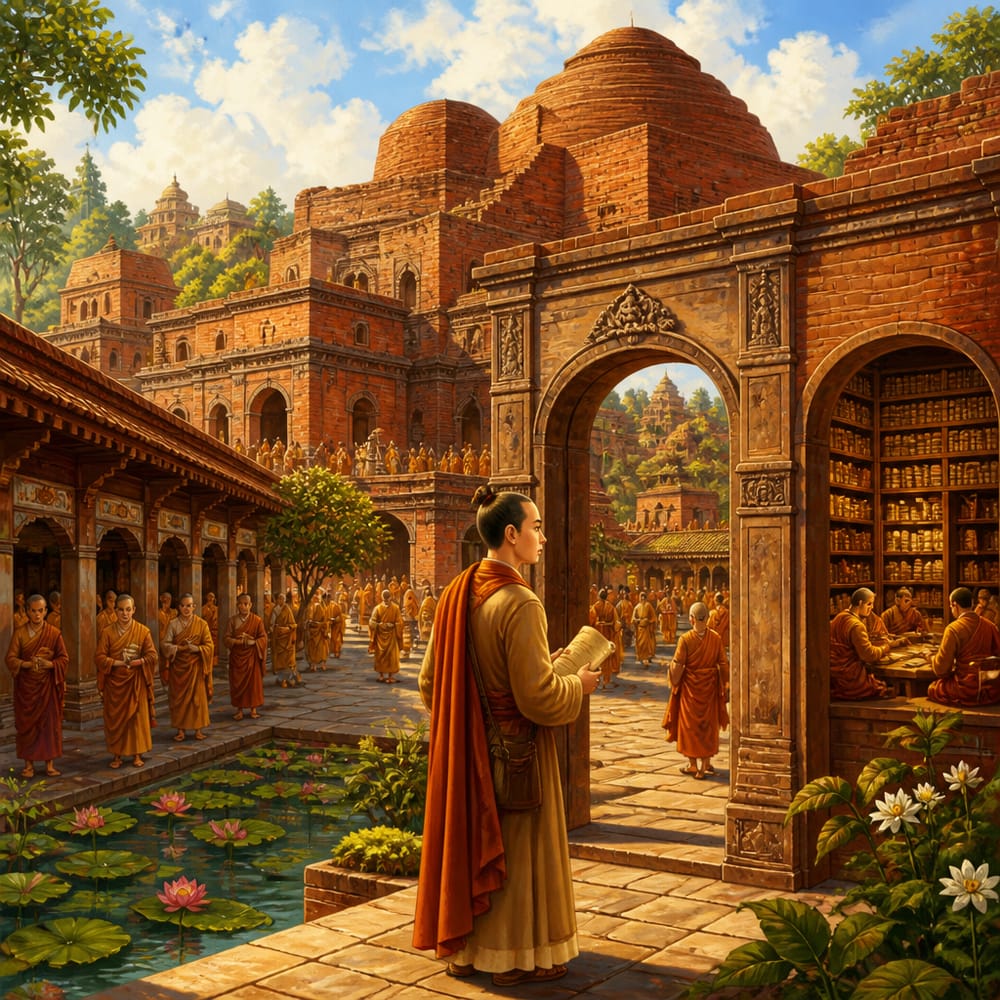
These were not isolated exceptions. Vikramashila in Bihar was renowned for tantric studies and logic. Vallabhi in Gujarat specialized in Hinayana Buddhism and secular subjects. Kanchipuram in Tamil Nadu functioned as a center of learning for Shaivism, Vaishnavism, Jainism, and Buddhism simultaneously. Mithila in Bihar was the premier center of Nyaya logic for centuries.
The critical point is this: India did not merely have great thinkers. It had great institutions that systematically produced, tested, and transmitted great thinking. The difference matters. Great thinkers without institutions are shooting stars. Great institutions produce generation after generation of great thinkers.
The Model: How Israel Built Its Institutional Ecosystem

Israel offers the most instructive modern model for civilizational institution building, not because its politics should be emulated but because its institutional strategy demonstrates what a small, embattled civilization can achieve through deliberate planning.
The Israeli institutional ecosystem was not an accident. It was built decades before the state itself existed. Chaim Weizmann, a chemist who would become Israel's first president, understood that a nation needs knowledge institutions before it needs a military. He founded the Weizmann Institute (originally the Daniel Sieff Research Institute) in 1934, fourteen years before Israeli independence. Hebrew University of Jerusalem was established in 1918, thirty years before statehood. Technion was founded in 1924.
This sequencing is crucial. The Zionist movement built universities and research centers first, then used the human capital those institutions produced to build the state. India's civilizational movement has largely attempted the reverse: political mobilization first, institutional infrastructure as an afterthought.
Israel's institutional strategy operates across five domains.
Knowledge production. Eight research universities for 9.8 million people. Israel produces more scientific papers per capita and more patents per capita than any other nation. The universities are not merely technical. Hebrew University's departments of Jewish philosophy, Jewish history, and Hebrew literature ensure that civilizational self-knowledge is produced at the highest academic standards.
Policy shaping. Over fifty think tanks produce policy research that shapes both Israeli domestic policy and global discourse about Israel. The Institute for National Security Studies (INSS) at Tel Aviv University publishes research that directly influences military and diplomatic strategy. These are not blogs or opinion pages. They are rigorous research institutions staffed by former generals, diplomats, and academics.
Global advocacy. AIPAC and a network of related organizations ensure that Israeli civilizational interests are represented in the corridors of American power. In 2024, AIPAC spent over $100 million on political campaigns. Whether one agrees with their positions or not, the institutional sophistication is undeniable.
Cultural transmission. The Birthright Israel program has sent over 800,000 young diaspora Jews on free trips to Israel since 1999, funded entirely by private philanthropy. This is civilizational identity maintenance through institutional design.
Independent funding. Israeli institutions are funded through a combination of government support and independent philanthropy, much of it from the global Jewish diaspora. This dual funding model ensures institutional independence from any single patron.
The lesson for India is not to copy Israel's specific institutions but to understand the principle: civilizational survival requires a deliberate, multi-domain institutional ecosystem, planned and funded generations in advance.
The New Paradigm: Digital-First Civilizational Institutions
While the Israeli model represents top-down, well-funded institution building, a parallel revolution is happening in India through grassroots, digital-first civilizational knowledge platforms.

Indica Academy (the Indic Academy Trust), founded by Hari Kiran Vadlamani, represents a new model of civilizational institution building. Rather than attempting to build a single large university, Indica operates as a distributed knowledge ecosystem. Indica Courses offers structured learning in Indic subjects from Sanskrit to Arthashastra. Indica Books publishes civilizational scholarship. Sangam Talks, their YouTube lecture platform, hosts over 500 recorded lectures by scholars, authors, and practitioners on Indic civilization, drawing hundreds of thousands of viewers.
The economics of this model are revolutionary. A traditional university requires hundreds of crores in capital, decades of accreditation battles, and ongoing operational funding. Indica's digital-first model reaches a comparable audience for a fraction of the cost. A single Sangam Talks lecture can reach more people than a university professor reaches in an entire career of classroom teaching.
Srijan Foundation operates a similar model with a focus on civilizational discourse and counter-narrative building. Their events, publications, and digital content create an institutional backbone for ideas that would otherwise have no platform.
These grassroots institutions share several characteristics that make them a genuine new paradigm. They are funded primarily by Indian donors, avoiding the dependency on foreign funding that compromises institutional independence. They are digital-first, giving them reach that physical institutions cannot match. They are networked rather than hierarchical, creating an ecosystem rather than a single point of failure. And they are run by practitioners who are building institutions out of civilizational conviction rather than career calculation.
The limitation of this model is also clear: digital platforms cannot yet grant degrees, conduct laboratory research, or produce the kind of peer-reviewed scholarship that shapes global academic discourse. The grassroots digital model and the traditional university model are not substitutes. They are complements. India needs both.
Dharmic Wisdom: Sangha and the Institutional Dharma
The Buddha did not simply teach the Dhamma. He built the Sangha: an institutional framework designed to preserve and transmit his teachings across generations. The Sangha is perhaps the world's oldest continuously operating institution, surviving 2,500 years through political upheavals, invasions, and cultural transformations.
The genius of the Sangha was its institutional design. It had clear rules of governance (the Vinaya). It had a process for resolving disputes. It had a mechanism for training new members. It had a funding model (alms and lay patronage). It had a system for quality control (the councils that periodically reviewed and standardized the teachings). Every element that modern institutional theory identifies as critical for organizational survival was built into the Sangha's design.
The Arthashastra extends this institutional thinking to statecraft. Kautilya devotes extensive attention to the design of institutions: how to structure bureaucracies, fund educational establishments, maintain intelligence networks, and create systems that outlast individual rulers. His concept of Yogakshema (the state's obligation to maintain conditions for public welfare and prosperity) is fundamentally institutional. It is not about the virtue of individual rulers but about the design of systems that produce good governance regardless of who occupies the throne.
The Dharmic tradition also provides a framework for funding institutions through Dana (philanthropic giving). The Dharmashastra literature extensively discusses the merit of funding vidya (knowledge) and the obligations of those with wealth to support learning. The Gupta emperors did not merely patronize individual scholars. They endowed institutions: Nalanda received land grants, tax revenues, and village incomes that sustained it for centuries independent of any single patron's lifespan.
This is the critical insight. Civilizational institutions must outlast their founders. Personal charisma builds movements. Institutional design builds civilizations. The Sangha survived the Buddha. Nalanda survived its founders by seven centuries. Israel's institutions were designed to outlast any individual leader. India's civilizational renewal requires institutions built with the same long-term architectural thinking.
The Blueprint: Five Pillars of Civilizational Institution Building
What would a comprehensive Indian civilizational institutional ecosystem look like? Based on the Israeli model, historical precedent, and the grassroots innovations already underway, five pillars emerge.
Pillar 1: Civilizational Think Tanks. India needs at least ten well-funded think tanks producing rigorous research on civilizational themes: Indic philosophy, dharmic economics, temple heritage, Sanskrit knowledge systems, and civilizational security. These must operate at international academic standards, publish in peer-reviewed formats, and engage with global policy discourse. Infinity Foundation, Vivekananda International Foundation, and India Foundation represent early examples, but the scale needs to increase by an order of magnitude.
Pillar 2: Knowledge-Producing Universities. India needs universities and research centers dedicated to producing original civilizational scholarship. The Indian Knowledge Systems (IKS) initiative under NEP 2020 is a beginning, but standalone institutions dedicated to Nyaya, Mimamsa, Ayurveda, Arthashastra, and other Indic knowledge traditions, operating at global standards, do not yet exist at sufficient scale. The model should follow Technion and Weizmann: focused excellence rather than sprawling mediocrity.
Pillar 3: Publishing and Media Infrastructure. A civilization that does not publish does not exist in global intellectual discourse. India needs civilizational publishing houses that produce scholarship, textbooks, translations, and popular works at global quality standards. It needs academic journals dedicated to Indic civilization. It needs digital media platforms that reach both elite and mass audiences. Indica Books and a handful of others are pioneering this, but the gap between Indian civilizational publishing output and, say, the volume of scholarship produced about ancient Greece or Chinese civilization remains enormous.
Pillar 4: Independent Philanthropic Foundations. Every institution needs funding, and the source of funding determines institutional independence. Indian civilizational institutions must be funded primarily by Indian philanthropists and the Indian diaspora. Dependence on FCRA-route foreign funding creates the same vulnerability that this course has documented across eight chapters: foreign money comes with foreign agendas. The Israeli model of diaspora philanthropy, where the global Jewish community funds Israeli institutions as a civilizational obligation, is directly replicable for the Indian diaspora.
Pillar 5: Digital Knowledge Networks. The Indica Academy and Sangam Talks model should be scaled and replicated. Digital platforms can reach millions at low cost, create communities of civilizational learning, and serve as the connective tissue between physical institutions. They are the modern equivalent of the pilgrimage networks that once connected Kashi to Rameswaram: pathways for civilizational knowledge to flow across geographic boundaries.
None of these pillars can function alone. Think tanks produce ideas. Universities train the people who staff think tanks. Publishing houses disseminate what both produce. Philanthropic foundations fund all of them. Digital networks connect everything to the wider public. The ecosystem is the institution. No single organization can substitute for the system.
The Defense: From Consumers to Producers of Knowledge
The institutional deficit is India's most consequential civilizational vulnerability. Without institutions that produce, preserve, and transmit civilizational knowledge at global standards, India remains a consumer of Western intellectual frameworks applied to Indian realities. This is epistemic colonialism by another name.
But the historical evidence proves the capacity exists. A civilization that built Nalanda and Takshashila, that designed the Sangha to survive 2,500 years, that produced the Arthashastra's institutional theory millennia before Western management science, does not lack the intellectual DNA for institution building.
The grassroots movement is already underway. Indica, Sangam Talks, Srijan Foundation, and dozens of smaller initiatives prove that the civilizational will exists. What is needed now is scale, professionalization, and the long-term thinking that builds institutions designed to outlast their founders by generations.
The previous lessons in this chapter addressed what Indians should think. This lesson addresses the infrastructure needed for that thinking to survive. Ideas without institutions are sparks without kindling. Institutions without ideas are empty shells. The civilizational renaissance requires both.
Israel built its institutional ecosystem before it built its state. India already has its state. The institutional ecosystem is overdue.
Case studies
Israel's Institutional Ecosystem: How 9 Million People Built Civilizational Infrastructure
Israel, a nation of approximately 9 million people, has built one of the most formidable institutional ecosystems in the modern world. Hebrew University was founded in 1918, before the state itself existed. The Technion (Israel Institute of Technology) followed in 1924, and the Weizmann Institute of Science in 1934. Today, Israel maintains 8 world-class research universities for its small population. Beyond academia, Israel built AIPAC into the most powerful foreign policy lobby in Washington, and developed Hasbara (public diplomacy) into a sophisticated civilizational narrative apparatus that operates across media, academia, and political institutions globally. Each component reinforces the others: universities produce research, think tanks translate it into policy, lobbying organizations push that policy into legislation, and Hasbara ensures the civilizational narrative remains coherent internationally.
The Arthashastra's concept of Danda extends beyond military force to institutional strength, the ability to project and defend civilizational interests through organized structures. Israel's institutional ecosystem is Danda in its most sophisticated modern form. Kautilya wrote that a king without institutions is like a tree without roots: standing, but unable to withstand any storm. Israel understood that civilizational survival required building institutional Danda before the state even existed. The universities came first, then the state. This mirrors the Arthashastra's insistence that the strength of a kingdom lies in its systems, not its territory.
Israel produces more per-capita scientific publications, patents, and startups than any country in the world. Its lobby infrastructure ensures sustained Western political and military support. Its universities generate both the human capital and the intellectual frameworks that sustain national identity. The Weizmann Institute alone has produced 4 Nobel laureates. This institutional ecosystem has allowed a nation of 9 million to project civilizational influence disproportionate to its size, maintaining strategic relevance against adversaries with populations 20 to 100 times larger.
Civilizational survival is not secured by population size or territorial expanse. It is secured by the density and quality of institutions. A small nation with world-class institutions can outperform a large nation with mediocre ones. Institution building must precede and outlast any single political regime.
India has approximately 1,000 universities for 1.4 billion people, yet very few produce original civilizational scholarship. India has no equivalent of AIPAC for coordinating its diaspora's political influence, no equivalent of Hasbara for narrative coherence, and no research university ranked consistently in the global top 50. The contrast is stark: Israel built institutions first and statehood followed. India achieved statehood in 1947 but has not yet built the institutional ecosystem that civilizational defense requires.
Israel has 8 research universities for 9 million people (1 per 1.1 million). India has roughly 1,000 universities for 1.4 billion people, but fewer than 10 produce significant original research in civilizational studies. Israel spends 5.4% of GDP on R&D (the highest in the world). India spends approximately 0.7%.
Indica Academy and Sangam Talks: The Digital Gurukul Model
In the 2010s, a new model of civilizational knowledge dissemination emerged in India. Indica Academy (founded by Indic Academy Trust) began running structured courses on Indic thought, philosophy, and civilizational studies. Sangam Talks launched as a YouTube-based platform featuring over 500 lectures by scholars, practitioners, and public intellectuals on topics ranging from temple architecture to Arthashastra to decolonization of education. Srijan Foundation complemented this ecosystem by organizing conferences, publishing research, and building networks of civilizational scholars. These organizations share a common DNA: they are grassroots, digital-first, decentralized, and operate at a fraction of the cost of traditional academic institutions. They bypassed the captured university system entirely, taking civilizational education directly to the public.
This ecosystem represents a modern reincarnation of the Gurukul model. The ancient Gurukul was not a centralized institution with a campus and bureaucracy. It was a knowledge transmission network organized around individual teachers and their students, distributed across geography, accessible to seekers regardless of location. Indica Academy and Sangam Talks replicate this structure using digital tools. The teacher speaks; the student listens and reflects. The knowledge flows directly, without institutional gatekeepers. The Arthashastra emphasizes that Vidya (knowledge) is the true foundation of all power. These platforms restore direct access to civilizational Vidya that the captured university system had blocked.
Sangam Talks has accumulated millions of views across 500+ lectures, creating a digital library of civilizational scholarship that did not exist a decade ago. Indica Academy has trained hundreds of students in structured courses on Indic philosophy, temple studies, and Sanskrit. Srijan Foundation's conferences have connected scholars who were previously isolated in hostile academic environments. Together, this ecosystem has created a parallel knowledge infrastructure outside the university system, proving that civilizational education does not require billion-dollar endowments or government approval.
When existing institutions are captured or hostile, the response is not to abandon institution building but to build new institutions using new models. The digital-first, decentralized approach reduces costs, eliminates gatekeepers, and enables scale that traditional institutions cannot match. The Gurukul model was always distributed. Technology has made it global.
The Indica/Sangam model demonstrates that civilizational institution building no longer requires capturing existing universities or lobbying for policy changes. A motivated group of scholars with digital tools can reach more students than many traditional universities. This is the template for scaling civilizational education: low cost, high reach, decentralized, and resistant to capture because there is no single node to attack.
Sangam Talks features over 500 lectures by scholars on Indic civilizational topics, with content freely accessible on YouTube. Indica Academy runs structured courses at a fraction of the cost of formal university programs. The combined reach of these platforms exceeds that of most Indian university departments focused on Indic studies, at less than 1% of the operational budget.
Nalanda and Takshashila: The Original Knowledge Superpowers
India once built the greatest knowledge institutions the world had ever seen. Takshashila (modern Taxila, Pakistan), possibly the world's first university, operated from approximately 700 BCE. It taught Chanakya (who strategized the Mauryan Empire), Charaka (who founded Ayurvedic medicine), and Panini (who formalized Sanskrit grammar). Students from across the subcontinent traveled to study there. Nalanda, founded in the 5th century CE, scaled this model to unprecedented levels: 10,000 students from Tibet, China, Korea, Indonesia, and Central Asia studied at a campus with 9 million volumes in its library. The Chinese scholar Xuanzang spent 5 years there and described it as the greatest center of learning he had encountered. Both institutions were destroyed by invaders. Takshashila declined after successive invasions from the 5th century CE onward. Nalanda was burned by Bakhtiyar Khilji's forces in 1193 CE. Its library reportedly burned for three months.
The Arthashastra itself is a product of this institutional ecosystem. Chanakya studied and taught at Takshashila before building the Mauryan Empire. The knowledge that produced India's greatest strategic treatise was cultivated in India's greatest institution. This demonstrates the Arthashastra's own principle: Vidya (knowledge) is the source of all Artha (wealth, power, security). Takshashila and Nalanda were not merely universities. They were the civilizational Danda of Bharatiya knowledge, projecting intellectual power across Asia. Their destruction was not incidental to India's civilizational decline. It was the primary cause. A civilization that loses its knowledge institutions loses the capacity to regenerate.
The destruction of Nalanda and Takshashila created a knowledge vacuum that India has never fully recovered from. Centuries of accumulated scholarship in philosophy, medicine, mathematics, astronomy, and governance were lost. The intellectual infrastructure that had made India a knowledge exporter to all of Asia was eliminated in a generation. In 2014, the Indian government re-established Nalanda University in Rajgir, Bihar. While symbolically significant, the new institution is still in its early stages and has not yet approached the scale or influence of its predecessor.
India did not lack the capacity for world-class institution building. It demonstrated that capacity for over a millennium. The loss was inflicted from outside, not caused by internal inability. The task of institution building is therefore not invention but reactivation. The civilizational DNA for building knowledge superpowers exists. It needs resources, vision, and protection.
The revival of Nalanda University in 2014 signals intent but not yet execution. India's challenge today is not whether it can build great institutions (history proves it can) but whether it will commit the resources, strategic vision, and civilizational will to do so again. Every IIT, every research center, every Indica Academy is a small step toward rebuilding what Takshashila and Nalanda once represented: India as the world's knowledge capital.
At its peak, Nalanda housed 10,000 students and 2,000 teachers from across Asia. Its library of 9 million manuscripts (the Dharmaganja, or 'Treasury of Truth') was contained in three multi-story buildings. When Bakhtiyar Khilji's forces burned it in 1193 CE, the library reportedly burned for three months. Takshashila, operating from approximately 700 BCE, predates Plato's Academy (387 BCE) by over three centuries.
Reflection
- What institutions, think tanks, or knowledge organizations do you currently support with your time, money, or attention? If the answer is none, what prevents you from contributing to civilizational institution building in your own capacity?
- Nalanda and Takshashila were among the greatest knowledge institutions in human history, attracting scholars from across Asia for centuries. Why did India lose this tradition of institutional scholarship, and what does its absence mean for civilizational continuity today?
- Is civilizational revival better served by grassroots, organic knowledge movements (like Indica Academy and Sangam Talks) or by planned, well-funded institutional strategy (like Israel's think tank ecosystem)? Can one succeed without the other?