Temple Ecosystem Revival
Restoring Temples as Institutions of Education, Economy, and Culture
For most of Indian history, temples were not just places of worship. They were the operating system of civilization: running schools, funding hospitals, employing artisans, managing agricultural land, financing trade, and anchoring entire regional economies. British colonial policy and post-independence government control reduced these multidimensional institutions to mere prayer halls. But the blueprint was never lost. Sringeri Sharada Peetham has operated continuously for over 1,200 years, running Sanskrit schools, modern education, healthcare, and community welfare without a single rupee of government funding. The Chidambaram Nataraja Temple's legal victory against state takeover proved that communities can reclaim institutional sovereignty through the courts. Japan's Shinto shrine network offers an international parallel: self-governing sacred institutions that serve as community anchors for education, welfare, and cultural continuity. Temple revival is not nostalgia. It is the reconstruction of India's most proved institutional model for delivering education, economic opportunity, and cultural continuity at scale.
See It Today: Sringeri's Quiet Revolution
In the hills of Karnataka's Chikkamagaluru district, an institution founded by Adi Shankaracharya around 800 CE continues to operate exactly as it was designed: as a complete civilizational ecosystem.
Sringeri Sharada Peetham runs Sanskrit pathashalas where students learn Vedic chanting, grammar, and philosophy through the traditional guru-shishya method. It simultaneously operates modern schools and colleges that teach science, mathematics, and technology. It runs a hospital providing free healthcare to surrounding villages. It feeds thousands daily through its Annadana program. It maintains a library preserving rare manuscripts. It supports artisans who create traditional temple art, sculpture, and ritual objects.
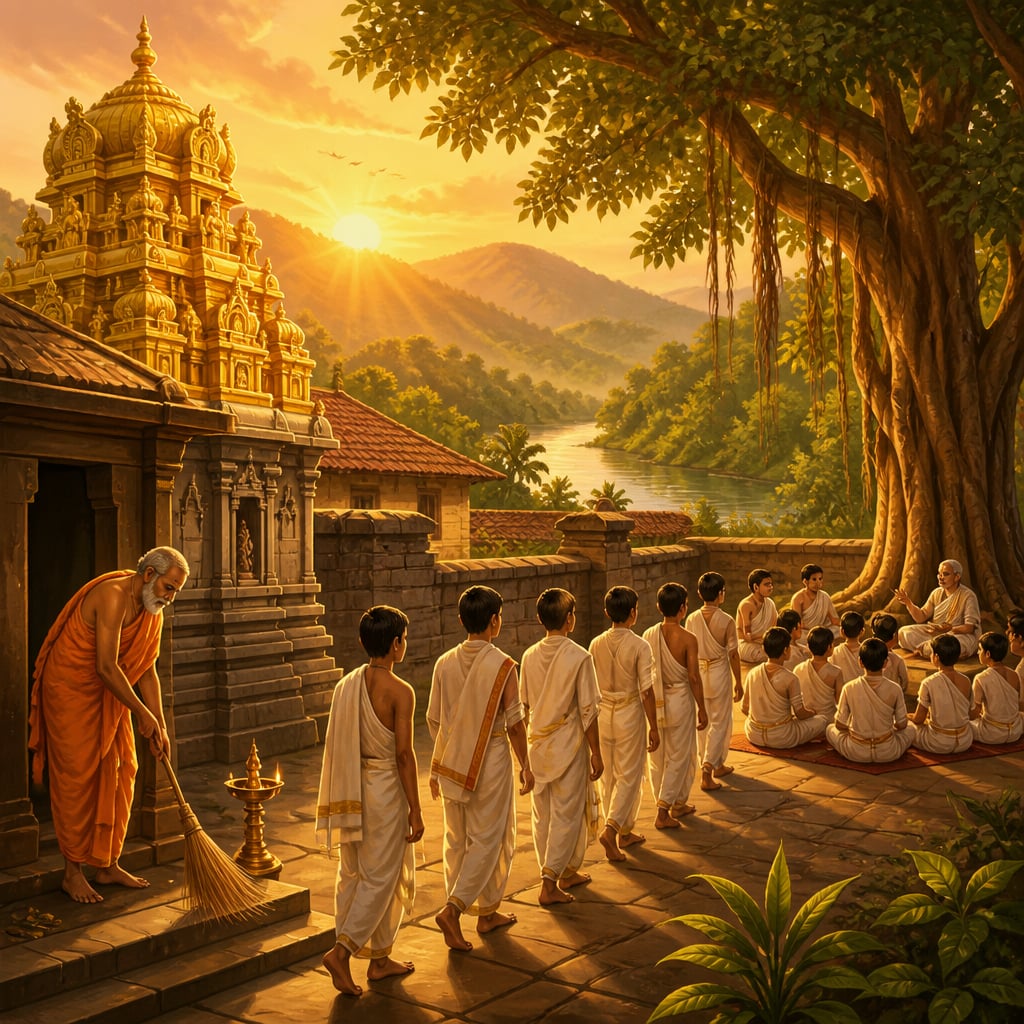
All of this runs without a single rupee of government funding or government control. The Peetham is managed by the Shankaracharya's lineage, the same unbroken parampara (succession) that has governed it for twelve centuries. It generates revenue through devotee contributions, agricultural land, and endowments managed by the matha itself.
Sringeri is not an anomaly. It is a living proof of concept. It demonstrates that the temple-matha ecosystem, when free from external interference, naturally generates the full spectrum of civilizational services: education, healthcare, food security, cultural preservation, and economic activity. The question for Indian civilization is not whether this model works. Sringeri proves it does. The question is why most temples in India have been stripped of the ability to function this way, and how to restore it.
The Mechanism: How Temple Ecosystems Actually Worked
The modern Indian understands a temple as a place you visit to pray and leave. This is the impoverished version. For most of Indian history, a temple was something closer to a university, a bank, an art academy, a hospital, and a community center rolled into one. Understanding how that ecosystem functioned is the first step toward rebuilding it.
The Five Functions of the Temple Ecosystem
Education hub. Temples were the primary sites of learning in pre-colonial India. The great temple complexes of Thanjavur, Madurai, Kanchi, and Varanasi housed schools teaching everything from Vedic literature and Sanskrit grammar to astronomy, mathematics, medicine, and the performing arts. The agrahara system attached to temples provided residential quarters for scholars and students. Temple inscriptions from the Chola period document endowments specifically designated for maintaining teachers and feeding students. Education was not a side activity of temples. It was a core function.
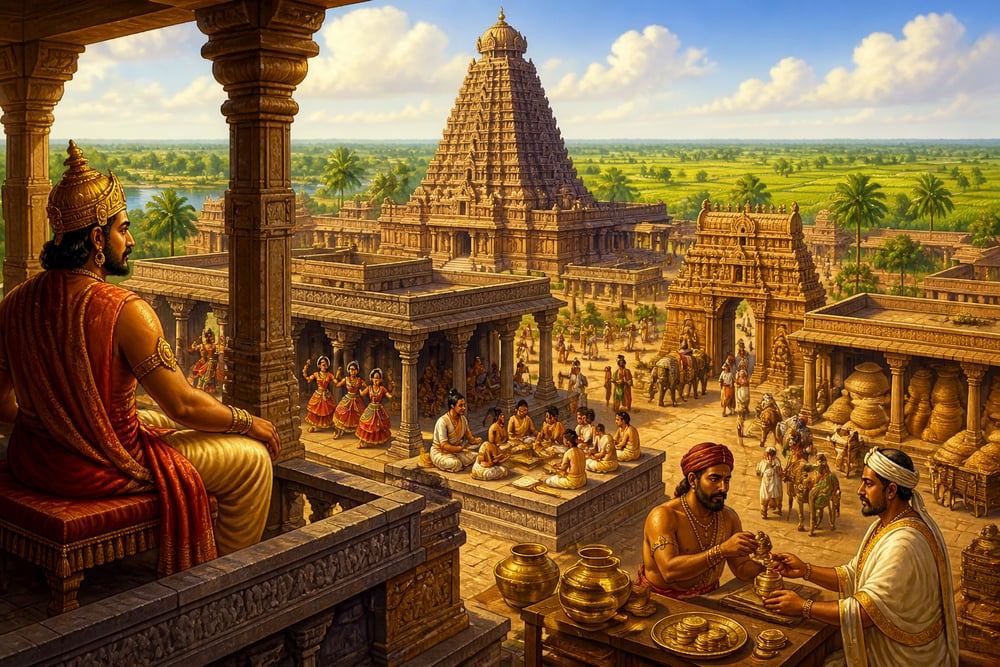
Economic engine. Temples were the largest landholders and employers in their regions. Thanjavur's Brihadeeswarar Temple during the Chola dynasty employed over 400 people directly: priests, musicians, dancers, sculptors, garland makers, cooks, accountants, and administrators. Temple lands generated agricultural revenue. Temple treasuries functioned as banks, providing loans to merchants and farmers. The temple was the anchor institution of the local economy, and its festivals were the primary drivers of regional trade. Pilgrim networks created inter-regional economic corridors that connected distant parts of the subcontinent.
Cultural conservatory. Every classical Indian art form was incubated, refined, and preserved within the temple ecosystem. Bharatanatyam was temple dance before it was stage performance. Carnatic and Hindustani music traditions were maintained by temple musicians. Sculpture, metalwork, painting, and textile arts were produced by artisan guilds attached to temples. The temple was not a patron of the arts in the way a European monarch might commission a painting. It was the institutional home of the arts, the place where artistic traditions lived, were transmitted, and evolved across generations.
Welfare system. Temples operated the most extensive pre-modern welfare infrastructure in the subcontinent. Annadana (free food distribution) was a daily function, not a special event. Chatrams (rest houses) along pilgrimage routes provided free lodging for travelers. Temple-attached vaidyashalas provided medical care. Endowments funded marriages for families that could not afford them, supported widows, and maintained facilities for the elderly. This welfare function was funded by temple revenues and managed by temple administrators, creating a decentralized safety net that required no centralized state apparatus.
Governance node. Temples served as sites of community governance. Village assemblies (sabhas) often met in temple premises. Disputes were adjudicated by temple-associated panchayats. Temple records served as legal documents for land transactions, contracts, and community agreements. The temple was the institutional anchor around which community self-governance organized itself.
What Broke This System
Lesson 08_04 documented the diagnosis in detail. The short version: British colonial policy systematically dismantled temple economic power by confiscating temple lands, redirecting temple revenues, and placing temples under government-appointed boards. Post-independence India inherited and deepened this structure through state-level Hindu Religious and Charitable Endowments (HR&CE) departments that control temple finances, appoint administrators, and divert temple revenue to state coffers. No other religious institution in India faces this level of government control. Churches manage their own properties and finances. Waqf boards manage Muslim endowments with constitutionally protected autonomy. Only Hindu temples operate under a regime where the state collects their revenue, appoints their managers, and determines how their funds are spent.
The result is predictable. Temples stripped of economic autonomy cannot fund education. Temples managed by bureaucrats rather than devotees cannot maintain artistic traditions. Temples whose revenue is diverted to state treasuries cannot operate welfare programs. The ecosystem was not destroyed by neglect. It was systematically dismantled by policy, and it can be systematically rebuilt by reversing those policies.
The Pattern: Japan's Shinto Shrine Network
Japan offers the clearest international parallel of what a functioning temple ecosystem looks like in a modern, industrialized democracy.
Japan has approximately 80,000 Shinto shrines, most managed by hereditary priestly families or local community boards. These shrines are not government-controlled. They are self-governing institutions that serve as community anchors across the country.
A typical Shinto shrine in Japan does far more than host prayers. It runs a kindergarten or preschool. It manages community festivals that drive local tourism and economic activity. It maintains green spaces and forested areas (chinju no mori, sacred groves) that serve as ecological preserves. It provides social welfare services for the elderly and vulnerable community members. It serves as the site of coming-of-age ceremonies, weddings, New Year celebrations, and seasonal festivals that mark the rhythm of community life.
The shrine's economic model is self-sustaining. Revenue comes from omamori (amulets), goshuin (calligraphy stamps collected by pilgrims), fees for ceremonies, community contributions, and income from shrine-owned properties. The shrine manages its own finances, employs its own staff, and makes its own decisions about how to serve its community.
The critical point: Japan modernized without destroying its shrine network. During the Meiji Restoration (1868), the government initially tried to bring shrines under state control through the shinbutsu bunri (separation of Shinto and Buddhism) and the creation of a state Shinto apparatus. Post-World War II reforms in 1945 separated shrines from the state, giving them institutional autonomy. The result was not the death of the shrine system but its revitalization. Freed from state bureaucracy, shrines adapted to modern needs while maintaining their traditional functions.
The lesson for India is structural. Japan's shrines thrive because they have three things that most Indian temples lack: financial autonomy (they control their own revenue), governance autonomy (they appoint their own leadership), and functional autonomy (they decide what services to provide). Remove any of these three, and the ecosystem collapses. Restore all three, and the ecosystem regenerates naturally.
Dharmic Wisdom: The Temple as Brahma-Sthana
The Agama Shastras, the foundational texts governing temple construction and ritual, do not describe a temple as merely a house of worship. They describe it as a Brahma-sthana, a place where the cosmic and the social intersect. The temple is designed as a microcosm of the universe. Its architecture maps the cosmic order. Its rituals maintain the relationship between the divine and the human. Its institutional functions serve as the practical infrastructure through which dharma operates in daily life.
This is why reducing a temple to a "place of worship" is not just an administrative choice. It is a philosophical mutilation. When the Agamas prescribe that a temple must have a patha-shala (school), a vaidya-shala (clinic), an anna-kshetra (food hall), and a natya-shala (performance hall), they are not listing optional amenities. They are describing the minimum functions that make a temple a Brahma-sthana rather than a shrine.
The matha tradition, established by Adi Shankaracharya with the four Amnaya Peethams (Sringeri, Puri, Dwaraka, Jyotirmath), institutionalized this principle. Each matha was designed as a complete ecosystem: a center of learning, debate, cultural production, and social service anchored by a spiritual lineage. The Shankaracharya was not merely a religious figurehead. He was the chief executive of an institutional ecosystem that served the civilizational needs of an entire region. The sampradaya (spiritual lineage) was the governance mechanism that ensured continuity across generations without depending on any single individual or state authority.
Reviving the temple ecosystem is therefore not innovation. It is restoration. The blueprints exist in the Agamas. The institutional model exists in the mathas. The proof of concept exists in Sringeri. What is required is the political will to restore institutional sovereignty to the institutions themselves.
The Defense: A Five-Point Blueprint for Temple Ecosystem Revival
The diagnosis was covered in Lesson 08_04. Here is the prescription. Temple ecosystem revival requires action on five fronts, in sequence.
1. Legal Liberation: Free Temples from State Control
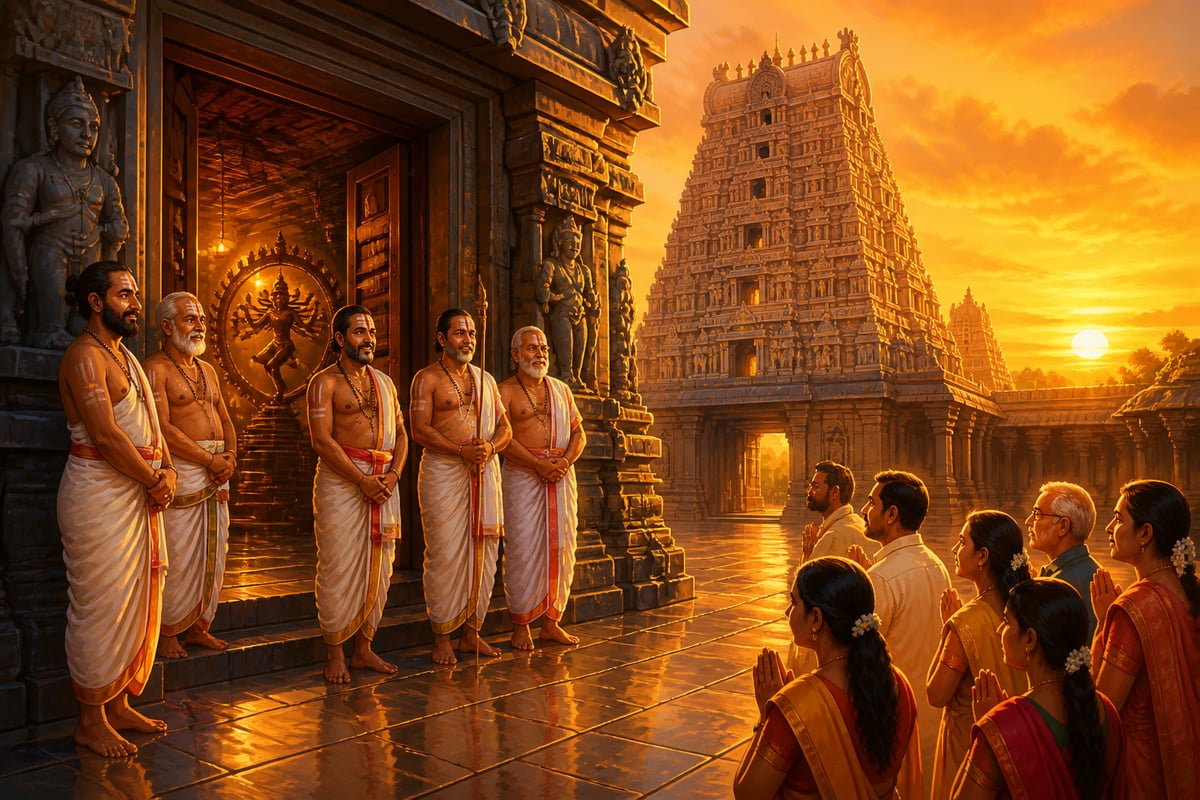
The Chidambaram Nataraja Temple case (2014) established the legal precedent. The Supreme Court ruled that the Tamil Nadu HR&CE department could not take over the temple's management from the Dikshitars, the hereditary priestly community that has managed it for centuries. The court held that the right to manage religious institutions is a fundamental right under Articles 25 and 26 of the Constitution.
This precedent must be systematically expanded. The legal strategy involves three tracks: challenging specific HR&CE takeovers through courts using the Chidambaram precedent, advocating for legislative reform of state-level Hindu endowment acts, and building the legal argument for equal treatment (if churches and waqf boards enjoy management autonomy, constitutional equality demands the same for Hindu institutions). Organizations like the Hindu Dharma Acharya Sabha and various legal advocacy groups are already pursuing these tracks.
2. Financial Reconstruction: Rebuild Temple Economies
Liberation without economic capacity is meaningless. Freed temples need revenue models that restore their economic function. The Sringeri model demonstrates one path: managed endowments, agricultural land, devotee contributions, and institutional investments. Modern additions include transparent crowdfunding platforms, NRI investment vehicles for temple reconstruction, and social enterprise models where temple-affiliated businesses (organic farming, traditional crafts, Ayurvedic products) generate revenue while reviving traditional livelihoods.
3. Educational Revival: Restore Temples as Learning Centers
Every major temple should operate at minimum a patha-shala teaching Sanskrit, local language, and civilizational knowledge alongside modern STEM education. The NEP 2020's emphasis on mother-tongue instruction and multidisciplinary education creates policy space for this. Temples can partner with existing educational institutions or establish their own schools. The BAPS Swaminarayan network demonstrates that temple-run education can achieve world-class standards. The key is moving from charity-based models to institutional models where education is a core temple function, funded by temple revenues.
4. Cultural Ecosystem: Revive Temple Arts and Festivals
Temples must again become the institutional home of classical arts. This means providing regular employment (not occasional gigs) for musicians, dancers, sculptors, and craftspeople. It means funding training in traditional arts through the guru-shishya model. It means restoring the architectural and artistic maintenance of temple structures using traditional methods and materials, creating both employment and skills transmission. Festival revival with authentic ritual meaning (not just commercial spectacle) drives community participation, tourism revenue, and cultural continuity simultaneously.
5. Sampradaya Strengthening: Invest in Spiritual Lineages
The matha-sampradaya system is the governance backbone of the temple ecosystem. Strengthening it means supporting the training of the next generation of acharyas, ensuring that spiritual lineages have the institutional capacity to manage the expanding ecosystem. It means building modern management capabilities within traditional governance structures, not replacing parampara with corporate boards but equipping parampara leaders with the tools to manage large, complex institutions in the 21st century.
The sequence matters. Legal liberation creates the political space. Financial reconstruction builds the economic foundation. Educational revival restores the knowledge function. Cultural ecosystem revival restores the artistic function. Sampradaya strengthening ensures the whole system sustains itself across generations.
No single actor needs to do all five. The legal battles are being fought by advocacy organizations. Financial reconstruction can be driven by devotee communities and NRI networks. Educational revival can be led by individual temples and mathas. Cultural revival can be powered by the classical arts community. Sampradaya strengthening is the work of the spiritual traditions themselves.
What is needed is coordination, mutual support, and the shared understanding that temple revival is not a religious project. It is a civilizational reconstruction project. The temple ecosystem was India's most successful institutional model for delivering education, economic opportunity, and cultural continuity at scale. Rebuilding it is not nostalgia. It is strategy.
Case studies
Chidambaram Nataraja Temple: Court-Ordered Revival
The Chidambaram Nataraja Temple in Tamil Nadu, one of the Pancha Bhuta Sthalams, faced a prolonged legal battle when the Tamil Nadu HR&CE Department attempted to take over its administration. The Podu Dikshitars, a community of around 360 hereditary Shaivite priests whose lineage traces back over a thousand years, had managed the temple through a traditional collective system. The HR&CE argued the temple needed government oversight for better management. The Dikshitars countered that the temple's rituals, finances, and community services had functioned continuously under their stewardship for centuries. In 2014, the Supreme Court of India ruled decisively in favor of the Dikshitars, declaring that the HR&CE takeover was unconstitutional. The court recognized the Dikshitars' hereditary right under Article 26 of the Constitution, which guarantees religious denominations the freedom to manage their own affairs and institutions.
The Agama Shastras prescribe specific lineages of trained priests for temple worship, not rotating government appointees. The Chidambaram temple follows the Makuta Agama tradition, where rituals must be performed by initiated Dikshitars who undergo years of Vedic training. This is not mere employment but a sacred covenant (sampradaya). The Arthashastra also distinguishes between state property and devadravya (property of the deity), recognizing that temple wealth belongs to the deity and its community, not the ruling authority. The Supreme Court's ruling effectively reaffirmed this ancient principle: the state has no inherent right to manage what belongs to a living religious tradition.
Post-verdict, the Dikshitars resumed full management. Temple rituals returned to their traditional Agamic schedule. Donations from the Hindu community increased as trust was restored. The case became a legal precedent cited in subsequent temple freedom petitions across India, demonstrating that constitutional mechanisms can be used to reverse state encroachment when communities organize and persist.
Temple revival is legally achievable. When hereditary custodians assert their constitutional rights with persistence, courts can restore traditional management. The Chidambaram case proves that legal frameworks already exist to protect temple autonomy.
The Chidambaram verdict is now a cornerstone case for temple liberation movements across Tamil Nadu, Andhra Pradesh, and Karnataka. Activist groups use it as a template for challenging HR&CE control over other temples.
The Chidambaram temple's Dikshitar community maintained unbroken ritual continuity for over 2,000 years, making it one of the longest-running hereditary priestly traditions on the planet, surviving Chola, Vijayanagara, Nayak, British, and post-independence eras.
Sringeri Peetham: A 1,200-Year Temple Ecosystem
The Sringeri Sharada Peetham in Karnataka, established by Adi Shankaracharya around 820 CE, has operated continuously for over 1,200 years as a self-sustaining dharmic ecosystem. Far from being a mere place of worship, Sringeri runs a network that includes Vedic pathshalas, Sanskrit colleges, modern schools affiliated with CBSE and state boards, a 100-bed hospital with free treatment, daily annadanam serving thousands, and support for dozens of sub-temples across South India. The Peetham manages all of this through its own trust structure, independent of government funding or HR&CE control. Its annual budget runs into hundreds of crores, funded entirely by devotee donations and endowment income. Each successive Shankaracharya has expanded the ecosystem while maintaining the core Advaita Vedanta teaching tradition without interruption.
Sringeri embodies the dharmic principle of Vidya Danam (gift of knowledge) and Anna Danam (gift of food) as core temple functions, not peripheral charity. The Arthashastra outlines how dharmasthanas should serve as centers of education, dispute resolution, and welfare. Sringeri fulfills every one of these functions. The Matha's governance follows a guru-shishya parampara model where the outgoing Shankaracharya selects and trains a successor over decades, ensuring institutional knowledge transfer. This is dharmic succession planning at its most refined, producing competent leaders without elections, bureaucracy, or political interference.
Sringeri today operates one of India's most respected private educational networks, with over 100 institutions. Its hospital treats roughly 300 patients daily at no cost. The daily annadanam feeds 3,000 to 10,000 people depending on the occasion. All of this runs without a single rupee of government funding, proving that temple ecosystems can scale sustainably when left under dharmic management.
Sringeri is living proof that temple ecosystems do not need state support to thrive. Spiritual lineages with clear succession, transparent finances, and community trust can run education, healthcare, and welfare at scale for centuries.
Sringeri's model is now studied by temple revival advocates as a blueprint. If one Matha can run 100+ institutions independently, the argument that temples need government management collapses. The question becomes: why not replicate Sringeri's trust model for other temples?
Sringeri Sharada Peetham has maintained an unbroken line of 36 Shankaracharyas over 1,200 years. Its educational network produces students who consistently rank among top Sanskrit scholars nationally, with several alumni holding positions at IITs and central universities.
Japan's Shinto Revival: 80,000 Self-Governing Shrines
After World War II, the American occupation authorities issued the Shinto Directive of 1945, forcibly separating Shinto from the Japanese state. State Shinto had been used as a tool of wartime nationalism, and the occupation sought to dismantle it entirely. Many predicted that Shinto would collapse without government funding and control. The opposite happened. Freed from state bureaucracy, Shinto shrines reorganized under the Association of Shinto Shrines (Jinja Honcho), a voluntary confederation established in 1946. Today, over 80,000 shrines operate across Japan as self-governing community institutions. They run kindergartens, host local festivals (matsuri), maintain forests and natural spaces, provide community gathering halls, and serve as anchors for neighborhood identity. Each shrine is managed by its local community and hereditary priest families, with the national association providing coordination without top-down control.
The Shinto model mirrors the dharmic concept of Kshetra Dharma, where each sacred site has its own character, traditions, and community relationship. Just as the Agama Shastras prescribe that each temple has unique protocols rooted in its sthala purana (local sacred history), each Shinto shrine maintains distinct kami (deity) traditions tied to its locality. The post-war Shinto revival also reflects the Arthashastra's principle that sacred institutions should serve the people directly rather than functioning as arms of the state. When the state connection was severed, the organic community connection reasserted itself.
Japan's shrine network now generates an estimated $8 billion annually in economic activity through festivals, tourism, and community services. Shrine kindergartens educate over 100,000 children. The hatsumode tradition (New Year shrine visit) draws over 80 million visitors in the first three days of January alone. Far from collapsing, Shinto thrived once freed from state control.
State control does not preserve sacred traditions. It distorts them. Japan's experience shows that when religious institutions are liberated from government management, they revitalize organically through community ownership and voluntary participation.
India's temple liberation movement can study Japan's post-1945 transition as a direct parallel. The fear that temples will 'collapse' without HR&CE management is identical to the prediction that Shinto would die without state support. Japan proved that prediction wrong within a single generation.
Japan has more Shinto shrines (80,000+) than convenience stores (roughly 56,000). After liberation from state control in 1946, the number of active community-run shrines actually increased, reversing the decline seen during the state-controlled era.
Reflection
- When you visit a temple, do you experience it as a living institution that shapes your community's education, economy, and cultural life, or primarily as a place for individual worship? What would need to change for temples to serve as complete civilizational hubs in your own locality?
- Temples historically sustained entire ecosystems of knowledge transmission, artistic patronage, and economic circulation through Devadravya. What is lost when a civilization's sacred institutions are reduced to tourist sites or bureaucratic entities, and how does that loss ripple outward across generations?
- If a sacred space is defined not merely by its physical structure but by the unbroken spiritual lineage (Parampara) that consecrates and maintains it, can a temple truly remain a temple when its governance is transferred to secular authorities with no obligation to that lineage? Where does sovereignty over the sacred rightfully reside?