The Intellectual Kshatriya
Every Educated Indian as Civilizational Defender
Civilizations are defended not just by armies but by intellectually confident citizens. This lesson introduces the Intellectual Kshatriya concept, traces its lineage from Adi Shankara's philosophical conquests to modern digital defenders, and outlines five competencies every educated Indian needs to become a civilizational guardian.
The Debate That Reshaped a Civilization
In the early 8th century CE, a young sannyasi barely into his twenties arrived at the home of Mandana Mishra, the most celebrated philosopher in India. Mandana was a Purva Mimamsa scholar of towering reputation, surrounded by students, patronized by kings, and undefeated in debate. The young challenger was Adi Shankara, who had walked across India from Kerala with nothing but his intellect and his conviction that Advaita Vedanta held the key to civilizational unity.
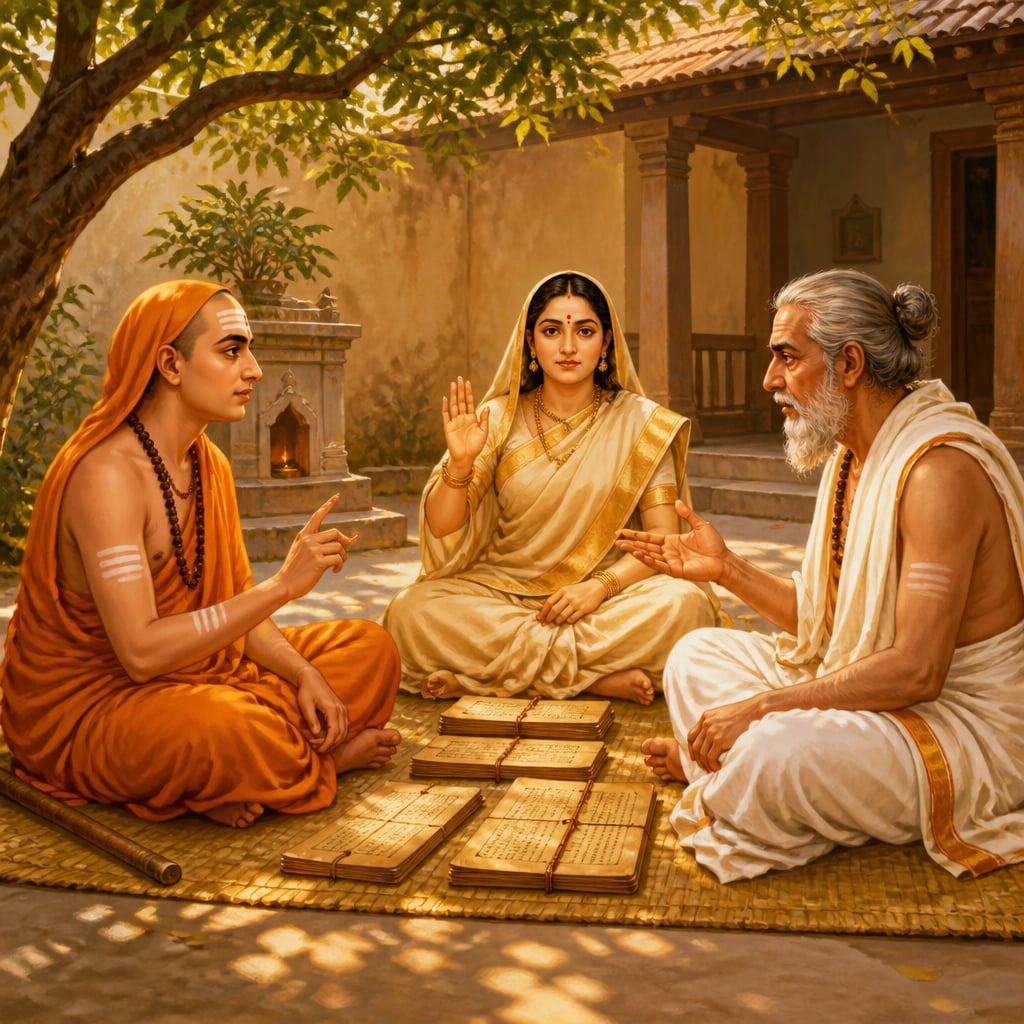
The debate that followed, with Mandana's wife Ubhaya Bharati serving as judge, lasted weeks. It covered the deepest questions of Indian philosophy: the nature of reality, the purpose of ritual, the relationship between knowledge and liberation. When it ended, Mandana Mishra accepted Shankara's arguments and became his disciple, taking the name Sureshvara.
No army was involved. No political mandate was sought. No institution was captured through force. A young philosopher, armed only with his mastery of the shastra and his clarity of argument, reshaped the intellectual trajectory of an entire civilization. This is the archetype of the Intellectual Kshatriya.
What Is an Intellectual Kshatriya?
The term was coined by Rajiv Malhotra to describe a role that Indian civilization has always recognized but rarely named: the individual who defends dharma not through physical force but through intellectual engagement. From Adi Shankara's philosophical conquest of the subcontinent to Swami Vivekananda's electrifying address at the Parliament of Religions in 1893, Indian civilization has repeatedly produced individuals who defend dharma through intellectual brilliance rather than military force.
The Kshatriya's dharma is protection. The Intellectual Kshatriya protects not territory but civilizational identity, not borders but narratives, not physical sovereignty but epistemic sovereignty.
This is not a metaphor. Civilizations are held together by shared knowledge, shared narratives, and shared frameworks of meaning. When those are captured, distorted, or destroyed, the civilization fragments regardless of how strong its military or economy may be. The Soviet Union did not collapse because it was militarily defeated. It collapsed because its narrative lost credibility. Every educated Indian who allows hostile narratives about their civilization to go unchallenged is abandoning a civilizational duty as real as any battlefield obligation.
The Intellectual Kshatriya operates in four domains:
The Epistemological Domain: Defending what India knows about itself. Challenging distorted histories, biased scholarship, and manufactured narratives. Producing original knowledge from Indian frameworks rather than merely consuming knowledge produced by others about India.
The Ontological Domain: Defending how Indians define themselves. Resisting the reduction of civilizational identity to sub-group fragments. Asserting that being Tamil AND Bharatiya, being Dalit AND Hindu, being modern AND traditional are not contradictions but natural expressions of civilizational richness.
The Institutional Domain: Building and defending institutions that produce, preserve, and transmit civilizational knowledge. Think tanks, research centers, digital platforms, educational initiatives, publishing houses.
The Cultural Domain: Defending and reviving the lived practices that make civilization a daily experience. Festivals with meaning, arts with lineage, languages with literature, rituals with understanding.
The Intellectual Colonization That Must Be Fought
In 1835, Thomas Babington Macaulay wrote his famous Minute on Education, declaring that "a single shelf of a good European library was worth the whole native literature of India and Arabia." The goal was explicit: create "a class of persons Indian in blood and colour, but English in tastes, in opinions, in morals and in intellect."
The project succeeded beyond Macaulay's wildest ambitions. Two centuries later, India produces more graduates than almost any country on earth, yet the vast majority cannot name five Upanishads, explain what the Arthashastra teaches about governance, or articulate what makes Indian civilization distinctive. They have been educated, but they have not been educated in their own civilization.
This is not ignorance. It is engineered ignorance. A civilization of 1.4 billion people that cannot articulate its own philosophical traditions is a civilization that has been intellectually disarmed. The weapons were not confiscated. The people were simply never taught how to use them.
The result is what Rajiv Malhotra calls the "atrocity literature" ecosystem: a global academic-media-NGO complex that produces narratives about India defined entirely by caste oppression, religious violence, gender inequality, and democratic backsliding. These narratives are not invented from nothing. They take real social challenges that every large civilization faces and strip them of all civilizational context, presenting them as uniquely Indian pathologies rather than universal human challenges with specifically Indian attempts at solutions.
The intellectual colonization operates through three mechanisms:
Information asymmetry: Western scholars study India; Indian scholars study the West. The result is that India is interpreted through Western frameworks by default. An Indian economist studies Western economic theory. A Western Indologist studies Indian civilization. Both produce knowledge about India, but from fundamentally different starting premises.
Credential gatekeeping: The global prestige hierarchy of universities, journals, and publishers means that knowledge about India is validated by institutions outside India. An Indian scholar's work about Indian civilization requires Western institutional validation to be considered legitimate, even within India.
The sepoy problem: The most effective critics of Indian civilization are Indians trained in Western academic frameworks who apply those frameworks to their own civilization without recognizing the embedded assumptions. They are intellectually devastating precisely because they combine insider access with outsider frameworks.
The Counter-Attack: India's Digital Intellectual Revolution
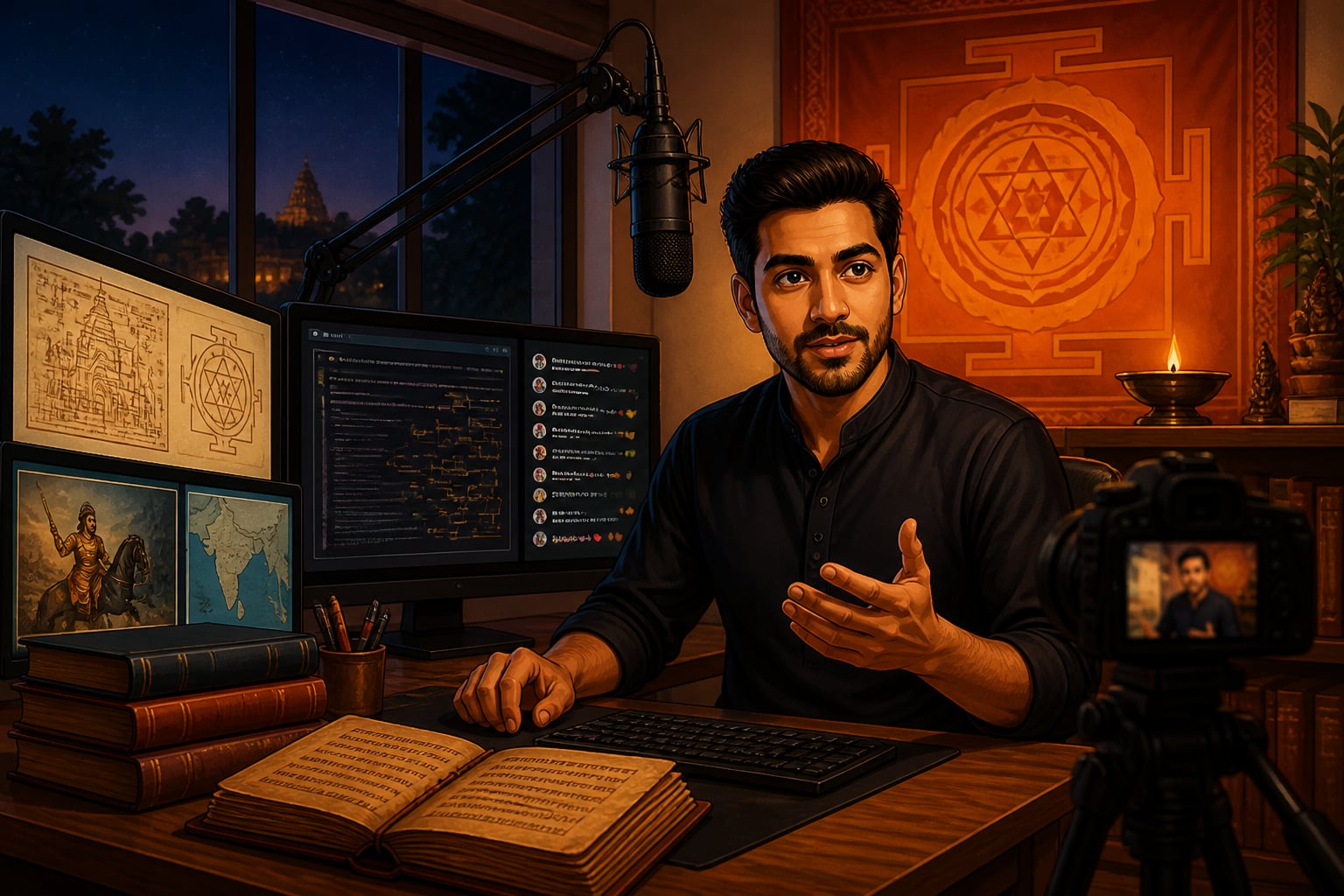
The most significant intellectual shift in post-independence India happened not in universities but on YouTube, Twitter, and independent publishing platforms. Between 2015 and 2025, a generation of professionals from STEM fields entered civilizational discourse and transformed it.
Abhijit Chavda, a physicist by training, began producing YouTube content on Indian civilizational history with a rigor and presentation quality that rivaled the best Western documentaries. His approach was distinctive: apply scientific methodology to historical claims, demand primary sources, and present Indian civilization not as a museum piece but as a living intellectual tradition. Sankrant Sanu, a technology entrepreneur, produced data-driven analyses of linguistic imperialism and educational inequality that systematically dismantled common narratives about Indian society. His work on the economic impact of English-medium education challenged deeply held assumptions with numbers, not sentiment. Anand Ranganathan, a scientist and author, brought analytical precision to civilizational commentary, demanding the same evidentiary standards in social discourse that he applied in his scientific work.
What made these figures significant was not their individual brilliance but the pattern they represented. None were trained in humanities departments. All brought professional discipline from STEM fields into civilizational discourse. They demonstrated that intellectual kshatriya-hood is not a separate career but an extension of one's svadharma. A physicist defends civilization with a physicist's methodology. An engineer defends it with an engineer's rigor. A scientist defends it with a scientist's demand for evidence.
This STEM-to-civilizational-defense pipeline shattered the monopoly that humanities departments had held over civilizational discourse. When a physicist challenges an Indologist's claims about Vedic chronology using astronomical data, or when a technology entrepreneur dismantles linguistic imperialism using economic analysis, the traditional gatekeeping mechanisms collapse. You cannot dismiss a peer-reviewed physicist as "uneducated" or a successful entrepreneur as "unqualified."
The digital revolution also democratized intellectual kshatriya-hood. Previously, defending your civilization required a university chair, a publishing deal, or a media platform. Now, any educated Indian with a smartphone and subject matter expertise can produce, publish, and distribute civilizational defense content. The shastrartha hall has moved online, and it is open to everyone.
Culture as the Ultimate Defense: The Korean Lesson
If intellectual kshatriya-hood is the sword, cultural self-confidence is the armor. The most powerful proof of this principle comes not from India but from South Korea.
In the 1990s, South Korea suffered from a cultural inferiority complex that Indians would recognize instantly. Colonized by Japan from 1910 to 1945, devastated by war, and then rapid-industrialized under authoritarian rule, Korea had prioritized economic growth while cultural identity withered. Korean youth consumed Japanese anime, American movies, and Western music. Korean culture was seen as provincial, embarrassing, something to escape from rather than celebrate.
Then Korea made a strategic decision. In 1999, the government established the Korea Creative Content Agency and began systematic investment in cultural industries: film, television, music, gaming, and animation. The investment was not in propaganda but in excellence. Korea did not ask the world to appreciate Korean culture out of charity. It produced cultural products of such quality that the world could not ignore them.
The results speak for themselves. By 2024, the Korean Wave (Hallyu) generates over $12.4 billion in annual cultural exports. BTS contributed an estimated $5 billion annually to the Korean economy. Squid Game became Netflix's most-watched series globally. Parasite won the Academy Award for Best Picture. A country of 52 million people became the world's fourth-largest cultural exporter.
The civilizational defense implications are profound. When Korean young people are proud of their culture, they are immune to narratives that frame them as culturally inferior. When the world admires Korean creativity, hostile narratives about Korea find no purchase. Cultural strength does not just preserve identity. It makes civilizational attack impossible.
India, with a civilizational heritage orders of magnitude deeper and more diverse than Korea's, has barely begun to tap this potential. The civilization that produced the Mahabharata, Bharatanatyam, Carnatic music, temple architecture, Ayurveda, and thousands of years of philosophical literature could make the Korean Wave look like a ripple. What is needed is not resources. It is intellectual self-confidence: the conviction that Indian culture deserves professional investment, global-quality production, and unapologetic presentation.
The Defense: Five Competencies of the Intellectual Kshatriya
Becoming an intellectual kshatriya is not about anger, ideology, or online outrage. It is about building five specific competencies.
Civilizational Literacy: Know your own tradition. Read at least one Upanishad, one book of the Arthashastra, one parva of the Mahabharata. Not summaries. Primary texts. You cannot defend what you do not know.
Adversary Literacy: Understand the frameworks used to attack your civilization. Read the Breaking India literature. Study how Orientalism, post-colonialism, and critical race theory are applied to India. Know the adversary's arguments better than the adversary does. This is what Chanakya meant by "learn even from your enemy's methods."
Debate Competence: Master the art of structured argument. The Indian tradition of shastrartha (formal debate) has three categories: Vaada (honest debate seeking truth), Jalpa (debate for victory), and Vitanda (destructive criticism). The intellectual kshatriya practices Vaada. Win through superior understanding, not through suppression or ridicule.
Content Creation: Produce, do not just consume. Write articles. Make videos. Create podcasts. Translate Sanskrit texts. Build digital archives. Every piece of quality content about Indian civilization produced by an Indian adds to the civilizational defense infrastructure.
Institutional Vision: Think beyond individual effort. Support and build organizations that will outlast any individual. Shankara did not just win debates. He established four mathas that have sustained his intellectual framework for 1,200 years. The intellectual kshatriya builds institutions.
The Civilizational Imperative
This is not optional work. It is civilizational dharma.
Every generation of Indians inherits a civilization that survived invasions, colonization, and partition. That survival was not inevitable. It happened because in every generation, individuals chose to defend the civilization's intellectual and cultural heritage through scholarship, debate, art, institution-building, and the simple daily practice of living as a civilizationally conscious person.
The intellectual battles of the 21st century will determine whether Indian civilization enters its next millennium as a confident, self-interpreting civilization or as a fragmented territory whose narratives are written by others. Every educated Indian who builds civilizational literacy, produces quality content, engages in honest debate, and supports civilizational institutions is an intellectual kshatriya.
The Bhagavad Gita's message is direct. When dharma requires defense, the one who can defend it but chooses not to commits the greater adharma. In the 21st century, the battlefield is intellectual. The weapons are knowledge, argument, and cultural confidence. The call is to every educated Indian.
When culture is strong, civilization is unbreakable.
Case studies
Adi Shankara's Digvijaya: Civilizational Conquest Through Debate
In the 8th century CE, Indian civilization faced an intellectual crisis. Buddhism had captured institutional power through vast university networks (Nalanda, Vikramashila) and royal patronage, while local Hindu traditions had fragmented into dozens of competing schools with no unifying philosophical framework. Into this vacuum stepped Adi Shankara, a young Brahmin from Kaladi, Kerala, who renounced worldly life at age eight and began a systematic philosophical campaign across the entire subcontinent. Between the ages of approximately 16 and 32, Shankara traveled from Kerala to Kashmir, from Puri to Dwaraka, engaging the leading scholars of every philosophical school in formal shastrartha (debate). His most celebrated contest was against Mandana Mishra, the foremost Mimamsa scholar, with Mandana's own wife Ubhaya Bharati serving as judge.
Shankara embodied every principle of the Intellectual Kshatriya. He practiced Vaada (honest debate seeking truth), not Jalpa (debate for mere victory). He engaged his opponents' strongest arguments, not straw men. When Ubhaya Bharati challenged him on topics outside his experience as a sannyasi, he acknowledged the gap rather than bluffing. His approach followed the Arthashastra's principle that lasting victory comes through intellectual persuasion (Sama), not force (Danda). Most crucially, Shankara combined intellectual victory with institutional vision, establishing four mathas to ensure his philosophical framework would outlast his own lifetime.
Shankara's digvijaya unified Hindu philosophical thought under the Advaita Vedanta framework, revived the authority of the Upanishads as the culmination of Vedic knowledge, and established four mathas at the four corners of India (Sringeri, Dwaraka, Puri, Jyotirmath) that continue to function as centers of Hindu scholarship over 1,200 years later. His commentaries on the Upanishads, Brahma Sutras, and Bhagavad Gita remain foundational texts for all subsequent Hindu philosophy.
Civilizational defense does not require armies. A single individual with deep knowledge, debate mastery, and institutional vision can reshape an entire civilization's intellectual trajectory. The Intellectual Kshatriya's ultimate measure is not debates won but institutions built.
Shankara's model is directly applicable today. Modern intellectual kshatriyas need the same three capacities: mastery of primary sources (Shankara's command of the Upanishads), willingness to engage hostile frameworks on their own terms (his debates across philosophical schools), and institutional vision (his four mathas as permanent infrastructure).
Shankara accomplished his entire civilizational transformation in approximately 16 years of active work (age 16 to 32), establishing institutional structures that have endured for over 1,200 years. No military conquest in Indian history has produced institutions of comparable longevity.
India's Digital Intellectual Warriors: The STEM-to-Civilizational-Defense Pipeline
Between 2015 and 2025, a fundamental shift occurred in Indian civilizational discourse. For decades, narratives about India had been dominated by Western-trained humanities scholars and their Indian academic allies, who interpreted Indian civilization through frameworks like post-colonialism, subaltern studies, and critical caste theory. Then a new generation of intellectuals emerged on digital platforms, bypassing traditional academic gatekeeping entirely. Abhijit Chavda, a physicist, built a YouTube following of millions by presenting Indian civilizational history with scientific rigor and production quality rivaling the best Western documentaries. Sankrant Sanu, a technology entrepreneur based in Seattle, authored 'The English Medium Myth' and produced data-driven analyses of linguistic imperialism that challenged narratives with numbers, not sentiment. Anand Ranganathan, a scientist and author, brought the evidentiary standards of scientific research to civilizational commentary on television and social media.
The Bhagavad Gita's concept of svadharma applies powerfully here. These individuals did not abandon their professional domains to become full-time activists. They brought their existing expertise into civilizational discourse, demonstrating that intellectual kshatriya-hood is an extension of one's svadharma, not a separate calling. A physicist defends civilization with a physicist's methodology. An entrepreneur brings market analysis to cultural questions. A scientist demands evidence. Kautilya's emphasis on gudhapurusha (intelligence through embedded agents) finds a modern parallel: civilizational defenders embedded in every professional field, applying their domain expertise to civilizational questions.
By 2025, civilizational discourse in India shifted from purely defensive to assertive. Indian-language and civilizational history YouTube channels collectively reach tens of millions of subscribers. The traditional gatekeeping mechanisms of Western academia weakened as alternative knowledge ecosystems gained credibility. A generation that grew up consuming only Western-validated narratives now had access to rigorous Indian-origin intellectual frameworks produced by credentialed professionals.
The Intellectual Kshatriya is not a specialist role requiring humanities training. It is a civilizational responsibility that every educated professional can fulfill by bringing their domain expertise to civilizational discourse. The STEM-to-civilizational-defense pipeline proves that the most effective intellectual warriors are often those whose credibility comes from outside the contested humanities space.
The digital intellectual warrior model is infinitely scalable. Every Indian doctor, engineer, lawyer, scientist, and entrepreneur who applies their professional rigor to civilizational questions adds to the defense ecosystem. The smartphone has become the new debating hall, and it is open to everyone.
Indian civilizational history and commentary YouTube channels grew from virtually zero serious content creators in 2015 to collectively reaching over 50 million subscribers by 2024, creating a parallel intellectual ecosystem entirely outside traditional academic gatekeeping.
South Korea's Hallyu Wave: Cultural Self-Confidence as Civilizational Armor
In the 1990s, South Korea suffered from a profound cultural inferiority complex. Colonized by Japan from 1910 to 1945, devastated by the Korean War (1950-53), and then rapid-industrialized under authoritarian rule, Korea had prioritized economic development while cultural identity withered. Korean youth consumed Japanese manga, American movies, and Western pop music. Korean culture was seen as provincial and embarrassing. Then, in 1999, the Korean government established the Korea Creative Content Agency (KOCCA) and began systematic, strategic investment in cultural industries: film, television, music, gaming, and animation. The investment philosophy was not propaganda but excellence. Korea did not ask the world to appreciate Korean culture out of charity or guilt. It produced cultural products of such quality that the world could not ignore them.
The Arthashastra's concept of svasthana bala (strength derived from one's own territory and resources) applies directly. Kautilya taught that a kingdom's deepest strength comes not from imported resources but from cultivating its own. Korea demonstrated this principle at civilizational scale: when it stopped trying to be a cultural importer and instead invested in its own creative traditions with professional excellence, it did not just achieve cultural self-sufficiency. It became a global cultural superpower. The Mahabharata's teaching is reinforced: atmashakti (self-strength) is the foundation of all other strengths.
By 2024, the Korean Wave generates over $12.4 billion in annual cultural exports. BTS contributed an estimated $5 billion annually to Korea's economy. Squid Game became Netflix's most-watched series globally. Parasite won the Academy Award for Best Picture. A country of 52 million people became the world's fourth-largest cultural exporter. Korean language enrollments surged worldwide. Young Koreans went from being ashamed of their culture to being its proudest ambassadors.
Cultural self-confidence is not a luxury or a soft policy goal. It is a civilizational defense strategy of the highest order. When a civilization's people are proud of their culture and the world respects their creative output, hostile narratives find no purchase. India, with a civilizational heritage orders of magnitude deeper than Korea's, has barely begun to tap this potential.
India's cultural export strategy remains fragmented and under-invested compared to Korea's systematic approach. The civilization that produced the Mahabharata, Bharatanatyam, Carnatic music, temple architecture, and thousands of years of philosophical literature has the raw material for a cultural renaissance that would dwarf Hallyu. What is missing is not talent or tradition but the strategic investment and institutional self-confidence that Korea demonstrated.
South Korea's cultural exports grew from approximately $500 million in 1999, when KOCCA was established, to over $12.4 billion by 2024. A 25x increase in 25 years. The return on government investment in cultural industries exceeded 1,600%, making it one of the most successful industrial policy investments in modern history.
Reflection
- What is your professional expertise, and how could you apply it to civilizational discourse? If you are an engineer, a doctor, a lawyer, a teacher, or a business professional, what unique perspective does your training give you on civilizational questions that a humanities scholar might miss?
- Adi Shankara reshaped Indian civilization through debate alone, without any army or political power. If ideas are truly more powerful than force in the long run, why do civilizations invest so heavily in military defense while neglecting intellectual defense?
- Compare South Korea's strategic cultural investment (KOCCA, systematic Hallyu promotion) with India's approach to cultural exports. What specific structural, institutional, or attitudinal differences explain the gap? What would an Indian equivalent of KOCCA look like?
- Is it possible to be an intellectual kshatriya without becoming tribal, exclusionary, or hostile to genuine criticism? How does the Vaada tradition (debate seeking truth) provide a framework for civilizational defense that remains honest and open rather than defensive and closed?