Cultural Adaptability & Civilizational Memory
How India Absorbed Influences Without Losing Identity
Indian civilization survived for over 5,000 years not by rejecting outside influences but by absorbing them through a sophisticated cultural digestive system. This lesson explores the double helix of civilizational survival: cultural adaptability (the ability to absorb and transform foreign inputs) and civilizational memory (the collective awareness that prevents absorption from becoming dissolution). From the Gupta synthesis to yoga's global journey, the pattern is consistent. Civilizations that remember who they are can learn from anyone. Those that forget, disappear.
See It Today: When the World Bent to Touch Its Toes
On June 21, 2015, something remarkable happened at the United Nations headquarters in New York. Over 35,000 people gathered at Times Square to perform Surya Namaskar. Across the world, from Paris to Tokyo to São Paulo, millions more joined in. The occasion was the first International Day of Yoga, proposed by India's Prime Minister and adopted by 177 UN member nations. It was the largest single-issue UN resolution support in history.

What made this moment extraordinary was not the diplomacy. It was the civilizational memory it represented.
Yoga is at least 5,000 years old. It was transmitted through guru-shishya parampara for millennia, surviving invasions, colonial suppression, and modernization. When the British dismissed it as superstition, practitioners kept the tradition alive in ashrams and homes. When post-independence India's Westernized elite looked down on it, traditional practitioners persisted.
Then came the adaptation. Yoga entered Western fitness culture in the 1960s and 70s. It was repackaged, commercialized, stripped of its spiritual dimensions, and turned into an $80 billion global industry. Critics saw this as cultural appropriation. But something else was happening simultaneously. In India, institutions like the Kaivalyadhama Yoga Institute, the Bihar School of Yoga, and SVYASA maintained the complete tradition: philosophy, pranayama, meditation, and the ethical framework alongside the physical postures.
The result was a dual track. The world got fitness yoga. India kept the full operating system. And when India asserted yoga on the global stage through the UN, it was not selling a fitness product. It was performing an act of civilizational memory, reminding the world and Indians themselves of the tradition's depth and origin.
This is cultural adaptability in its most sophisticated form. Not rigid rejection of change. Not wholesale surrender to foreign frameworks. A civilization's ability to let its knowledge travel and transform while keeping the source code intact at home.
The Mechanism: The Double Helix of Civilizational Survival
Indian civilization has survived for over 5,000 years. Not as a museum piece, but as a living, evolving system. The secret is a double helix: two intertwined strands that work together. Cultural adaptability is one strand. Civilizational memory is the other. When both function, the civilization absorbs, evolves, and thrives. When either breaks, decline follows.
How Cultural Adaptability Works
India's civilizational "digestive system" processes foreign influences through four distinct mechanisms.
The first is selective adoption: take what works, leave the rest. When gunpowder technology arrived from China and Central Asia, Indian kingdoms adopted it for warfare. They did not adopt Chinese political philosophy or Central Asian nomadic social structures. The Vijayanagara Empire mastered Muslim cavalry tactics and Turkish-style administrative districts while remaining a Hindu civilizational fortress. Technology was absorbed. Identity was not surrendered.
The second is reinterpretation: take a foreign concept and pass it through an Indian philosophical framework until it becomes something new. Greek astronomical models reached India through Alexandrian trade routes. Indian mathematicians like Aryabhata did not simply copy them. They reworked the models using Indian mathematical methods, developed the concept of zero and the decimal system, and created the Siddhantic astronomical tradition that surpassed its Greek predecessors. The input was Greek. The output was unmistakably Indian.
The third is synthesis: combine foreign forms with Indian content to create something neither side could have produced alone. The Gandhara school of art merged Greek sculptural realism with Buddhist spiritual content. The result was not Greek art or Indian art. It was a new form: the first human representations of the Buddha, rendered with Greek anatomical precision but radiating Indian spiritual depth. This synthesis then evolved into the Gupta-era classical sculpture that became the template for Buddhist and Hindu art across Asia.
The fourth is parallel maintenance: allow new traditions to exist alongside existing ones without forcing a choice. When Islam arrived in India, Indian civilization did not collapse into either total resistance or total surrender. Instead, new syncretic traditions (Sufi-Bhakti interactions, Indo-Islamic architecture, Hindustani classical music) emerged alongside the continued practice of unmodified Vedic rituals, temple worship, and Sanskrit scholarship. Multiple streams flowed simultaneously.
Why Regional Diversity is a Feature, Not a Bug
This adaptability works precisely because Indian civilization is not centralized. A Tamil Shaiva tradition, a Bengali Shakta tradition, a Rajasthani Vaishnavite tradition, and a Kashmiri Shaiva tradition can all absorb different influences at different rates while remaining connected through shared Dharmic principles. If one region's cultural memory weakens, others preserve the knowledge. This is the civilizational network architecture described earlier in this course: distributed, resilient, and self-healing.
The Civilizational Memory Imperative
But adaptability without memory is just drift. A civilization that absorbs everything and remembers nothing is not adapting. It is dissolving.
Civilizational memory is the collective awareness of who you are, where you came from, and what makes your civilization distinct. It is carried through language (Sanskrit as the pan-Indian intellectual language), texts (the Vedas, Upanishads, Epics), practices (rituals, festivals, pilgrimages), institutions (temples, mathas, gurukuls), and living human chains (guru-shishya parampara).
When this memory is strong, adaptability becomes powerful. Japan absorbed Western technology during the Meiji Restoration because Japanese civilizational memory (Shinto, Bushido, the Emperor as cultural anchor) remained intact. The Japanese knew who they were, so they could borrow without becoming someone else.
When memory is lost, civilizations die. Ancient Egypt's hieroglyphic tradition was broken by Christianization, and Egyptian civilizational memory collapsed so completely that modern Egyptians have no cultural continuity with the pyramid builders. Mesopotamian civilization was similarly erased. The Aztec and Inca civilizations were destroyed not just by Spanish weapons but by the systematic destruction of their memory systems: texts burned, priests killed, traditions banned.
India stands at a critical crosspoint. Its civilizational memory has been damaged by centuries of invasion and colonial education. But it has not been destroyed. The guru-shishya chains were never fully broken. The texts survived. The festivals continued. The memory is wounded, but alive.
The question is whether India will choose to heal that memory or let it fade.
The Pattern: The Gupta Synthesis
The Gupta Empire (320-550 CE) represents the greatest demonstration of cultural adaptability in Indian history. It was India's Golden Age not because it rejected outside influences, but because it absorbed them so completely that the output was more Indian than what came before.
When Chandragupta I established the dynasty, India had already been processing foreign influences for centuries. Greek settlers from Alexander's campaigns had intermarried with local populations. Kushan rulers from Central Asia had patronized Buddhist art in Gandhara. Trade routes connected India to Rome, China, Southeast Asia, and Persia.
The Gupta response was not defensive isolation. It was confident synthesis.
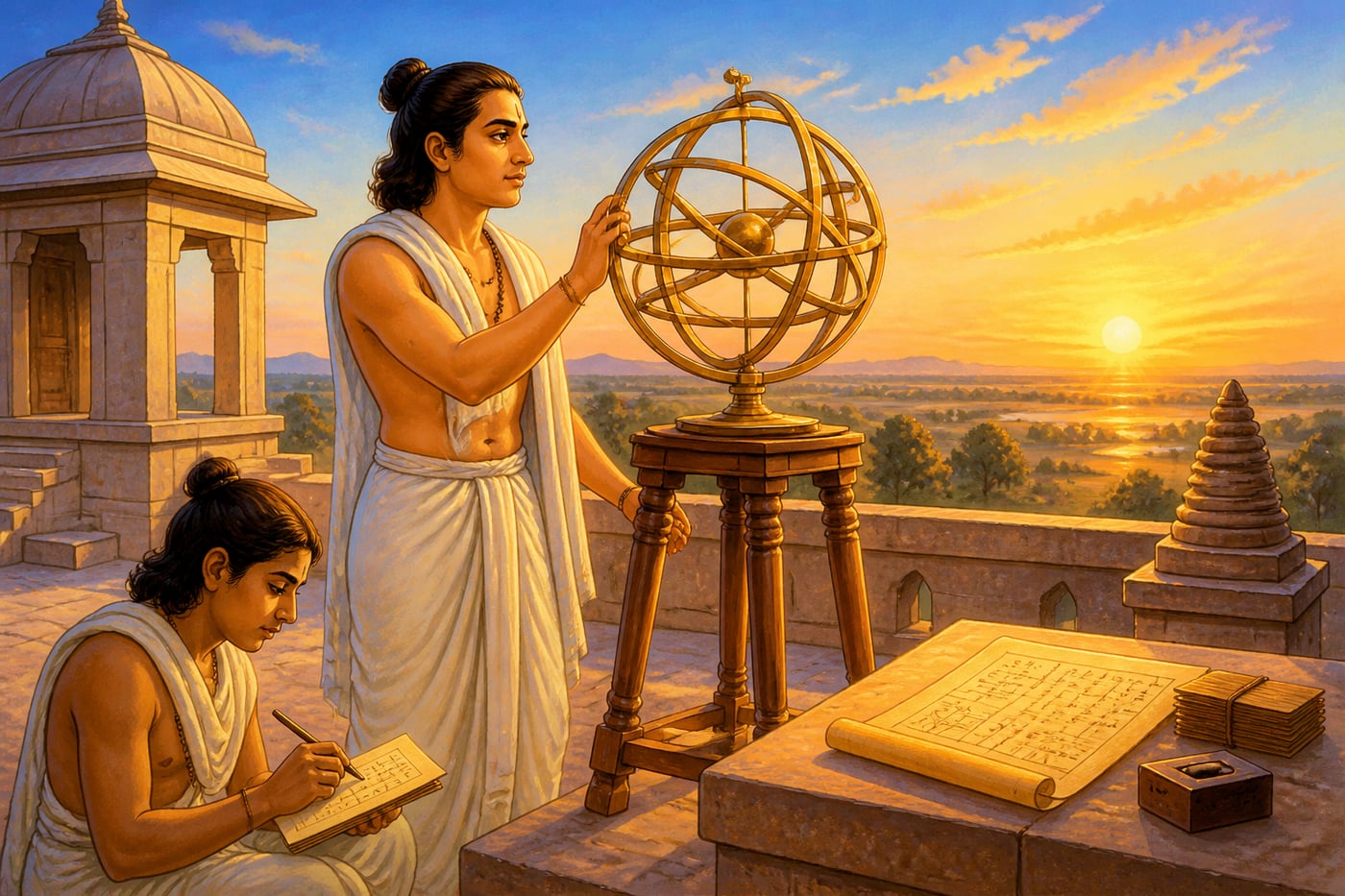
In mathematics, Aryabhata (476-550 CE) built on Greek astronomical knowledge but transformed it through Indian mathematical innovations. His calculation of pi to four decimal places, his understanding of the Earth's rotation, and his development of algebraic methods went far beyond anything Greek astronomers had achieved. He did not reject Greek knowledge. He consumed it, improved it, and made it Indian.
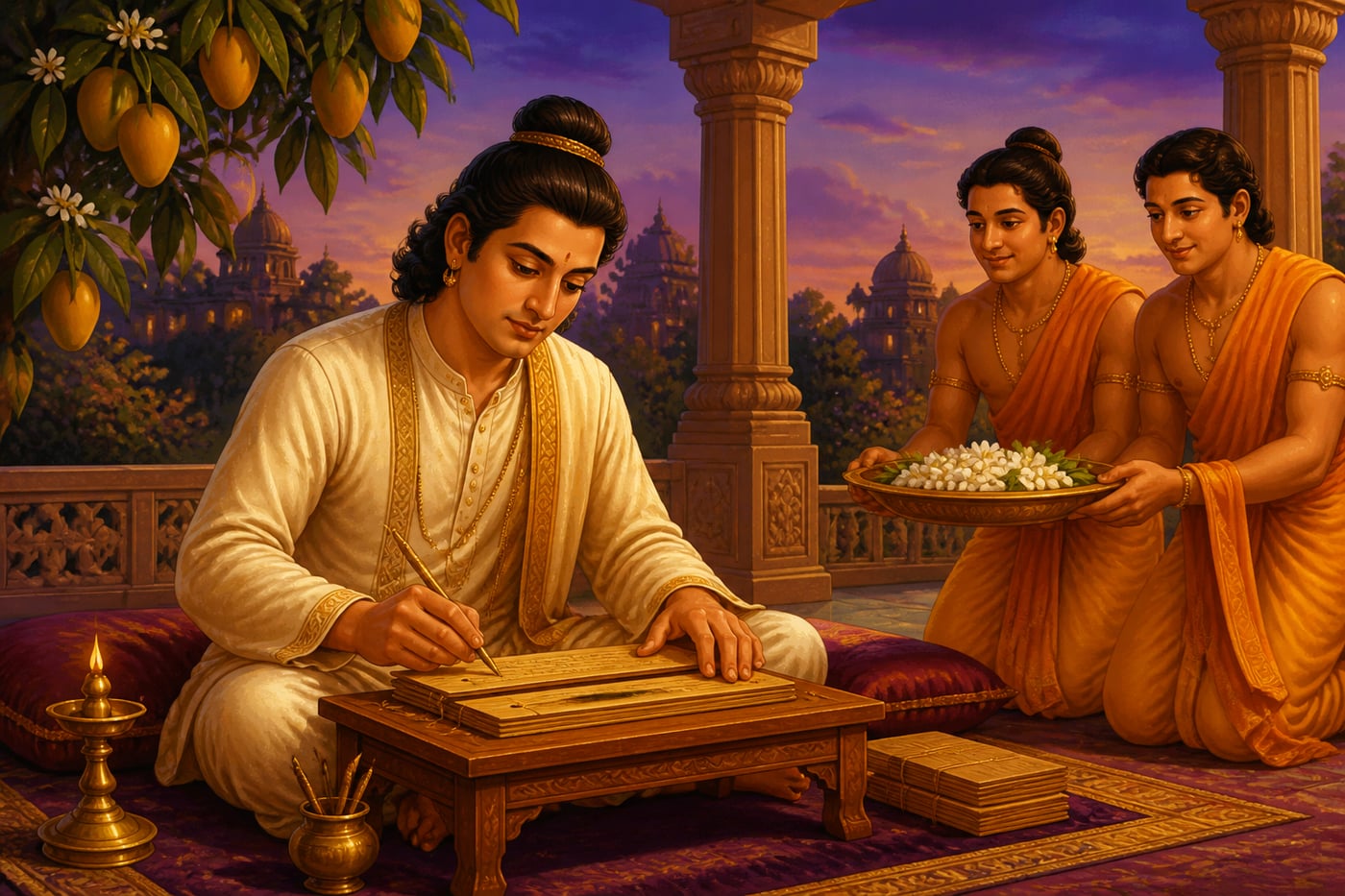
In literature, Kalidasa created works of such sophistication that they drew comparisons to Shakespeare a millennium before Shakespeare was born. His plays and poems synthesized folk traditions, classical Sanskrit aesthetics, and philosophical depth into a literary tradition that defined Indian artistic expression for centuries.
In art, the transition from Gandhara's Greco-Buddhist style to the classical Gupta sculpture represents perhaps the most elegant cultural synthesis in human history. The Buddha figures at Sarnath show none of the heavy Greek musculature of Gandhara. Instead, they radiate an inner luminosity, eyes half-closed in meditation, bodies expressing spiritual rather than physical power. The Greek input had been fully digested. What remained was purely Indian.
Meanwhile, in the deep south, Tamil Sangam literature flourished independently. The Gupta synthesis did not homogenize India. It demonstrated that multiple regional traditions could reach artistic peaks simultaneously, connected by shared civilizational principles but expressed through distinct regional voices.
This is the pattern: absorb confidently, transform completely, maintain regional diversity, and emerge stronger. The civilization that remembers who it is can learn from anyone.
Dharmic Wisdom: Smriti and Yukti
The Sanskrit tradition carries deep vocabulary for both adaptability and memory. These are not modern management concepts. They are civilizational operating principles embedded in the language itself.
Smriti (स्मृति), from the root "smr" (to remember), means far more than personal recollection. In the Dharmic framework, Smriti is the entire body of remembered tradition: the Dharmashastras, the Epics, the Puranas, the cultural practices passed from generation to generation. Smriti is the civilization remembering itself.
When the Bhagavad Gita speaks of knowledge being lost and then restored, it describes the cycle of civilizational memory. Krishna tells Arjuna that this yoga was already known but forgotten, and he is now re-teaching it. This is the civilizational memory pattern: knowledge exists, transmission breaks, someone reconnects the chain. The role of every generation is to be that reconnector.
Yukti (युक्ति), meaning discernment, skillful means, or practical wisdom, represents the adaptive intelligence. The Arthashastra uses yukti repeatedly to describe the ability to read situations and respond appropriately. A civilization with yukti does not blindly resist all change, nor does it blindly accept everything. It exercises judgment about what to absorb, what to reject, and how to transform what it takes in.
The combination of Smriti and Yukti is the formula. Remember who you are (Smriti). Then adapt wisely (Yukti). One without the other fails. Memory without adaptability becomes fossilization. Adaptability without memory becomes dissolution.
The Defense: Becoming the Living Archive
If the Gupta synthesis teaches us anything, it is that civilizational survival is not passive. It requires active participants. People who remember, and who adapt that memory for new contexts. Here is what that looks like in practice.
Individual Actions: Become a Memory Carrier
Learn one classical Indian knowledge tradition deeply. Not as an academic exercise, but as a practitioner. Study Sanskrit, even at a basic level, to access primary texts directly. Read one Upanishad, one section of the Mahabharata, one Kalidasa play in the original with translation support. When you encounter Indian concepts through Western interpretations, seek the original source. The difference between reading about yoga in a Western self-help book and reading the Yoga Sutras of Patanjali is the difference between a photocopy and the original painting.
Practice one traditional art form or discipline. Carnatic music, Bharatanatyam, Kathak, Kalaripayattu, traditional cooking methods, Ayurvedic self-care. The knowledge that lives in your body and daily practice is more resilient than knowledge that lives only in books.
Document family traditions. Ask your grandparents about the rituals, stories, and practices they grew up with. Record them. Many families are one generation away from losing traditions that are centuries old. You are the bridge.
Community Actions: Build Memory Networks
Support and participate in traditional knowledge institutions. Gurukuls, pathashalas, temple education programs, and cultural organizations that maintain living traditions need students, volunteers, and donors. These institutions are the civilizational memory's immune system.
Create local study circles. Five families reading the Ramayana together, or discussing one Upanishad per month, creates a micro-network of civilizational memory transmission. Digital platforms make this easier than ever. Start a group for discussing one Sanskrit shloka per week.
Organize cultural festivals with meaning, not just spectacle. When Diwali becomes only about shopping and firecrackers, civilizational memory leaks away. When it includes Ramayana recitation, the story of Rama's return, and reflection on the victory of Dharma, it becomes a memory transmission event.
Institutional Actions: Build the Infrastructure
Support digital preservation of manuscripts, oral traditions, and endangered knowledge systems. Organizations working on digitizing Sanskrit manuscripts, the Indian Knowledge Systems initiative, and regional language digital archives need funding and volunteers.
Advocate for educational reform that includes Indian knowledge traditions alongside modern subjects. Not as religious instruction, but as civilizational literacy. A student who studies Aryabhata alongside Copernicus, Kalidasa alongside Shakespeare, and the Arthashastra alongside Machiavelli receives a complete education. One who studies only the Western canon receives half.
Build bridges between traditional knowledge holders and modern institutions. The pandit who has memorized the Vedas and the computer scientist who builds AI systems need to be in the same room. The traditional weaver who knows centuries-old techniques and the fashion designer who serves global markets need to collaborate. These bridges allow civilizational memory to flow into modern forms without losing its essence.
The Gupta synthesis happened because people chose to remember AND adapt. The yoga tradition survived because unbroken human chains carried it forward. The civilizational memory imperative is not about living in the past. It is about carrying the past into the future, transformed but unbroken.
You are not a spectator to this process. You are a node in the civilizational network. What you remember, practice, and transmit shapes whether Indian civilization continues its 5,000-year journey or joins Egypt and Mesopotamia in the museum of extinct cultures.
The choice, as Krishna told Arjuna, is yours.
Case studies
Yoga's Global Journey: Cultural Adaptability in Action
By the mid-20th century, yoga was a marginalized practice in India, dismissed by the Westernized elite as backward superstition. Traditional practitioners kept the knowledge alive in ashrams and small schools. Then, beginning in the 1960s, yoga began entering Western consciousness through teachers like BKS Iyengar, Pattabhi Jois, and Indra Devi, all students of Krishnamacharya. By 2024, the global yoga industry was worth over $80 billion. The physical postures (asanas) were extracted, repackaged for fitness culture, and commercialized. Meanwhile, in India, institutions like Kaivalyadhama (founded 1924), the Bihar School of Yoga (founded 1964), and SVYASA maintained the complete tradition: philosophy, pranayama, meditation, ethical framework, and physical practice. In 2014, India proposed International Day of Yoga at the UN. 177 nations co-sponsored the resolution, the highest ever for a single-issue UN proposal. On June 21, 2015, millions practiced yoga simultaneously across the globe.
Yoga's global journey demonstrates all four mechanisms of cultural adaptability. Selective adoption: the West took the physical practices but initially left behind the philosophy. Reinterpretation: yoga was reframed through Western fitness and wellness paradigms. Synthesis: new forms like 'power yoga' and 'hot yoga' emerged that neither traditional Indian practitioners nor Western fitness trainers would have created alone. Parallel maintenance: the full traditional system continued alongside the adapted versions. The critical insight is the dual-track model. India did not fight the adaptation. It allowed yoga to travel in simplified form while maintaining the complete source code at home. When India asserted yoga on the global stage through the UN, it was not competing with Western yoga studios. It was reminding the world of the tradition's origin and depth. This is Yukti: strategic wisdom about when to hold tight and when to let go.
Yoga is now the most globally recognized Indian cultural export. The International Day of Yoga has become an annual civilizational memory event, practiced in over 190 countries. Traditional yoga institutions in India have seen increased enrollment and funding as global interest drove renewed domestic respect. The original source tradition has been strengthened, not weakened, by the global adaptation. India demonstrated that a confident civilization can let its knowledge adapt to foreign contexts without losing the original. The key was maintaining the parampara: as long as the complete tradition exists somewhere, simplified versions in the wider world become entry points rather than replacements.
Cultural adaptability is not about controlling how others use your knowledge. It is about ensuring the original source remains alive and accessible. When the source code is strong, adaptation becomes expansion rather than dilution. When the source code is lost, adaptation becomes erasure. The yoga story shows both paths: where parampara chains held (Krishnamacharya's lineage), the tradition thrived in both traditional and adapted forms. Where chains broke, yoga was reduced to mere exercise. The lesson for Indian civilization as a whole is clear: protect the source traditions, and let adaptations happen naturally.
The global yoga industry's $80 billion valuation demonstrates both the opportunity and the risk of cultural adaptability. India now actively works to maintain connection between commercialized global yoga and its philosophical source through initiatives like the International Day of Yoga and traditional guru-shishya certification standards.
India's 2014 UN proposal for International Day of Yoga received 177 co-sponsors, the highest ever for a single-issue UN resolution. By 2024, the global yoga industry exceeded $80 billion in value, while traditional institutions like Kaivalyadhama and the Bihar School of Yoga saw record enrollment driven by renewed domestic and international interest.
The Gupta Synthesis: When Absorption Produced a Golden Age
By the 4th century CE, India had been absorbing foreign cultural inputs for over 600 years. Alexander's campaigns (326 BCE) left Greek settlers in the northwest. The Indo-Greek kingdoms (2nd-1st century BCE) produced rulers who patronized Buddhism and adopted Indian customs. The Kushan Empire (1st-3rd century CE) brought Central Asian influences and created the Gandhara art tradition that merged Greek sculptural techniques with Buddhist content. Trade routes connected India to Rome, Persia, China, and Southeast Asia, creating constant cultural exchange. When the Gupta dynasty rose to power under Chandragupta I (c. 320 CE), they inherited a subcontinent rich with absorbed foreign influences but fragmented politically. The Gupta response was not to purge these influences or to surrender to them. It was to synthesize them into something entirely new.
The Gupta synthesis operated through all four mechanisms of cultural adaptability simultaneously. In mathematics, Aryabhata performed reinterpretation: he took Greek astronomical models and transformed them using Indian methods, producing the Aryabhatiya (499 CE), which surpassed Greek astronomy in accuracy and innovation. In art, the transition from Gandhara's Greco-Buddhist sculpture to Gupta classical art was pure synthesis: the heavy Greek musculature dissolved into the luminous serenity of the Sarnath Buddha, an artistic achievement neither Greek nor pre-Gupta Indian art could have produced alone. In literature, Kalidasa practiced selective adoption and creative synthesis, drawing on folk traditions, Vedic imagery, and classical aesthetics to create works of world-class literary merit. And through it all, parallel maintenance ensured that Tamil Sangam literature, regional folk traditions, and local religious practices continued independently, enriching the civilization's diversity. The Gupta genius was confidence. They did not fear foreign knowledge because their civilizational memory was strong. They knew who they were (Smriti), so they could learn from anyone (Yukti).
The Gupta period (320-550 CE) is universally recognized as India's Golden Age. Its achievements in mathematics (the decimal system, concept of zero, early algebra), astronomy (Aryabhata's Earth-rotation model), literature (Kalidasa's works), art (Sarnath sculptures, Ajanta paintings), and philosophy (major commentaries on the Upanishads and Brahma Sutras) established templates that influenced Indian civilization for the next 1,500 years. Gupta mathematical innovations traveled through Arab intermediaries to Europe, becoming the foundation of modern global mathematics. Gupta artistic styles spread to Southeast Asia, shaping the Buddhist and Hindu art of Cambodia, Indonesia, Thailand, and beyond. A single empire's confident cultural synthesis produced knowledge that the entire world still uses.
The Gupta synthesis proves that civilizational greatness comes not from isolation but from confident absorption. The key is the word 'confident.' The Guptas absorbed Greek astronomy not because they felt inferior to Greek thought, but because they had the mathematical sophistication to improve upon it. They synthesized Gandhara art not by imitating Greek forms, but by infusing them with Indian spiritual depth until the Greek DNA was unrecognizable. This only works when civilizational memory is strong. A civilization that does not know its own intellectual and artistic traditions cannot judge what to absorb or how to transform it. Memory provides the digestive enzymes. Without them, foreign inputs are swallowed whole, and the civilization chokes on what it cannot process.
The Gupta synthesis model of confident absorption is directly relevant to India's current engagement with AI, quantum computing, and biotechnology. The question is whether India will absorb these technologies on its own civilizational terms, as the Guptas absorbed Greek astronomy, or merely consume them as a dependent adopter.
Aryabhata's Aryabhatiya (499 CE) calculated the length of the solar year as 365.3586805 days, accurate to within 3 minutes of the modern value. Gupta-era decimal numerals and the concept of zero traveled through Al-Khwarizmi's 9th-century translations to Europe, becoming the foundation of all modern mathematics.
Historical context
Gupta Period (320-550 CE) as primary context, with threads extending to the modern era (20th-21st century yoga revival)
India's cultural adaptability has been a defining characteristic across its entire history. The Indo-Aryan synthesis with existing Harappan traditions (c. 1500-500 BCE), the absorption of Greek influences post-Alexander (3rd-1st century BCE), the creative engagement with Central Asian cultures under the Kushans (1st-3rd century CE), the Gupta synthesis (4th-6th century CE), the complex negotiation with Islamic civilization (8th-18th century CE), and the response to British colonialism (18th-20th century CE) all demonstrate the same pattern. Each era tested the civilization's ability to absorb without dissolving. Where civilizational memory remained strong (through parampara, texts, and institutional infrastructure), absorption enriched the civilization. Where memory weakened (as during the colonial period), absorption threatened to become erasure.
In the 21st century, India faces a new wave of cultural inputs from globalization, digital technology, and Western pop culture. Understanding how the civilization historically managed absorption is essential for navigating this challenge. The lesson of the Gupta synthesis and the yoga revival is the same: strong civilizational memory enables confident adaptation. Weak memory produces either defensive rigidity (rejecting all change) or uncritical surrender (accepting everything without judgment). Both responses lead to civilizational decline. Only the combination of memory and adaptability produces renewal.
Reflection
- Think about your own family traditions: the rituals, stories, recipes, and practices that your grandparents or great-grandparents observed. How many of these have been passed to your generation? How many have already been lost? If you are one generation away from losing a tradition, what would it take to document and transmit it?
- The lesson describes India's 'civilizational digestive system' with four mechanisms: selective adoption, reinterpretation, synthesis, and parallel maintenance. In today's globalized world, India is absorbing Western technology, business practices, entertainment, and social norms at an unprecedented pace. For each mechanism, can you identify a current example where India is processing a foreign influence well, and one where it is struggling?