Epistemic Sovereignty: The Right to Interpret Yourself
Pramana Framework and From Consumer to Producer of Knowledge
Every civilization needs two things to survive: the ability to produce knowledge, and the ability to define what counts as knowledge. India had both. For over two millennia, its six philosophical schools (Shad Darshana) developed the world's most sophisticated epistemological frameworks, the Pramana system, with formal rules for perception, inference, analogy, and testimony that rivaled and sometimes surpassed anything produced in Greece, Rome, or medieval Europe. Then, in a single policy document in 1835, a British politician who had never read an Indian text in its original language declared that 'a single shelf of a good European library was worth the whole native literature of India and Arabia.' Thomas Macaulay's Minute did not just change what Indians studied. It changed how Indians knew. It replaced the civilizational operating system. This lesson examines what was lost, what it means to reclaim it, and why ISRO's journey from technology denial to lunar landing is not just a space story but an epistemic sovereignty story.
What Is Epistemic Sovereignty?
Before a civilization can defend its borders, its economy, or its culture, it must defend something more fundamental: its right to define what counts as knowledge.
This is epistemic sovereignty. Not just the freedom to think, but the freedom to decide how to think. Not just the right to produce knowledge, but the right to set the rules by which knowledge is validated, transmitted, and applied.
Every civilization that has endured has exercised epistemic sovereignty. China thinks about governance through Confucian categories, even when using Western economic tools. Japan modernized by translating Western science into Japanese epistemological frameworks, not by replacing its own. Israel resurrected a dead language, Hebrew, to ensure its people would think in their own civilizational categories.
India is the only major civilization that surrendered its epistemological framework almost entirely, and did so not through conquest on the battlefield but through a policy memo written in 1835.
India's Epistemological Toolkit: The Pramana System
To understand what was lost, you must first understand what existed.
India did not merely philosophize about truth. It built formal systems for how truth can be known. These systems, called Pramana (valid means of knowledge), were developed across six major philosophical schools (Shad Darshana), each with its own epistemological framework:
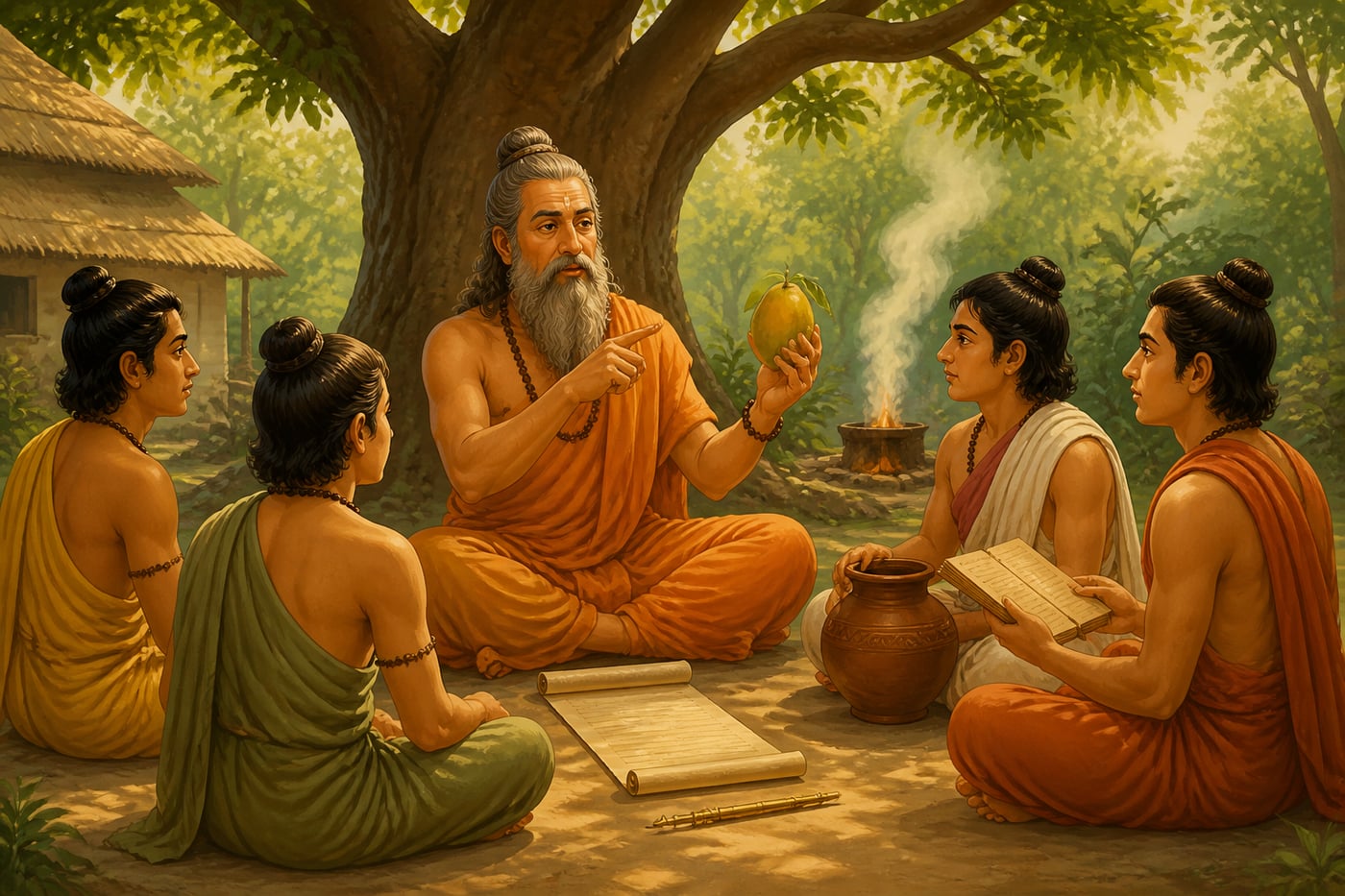
The Nyaya school recognized four Pramanas:
- Pratyaksha (direct perception): Knowledge through sensory contact with the object. Not naive "seeing is believing" but a sophisticated taxonomy that distinguished ordinary perception from extraordinary perception, including yogic perception.
- Anumana (inference): Knowledge through logical reasoning. The Nyaya school developed a five-part syllogism (panchavayava) that required not just logical validity but empirical grounding through a concrete example (udaharana). This was more rigorous than Aristotle's three-part syllogism.
- Upamana (analogy): Knowledge through comparison. Understanding a new concept by its resemblance to a known concept.
- Shabda (verbal testimony): Knowledge from a reliable, competent authority (apta). Not blind faith, but a formal framework for evaluating when transmitted testimony constitutes valid knowledge.
The Vedanta school added Arthapatti (postulation): inferring an unseen fact to explain a known fact. If Devadatta is alive but not at home, you postulate he is somewhere else.
The Mimamsa school added Anupalabdhi (non-apprehension): knowing something through its demonstrable absence. The absence of a pot on the table is itself valid knowledge.
Six Pramanas across six schools, debated, refined, and stress-tested over two millennia. This was not armchair philosophy. It was India's operating system for knowledge production.
The debates between these schools, recorded in thousands of texts, constitute the world's longest continuous epistemological dialogue. The Nyaya-Vaisheshika tradition alone produced a formal logic system that handled inference, fallacy detection, and debate protocol with a rigor that Western philosophy would not match until the 19th century.
This is what Macaulay dismissed without reading.
The Epistemic Coup: Macaulay's Minute of 1835
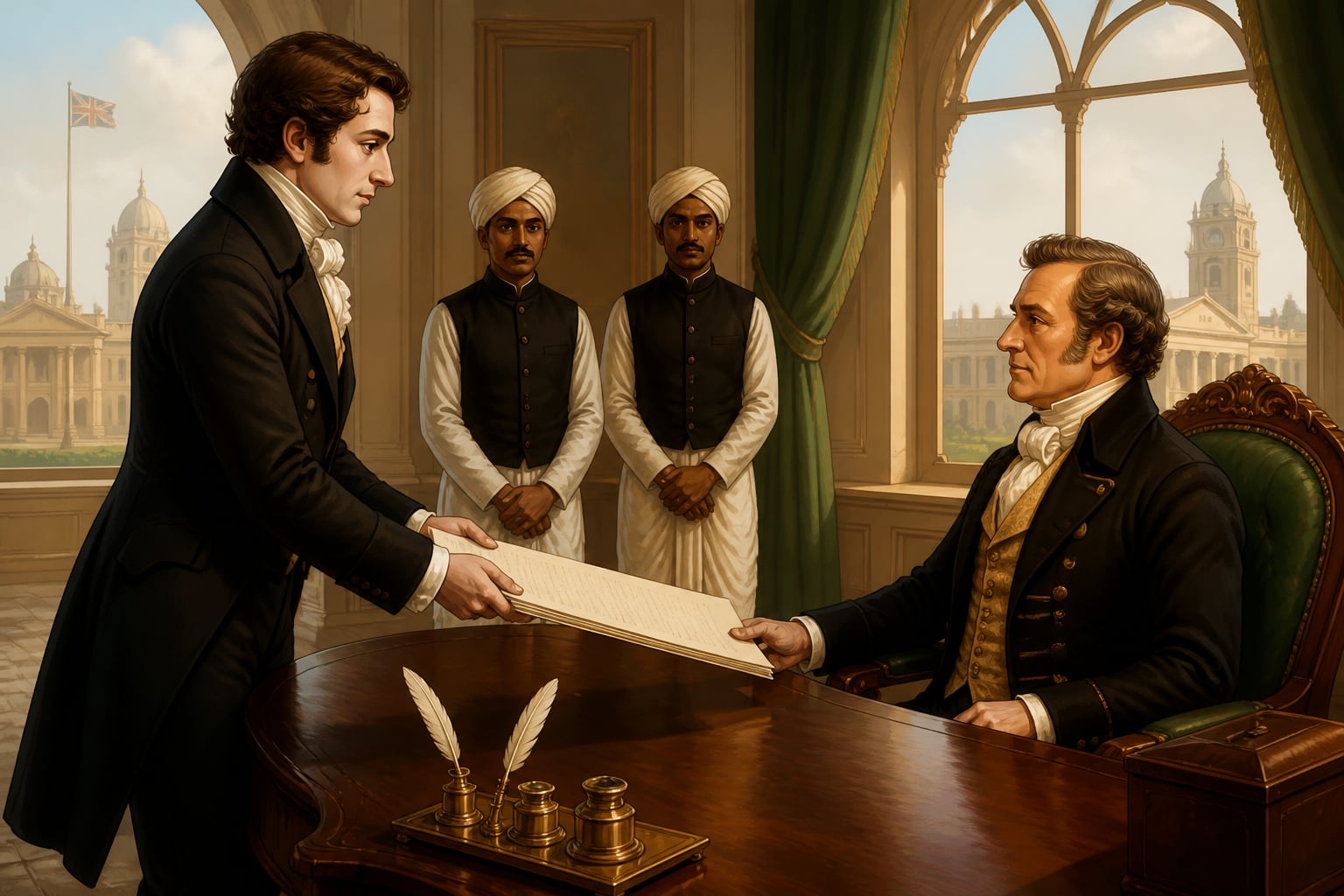
On February 2, 1835, Thomas Babington Macaulay, a British politician serving on the Supreme Council of India, submitted a memorandum to Governor-General William Bentinck that would reshape Indian civilization more thoroughly than any military campaign.
Macaulay had never studied Sanskrit or Arabic. He had never read an Indian philosophical text in its original language. He had never visited an Indian school or spoken with an Indian scholar about their tradition's epistemological frameworks. His knowledge of Indian civilization came entirely from English translations produced by other Europeans.
Yet his Minute was absolute in its judgment:
"I have no knowledge of either Sanskrit or Arabic. But I have done what I could to form a correct estimate of their value... I have never found one among them [Orientalists] who could deny that a single shelf of a good European library was worth the whole native literature of India and Arabia."
The Minute proposed, and Bentinck approved, a complete reorientation of Indian education. Government funds would no longer support the study of Sanskrit, Arabic, or Indian classical learning. Instead, they would fund English-medium education designed, in Macaulay's words, to create "a class of persons Indian in blood and colour, but English in tastes, in opinions, in morals, and in intellect."
This was not a reform. It was an epistemic coup.
What made it devastating was not that it introduced English or Western science. Knowledge traditions have always borrowed from each other, and India had a long history of absorbing useful ideas from outside. What made it devastating was that it replaced the Indian epistemological framework entirely, rather than adding Western knowledge alongside it.
After 1835, educated Indians would learn what to think through Western categories and how to think through Western epistemology. The Pramana framework, the Nyaya logic system, the Mimamsa hermeneutics, the Vedantic classification of knowledge into Para and Apara Vidya, none of these would be taught. Within two generations, India's intellectual elite could quote John Stuart Mill but could not read the Nyaya Sutra.
The result was not ignorance. It was something more subtle and more damaging: epistemic dependency. Indians became consumers of knowledge produced elsewhere, evaluated by frameworks designed elsewhere, validated by institutions controlled elsewhere. They could excel within the imported system, and many did, brilliantly. But they could not step outside it to ask whether the system itself was the right one for their civilization.
What Was Actually Destroyed
Macaulay's Minute did not just change curricula. It severed a civilization from its own way of knowing.
Dharampal, the Gandhian historian, spent decades in British archives researching what India's education system looked like before Macaulay. What he found, published in The Beautiful Tree (1983), was staggering:
- Thomas Munro's survey of the Madras Presidency (1826) found schools in virtually every village. In many districts, Shudra students outnumbered Brahmin students.
- William Adam's reports on Bengal and Bihar (1835-1838) documented over 100,000 indigenous schools, with instruction in reading, writing, arithmetic, and classical learning.
- G.W. Leitner's survey of Punjab (1882) showed that pre-British Punjab had more schools per capita than contemporary England.
This evidence was not hidden in obscure sources. It was in official British government surveys. But it was buried, because it contradicted the narrative that India was an intellectual wasteland rescued by English education.
The pre-colonial system was not perfect. It had inequities of access. But it was indigenous. It operated through the Guru-Shishya parampara (teacher-student lineage). It taught through Indian languages. It used Indian epistemological categories. It produced scholars who could navigate their own civilization's knowledge traditions from the inside.
Macaulay's system produced something different: Indians who were extraordinarily skilled within Western categories but strangers to their own. They could parse British case law but not the Mimamsa rules of textual interpretation that had governed Indian jurisprudence for millennia. They could cite Adam Smith but not Kautilya. They could explain Aristotelian logic but had never heard of Dignaga or Dharmakirti.
This was not education. It was civilizational amnesia, engineered at scale.
From Consumer to Producer: The ISRO Story
If epistemic dependency is the disease, then ISRO is the proof that the cure works.
In 1963, India's space program began with a sounding rocket launched from a church in Thumba, Kerala. The rocket was American. The launchpad was borrowed. The scientists had been trained in Western institutions. India was, in every sense, a consumer of other people's space knowledge.
The first turning point came through denial. In 1992, India had contracted with Russia's Glavkosmos to purchase cryogenic engine technology, the critical component for launching heavy satellites into geostationary orbit. The United States pressured Russia to cancel the deal, invoking the Missile Technology Control Regime. Russia agreed to sell India finished engines but refused to transfer the technology to build them.
The message was clear: certain knowledge would not be shared. India could buy the product but not the capability.
ISRO's response was to build it themselves. It took 20 years. The indigenous cryogenic engine, the CE-20, was successfully tested in 2017 and used operationally in the GSLV Mk III. What had been denied was now produced domestically.
But the journey did not stop at matching what was denied. India began producing knowledge that no one else had:
- Mangalyaan (2014): India became the first country to reach Mars orbit on its first attempt. The mission cost $74 million, less than the budget of a Hollywood film. NASA's equivalent MAVEN mission cost $671 million.
- Chandrayaan-3 (2023): India became the first country to land near the Moon's south pole, a region no other space agency had reached.
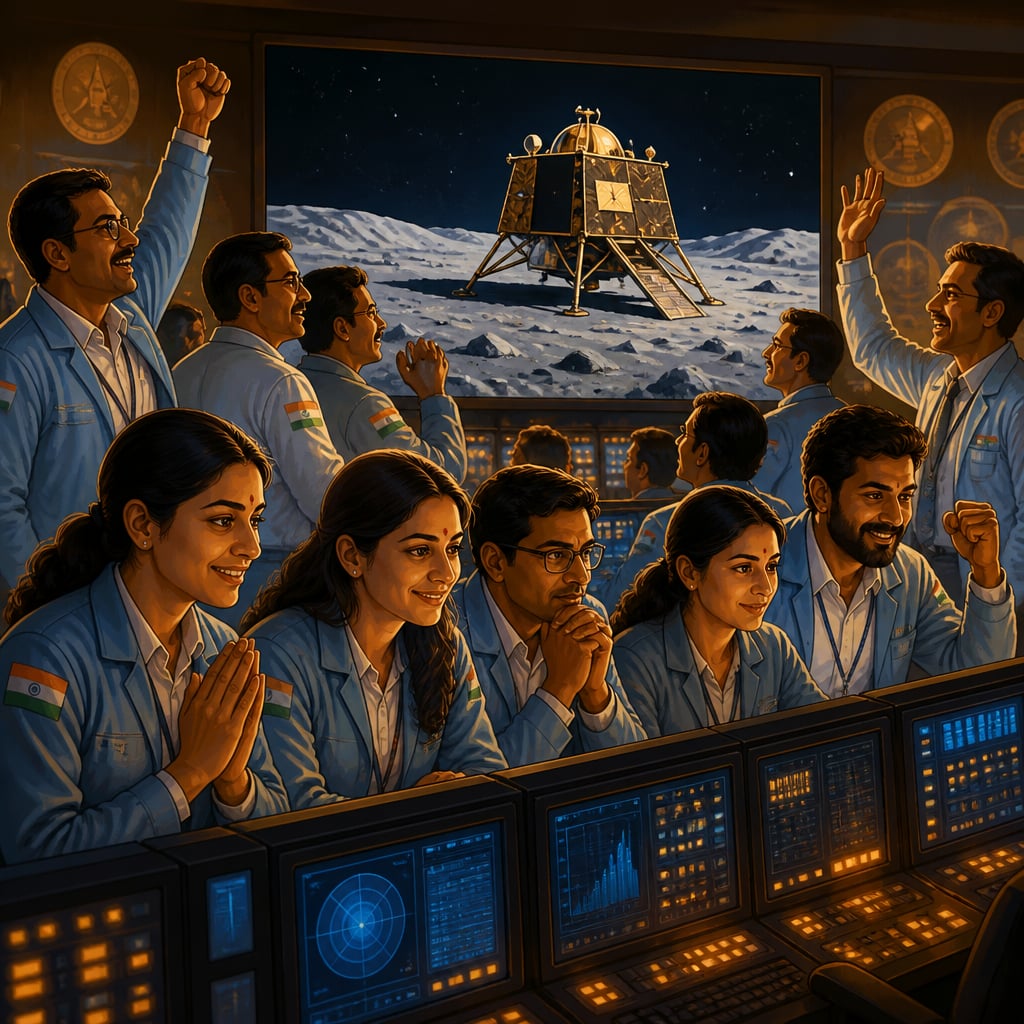
These were not just engineering achievements. They were epistemic sovereignty in action. India moved from consuming space knowledge produced by others to producing space knowledge that others had not yet generated. From a country that could not build a cryogenic engine to a country that landed where no one else had. From technology denial to technology leadership.
The Kena Upanishad's equation proved true: Atmanā vindate vīryam, vidyayā vindate amritam. Through self-reliance, strength. Through knowledge, imperishability.
The Deeper Pattern
The ISRO story is inspiring, but the lesson is not about rockets. It is about the pattern.
Epistemic sovereignty follows a three-stage arc:
Stage 1: Dependency. A civilization consumes knowledge produced by others, evaluated by others' frameworks, validated by others' institutions. India after Macaulay. India buying rockets from other countries.
Stage 2: Denial and Awakening. External denial forces self-reliance. The technology denial that blocked India's cryogenic engine. The intellectual denial that dismissed India's knowledge traditions as "primitive." The denial is painful, but it creates the conditions for awakening.
Stage 3: Production. The civilization begins producing knowledge from its own foundations. Not rejecting outside knowledge, but no longer dependent on it. Not imitating, but innovating. Not seeking validation, but generating it.
India has achieved Stage 3 in space technology. It has not yet achieved it in the broader epistemological domain. Indian universities still teach Western philosophy as "philosophy" and Indian philosophy as "Eastern philosophy" or "religious studies." Indian medical colleges teach allopathy as "medicine" and Ayurveda as "alternative medicine." Indian law schools teach British jurisprudence as "law" and Dharmashastra as "ancient history."
The Pramana framework is still not taught in Indian schools. Nyaya logic is still not part of the standard curriculum. The Mimamsa rules of interpretation, which governed Indian textual analysis for two millennia, are unknown to Indian lawyers trained in British common law.
The epistemic coup of 1835 has not been reversed. It has been reinforced by 190 years of institutional inertia.
What Reclamation Looks Like
Reclaiming epistemic sovereignty does not mean rejecting Western knowledge. Japan did not reject Western science when it modernized. It translated Western knowledge into Japanese categories, creating Japanese terms for Western concepts rather than importing English vocabulary wholesale. Japanese scientists think in Japanese. Japanese philosophers engage Western philosophy from within a Japanese intellectual tradition. Japan produces Nobel Prize-winning science while maintaining its own epistemological identity.
This is the model. Not rejection, but integration on your own terms.
For India, reclamation means:
- Teaching the Pramana framework alongside Western epistemology. Not as a historical curiosity, but as a living toolkit for evaluating knowledge claims.
- Restoring Nyaya logic to the curriculum. Indian students should know Dignaga's theory of inference alongside Aristotle's syllogism.
- Treating Indian knowledge systems as parallel, not alternative. Ayurveda is not "alternative medicine." It is a different medical epistemology with different Pramanas, different diagnostic categories, and different therapeutic goals.
- Producing knowledge from Indian frameworks. Not merely studying the Arthashastra as ancient history, but using its categories to generate new political analysis. Not merely preserving Panini's grammar, but using its formal methods to advance computational linguistics.
- Building institutions that embody Indian epistemology. Not replicating Oxford with Sanskrit mantras at the entrance, but creating universities where the Pramana framework is the operating system and Western knowledge is one of many inputs.
This is the work of a generation. It is the work that this chapter, and this course, exists to begin.
The Mundaka Upanishad asked: "By knowing what does all this become known?" The answer is Para Vidya, the foundational self-knowledge without which all other knowledge remains rootless.
A civilization that cannot interpret itself through its own categories is epistemically colonized, regardless of how many satellites it launches.
The right to interpret yourself is not a luxury. It is the foundation of everything else.
Case studies
Macaulay's Minute of 1835: The Epistemic Coup
In 1835, a debate raged within the British colonial administration: should government funds support the study of Indian classical learning (Sanskrit, Arabic, indigenous sciences) or should they fund exclusively English-medium education? The 'Orientalists' (led by H.T. Prinsep) argued for continuing support for Indian learning alongside English. The 'Anglicists' (led by Macaulay) argued for a complete switch. Macaulay's Minute, submitted to Governor-General William Bentinck on February 2, 1835, settled the debate decisively. Despite having 'no knowledge of either Sanskrit or Arabic' by his own admission, Macaulay declared that 'a single shelf of a good European library was worth the whole native literature of India and Arabia.' Bentinck approved the Minute, and government funding was redirected entirely to English education.
Through the Pramana framework, Macaulay's Minute fails at every level. His Pratyaksha (direct perception) was zero: he never visited an Indian school, never read an Indian text in the original, never observed Indian knowledge production firsthand. His Anumana (inference) was based on contaminated premises: he inferred the value of Indian knowledge from European translations made by people with missionary or imperial agendas. His Shabda (testimony) was selective: he consulted only those Orientalists who agreed with him, ignoring those who recognized India's intellectual achievements. A Naiyayika (Nyaya logician) would have dismissed the entire Minute as a textbook case of hetvabhasa (fallacious reasoning).
Within two generations, India's intellectual elite could quote John Stuart Mill but could not read the Nyaya Sutra. The indigenous education system, which Dharampal's research later showed had schools in virtually every village with broad-caste enrollment, withered as government funding was withdrawn. By 1900, English-educated Indians had internalized the colonial assumption that Western knowledge was 'universal' and Indian knowledge was 'traditional' (meaning: obsolete). The most successful products of Macaulay's system became its most effective propagators, teaching subsequent generations that their own civilization had nothing worth studying.
Epistemic sovereignty can be destroyed not by burning libraries (though that happened too, at Nalanda) but by replacing the framework through which a civilization evaluates knowledge. Macaulay did not ban Indian learning. He defunded it, redirected institutional support to English education, and created incentives (government jobs, social status) that made Western-educated Indians the new elite. The old system died not from prohibition but from institutional starvation. This is a far more effective form of civilizational warfare than military conquest, because the conquered population eventually enforces the conqueror's framework on itself.
Macaulay's framework persists in India's continued reliance on English-medium education as the marker of intellectual quality. The National Education Policy (2020) represents the first systemic attempt to reverse this by promoting mother-tongue instruction, but the social prestige hierarchy Macaulay engineered remains deeply embedded.
Dharampal's research found that Thomas Munro's 1826 survey of the Madras Presidency documented schools in virtually every village, with Shudra students often outnumbering Brahmin students. William Adam's reports on Bengal (1835-1838) found over 100,000 indigenous schools. G.W. Leitner's survey of Punjab (1882) showed pre-British Punjab had more schools per capita than contemporary England. This evidence was buried in British government archives for over 150 years.
ISRO's Cryogenic Journey: From Denied Knowledge to Produced Knowledge
In 1992, India signed a deal with Russia's Glavkosmos to acquire cryogenic rocket engine technology, the critical capability for launching heavy satellites into geostationary orbit. The United States intervened, pressuring Russia under the Missile Technology Control Regime (MTCR) to cancel the technology transfer. Russia eventually agreed to sell India a few finished engines but refused to share the technology to build them. The message was unambiguous: India could consume space technology but would not be allowed to produce it. ISRO was left with a choice: remain permanently dependent on foreign engines for heavy-lift capability, or build the technology from scratch.
The ISRO story maps precisely onto the Kena Upanishad's equation: 'Atmanā vindate vīryam' (Through the Self one gains strength). The technology denial forced India into Atman, self-reliance, and the result was Virya, capability. The second half, 'Vidyayā vindate amritam' (Through knowledge one attains the imperishable), describes what happened next. India did not merely replicate what was denied. It produced knowledge that did not exist before: Mangalyaan reached Mars on the first attempt at one-tenth of NASA's cost. Chandrayaan-3 landed where no one else had. The Vidya produced from self-reliance yielded achievements beyond what dependency could ever have delivered.
It took ISRO 20 years to develop the indigenous CE-20 cryogenic engine, successfully tested in 2017 and used operationally in the GSLV Mk III. But the achievement went far beyond engines. Mangalyaan (2014) made India the first country to reach Mars orbit on its first attempt, at a cost of $74 million versus NASA's $671 million MAVEN mission. Chandrayaan-3 (2023) made India the first to land near the Moon's south pole. India moved from being denied technology to producing knowledge no other country possessed. The trajectory: consumer to denied to producer to leader.
Epistemic sovereignty is not an abstract philosophical concept. It is a strategic imperative with measurable consequences. When India was a consumer of space technology, it was vulnerable to denial regimes. When it became a producer, it achieved what denial regimes said was impossible. The same pattern applies to every domain of knowledge: medicine, law, education, governance, economics. A civilization that produces knowledge on its own terms cannot be denied. A civilization that consumes knowledge produced by others can be cut off at any time. The ISRO story is a proof of concept for civilizational epistemic sovereignty.
ISRO's trajectory from technology denial to Mars-mission success is now the standard reference case for India's broader push toward epistemic sovereignty in semiconductors, AI, and quantum computing. The pattern is clear: external denial, followed by painful indigenous development, followed by sovereign capability that exceeds what was originally denied.
Mangalyaan (Mars Orbiter Mission): $74 million cost, first-attempt success. NASA's MAVEN: $671 million. Chandrayaan-3: first-ever lunar south pole landing. ISRO's annual budget (~$1.9 billion) is roughly 1/12th of NASA's ($25.4 billion), yet India now has capabilities in lunar exploration, Mars missions, and satellite deployment that most spacefaring nations do not.
Living traditions
India's indigenous knowledge frameworks are experiencing a measurable revival. The National Education Policy 2020 mandates teaching Indian knowledge systems alongside Western ones. IIT Gandhinagar, IIT Kharagpur, and IIT Madras have established formal programs in Indian Knowledge Systems (IKS). AYUSH ministry protocols now govern Ayurveda, Yoga, and Siddha alongside allopathic medicine. India's space program (ISRO) and nuclear program (developed after sanctions) are living proof that epistemic sovereignty translates directly into strategic sovereignty. The Swadhyaya movement reaches 5 million practitioners. Sanskrit is taught in over 15,000 schools. The civilizational knowledge tradition is not dead. It is being rebuilt.
- Shastrartha (Formal Philosophical Debate): The tradition of structured public debate between scholars of different philosophical schools, governed by formal rules of logic and evidence. Still practiced in Tibetan Buddhist monasteries (where it was carried from Nalanda) and in traditional Sanskrit pathshalas across India, particularly in Varanasi, Sringeri, and Kanchipuram. Debaters must state their thesis (pratijna), provide reasons (hetu), cite examples (udaharana), and withstand counter-arguments (vitanda).
- Svadhyaya (Daily Self-Study Practice): The disciplined daily practice of studying one's own tradition's texts, listed as one of the five Niyamas in Patanjali's Yoga Sutras. Traditionally meant recitation of one's Vedic shakha; in modern practice, it extends to daily study of any foundational text (Gita, Upanishads, Ramayana). Practiced individually or in satsang groups.
- Nalanda Archaeological Complex (UNESCO World Heritage): Ruins of the world's first residential university (5th-12th century CE), which housed 10,000 students and 2,000 teachers at its peak. Scholars from China, Korea, Tibet, Central Asia, and Southeast Asia came here. The library (Dharmaganja) had nine stories and held manuscripts on every branch of knowledge. Its destruction by Bakhtiyar Khilji in 1193 CE was one of the greatest epistemic catastrophes in human history.
- Satish Dhawan Space Centre (ISRO Sriharikota): India's primary orbital launch facility, where Mangalyaan, Chandrayaan-3, and India's communication satellites were launched. The site represents modern epistemic sovereignty in action: India producing its own space technology after being denied it by technology-denial regimes. The Space Museum on-site documents India's journey from importing sounding rockets on bicycle parts to launching lunar landers.
- Sharada Peeth: The ancient seat of Sharada, the goddess of learning, once the supreme center of Sanskrit scholarship in the Indian subcontinent. Scholars from across India traveled here for advanced study and to receive the title 'Sharadopadhyaya.' Its inaccessibility since 1948 is itself a symbol of epistemic loss. Its ruins, visible from the Indian side of the Line of Control, represent unfinished civilizational recovery.
Reflection
- Think of a subject you studied in school (history, science, medicine, governance). Was the framework through which you learned it indigenous Indian or imported Western? How would the same subject look if taught through an Indian epistemological lens?
- The Mundaka Upanishad asks: 'By knowing what does all this become known?' What would it mean for India, as a civilization, to recover its Para Vidya, its foundational self-knowledge? What would change?
- Can a civilization produce truly original knowledge while thinking in borrowed epistemological categories? Or does the framework itself shape what can be discovered?