Education Revolution
NEP 2020, Gurukul-Modern Hybrid, and Guru-Shishya Revival
India's education system was deliberately engineered to produce colonial intermediaries, not civilizational inheritors. This lesson traces what was lost through Dharampal's research on pre-British indigenous education, analyzes NEP 2020 as the first structural course correction since Macaulay, and blueprints the Gurukul-Modern hybrid that can restore education as civilizational preparation rather than mere job training.
See It Today: The Education System That Forgot Its Own Civilization
Walk into any elite school in India. Students can name the Renaissance, the Enlightenment, and the French Revolution. Ask them about Panini's Ashtadhyayi, Aryabhata's place-value system, or Sushruta's surgical instruments, and you get blank stares. This is not ignorance. It is the result of an education system deliberately designed to produce it.
In 1835, Thomas Babington Macaulay wrote in his infamous Minute on Education: "We must at present do our best to form a class who may be interpreters between us and the millions whom we govern; a class of persons, Indian in blood and colour, but English in taste, in opinions, in morals, and in intellect." This was not casual prejudice. It was a strategic blueprint. And it worked.
Nearly 190 years later, Indian education still operates on Macaulayan architecture. The content has changed. The structure has not. Students still learn through rote memorization rather than comprehension. Knowledge still flows in English-first hierarchies. History textbooks still begin with invasions rather than civilizational achievements. And the fundamental purpose of education, producing "interpreters" between a governing class and the masses, has merely shifted from colonial to globalised elitism.
The education revolution is not about rejecting modern knowledge. It is about reclaiming the right to educate Indians as Indians, not as colonial subjects in a post-colonial wrapper.
The Beautiful Tree: What We Lost
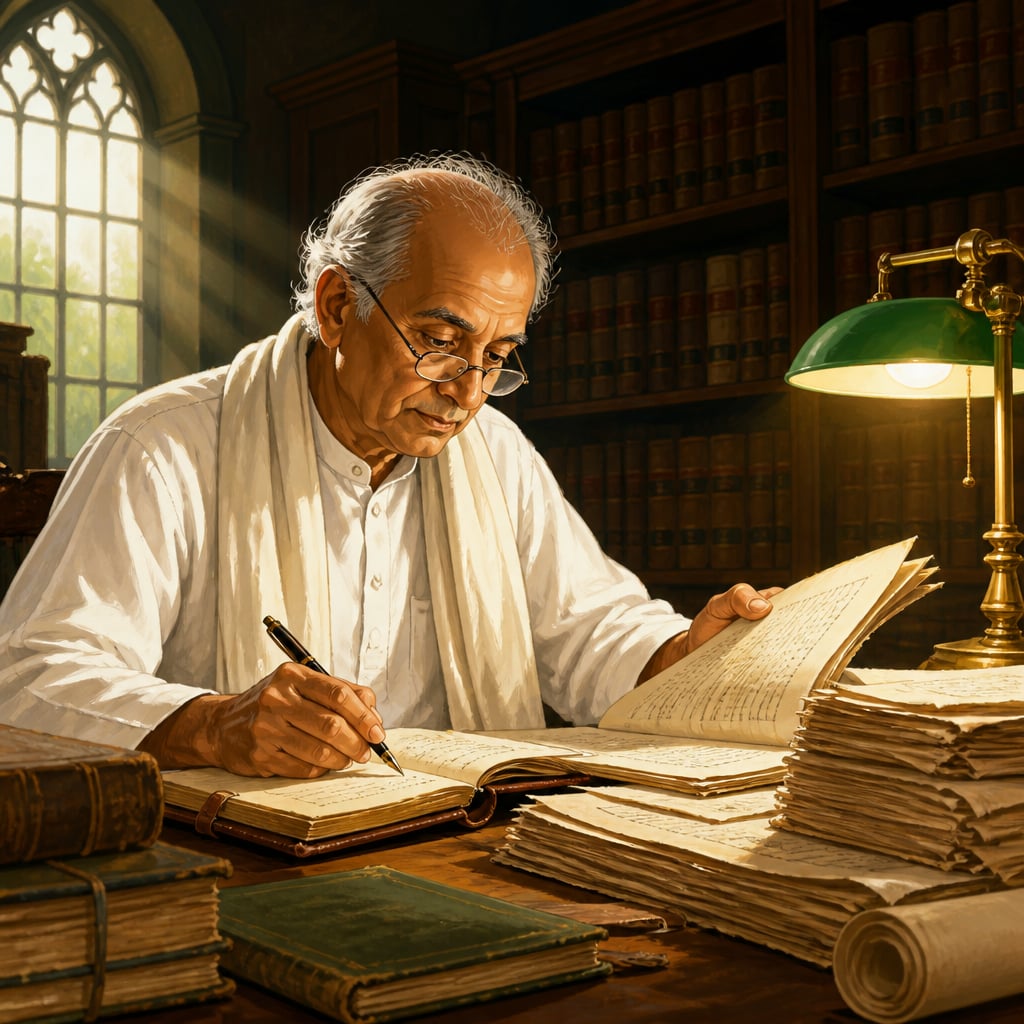
In 1983, historian Dharampal published "The Beautiful Tree: Indigenous Indian Education in the Eighteenth Century," a book that shattered the colonial narrative that pre-British India was educationally backward. Drawing on British survey reports that the British themselves had buried, Dharampal documented an indigenous education system of extraordinary reach and sophistication.
The Evidence the British Buried
William Adam, appointed by the Bengal government, conducted surveys of indigenous education in Bengal and Bihar between 1835 and 1838. He found over 100,000 pathshalas (community schools) in Bengal alone, with an estimated one school for every 400 people. Thomas Munro's survey of the Madras Presidency found similar density. G.W. Leitner's survey of Punjab documented a thriving network of community-funded schools that were systematically dismantled after British annexation.
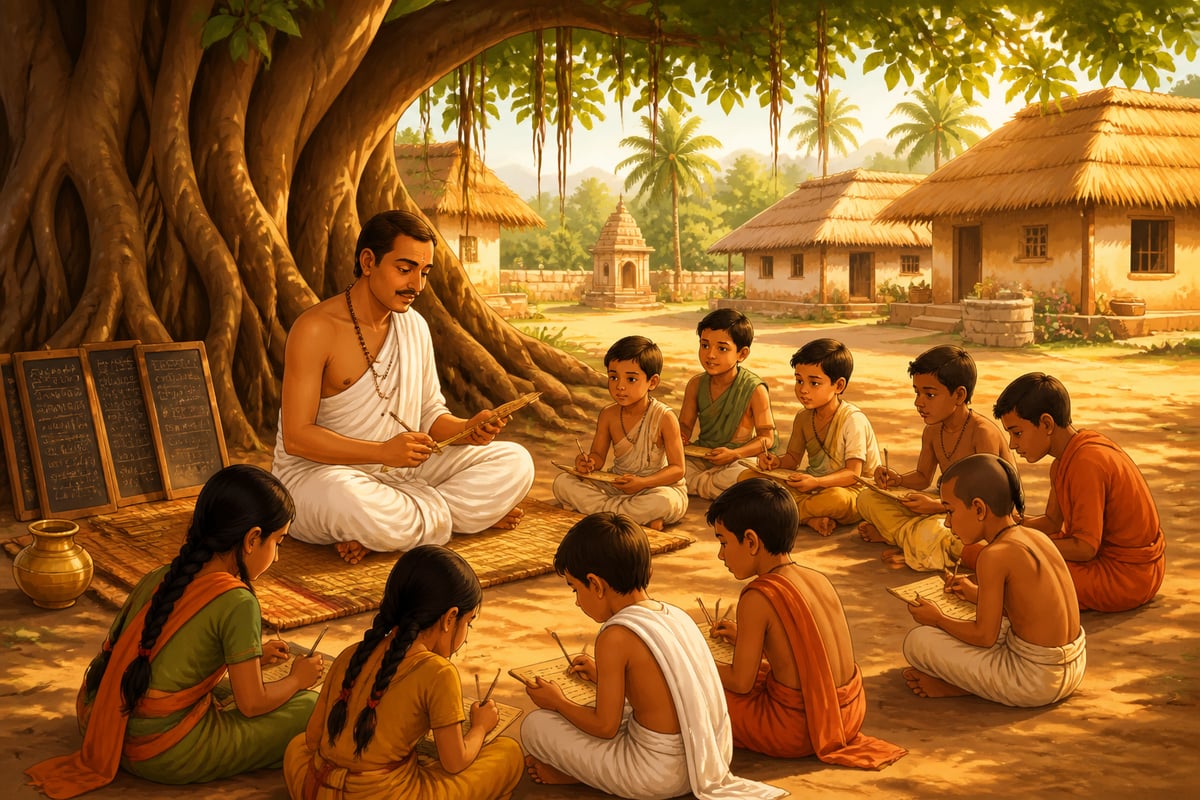
The indigenous system was not elite. Adam's reports documented that students from all social backgrounds, including what the British classified as "lower castes," attended these schools. Funding came from community contributions, land grants, and local patronage. Teachers were respected community figures who received sustenance, not salaries, embedding education within the social fabric rather than above it.
The curriculum was far from narrow. Students studied Ganita (mathematics), Jyotisha (astronomy), Vyakarana (grammar), Kavya (literature), Nyaya (logic), and Dharmashastra (ethics and law). The Guru-Shishya model meant education was personalized. A student progressed at their own pace, mastered fundamentals before advancing, and learned through dialogue, debate, and practical application rather than rote memorization of textbooks.
The Systematic Destruction
Macaulay's Minute of 1835 was the strategic declaration. Wood's Despatch of 1854 was the operational blueprint. Together, they accomplished the most comprehensive educational replacement in colonial history.
The mechanism was precise. First, English was made the medium of higher education and government employment, instantly devaluing indigenous knowledge systems by disconnecting them from economic opportunity. Second, state funding was redirected from pathshalas to English-medium schools. Community schools that had sustained themselves for centuries found themselves competing with government-funded alternatives that offered the only pathway to employment. Third, the curriculum was redesigned to center European knowledge while systematically excluding Indian intellectual traditions. Sanskrit, Persian, and regional language scholarship was not banned outright. It was made economically irrelevant.
The result was not the disappearance of Indian knowledge but its marginalization. The Gurukul did not die overnight. It was slowly strangled by an economic system that rewarded English education and penalized indigenous learning. By the early 20th century, the "Beautiful Tree" that Mahatma Gandhi mourned had been reduced to scattered roots surviving without sunlight.
NEP 2020: The First Structural Course Correction
For 73 years after independence, India's education policy remained essentially Macaulayan in structure. The Kothari Commission (1964-66) made important recommendations but did not fundamentally challenge the colonial architecture. The National Policy on Education (1986, revised 1992) introduced some reforms but left the 10+2 structure and English-first hierarchy intact.
The National Education Policy 2020, drafted by a committee chaired by Dr. K. Kasturirangan, represents the first genuine attempt to rebuild Indian education on civilizational foundations while integrating modern global standards.
The Structural Revolution
NEP 2020 replaces the colonial 10+2 structure with a 5+3+3+4 framework aligned with cognitive development stages.
The Foundational Stage (ages 3-8) emphasizes play-based, activity-based learning in the mother tongue. This directly reverses the Macaulayan principle of early English immersion by grounding children in their linguistic and cultural heritage before introducing additional languages.
The Preparatory Stage (ages 8-11) introduces formal but experiential education, building on the mother-tongue foundation with gradual introduction of other languages including English.
The Middle Stage (ages 11-14) introduces subject-oriented learning while maintaining the multidisciplinary approach. Critical thinking, discussion in the Shastrartha tradition, and project-based learning replace pure rote memorization.
The Secondary Stage (ages 14-18) offers genuine multidisciplinary choice. A student can study Physics alongside Music, Mathematics alongside Philosophy. This dismantles the rigid Arts/Science/Commerce silos that colonial education imposed and restores the holistic knowledge vision of traditional Indian education, where a scholar was expected to be versed across disciplines.
Indian Knowledge Systems Integration
The most civilizationally significant provision of NEP 2020 is the formal integration of Indian Knowledge Systems (IKS) into mainstream education. This is not about adding a Sanskrit elective. It is about recognizing that Ayurveda, Yoga, Vastu, Jyotisha, Ganita, Nyaya, and other Indian knowledge traditions contain substantive intellectual content that deserves curricular status alongside their Western equivalents.
IKS cells have been established at universities including IIT Kharagpur, IIT Madras, and numerous central universities. These cells are tasked with developing curricula that integrate traditional knowledge with modern research methodologies. The goal is not nostalgia but synthesis: using the conceptual frameworks of Indian knowledge traditions to generate new research and applications.
What Needs Acceleration
NEP 2020 is a policy document, not yet a fully realized reality. Several critical gaps remain. Teacher training has not caught up with the policy's vision. Most teachers were themselves products of the Macaulayan system and lack the training to teach Indian Knowledge Systems with rigor. Textbook reform is proceeding slowly. State-level implementation varies dramatically, with some states embracing the reforms and others treating them as optional guidelines. The deeper challenge persists: building an education system that produces civilizationally rooted Indians requires not just curriculum change but a fundamental shift in what education is understood to be for.
The Gurukul-Modern Hybrid: A 21st-Century Blueprint
Neither pure traditionalism nor pure modernism will serve India's educational needs. The Gurukul system, for all its strengths, was designed for a pre-industrial society. Modern education, for all its scale, was designed to produce standardized workers for industrial economies. India needs a third model: one that combines the Gurukul's personalization, character integration, and civilizational rootedness with modern education's scale, research methodology, and global connectivity.
The Five Pillars of the Hybrid Model
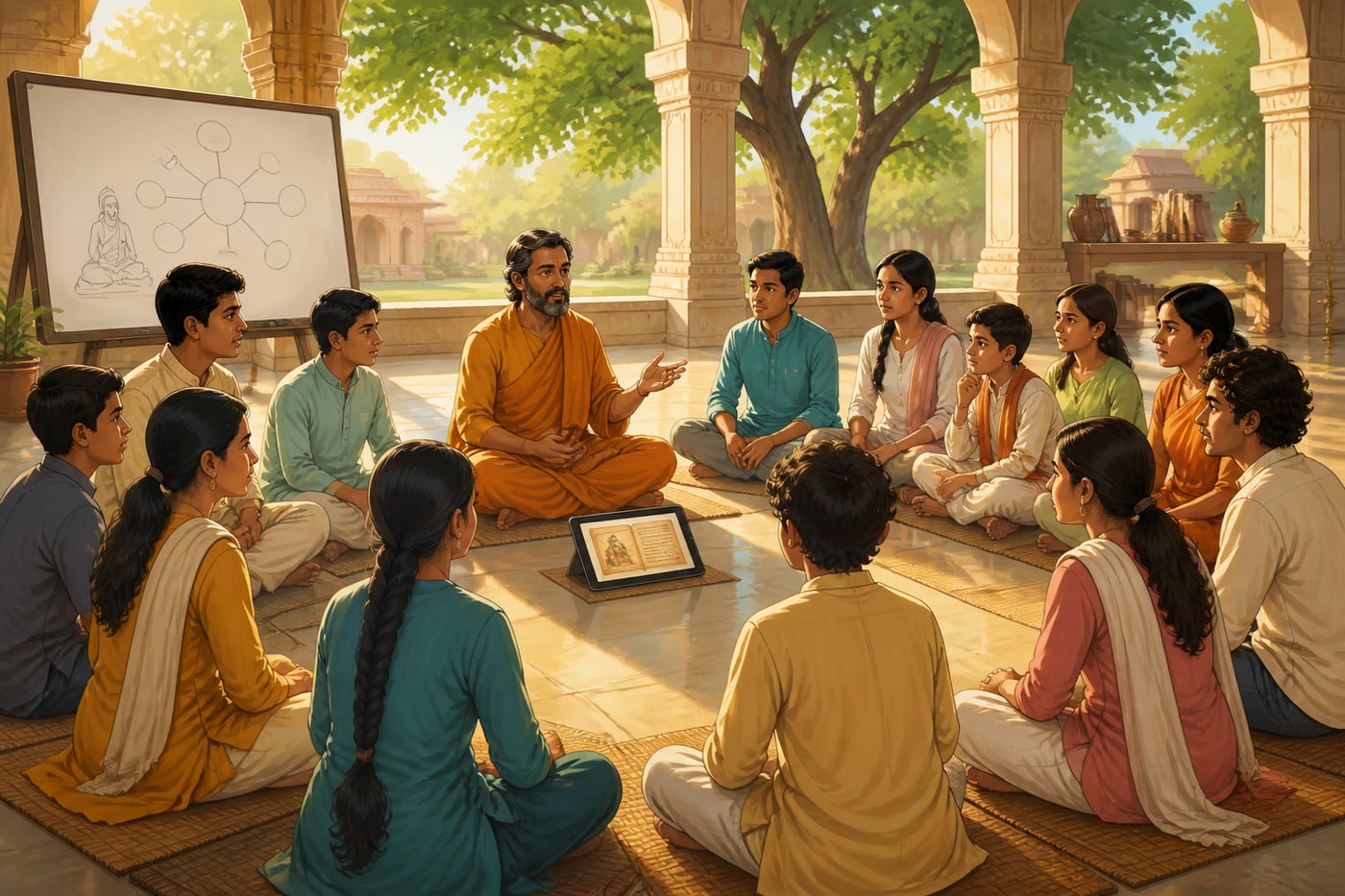
Pillar 1: Mentorship Pods (Guru-Shishya Adapted). Replace the anonymous lecture hall with mentorship pods of 5 to 7 students per mentor-teacher. Each student has a dedicated Guru-figure who tracks not just academic performance but character development, intellectual curiosity, and personal growth. This is not tutoring. It is the Guru-Shishya relationship scaled through institutional structure: a teacher who knows each student deeply enough to customize their learning path.
Pillar 2: Shastrartha Periods (Structured Debate). Allocate dedicated curriculum time for structured debate in the tradition of Shastrartha. Students learn to construct arguments, engage with opposing views, and defend positions using evidence and logic. Unlike Western-style debate which often prioritizes winning, Shastrartha prioritizes truth-seeking. The goal is not to defeat an opponent but to arrive at a more refined understanding through rigorous exchange.
Pillar 3: Seva Integration (Service Learning). Make community service a graded, structured component of the curriculum, not an extracurricular afterthought. The Gurukul tradition integrated Seva as fundamental to education. The student served the Guru, the ashram, and the community as part of learning. Modern Seva integration means students engage with real community challenges, from village water management to elder care to environmental restoration, as part of their academic work.
Pillar 4: IKS-STEM Synthesis. Teach Ayurveda alongside Biology, not as alternative medicine but as a complementary knowledge framework. Teach Ganita alongside modern mathematics, showing how Brahmagupta's zero, Madhava's infinite series, and Baudhayana's geometry contributed to global mathematical knowledge. Teach Vastu alongside Architecture, Jyotisha alongside Astronomy. The synthesis is not about replacing Western science but about demonstrating that Indian knowledge traditions contain rigorous intellectual frameworks that can generate new insights when combined with modern research methods.
Pillar 5: Character Curriculum (Vidya + Vinaya). Restore the ancient principle that education without character formation is incomplete. The Taittiriya Upanishad's convocation address does not congratulate the graduate on mastering content. It charges the graduate with ethical responsibility: speak truth, practice dharma, do not neglect self-study, do not neglect your duties to the world. A modern character curriculum integrates Viveka (discernment), Dharma (ethical responsibility), Karuna (compassion), and Seva (service) as assessed learning outcomes, not optional values sessions.
Guru-Shishya Parampara: Beyond Nostalgia to Revival
The Guru-Shishya relationship is perhaps the most distinctive feature of Indian education, and the most misunderstood. It was never about blind obedience to authority. It was about the transmission of knowledge with context, wisdom with application, and skill with character.
What the Relationship Actually Meant
In the traditional framework, the Guru assumed responsibility for the student's complete development. Dronacharya did not merely teach Arjuna archery. He assessed Arjuna's temperament, customized his training, challenged his assumptions, and prepared him for the specific challenges Arjuna would face. Sandipani did not teach Krishna and Sudama a generic curriculum. He observed each student's nature and potential and shaped instruction accordingly.
The Shishya's role was equally demanding. Shraddha (committed engagement) was the foundation. The student was expected to bring not just intellect but dedication, humility, and the willingness to be transformed by the learning process. This was not obedience. It was the recognition that genuine knowledge transformation requires surrender of preconceptions.
The relationship was also bounded by Dharma. The Guru was accountable for the quality and ethics of what they transmitted. A Guru who taught destructively or selfishly violated their Dharma. The Mahabharata's treatment of Dronacharya's moral failures alongside his pedagogical brilliance demonstrates that the tradition never idealized Gurus uncritically.
Modern Revival Pathways
The Guru-Shishya model can be revived without romanticizing the past. Modern mentorship programs in research universities already approximate this relationship: a doctoral supervisor who guides, challenges, and shapes a student's intellectual development over years. The missing element is the character dimension. Adding ethical mentorship, personal guidance, and civilizational context to the academic mentorship model recreates the Guru-Shishya Parampara in modern institutional form.
Community-based knowledge transmission offers another pathway. Village elders who carry traditional knowledge of agriculture, crafts, medicine, and ecology can be integrated into educational systems as adjunct Gurus, their experiential knowledge complementing textbook learning. This is not sentimentality. It is practical recognition that knowledge systems developed over centuries through observation and practice contain genuine insights that academic education alone cannot provide.
The Civilizational Purpose of Education
The deepest difference between Macaulayan education and Dharmic education is not curriculum. It is purpose.
Macaulayan education asks: "What can this person produce?" Dharmic education asks: "What can this person become?"
The Taittiriya Upanishad's convocation address, perhaps the oldest recorded graduation speech, does not mention career success. It charges the graduating student with five responsibilities: Satyam vada (speak truth). Dharmam chara (practice righteousness). Svadhyayan ma pramadah (never neglect self-study). Matru devo bhava, Pitru devo bhava, Acharya devo bhava, Atithi devo bhava (honor your mother, father, teacher, and guest as divine).
This is education as civilizational preparation, not job training. The educated Indian, in the Dharmic vision, is not merely skilled but discerning. Not merely employable but responsible. Not merely knowledgeable but wise.
The education revolution is not about adding Sanskrit classes to an English curriculum. It is about reclaiming the civilizational purpose of education: producing human beings who understand who they are, where they come from, what they owe their civilization, and what they can contribute to the world. NEP 2020 opened the door. The Gurukul-Modern hybrid provides the architecture. The Guru-Shishya revival provides the soul. What remains is the collective will to walk through that door.
Case studies
Dharampal's Beautiful Tree: The Indigenous Education System Britain Dismantled
Before British colonization reshaped the subcontinent, India operated one of the most decentralized and accessible education systems in the world. Historian Dharampal, drawing on colonial-era surveys that the British themselves commissioned, documented a staggering reality. William Adam's surveys of Bengal and Bihar between 1835 and 1838 found over 100,000 functioning pathshalas, roughly one school for every 400 people in the surveyed districts. Thomas Munro's Madras Presidency survey found comparable density in the South. G.W. Leitner's documentation of Punjab revealed that a thriving network of schools collapsed almost immediately after British annexation, not due to organic decline but due to deliberate administrative neglect and economic displacement. These were not elite institutions. Students from across social backgrounds attended pathshalas that were funded through community patronage, local land grants, and the social contract of the village economy. The curriculum was rich and practical: Ganita (mathematics), Jyotisha (astronomy and time-keeping), Vyakarana (grammar and linguistics), Kavya (literature and rhetoric), and Nyaya (formal logic) formed the core. The Guru-Shishya model meant instruction was personalized and pace-based. There were no rigid age-groupings. A student advanced when mastery was demonstrated, not when a calendar said so. Macaulay's Minute of 1835 and Wood's Despatch of 1854 did not destroy this system through direct prohibition. They made it economically irrelevant. By routing government employment and social advancement exclusively through English-medium institutions, they starved the pathshala network of its patrons, its students, and its social legitimacy. Gandhi's phrase 'Beautiful Tree' captures exactly what happened: the roots were severed, and the tree was left standing just long enough to appear as though it had died of its own weakness.
The Taittiriya Upanishad's graduation address from a Guru to a departing student outlines education as a civilizational compact: 'Speak the truth. Practice virtue. Do not neglect your studies. Do not neglect your duties to the gods and ancestors.' This vision treats education not as credential acquisition but as the transmission of civilizational responsibility from one generation to the next. The pathshala system, precisely because it was embedded in the life of the village and funded by its social fabric, embodied this compact. The Arthashastra of Kautilya also emphasizes that a state's strength depends on a literate, philosophically trained populace. The colonial policy inverted this: it produced a literate class trained for administration of a foreign power's interests, not for the cultivation of their own civilization.
Within two generations of Macaulay's Minute, enrollment in indigenous schools had collapsed across major provinces. By the early 20th century, India's literacy rate, which pre-colonial surveys suggest was reasonably high by the standards of the era, had declined significantly under British administration. The 1901 census recorded overall literacy at around 5 to 6 percent. The knowledge traditions once transmitted through pathshalas fragmented into oral and family-based preservation, losing institutional continuity. India arrived at independence in 1947 with a colonial education architecture still largely intact and a largely dismantled indigenous alternative.
Educational systems do not need to be abolished to be destroyed. Making them economically irrelevant achieves the same result more efficiently and with less visible resistance. The pathshala network's collapse is a lesson in how soft power and economic incentive structures can accomplish what direct coercion cannot. Any revival of indigenous education must therefore address material incentives, not just curriculum content.
India currently debates the legacy of its colonial education system through NEP 2020 and the IKS integration push. Understanding that the pathshala system was not primitive or failed, but was actively outcompeted through administrative and economic means, reframes this debate. It is not about romanticizing the past. It is about recognizing that a sophisticated, community-rooted system existed and was deliberately displaced, and that reconstruction requires deliberate policy in the opposite direction.
William Adam's 1835-38 surveys of Bengal and Bihar documented over 100,000 functioning indigenous schools, approximately one school per 400 people in surveyed districts.
NEP 2020 and the IKS Integration: A Policy Framework in Progress
The National Education Policy 2020, drafted under the K. Kasturirangan committee, represents the most structurally ambitious reform of Indian education since independence. Its 5+3+3+4 curricular structure replaces the colonial 10+2 architecture by aligning schooling stages with cognitive development research rather than administrative convenience. The policy mandates mother tongue instruction through Grade 5, a direct reversal of the English-first assumption that has dominated Indian schooling since Macaulay. Perhaps most significantly for civilizational continuity, NEP 2020 formally institutionalizes Indian Knowledge Systems (IKS) through dedicated cells at IITs and central universities, tasked with integrating Ayurveda, Sanskrit epistemology, classical mathematics, and philosophical traditions into mainstream academic research. The IKS cells represent a genuine structural shift. Rather than treating Indian intellectual traditions as heritage artifacts to be preserved in isolation, they are being positioned as living knowledge systems with contemporary research relevance. Courses on Paninian grammar are being developed alongside computational linguistics. Sulbasutras, the ancient geometric texts used in Vedic altar construction, are being studied in relation to early mathematical history. Sanskrit and other classical languages have been introduced as viable options, not as optional extras. The removal of the Arts/Science/Commerce silo structure at the higher secondary level enables multidisciplinary education closer to the holistic model that traditional gurukuls embodied. Implementation, however, is where complexity accumulates. State-level uptake varies dramatically. Some states have moved aggressively on mother tongue instruction and textbook reform. Others have barely adjusted administrative procedures. Teacher training pipelines for IKS content barely exist at scale. The textbook overhaul, which is foundational to any genuine curriculum shift, remains incomplete at the national level. The gap between policy architecture and classroom reality is wide, and the timeline for closing it is measured in decades, not years.
The Arthashastra classifies knowledge into four categories: Anvikshaki (philosophical inquiry), Trayi (Vedic learning), Varta (economic sciences), and Dandaniti (governance). A complete education, in Kautilya's framework, produces citizens capable of operating across all four domains. The 10+2 colonial structure, with its hard silos between Arts, Science, and Commerce, directly contradicts this integrated vision. NEP 2020's multidisciplinary mandate is, in this light, not a Western liberal arts import but a recovery of the Arthashastra's vision of a complete education. The IKS integration likewise reflects the Upanishadic insistence that Para Vidya (higher, philosophical knowledge) and Apara Vidya (practical, applied knowledge) must develop together, neither subordinated to the other.
As of the mid-2020s, IKS cells are operational at multiple IITs and central universities, producing research publications and pilot courses. Mother tongue instruction has seen meaningful implementation in several states, with early data suggesting improved foundational literacy outcomes in regional language instruction cohorts. Textbook revision at the national level has begun but remains contested. The full 5+3+3+4 structure is being phased in gradually. Teacher training for IKS content remains the largest bottleneck: without teachers who can deliver integrated IKS-STEM or philosophy-alongside-science instruction, the policy framework stays on paper. Full transformation is projected to require 10 to 15 years of consistent implementation across administrations.
Policy architecture and classroom reality require separate strategies. NEP 2020 has produced an intellectually coherent framework that reverses colonial assumptions at the structural level. But curricular reform without teacher capacity building produces mandates that schools nominally comply with and practically ignore. The lesson from NEP 2020's early years is that the bottleneck in education reform is almost never the policy document. It is the trained human beings who must deliver it daily in 1.5 million schools.
NEP 2020 is the most direct government acknowledgment that India's education system requires decolonization, not just modernization. Its success or failure will determine whether India produces a generation that understands its own civilizational inheritance alongside global knowledge systems, or a generation that continues to be educated primarily for the consumption of Western intellectual frameworks. The IKS integration, in particular, is a test case for whether traditional knowledge can be institutionalized without being museumified.
NEP 2020 mandates mother tongue as the medium of instruction through Grade 5, affecting an estimated 250 million school-age children in a country with 22 scheduled languages and hundreds of regional dialects.
The Gurukul-Modern Hybrid Blueprint: A Practical Architecture for Civilizational Education
The Gurukul-Modern Hybrid is a school design built on five structural pillars, each combining a specific gurukul strength with a specific modern educational tool. It is not a heritage project or a nostalgia exercise. It is an operational framework designed to be implemented in existing schools with existing resources, scaled gradually. Pillar One is the Mentorship Pod: groups of 5 to 7 students assigned to a single mentor-teacher for three to four years. This is the Guru-Shishya relationship adapted for institutional scale. The mentor tracks each student's intellectual development, emotional wellbeing, and character formation across subjects and over time, replacing the anonymous progression through disconnected year-group classrooms. Pillar Two is the Shastrartha Period: a dedicated weekly session structured around formal debate. Students are assigned positions on contested questions, required to argue from evidence and reason, then required to argue the opposing position. This trains the truth-seeking orientation of classical Indian intellectual culture rather than the performance-winning orientation of Western debate competition. Pillar Three is Seva Integration: community service embedded into the graded curriculum, not as extracurricular activity but as assessed learning. Students design, execute, and reflect on service projects that connect subject knowledge to community need, operationalizing the Taittiriya Upanishad's injunction that learning must flow outward into responsibility. Pillar Four is IKS-STEM Synthesis: Ayurveda studied alongside Biology to understand different epistemological frameworks for the same domain; Ganita (classical Indian mathematics) studied alongside modern mathematics to trace intellectual genealogy and develop historical perspective; Yoga philosophy alongside Physical Education. Pillar Five is the Character Curriculum: Vidya (knowledge) and Vinaya (humility and ethical responsibility) treated as inseparable learning outcomes, assessed through mentor observation and student self-reflection portfolios rather than standardized testing. The blueprint draws its philosophical foundation from the Taittiriya Upanishad's Shiksha Valli, which opens with the Guru's instruction to the student as the transmission of a civilizational compact. Education in this framework is not the acquisition of information. It is the preparation of a person to carry and advance a civilization. The modern additions, including research methodology, global connectivity, and technology fluency, are incorporated not as replacements for this foundation but as tools that extend its reach.
The Taittiriya Upanishad articulates three foundational educational values: Satyam (truth), Dharma (ethical conduct), and Svadhyaya (continuous self-study). Each of the five pillars maps directly onto one or more of these. Mentorship Pods operationalize Svadhyaya through personalized intellectual accompaniment. Shastrartha Periods operationalize Satyam by training students to pursue truth through structured inquiry rather than accept received opinion. Seva Integration operationalizes Dharma by making ethical responsibility a graded, assessed outcome rather than an aspiration. IKS-STEM Synthesis operationalizes Svadhyaya at a civilizational scale by teaching students to understand their own knowledge tradition, not just import external ones. The Character Curriculum holds all five under the ancient insistence, documented across the Upanishads and the Arthashastra alike, that the purpose of education is the formation of a person capable of sustaining and advancing a good society.
Projected outcomes across a ten-year cohort following this model include: higher rates of civic engagement among graduates compared to conventional school cohorts; stronger performance on analytical and philosophical reasoning assessments due to Shastrartha training; measurable community impact from Seva projects; and documented student ability to articulate both IKS and modern scientific frameworks for the same domain. Pilot schools in this model, including some existing neo-gurukul institutions in Karnataka, Gujarat, and Rajasthan, report stronger student retention, lower dropout rates, and higher parental trust. Full validation would require longitudinal research. The blueprint is designed to be implemented in phases, beginning with Mentorship Pods and Shastrartha Periods in Years 1 to 2, adding Seva Integration and Character Curriculum in Years 3 to 4, and achieving full IKS-STEM synthesis by Year 5.
The opposition between 'traditional' and 'modern' education is a false binary that has paralyzed Indian educational reform for decades. The gurukul's strengths, personalization, character integration, philosophical depth, and mentorship continuity, are precisely what modern mass schooling lacks. Modern education's strengths, scale, research methodology, technology access, and global connectivity, are precisely what the gurukul could not sustain alone. The hybrid blueprint demonstrates that these strengths are not in conflict. They are complementary, and the design challenge is integration, not selection.
As India scales its education system to serve 250 million school-age children while simultaneously attempting to decolonize its curriculum through NEP 2020, the Gurukul-Modern Hybrid offers a practical design language for what decolonized education actually looks like in a classroom on a Tuesday afternoon. It moves the conversation from abstract cultural recovery to operational specificity: exactly how many students per mentor, exactly what the Shastrartha period agenda looks like, exactly how Seva projects are assessed. This specificity is what transforms a cultural aspiration into an institutional reality.
The Taittiriya Upanishad's Shiksha Valli, composed approximately 800 to 600 BCE, contains one of the oldest documented statements of educational philosophy, specifying not just content but the ethical obligations of both teacher and student as the foundation of civilizational transmission.
Reflection
- Think back to your own schooling. What subjects did you study, and what did they prepare you for? Were you taught the history of Indian mathematics, the logic of Nyaya, the grammar of Panini, or the statecraft of Kautilya as living knowledge rather than footnotes? What would be different today if you had been?
- The Taittiriya Upanishad records perhaps the oldest known convocation address. The teacher tells the graduating student: 'Speak the truth. Practice dharma. Do not neglect your study, your duty to the ancestors, the gods, and fellow human beings.' No mention of salary packages or career ladders. What does this suggest about what education was fundamentally for, and what would it mean to hold that standard today?
- Two traps await any attempt to revive traditional Indian education. The first is pure nostalgia: imagining a golden past that was perfect and demanding its wholesale return. The second is wholesale westernization: treating modernity as neutral and tradition as superstition. NEP 2020 attempts a hybrid. Is synthesis genuinely possible, or does one framework always end up subordinating the other? What would an education system look like that is modern in its tools but Bharatiya in its soul?