Arts & Festival Revival
Classical Arts, Festival Meaning, and Inter-Regional Cultural Exchange
India's classical arts and festival traditions are two of its 24 civilizational weapons. Chennai's Margazhi season, Bharatanatyam's rescue from extinction, and Garba's global spread reveal how living cultures revive through community ownership, not government decree.
See It Today: The Margazhi Miracle
Every December, Chennai transforms into the classical music capital of the world. The Margazhi season, named after the Tamil month considered most sacred for spiritual practice, hosts over 2,000 Carnatic music and Bharatanatyam performances across the city in roughly six weeks. The Music Academy, Narada Gana Sabha, Krishna Gana Sabha, and hundreds of smaller sabhas (music societies) run concerts from morning to midnight. Audiences range from octogenarian connoisseurs to college students discovering ragas for the first time.
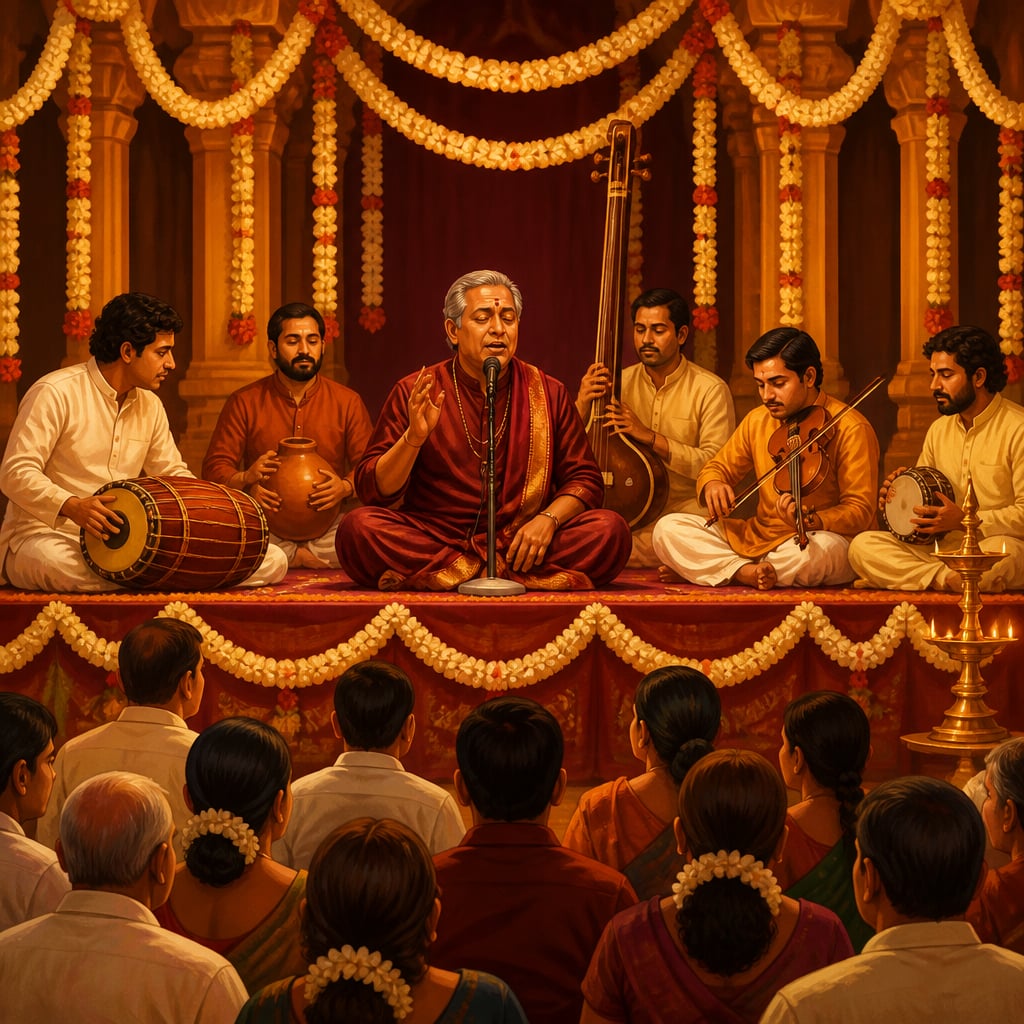
What makes Margazhi remarkable is not its scale but its economics. This is a traditional art form that thrives commercially. The season generates an estimated Rs 1,000+ crore in economic activity: concert tickets, accommodation, food, instrument sales, recording rights, and cultural tourism. Corporate sponsors compete for association with prestigious sabhas. Young artists build careers through the kutcheri (concert) circuit. None of this required government subsidy or UNESCO validation. The sabha system, a uniquely Indian institution where communities self-organize around classical arts, created a self-sustaining ecosystem.
Margazhi proves something that civilizational pessimists deny: traditional arts can thrive in the modern world when the transmission infrastructure remains intact. Chennai's sabhas are the descendants of temple-based artistic communities. When colonial disruption weakened temple patronage, the arts migrated to community-funded sabhas rather than dying. When concert halls replaced temple mandapas, the music carried its sacred character with it. The December season coincides with the Margazhi month because the original connection between art and devotion was never severed.
This is the template for civilizational cultural revival. Not museum preservation. Not government schemes. Living, breathing, commercially viable, spiritually rooted artistic ecosystems sustained by community ownership.
The Mechanism: How Civilizations Revive Their Arts
India's classical arts and festival traditions represent two of the 24 civilizational weapons identified earlier in this course. Artistic traditions (Weapon #21) and Festival networks (Weapon #10) historically functioned as distributed cultural infrastructure, binding regions together, transmitting values across generations, and making civilizational identity experiential rather than abstract. Understanding how they can be revived requires analyzing the mechanics of cultural revival itself.
The Three Pillars of Cultural Survival
Every living art form or festival tradition depends on three interlocking systems.
Patronage: Who pays for it? Temple endowments funded classical arts for centuries. When colonial and post-colonial governments seized temple wealth, the patronage structure collapsed. Arts that found alternative patronage (Carnatic music through the sabha system, Kathak through Lucknow's nawabi courts, then national academies) survived. Arts that did not (many folk and tribal performance traditions) withered.
Transmission: Who teaches the next generation? The Guru-Shishya Parampara created an unbroken chain of artistic knowledge. A single broken link in this chain can extinguish centuries of accumulated technique, repertoire, and aesthetic understanding. When Devadasis were stigmatized out of their artistic role, entire traditions of temple dance nearly vanished. When master craftsmen could not feed their families, apprenticeship systems collapsed.
Participation: Who is the audience? Arts and festivals survive when communities actively participate, not just passively consume. Garba works because thousands dance. Carnatic music works because audiences understand the raga system well enough to appreciate improvisation. When participation declines into spectatorship, and spectatorship declines into indifference, the art form becomes a museum exhibit.
Revival requires rebuilding all three pillars simultaneously. Funding alone (patronage) without new artists (transmission) produces empty concert halls. Training artists (transmission) without audiences (participation) produces performers without careers. The genius of successful revivals is that they addressed all three at once.
The Sabha Model: Community as Patron
Chennai's sabha system is the clearest example of successful patronage transfer. When temple patronage was disrupted, Carnatic music did not seek government protection. Instead, community organizations (sabhas) emerged in the early 20th century as self-funded patrons. Members paid annual subscriptions. Concert tickets covered artist fees. The December season created a concentrated market where supply and demand converged annually.
This model works because it keeps the art form accountable to its community rather than to distant bureaucrats or foreign grant-makers. A sabha that programs poorly loses members. An artist who does not practice loses invitations. The market mechanism, embedded within a cultural community, ensures quality without requiring external regulation.
Festival Revival: Meaning vs. Commerce
India's festivals face a different challenge. Unlike classical arts, which risk obscurity, major festivals risk the opposite: commercialization that strips away meaning. Diwali becomes a shopping season. Holi becomes a paint party. Navratri becomes a Bollywood dance night. The form survives but the substance evaporates.
The most successful festival revivals have maintained meaning while embracing scale. Kolkata's Durga Puja is a striking example. After 2000, the pandal tradition evolved from religious decoration into one of the world's most dynamic public art movements. Artists trained at Shantiniketan and international art schools began designing pandals as conceptual installations addressing contemporary themes: environmental destruction, refugee crises, digital alienation. The 2021 UNESCO Intangible Cultural Heritage recognition validated what Bengalis had built: a festival that generates over Rs 40,000 crore in economic activity while deepening, not diluting, its cultural and artistic significance.
The key mechanism is community ownership. When festivals are organized by communities rather than corporations or governments, the community's relationship with the festival's deeper meaning acts as a check on pure commercialization. The pandal committee that commissions a cutting-edge art installation still performs the same Durga Puja rituals their grandparents performed. Form and meaning coexist because the same community holds both.
Inter-Regional Exchange: The Lost Civilizational Function
India's arts historically performed a function that no modern institution has replaced: inter-regional cultural exchange. When a Kathakali troupe from Kerala performed at a North Indian court, or a Hindustani musician traveled to a Carnatic festival, they were not just entertaining. They were weaving the civilizational fabric, making distant regions legible to each other through shared aesthetic vocabularies.
Colonial disruption and post-independence regionalism severed many of these cross-pollination channels. The linguistic reorganization of states in 1956 inadvertently hardened cultural boundaries. A Tamil musician and a Marathi musician increasingly performed within their regional ecosystems, rarely crossing the linguistic divide that their artistic ancestors had routinely bridged.
Reviving this inter-regional exchange is perhaps the most underappreciated dimension of cultural revival. The Kashi-Tamil Sangamam initiative (2022-23), which brought over 2,500 Tamil scholars, artists, and students to Varanasi, demonstrated the hunger for such exchange. The ancient Kashi-Rameswaram cultural axis, which connected North and South India through shared Shaiva devotion, had been dormant for generations. Its reactivation, even symbolically, reminded participants that India's cultural geography transcends its administrative geography.
The Pattern: When Bharatanatyam Nearly Died
The revival of Bharatanatyam is the most dramatic cultural rescue story in modern Indian history, and it reveals the pattern that all arts revival follows.
For centuries, the tradition now called Bharatanatyam was known as Sadir or Dasi Attam, performed by Devadasis (temple dancers) as an integral part of temple worship. The Devadasi was not a prostitute, as colonial narratives claimed, but a ritual specialist whose dance was a form of sacred offering. The Abhinaya Darpana and Natyashastra codified this tradition as divine art. Temples in Thanjavur, Chidambaram, and across Tamil Nadu maintained dance traditions spanning centuries.
The colonial assault came from two directions simultaneously. British administrators viewed temple dance through the lens of Victorian morality and classified it as immoral. Indian social reformers, internalizing colonial values, launched the "Anti-Nautch" movement in the 1890s, campaigning to abolish Devadasi traditions. The Madras Devadasis (Prevention of Dedication) Act of 1947 effectively criminalized the practice. In the space of fifty years, a sacred art with a thousand-year lineage was legislated into near-extinction.
What happened next is instructive. The art did not revive itself. It was rescued by deliberate intervention.
E. Krishna Iyer, a freedom fighter and lawyer, began performing Sadir publicly in the 1920s and 1930s, sometimes in women's attire, to challenge the stigma. His advocacy created intellectual space for the art to be reconsidered as cultural heritage rather than social vice.
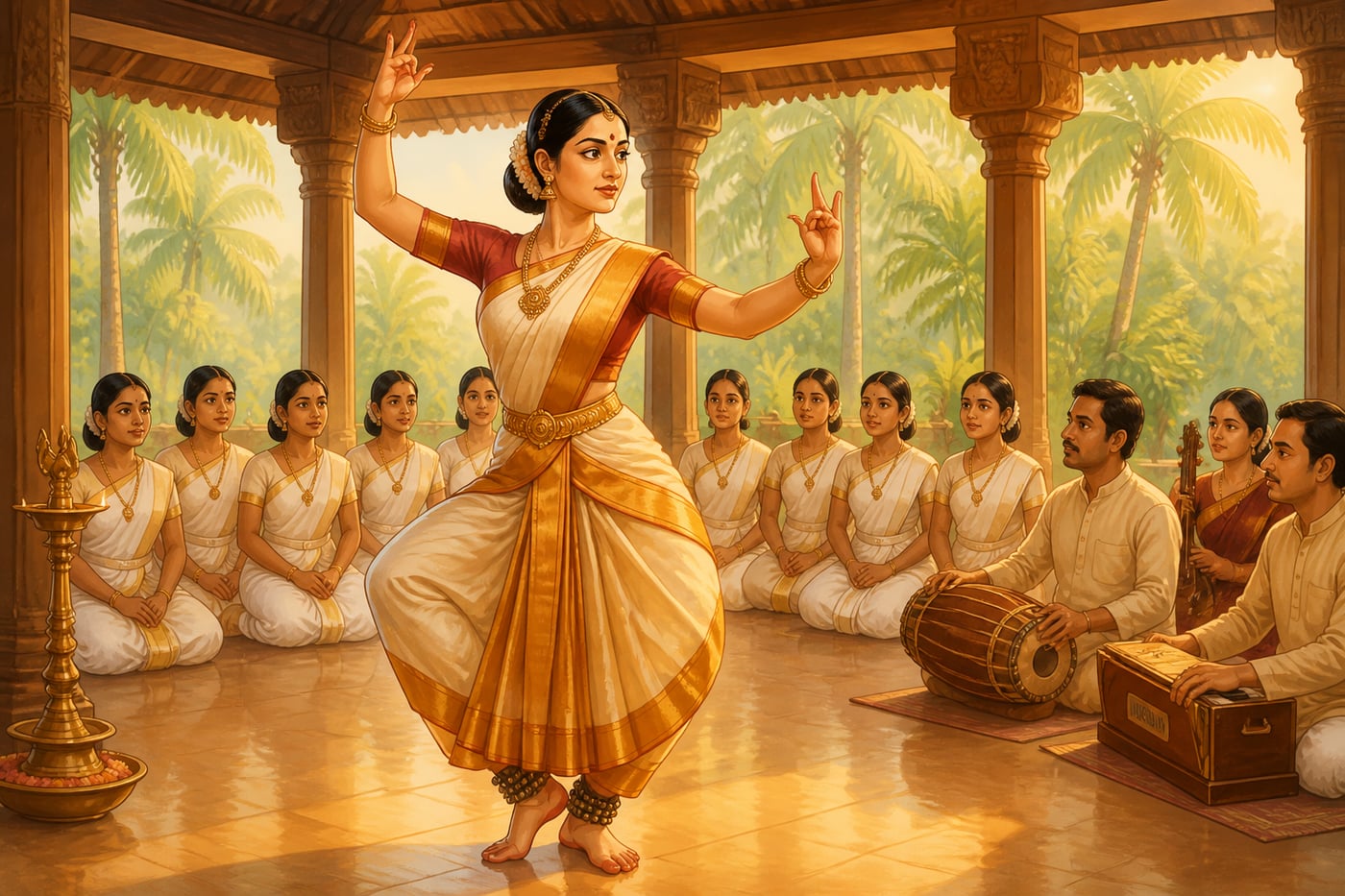
Rukmini Devi Arundale delivered the decisive intervention. A Brahmin woman from a reformist family, she was inspired by Anna Pavlova (the Russian ballerina) to see Indian dance as high art. In 1936, she founded Kalakshetra in Chennai, an institution dedicated to reviving and teaching Bharatanatyam in a new context: stage performance rather than temple ritual, open to students regardless of caste or community, with systematic pedagogy replacing the informal Devadasi transmission.
Her approach was both preservation and transformation. She drew from the Devadasi repertoire (the Thanjavur Quartet's compositions remained central) but reframed the context. Dance moved from temple to stage, from ritual to performance, from hereditary practice to institutional education. The form was preserved. The social context was reimagined.
Kalakshetra became the model for arts institutions worldwide. By the late 20th century, Bharatanatyam had transformed from a stigmatized regional practice into one of the world's recognized classical dance forms, with practitioners on every continent. The three-pillar pattern was clear: new patronage (urban middle-class audiences and later global audiences), new transmission (institutional education replacing hereditary apprenticeship), and new participation (students from all backgrounds, audiences worldwide).
The Bharatanatyam story carries a warning alongside its hope. When the social context shifted, the Devadasis who had preserved the art for centuries were largely excluded from the revival. Their hereditary knowledge was absorbed into institutional curricula, but they themselves were marginalized. Revival is not always just. The question of who benefits from cultural renewal, and who is left behind, remains uncomfortable and necessary.
Dharmic Wisdom: Natya as the Fifth Veda
The Natyashastra, attributed to Bharata Muni, opens with a profound claim: Brahma created Natya (dramatic arts) as the fifth Veda, accessible to all varnas, combining elements from each of the four Vedas. Pathya (recitation) from the Rig Veda, Gita (song) from the Sama Veda, Abhinaya (expression) from the Yajur Veda, and Rasa (aesthetic emotion) from the Atharva Veda. This was not a casual metaphor. It was a civilizational declaration that the arts carry the same sacred authority as scripture.
The concept of Rasa, the aesthetic emotion that great art evokes, reveals the depth of India's artistic philosophy. Bharata Muni identified eight primary Rasas (Shringara, Hasya, Karuna, Raudra, Vira, Bhayanaka, Bibhatsa, Adbhuta), later expanded to nine with Abhinavagupta's addition of Shanta. Rasa theory argues that art is not entertainment or decoration. It is a technology for emotional and spiritual transformation. A perfectly performed dance or musical composition creates a state of Rasanubhava (aesthetic experience) that momentarily dissolves the boundary between performer, performance, and audience. This is not metaphor. It is a precise description of what happens in a great Carnatic concert during a perfectly executed Raga Alapana.
Shiva as Nataraja, the cosmic dancer, embeds artistic creation at the very heart of reality. The Ananda Tandava (dance of bliss) is not a story about a god who happens to dance. It is a philosophical statement that the universe itself is a creative performance. Creation, preservation, destruction, concealment, and grace: the five acts (Panchakritya) that Nataraja performs are simultaneously cosmic functions and artistic movements.
When a civilization treats its arts as sacred technology rather than mere entertainment, revival becomes a spiritual imperative, not a cultural luxury. The decline of Indian classical arts was never just an aesthetic loss. It was a civilizational amputation, cutting off one of the primary channels through which Dharmic values were transmitted, experienced, and renewed across generations.
The Defense: Reviving India's Cultural Immune System
The evidence is clear: India's arts and festivals are not merely cultural ornaments. They are civilizational immune system components. Reviving them requires strategic action at every level.
Individual Action
Learn one traditional art form. Not as a hobby to be listed on a resume, but as a practice. Carnatic music, Bharatanatyam, Kathak, Odissi, a regional folk tradition. The act of learning connects you to a transmission chain that spans centuries. You become a node in the civilizational network.
Attend festivals with understanding. Before the next Navratri, Durga Puja, or Pongal, learn the mythology, the ritual structure, and the historical significance. The difference between a participant and a spectator is knowledge. A participant who understands why nine nights of Navratri map to nine forms of Shakti experiences the festival as civilizational software. A spectator sees only music and dance.
Support artists directly. Attend kutcheris and buy tickets. Commission traditional artisans. The market signal matters: when communities demonstrate willingness to pay for traditional arts, the economic case for preservation strengthens.
Community and Institutional Action
Build sabha-style institutions locally. Chennai's model can be replicated in any city. A community music or dance society that organizes regular performances, funds young artists, and creates an annual season does more for cultural revival than any government scheme.
Create inter-regional cultural exchanges. Organize exposure trips where artists and audiences from one region experience the traditions of another. A group of Bihari folk musicians performing in Kerala, or a Yakshagana troupe in Rajasthan, rebuilds the cross-pollination networks that colonialism severed.
Document oral traditions digitally. Every village has elders who carry songs, stories, ritual knowledge, and performance traditions that exist nowhere in writing. Recording, transcribing, and archiving these before the last practitioners die is urgent civilizational infrastructure work.
Teach festival meaning in schools. Not religious instruction, but civilizational literacy. Why do we celebrate Makara Sankranti across every state under different names? Why does every region have its own harvest festival? What does this tell us about Indian civilization's relationship with nature, seasons, and gratitude? When children understand festivals as civilizational architecture, they inherit the tradition with intelligence, not just habit.
The arts and festivals that unified India for millennia were never decorative. They were the distributed operating system of a civilization that survived when centralized empires fell. Reviving them is not nostalgia. It is the most elegant form of civilizational defense available.
Case studies
Bharatanatyam: From Temple to Stage, From Stigma to Survival
Bharatanatyam nearly vanished within a generation. British colonial administrators classified temple dance as immoral, targeting the Devadasi tradition that had preserved the art form for over a thousand years. The Anti-Nautch movement, led by Indian reformers who had internalized Victorian values, campaigned to abolish Devadasi practices entirely. The Madras Devadasis (Prevention of Dedication) Act of 1947 criminalized the tradition just as India gained independence. A sacred performing lineage stretching back to the Natyashastra was pushed to the edge of extinction by law. Two figures intervened. E. Krishna Iyer, a freedom fighter, performed Sadir publicly in the 1930s to directly challenge the colonial stigma. Rukmini Devi Arundale founded Kalakshetra in Chennai in 1936, reframing temple dance as stage performance, opening training to all communities, and creating a systematic pedagogical framework that separated the art form from its ritual context so it could survive in a post-Devadasi world.
The Natyashastra describes Natya as the fifth Veda, a sacred technology for transmitting dharmic knowledge through embodied performance. Bharata Muni's framework treats the performing arts not as entertainment but as a complete system for communicating rasa, emotional and spiritual truth, to audiences across social and linguistic boundaries. The Devadasis were not performers in any secular sense. They were ritual specialists, custodians of a sacred lineage that transmitted divine aesthetic knowledge. Colonial morality frameworks could not comprehend sacred art. They saw bodies in motion and imposed Victorian categories. The tragedy is that Indian reformers applied the same framework, severing the tradition from its theological grounding before understanding what they were cutting.
Bharatanatyam transformed from a stigmatized regional practice into one of the world's most recognized classical dance forms, with practitioners across 40 countries. Kalakshetra became the foundational model for formal arts education in India. The revival succeeded in preserving technique and aesthetic. The deeper loss is that the Devadasis who had preserved the art for centuries were largely excluded from the institutional revival that used their knowledge. The form was saved. The original lineage was not.
Colonial frameworks do not merely occupy territory. They reframe sacred traditions as immoral practices, recruiting local reformers to finish the demolition. Revival is possible, but it requires understanding what was lost alongside what was saved. Technique can be transmitted through institutions. Lineage requires something deeper.
The Bharatanatyam revival model is now being applied to dozens of other classical forms across India, from Kuchipudi to Manipuri to Chhau. The question each revival must confront is the same: can an art form be institutionalized without losing its ritual intelligence? Kalakshetra solved for survival. The next generation must solve for depth.
In the 1930s, Bharatanatyam was on the verge of extinction, with active practitioners numbering in the hundreds and the tradition legally criminalized by 1947. By 2020, an estimated 10,000 or more active practitioners trained in the form, with institutions and performance groups operating across 40 countries.
Kolkata's Durga Puja: Festival as Living Contemporary Art
After 2000, Kolkata's Durga Puja pandal tradition evolved from elaborate religious decoration into one of the world's most dynamic public art movements. Artists trained at Shantiniketan, Visva-Bharati, and international institutions began designing pandals as full-scale conceptual installations. Themes address urgent contemporary issues: deforestation, refugee displacement, digital alienation, plastic pollution. Each pandal becomes a site-specific installation viewed by hundreds of thousands over five days, making Durga Puja the largest recurring open-air gallery in Asia. The festival generates over Rs 40,000 crore in annual economic activity across West Bengal, supporting artisans, sculptors, fabric workers, and lighting specialists. UNESCO recognized Kolkata's Durga Puja as Intangible Cultural Heritage of Humanity in 2021, the first time a Hindu festival received this designation.
Sanskrit aesthetics describe Utsava as that which elevates, from the root words meaning to lift or raise up. A true festival does not merely celebrate. It elevates the community that participates in it. Durga Puja succeeds as both art and ritual because the same community holds both dimensions without separating them. The para (neighborhood committee) that commissions a cutting-edge conceptual installation also performs the traditional Saptami, Ashtami, and Navami rituals with full Agamic precision. Form and meaning coexist because community ownership ensures neither displaces the other.
Durga Puja proved that festivals can evolve artistically across generations without losing their spiritual core. UNESCO recognition in 2021 validated the model internationally and opened new avenues for artisan training, tourism, and institutional funding. The festival's economic footprint grew alongside its cultural depth, disproving the assumption that commercialization inevitably degrades sacred traditions. Community ownership, not institutional gatekeeping, produced both artistic quality and ritual continuity.
Cultural preservation and artistic innovation are not opposites. When a community owns both the spiritual and artistic dimensions of a tradition, it can evolve the form without losing the meaning. The failure mode is external gatekeeping, whether by state cultural bureaucracies or academic art institutions, that severs the connection between art and its living community.
The Durga Puja model offers a template for other festivals across India: Onam, Pongal, Ganesh Chaturthi, Navratri. Each has the structural capacity to become a living art institution while remaining a spiritual event. The question is whether communities retain ownership or surrender curation to tourism boards and government committees that optimize for spectacle over meaning.
Over 36,000 Durga Puja pandals are registered across West Bengal each year. Top pandals in Kolkata attract 2 to 3 lakh visitors per night during the five-day festival. The total economic activity generated across West Bengal exceeds Rs 40,000 crore annually.
Garba's Global Journey: Sacred Form That Survived Scale
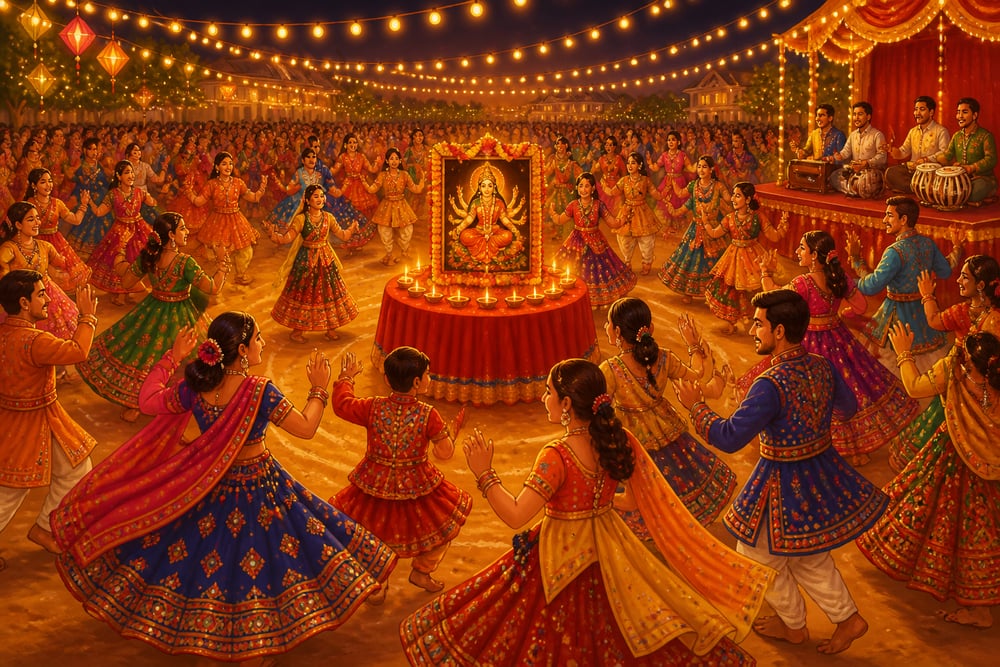
Garba, the devotional dance performed during the nine nights of Navratri, achieved something rare in the era of globalization: it spread to over 40 countries while retaining its spiritual architecture. UNESCO inscribed Garba of Gujarat on its Representative List of Intangible Cultural Heritage of Humanity in 2023. From village courtyards in Saurashtra to events in London, New Jersey, and Melbourne, the tradition expanded through community ownership rather than government export programs or institutional intervention. The nine nights of Navratri map directly to nine forms of Shakti, the divine feminine principle, making each evening of dance a specific devotional act rather than a generic celebration. Unlike many Indian traditions that hollowed out during globalization, retaining the surface while losing the meaning, Garba maintained its theological structure across diaspora communities.
The circular formation of Garba is not choreographic decoration. It is sacred geometry built into the tradition's structure. Dancers face the center, where a lamp or garbo (clay pot representing the divine feminine) is placed, while moving in a circle that represents the cycle of creation, preservation, and dissolution. Every participant faces the divine while moving. The devotional orientation is embedded in the form itself, not in instructions issued by a religious authority. This built-in spiritual architecture explains why Garba resists commercial dilution: you cannot remove the center and still have Garba. The form carries the meaning.
Garba became India's most successful cultural export to retain its spiritual identity at global scale. Community ownership, not institutional control, proved the most effective model for preservation during rapid globalization. The UNESCO recognition in 2023 formalized what practitioners already knew: Garba had traveled the world without losing its soul. The tradition demonstrates that economic scale and spiritual depth are not in conflict.
Traditions survive globalization when their meaning is encoded in their form rather than in the instructions of external authorities. Garba's sacred geometry is inseparable from its physical structure. Communities worldwide preserve it not because they are told to, but because removing it would make the tradition unrecognizable. The most resilient cultural preservation strategy is to ensure meaning cannot be separated from form.
Garba offers a design principle for other endangered traditions: if the spiritual meaning can be separated from the form, it will be. The task of revival and preservation is not just documenting what a tradition looks like, but ensuring the theological and philosophical architecture is so deeply embedded in the form that extraction is impossible.
Gujarat's Navratri economy is estimated at over Rs 25,000 crore annually. Over 10,000 Garba events take place worldwide each Navratri. UNESCO's 2023 inscription recognized Garba as Intangible Cultural Heritage, making it one of the few living devotional dance traditions to receive this designation while still in active, large-scale practice.
Reflection
- Think of a cultural practice, art form, or festival in your own family or community that has faded or become purely commercial. What would it take for you to participate in restoring its original meaning, even in a small way, this year?
- Bharatanatyam was nearly erased within two or three generations of colonial stigmatization, but was revived within another two generations through deliberate institutional effort. What does this cycle reveal about how fragile and how resilient living civilizational traditions actually are?
- Bharata Muni's Natyashastra frames performing arts as a sacred technology for Rasa, the transmission of emotional and spiritual states from performer to audience. If this framing is correct, what is lost when arts are reduced to entertainment or commercialized into spectacle?