Talapatram

Ya Devi Sarva-Bhuteshu: The Refrain of the Whole Course

The hymn revisited as practice; the Goddess in all beings. Reciting is remembering she is in you.

The hymn revisited as practice; the Goddess in all beings. Reciting is remembering she is in you.

The Line You Have Been Hearing All Along
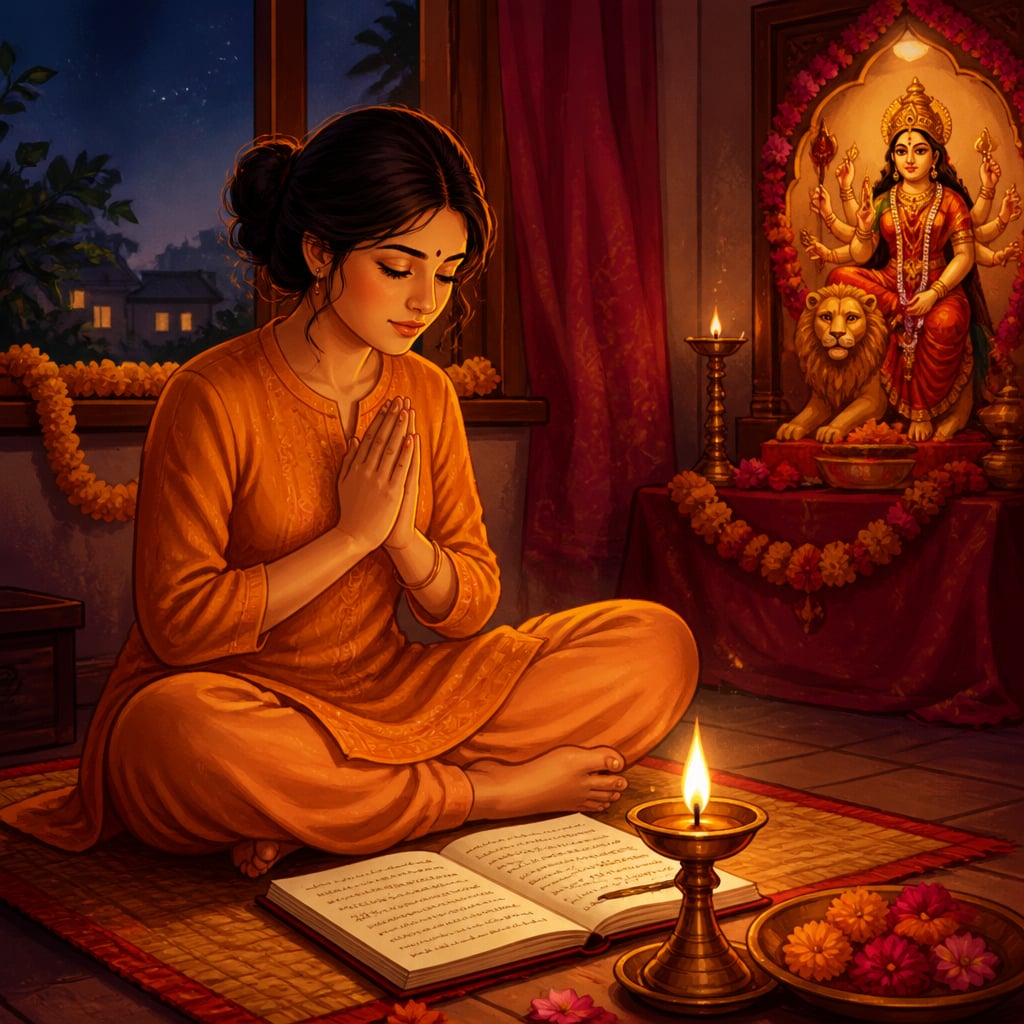
Ananya reciting the hymn by lamplight

Picture a student, call her Ananya, home in Pune on the third night of Navaratri. A clay lamp burns on the floor. The room smells of camphor and marigold, and her grandmother's worn copy of the Saptashati lies open on her knees. Ananya has recited this hymn every autumn since she was small, the way you sing a song whose words you never quite look at. Tonight, for no reason she can name, she stops at the line she has said a hundred times, and reads it slowly, and asks what it actually means.

The line is the refrain that has run through this whole course.

या देवी सर्वभूतेषु विष्णुमायेति शब्दिता। नमस्तस्यै नमस्तस्यै नमस्तस्यै नमो नमः॥

yā devī sarvabhūteṣu viṣṇumāyeti śabditā | namas tasyai namas tasyai namas tasyai namo namaḥ ||

To the Goddess who in all beings is called the power that veils and sustains, salutations to Her, salutations to Her, again and again salutations.

Devi Mahatmyam, Chapter 5 (the Ya Devi hymn)
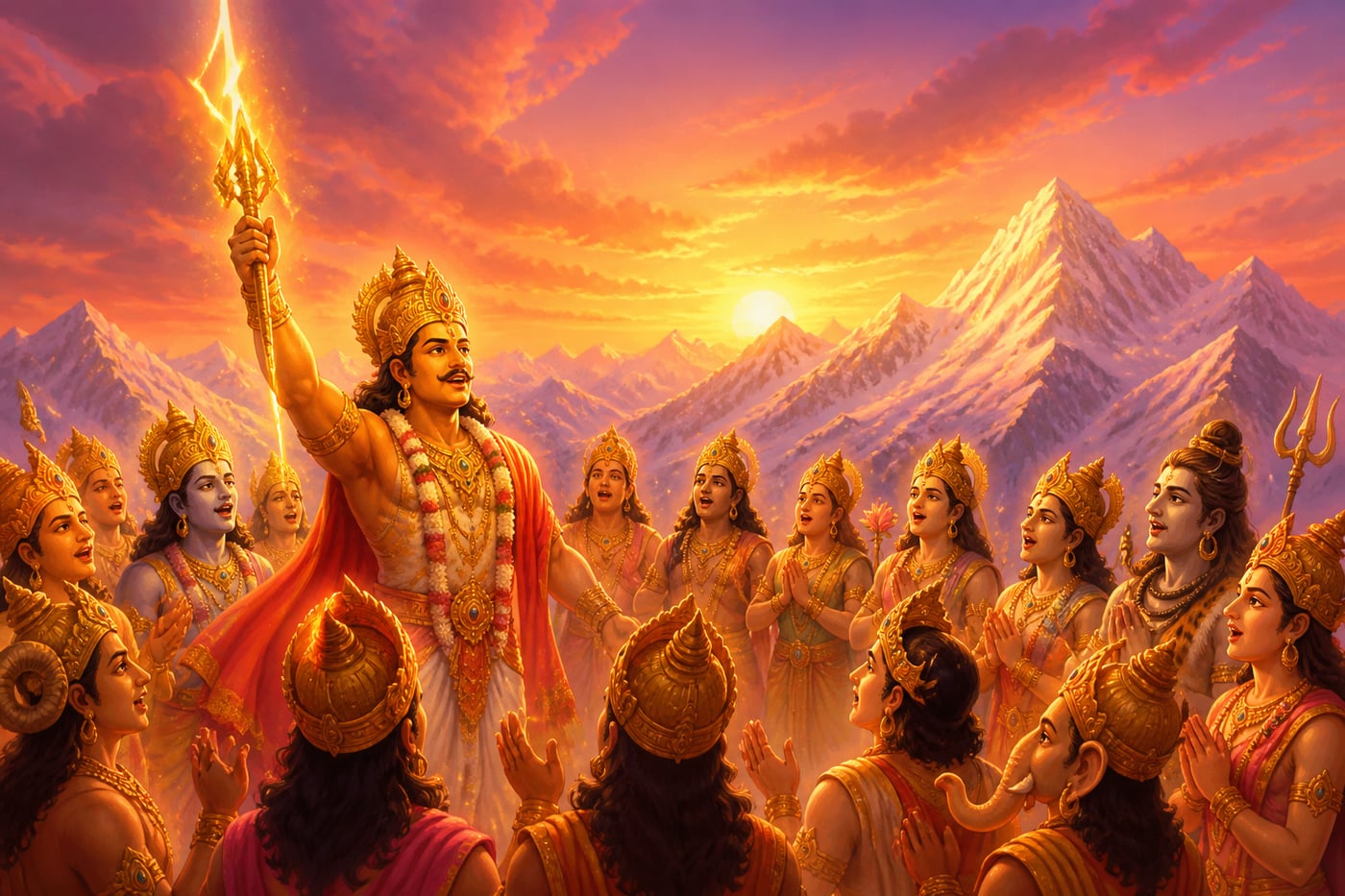
Indra and the gods singing the first hymn

The gods sang this on the Himalayas before the last battle, aspect after aspect, and we have met its verses all through the story: the Goddess as intelligence, as forbearance, as memory, as faith. Now, at the start of the final chapter, it is worth stopping where Ananya stopped, and reading the refrain as what the tradition says it truly is: not a prayer sent far away, but a description of where the Goddess actually lives.

Read the Grammar, Find the Teaching

Look at the three words that repeat in every verse. Sarva-bhuteshu means in all beings. Rupena means in the form of. Samsthita means she abides, she is established. The hymn does not say the Goddess is above all beings, or beyond them, or watching from a far heaven. It says she abides in all beings, as this quality and that one.

So each verse names a place you can find her, and the places are not temples. They are faculties of your own mind:

Run down the long hymn and the pattern holds for every aspect: hunger, sleep, shadow, energy, contentment, compassion. The Goddess is not one more being among beings. She is the power by which every being lives at all. The refrain is a map of where that power is, and the map keeps pointing to the same place, which is inside you.

The hymn ends on the aspect that gathers the rest.

या देवी सर्वभूतेषु चेतनेत्यभिधीयते। नमस्तस्यै नमस्तस्यै नमस्तस्यै नमो नमः॥

yā devī sarvabhūteṣu cetanety abhidhīyate | namas tasyai namas tasyai namas tasyai namo namaḥ ||

To the Goddess who in all beings is named consciousness itself, salutations to Her, salutations to Her, again and again salutations.

Devi Mahatmyam, Chapter 5 (the Ya Devi hymn)

Chetana is consciousness, the bare fact of awareness that lets you register anything at all. The hymn names her, finally, as that. Not a quality you have, but the awareness in which all your qualities appear. This is the deepest reach of the refrain: the Goddess praised as the very consciousness reading these words.

Reciting Is Remembering

Here is why this matters for practice, and it is the quiet teaching of the whole chapter. If the Goddess abides in all beings as these powers, then to recite the hymn is not to flatter a distant deity. It is to walk down the list of your own faculties and remember, one by one, whose they are.

You have fought the demons of this course with exactly these powers. Discernment saw through the shape-shifting ego. Memory starved the multiplying craving. Forbearance waited out the insult. The refrain is telling you where those powers came from: not manufactured by the small self straining, but already present, the Goddess herself, abiding in you as your own capacity to meet what comes.

That is what Ananya understood on the third night, with the lamp low. The hymn she had recited as sound was a mirror all along. Each namas tasyai, each salutation, bows not away from herself but toward the power seated within her. To recite the refrain is to remember that the strength you will need for your own battles is not somewhere else. It is here, as near as your own awareness, waiting only to be recognised.

The rest of this chapter turns to how the tradition guards and carries this recognition: the armour-hymn that protects the reciter, the bolt and pin that frame the recitation, the many names the one Goddess wears, and the temples where the whole of it is kept alive. It begins with the hymn that wraps the reciter in protection, limb by limb, which is the next lesson.

Living traditions

The Ya Devi hymn is among the most recited passages in all of Goddess worship, chanted in temples and homes far beyond those who could translate its Sanskrit. Its teaching survives in that daily practice: that the Goddess is not sought far away but recognised within, as the intelligence, patience, memory, and awareness by which every being lives. To recite it remains, as it has always been, a way of remembering where one's own strength comes from.

  • Kollur Mookambika Temple: A revered temple to the Goddess as Mookambika, worshipped as the union of Saraswati, Lakshmi, and Kali, learning, abundance, and power in one form. It is a great centre of Devi recitation, where the Saptashati and the Ya Devi hymn are chanted daily. The temple embodies this lesson's teaching that the one Goddess is the power seated in all beings, praised through many aspects. (The Shakti Peethas course maps the wider network of Goddess sites.)

Reflection

  • The refrain says the Goddess abides in all beings as intelligence, forbearance, and memory. Which of these powers have you leaned on lately without noticing where it came from?
  • Ananya had recited the hymn for years as sound before she read it for meaning. Where in your own life do you repeat words, a prayer, a phrase, a resolution, without looking at what they say?
  • The hymn names the Goddess, finally, as consciousness itself, the awareness reading these words. What is it like to turn attention from what you are aware of toward the bare fact of being aware?

More in The Hymns, the Names, and the Goddess Who Saves

All lessons in The Hymns, the Names, and the Goddess Who Saves · Durga: The Goddess Who Saves the World ebook course