Argala, Kilaka, and How the Chandi Is Recited
The bolt and pin that frame recitation; the tradition of the full Path. Discipline as devotion.
Why You Cannot Just Open to the Battle
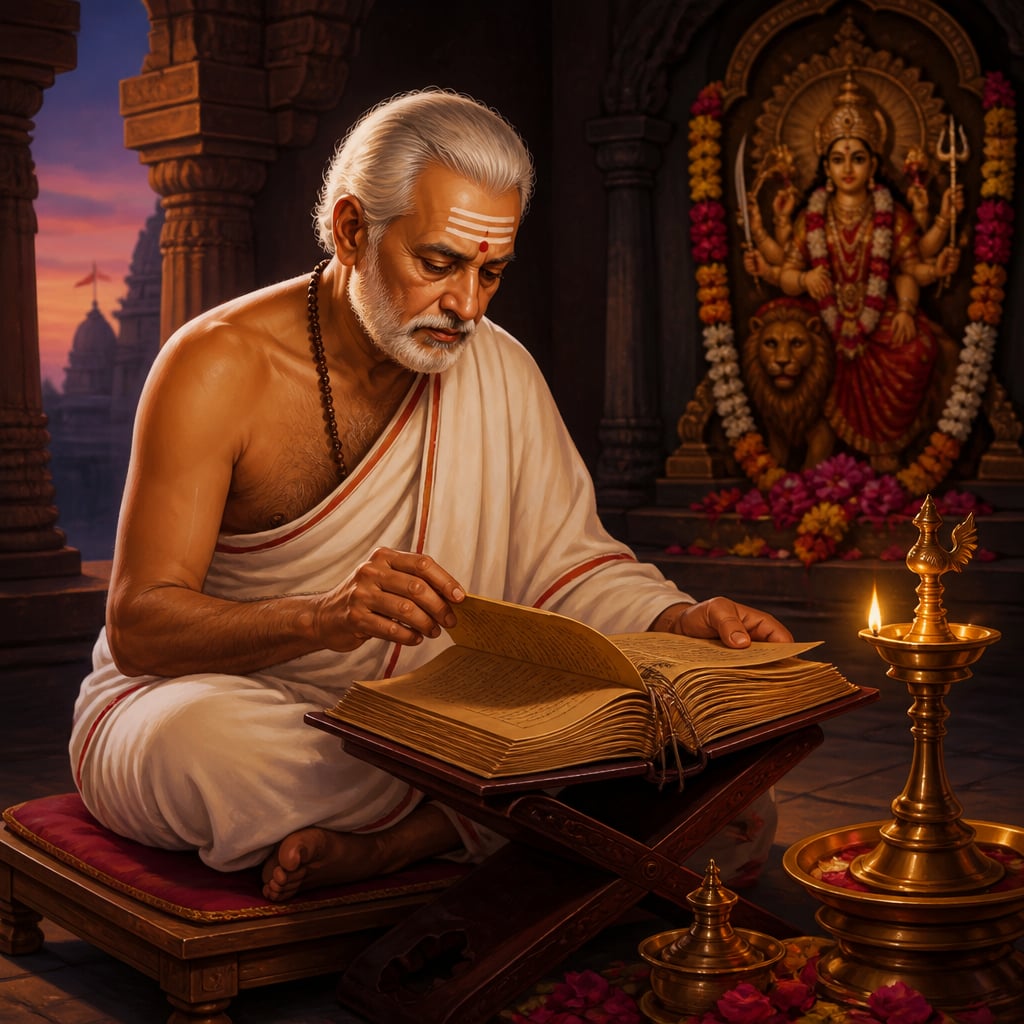
Before dawn in a Chandi temple, a reciter named Keshav sits on a low wooden seat with a brass lamp and a worn manuscript. It is the first day of Navaratri, and he means to recite the whole Saptashati, all seven hundred verses of the Goddess's story. But he does not open to the demon-battles and begin. He does something that a newcomer beside him finds strange. He recites two short hymns first, and only then turns to verse one.
The newcomer asks why. Why not go straight to the story everyone loves, the shape-shifting buffalo-demon, the blood-cloning Raktabija? Keshav's answer is the whole of this lesson: the tradition frames the recitation with a bolt and a pin, and without them, it says, the reading does not open.
The Bolt and the Pin
The main text is called the Saptashati, the seven hundred, for its roughly seven hundred verses. Around it the tradition places short guarding hymns, recited in a fixed order. The Kavacham of the last lesson is the first. Then come two more, with unusual names.
The Argala Stotram is named for the argala, the bolt or latch of a door. It is a hymn of plain, forceful requests, each line asking the Goddess for something and ending with the same drumbeat.
रूपं देहि जयं देहि यशो देहि द्विषो जहि।
rūpaṃ dehi jayaṃ dehi yaśo dehi dviṣo jahi |
Grant me grace, grant me victory, grant me honour, and destroy what opposes me.
Argala Stotram
The Kilaka Stotram is named for the kilaka, the pin or nail that locks a thing shut, and it is the stranger of the two. The tradition holds that the power of the Saptashati was, in a sense, pinned closed, and that reciting the Kilaka draws the pin and unlocks the fruit of the whole recitation. Where the Argala clears the obstacles in front, the Kilaka opens the lock.
Set the three hymns in order and the frame becomes clear:

| Hymn | Its Name Means | What It Does |
|---|---|---|
| Kavacham | Armour | Protects the reciter, limb by limb |
| Argala | Bolt or latch | Clears obstacles, opens the way |
| Kilaka | Pin or nail | Unlocks the fruit of the recitation |
Only after these does Keshav turn to the first verse of the story itself. The tradition also frames the recitation with a sankalpa, a stated intention at the start, and with rites of closing at the end. The story sits inside a careful structure, like a jewel inside a setting.
Discipline as Devotion
This one runs against a modern instinct. We want the good part now. Skip the preliminaries, get to the story, extract the meaning, move on. The recitation tradition says, gently, no. The frame is not an obstacle in front of the treasure. The frame is part of how the treasure is received.
Think about what the preliminaries actually do to the reciter. By the time Keshav reaches verse one, he has armoured his attention, cleared his distractions, stated his intention, and settled his mind into order. He does not arrive at the story scattered and casual. He arrives prepared. The bolt and the pin have been worked on him as much as on any unseen lock.
- Rushing to the meaning treats it as information to grab.
- Framing the recitation treats it as something to be entered, in the right state.
- The discipline is not a delay before the devotion. The discipline is the devotion.
This is a truth far wider than one recitation. Anything worth receiving deeply asks to be approached in the right state, and the approach is not wasted time. The musician tunes before playing. The preparation shapes what the encounter can become. The tradition simply refuses to pretend that you can seize the depth of a sacred text by flipping straight to the exciting part, casually, on the way to something else.

The Full Path
The disciplined reading-through has a name, parayana, and over Navaratri it becomes a practice with real weight. Some recite the whole Saptashati each of the nine days. Some divide it across the nights. Some add the secret concluding chapters, the Rahasyas, that reflect on the Goddess's nature. The point is not speed or completion for its own sake. The point is that the reciter gives the text time and order, and lets it work on them across days rather than in one grab.
Keshav's newcomer, by the third morning, has stopped asking why not skip ahead. Reciting the bolt and the pin has become the part where he settles, and the settling has become the part he values. He has learned what the frame was for. It was never keeping him from the Goddess. It was preparing him to meet her.
The story he prepares to enter is the one this course has walked through, with its many-named Goddess and its inner demons. The next lesson turns to those names directly: why the one Goddess is called Durga in one place and Kali in another, Ambika here and Chamunda there, and how the many names hold together as one.
Living traditions
The Chandi Path, the framed recitation of the Saptashati, is performed in temples and homes across the land, especially through Navaratri, exactly as this lesson describes: the guarding hymns first, then the seven hundred verses, then the closing rites. The tradition's insistence that the frame is part of the treasure survives in every reciter who settles themselves with the bolt and the pin before turning to the Goddess's story.
- Chandi Devi Temple: A revered temple to the Goddess as Chandi, set on a hilltop above Haridwar where the Ganga leaves the mountains. The recitation of the Saptashati is often called the Chandi Path, the reading of Chandi, and this shrine to the fierce Goddess is a fitting place for a lesson on how that recitation is framed and performed. Pilgrims climb or take the ropeway to seek her, especially through Navaratri. (The Shakti Peethas course maps the wider network of Goddess sites.)
Reflection
- The reciter frames the story with a bolt and a pin before beginning, refusing to skip to the exciting part. Where do you rush to grab the meaning of something, treating the approach as an obstacle rather than part of it?
- By verse one, the reciter is armoured, cleared, and settled; the preliminaries worked on him as much as on any lock. In your own life, where does preparation quietly shape what an experience can become?
- The parayana lets the text work over nine nights rather than in one grab. What in your life are you trying to absorb in a single rushed pass that would give more if you gave it steady, ordered time?