One Goddess, a Thousand Temples
Shakti Peethas, Vindhyavasini, Kolkata's Kali, Vaishno Devi; Durga Puja in Bengal, the artisans, the immersion.
The Idol That Is Made to Be Given Back
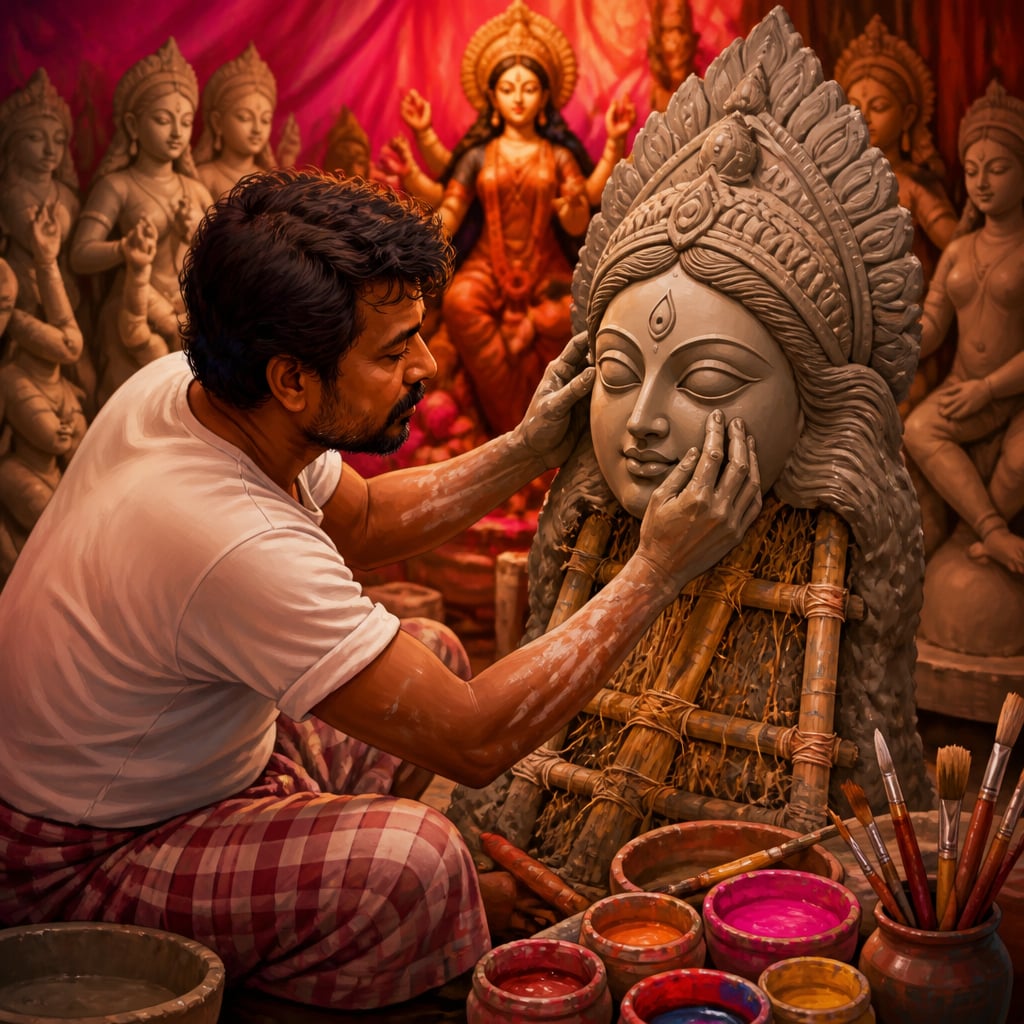
Six weeks before Durga Puja, in the narrow lanes of Kumartuli in Kolkata, an idol-maker named Nemai works knee-deep in wet clay. The armature is straw and bamboo, lashed by hand. Over it he presses clay dug from the Ganga, layer on layer, until the shape of the Goddess rises: ten arms, the lion, the buffalo-demon beneath her spear. The lanes smell of river mud and drying paint. The eyes are still blank; they will be painted last, in a rite called the giving of the eyes, on an auspicious morning.
Nemai will spend two months on this figure. And he knows, with every layer he smooths, exactly where it is going. In ten days of festival it will be worshipped by thousands, and then it will be carried to the river and let go, dissolved back into the same clay it came from. He is making something beautiful precisely in order to give it back. That fact, which a visitor finds almost unbearable, is the deepest teaching of the living tradition.
One Goddess, Held Across a Whole Land
Step back from Kumartuli and look at the map. The Goddess of this course is not kept in one shrine. She is held across the entire subcontinent, in a network so old and so wide that a person could spend a life visiting it.
There are the Shakti Peethas, the seats of the Goddess. The tradition tells that when the body of Sati was scattered across the land, each place where a part fell became a seat of her power, dozens of them, from Kamakhya in the east to sites across the north and south. There are the great independent shrines:
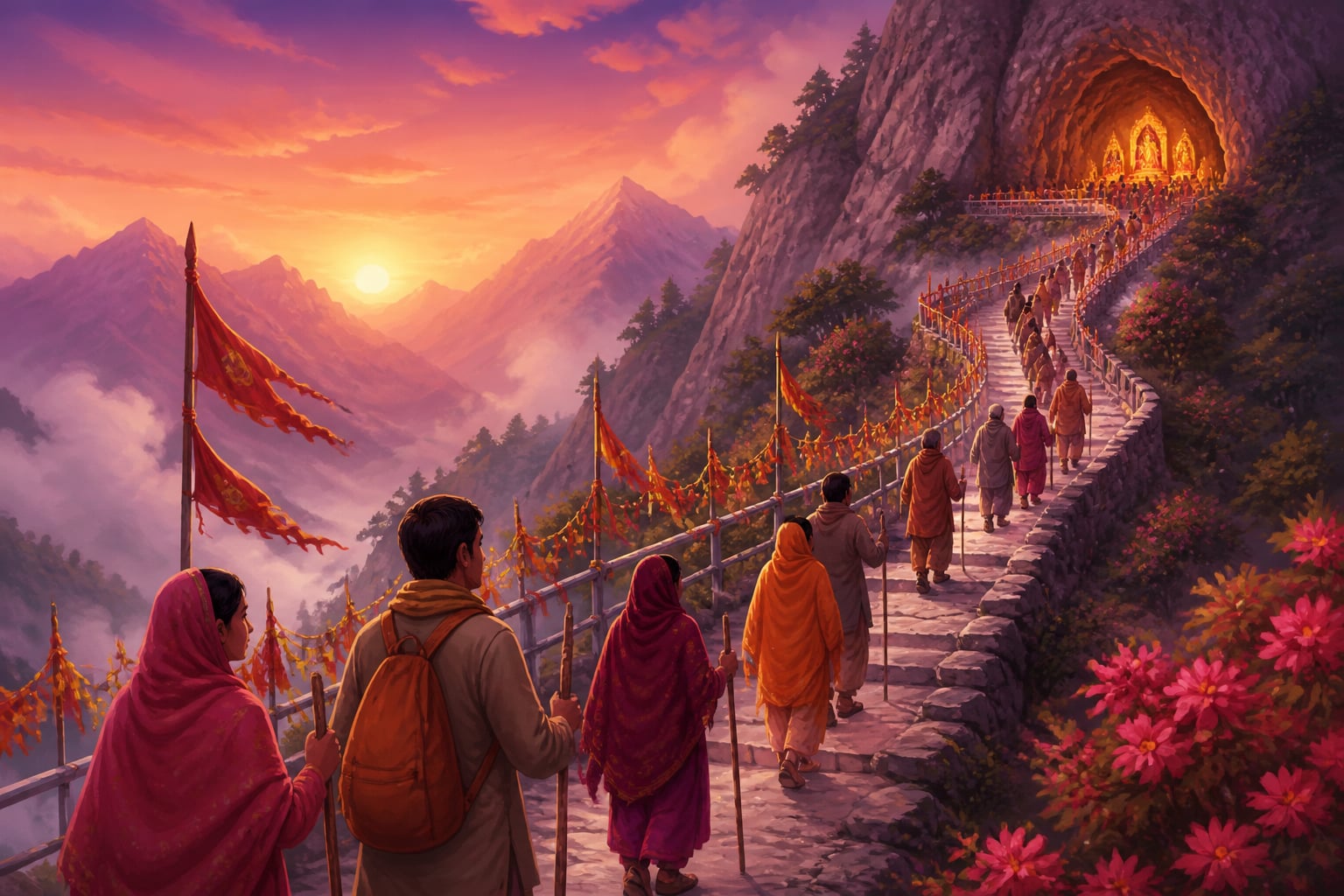
- Vaishno Devi in the Jammu hills, where millions climb a mountain track each year to a cave.
- Vindhyavasini on the Ganga, worshipped as the Goddess who took birth to slay Shumbha and Nishumbha.
- Kalighat in Kolkata, the fierce Mother who gave the city its name.
- Kamakhya in Assam, the Goddess in her most primal, life-giving form.
One Goddess, a thousand temples. The many names of the last lesson become, on the ground, many places, each with its own stone and story, all of them held by worshippers as the same Devi.
सर्वमङ्गलमाङ्गल्ये शिवे सर्वार्थसाधिके। शरण्ये त्र्यम्बके गौरि नारायणि नमोस्तु ते॥
sarva-maṅgala-māṅgalye śive sarvārtha-sādhike | śaraṇye tryambake gauri nārāyaṇi namo 'stu te ||
O auspiciousness of all that is auspicious, O gracious one who accomplishes every aim; O refuge, three-eyed and radiant, O Narayani, salutations to you.
Devi Mahatmyam 11.10
This single verse is recited at temples across every one of those regions, in Bengali and Tamil and Marathi mouths alike. It is one of the most beloved lines in all of Goddess worship, and it binds the thousand temples into one devotion.
Made, Adored, and Released
Return to Nemai's idol, because the great festival of Bengal turns his two months of clay into a lesson the whole tradition means to teach.
For the days of Durga Puja the image is not treated as clay at all. Through the rite of the giving of the eyes, the Goddess is invited to be present in it, and for the festival she is there, fully, adored with light and drums and food and the gathered love of a whole city. The murti, the sacred image, becomes the Goddess made visible, held, and served.

And then, on the last day, she is carried to the river and immersed. The drums follow her to the water. The clay softens, the paint runs, the beautiful form dissolves, and the Goddess who was invited in is bid farewell, returned to the formless from which she came. This is the visarjan, the immersion, and it is not a sad accident of impermanent materials. It is the point.
Watch what the festival enacts, start to finish:
| The Rite | What It Teaches |
|---|---|
| Making the image | Form is shaped from the formless |
| Giving the eyes | The divine is invited into form |
| The days of worship | Form is fully honoured and loved |
| The immersion | Form is released back to the formless |
This gathers the whole course. Everything you love takes form, is worth honouring completely while it is here, and will be returned to the formless in the end. The tradition does not resolve this by refusing to love the form, nor by pretending it will last. It does both hard things at once: it pours two months of devotion into the clay, adores it without reserve, and then, when the time comes, lets the river take it without clinging. To make something beautiful, love it fully, and give it back is not a defeat. It is how the tradition holds a world where every form is temporary and every form is the Goddess.
Nemai will begin another idol next year. The letting-go does not stop the making; it is what makes the making free. That freedom, and what this whole ancient text finally offers to anyone facing their own battles, is the last lesson of the course.
Living traditions
The making and immersion of the Durga image, repeated in thousands of pandals each autumn, keeps alive one of the tradition's subtlest teachings: that a form can be shaped with total devotion, adored without reserve, and then released to the river without grief. Alongside the great pilgrim shrines and the Shakti Peethas, the festival holds the one Goddess across the living land, worshipped in countless places and forms and recited into unity by verses said in every region alike.
- Vaishno Devi: One of the most visited shrines in the land, where millions each year climb a mountain track to a cave to seek the Goddess, worshipped there in three natural rock forms. Vaishno Devi is the great living emblem of this lesson's teaching that one Goddess is held across the land and sought by countless pilgrims. The journey itself, the long climb to the cave, is part of the devotion. (The Shakti Peethas course maps the wider network of Goddess sites.)
Reflection
- The idol-maker spends two months on an image he knows will be dissolved in the river. Where in your life could you love something fully while holding it loosely enough to let it go when its time comes?
- Knowing the image will be immersed does not stop the artisan from making it beautiful; it frees him. Where does the fear that something will end make you withhold your full care from it?
- One Goddess is held across a thousand temples and countless forms, bound into one devotion. Where do you meet the same deep reality in many forms, and does the variety enrich your seeing or scatter it?