The Boons and the Two Paths
Suratha asks for a kingdom, Samadhi for liberation; the phala-shruti. The two things people come for, and that she grants both.
Two Ruined Men in a Forest
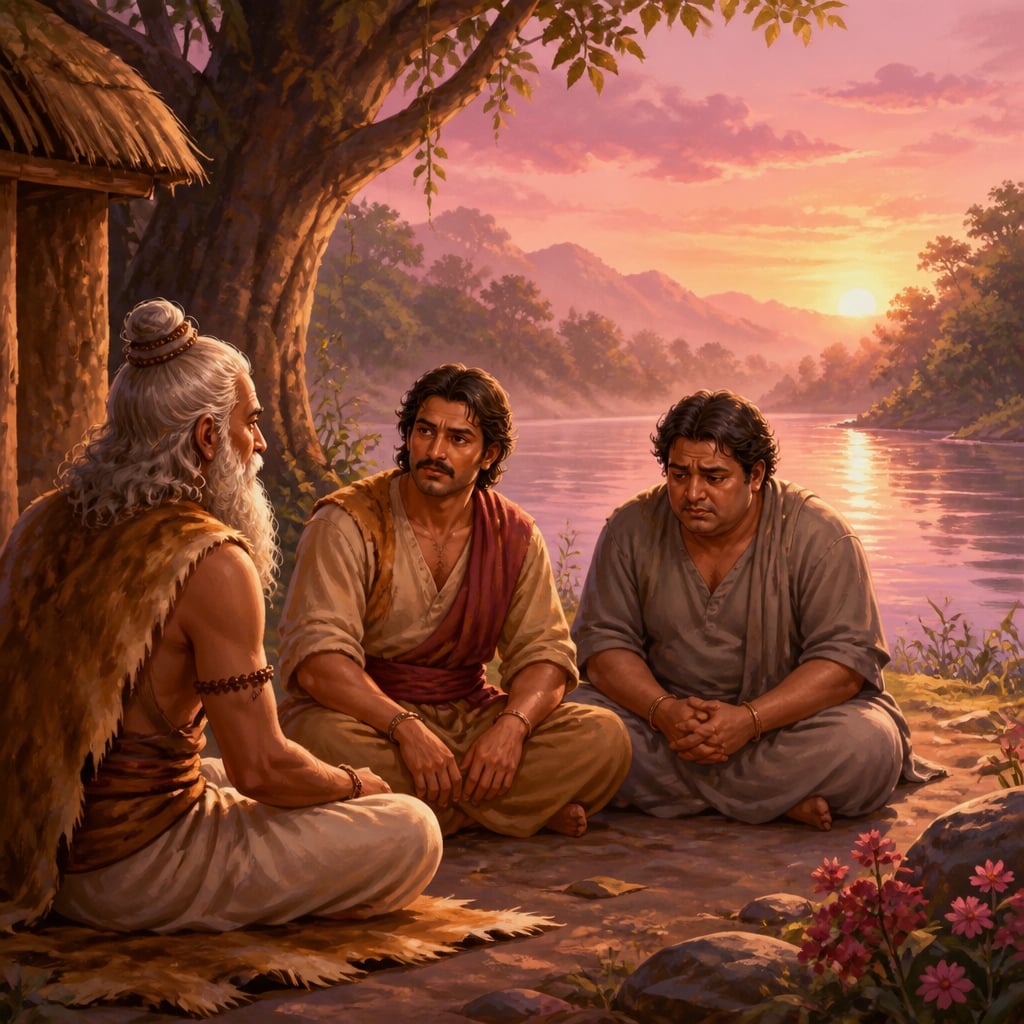
On the bank of a quiet river, in the ashram of a sage named Medhas, two ruined men sat and could not understand their own hearts. One was a king, Suratha, driven from his throne by his own ministers, his treasury and army taken. The other was a merchant, Samadhi, thrown out of his house by the wife and sons he had provided for, who now wanted only his wealth. Both had lost everything. Both had every reason to be done with the people who had wronged them.
And yet neither could stop caring. The king's mind kept returning to the kingdom that had cast him out. The merchant, robbed and abandoned, still ached for the family that had robbed him. This was the thing they could not fathom, and they put it to the sage. Why, when we know these people betrayed us, do our hearts still cling to them? Why can we not simply let go?
Medhas's answer was the entire Devi Mahatmyam. This whole course, every demon and every battle, was the story he told these two men to explain the grip that would not release them.
The Power That Binds and the Power That Frees
The sage named the force that held them. It was Mahamaya, the great power of the Goddess that casts the mind into attachment, that makes even the wise cling to what harms them. The same power that spins the whole world into being also wraps the individual mind in longing. This was not their personal weakness. It was the Goddess herself, in her binding aspect, at work in them as she works in all beings.
But Medhas told them the rest, too. The Goddess who binds is the Goddess who frees. The same power that casts the mind into attachment can, when turned toward, lift the mind clear of it. So he sent them to do what the gods and the sages had done: to worship her, to sit in tapas on the riverbank, and to ask.
For three years the king and the merchant practised. And the Goddess came. She stood before them, pleased, and offered each the boon he most wanted.
What Each One Asked For
Here the story does something quietly profound. It does not send both men to the same request. It lets each ask for what he actually wants, and the two wants are the two great directions a human life can take.

Suratha the king asked for the world, restored and made secure.
ततो वव्रे नृपो राज्यमविभ्रंश्यन्यजन्मनि। अत्रैव च निजं राज्यं हतशत्रुबलं बलात्॥
tato vavre nṛpo rājyam avibhraṃśy anya-janmani | atraiva ca nijaṃ rājyaṃ hata-śatru-balaṃ balāt ||
Then the king chose a kingdom imperishable even in a future birth, and here too his own kingdom restored, its enemy hosts destroyed by force.
Devi Mahatmyam 13.16
He asked for his kingdom back in this life, and an imperishable sovereignty hereafter. The tradition says the Goddess granted it, and that Suratha would be born in a future age as a Manu, a ruler of an entire world-cycle. He chose engagement, the full and rightful embrace of the world, and she gave it without reproach.

Samadhi the merchant asked for the opposite. Having seen how attachment had wrung him, he wanted no more of the world at all. He asked for the knowledge that dissolves the very clinging that had broken him, the wisdom that frees. And the Goddess granted him that liberating knowledge, the release the tradition calls moksha, just as freely.
Set the two side by side and the lesson is complete:
| Suratha the King | Samadhi the Merchant |
|---|---|
| Asked for the world restored | Asked to be free of the world |
| The path of engagement (pravritti) | The path of renunciation (nivritti) |
| Granted a kingdom, now and hereafter | Granted liberating knowledge |
| Neither reproached, both fulfilled |
She Grants Both
The generosity here is easy to miss. People come to the sacred for two very different reasons. Some come, like Suratha, wanting the world to go well: health, work, family, a rightful place, a good and full life in the thick of things. Others come, like Samadhi, wanting out of the whole machinery of wanting, seeking the peace that no worldly gain can give. The tradition does not rank these and send one away.
- The one who wants the world set right is not told his desire is base.
- The one who wants freedom from the world is not told his renunciation is escape.
- The Goddess grants each the thing he truly asks for.
This is the tradition at its most spacious. The path of pravritti, of engaged action in the world, and the path of nivritti, of turning inward toward release, are both real roads, and the same Goddess stands at the end of each. What she asks is not that you choose the approved path, but that you come to know what you actually want, and ask for it honestly, as these two men finally did.
And notice the deepest point. The very power that bound them, Mahamaya, is the power they turned toward for release. They did not defeat the Goddess who had them in her grip. They took refuge in her, and she who had spun the attachment loosened it. The binding and the freeing were one power, met the right way.
That is nearly the whole teaching of the Devi Mahatmyam, gathered into one frame story. What remains is to see how the tradition keeps this Goddess present across the living land, in her temples and her great festival, and then to ask, at the very close, why this ancient text still saves those who turn to it. Those are the final two lessons.
Living traditions
The frame story of Suratha and Samadhi is recited at the close of every full reading of the Devi Mahatmyam, and its teaching remains strikingly current: that the sacred honours both the one who seeks a good life in the world and the one who seeks freedom from it. Pilgrims still come to the Goddess with these two ancient requests, and the tradition, like the Goddess in the tale, sends neither away.
- Jwalamukhi Temple: A famed Shakti Peetha where the Goddess is worshipped not as an image but as natural flames that burn from the rock without fuel. Pilgrims come to the living fire to seek boons and refuge, much as Suratha and Samadhi came to the Goddess with their two very different requests. It is a place that dramatises the Goddess as living power met directly, granting what each seeker truly asks. (The Shakti Peethas course maps the wider network of Goddess sites.)
Reflection
- The king and merchant could not stop caring for the very people who betrayed them. Where does your heart cling to something or someone you know has harmed you, against all your reasoning?
- Suratha chose the world restored; Samadhi chose freedom from the world, and both were granted. Which road pulls at you more honestly right now, engagement or release, and are you pursuing your true direction or a borrowed one?
- The Goddess did not tell the two men what to want; she let each ask for his true longing and granted it. Do you actually know what you most want, or only what you think you should want?