Why the Devi Mahatmyam Still Saves
The course close: Shakti as the active power of all that is, and what the reader carries to their own inner battles.
The Last Verse, and the First Battle
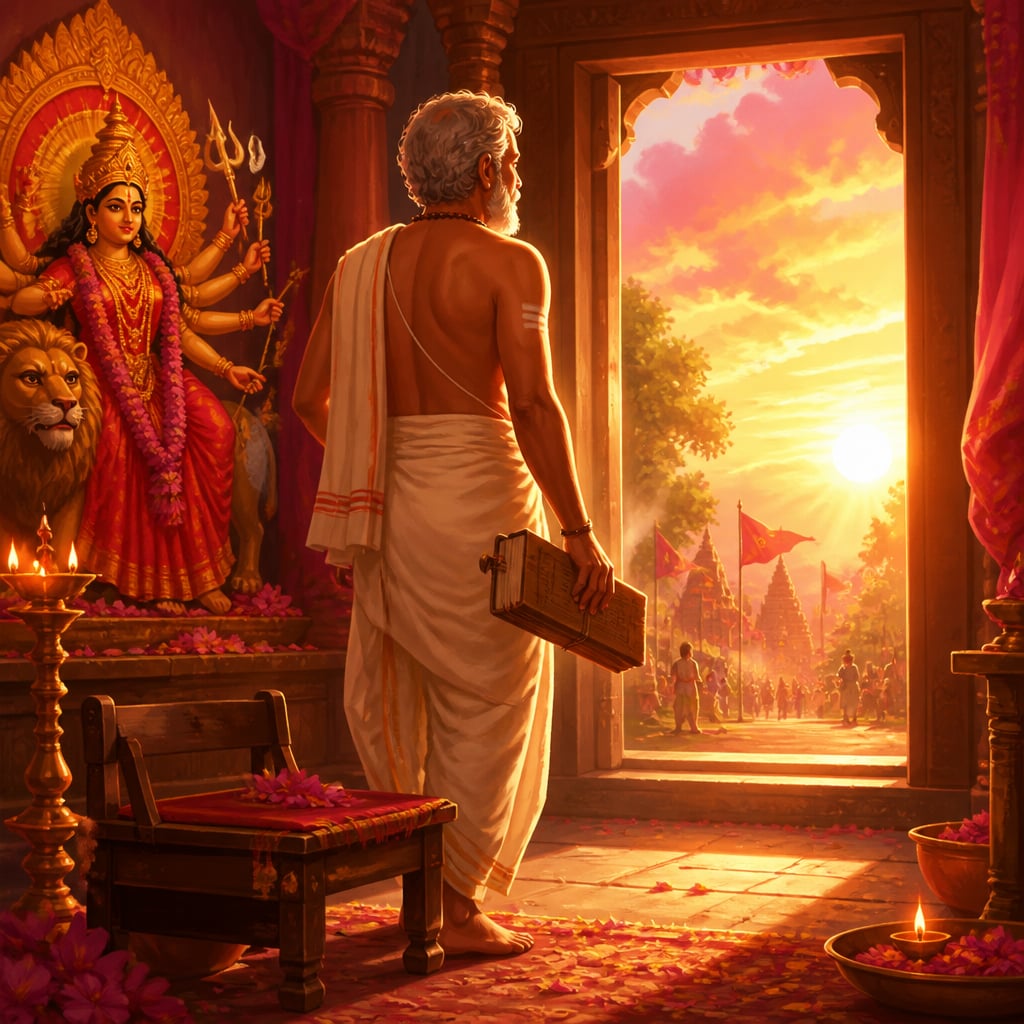
On the tenth morning, the dawn of Vijayadashami, a reciter finishes the seven hundredth verse of the Saptashati. The lamp has burned low over nine nights. Outside, the city is waking to the day of victory. She closes the manuscript, and in the quiet after the last line, the question that this whole course has been circling arrives on its own: what was all of that for? Buffalo-demons and blood-clones, a goddess with ten arms, battles in an age before this one. Why does an ancient story of monsters still hold a modern person on a low seat at dawn, night after night, year after year?
The tradition has an answer, and it is not that the story is a charming relic. It is that the demons were never only out there. They were a map of the battles fought inside every person who has ever lived, and the Goddess was never only a figure in the sky. She is the power to meet them.
The Whole War Was Always Inside
Gather the enemies of the course and read them as one sequence, the way the tradition reads them.
- Madhu and Kaitabha, born from the fog of cosmic sleep, are confusion and inertia, the dullness that grips the mind before it can even see clearly.
- Mahishasura, the buffalo who shifts shape the moment he is cornered, is the ego that changes its story to survive, never quite pinned down.
- Shumbha and Nishumbha, the two brothers, are arrogance and self-doubt, the ego swollen and the ego shrunk, trading the throne between them.
- Raktabija, cloning from his own blood, is craving that multiplies the moment you strike at it.
Set out like that, the Devi Mahatmyam stops being a bestiary and becomes a description of your own inner life, in order, from the grossest obstacle to the subtlest. Everyone who has tried to change themselves has met these enemies. The dullness that will not lift. The ego that slips every argument. The swing between conceit and worthlessness. The desire that grows stronger the harder it is fought. The text names them, ranks them, and shows each one being met.
And the one who meets them is Shakti, the active power of all that is. Not a distant deity to be begged, but the very energy by which anything moves, acts, or lives at all. The gods themselves, in the story, are helpless without her; their power is hers. This is the tradition's deepest claim about the Goddess, and it is what makes the text more than mythology.
विद्याः समस्तास्तव देवि भेदाः स्त्रियः समस्ताः सकला जगत्सु।
vidyāḥ samastās tava devi bhedāḥ striyaḥ samastāḥ sakalā jagatsu |
All knowledges are your forms, O Goddess, and all women in all the worlds are yours.
Devi Mahatmyam 11.6

Every form of knowledge, every power, every living force is named here as hers. Shakti is not one thing among many. She is the active power itself, wherever it appears. And the Ya Devi hymn told us where it appears most nearly: in all beings, as their own intelligence, forbearance, memory, and awareness. The power that meets the demons is seated in you.
Why It Saves
Now the word the tradition actually uses. It does not merely say the Devi Mahatmyam is wise or beautiful. It says the text saves, that it protects and rescues the one who takes refuge in it. Read plainly, without either dismissing the claim or inflating it, here is what that means.
The text saves the way a true map saves a traveller lost in the dark. It does three things, and each is real:
- It names the enemy, so the confusion, the ego, the craving are no longer a formless dread but recognisable foes with shapes and orders.
- It ranks them, so you know the dullness must lift before the subtle pride can even be seen, and you do not fight the last battle first.
- It shows the power that meets them is your own, seated within as Shakti, so the fight is not hopeless and the strength is not somewhere else.
A person who knows the map of their inner war is genuinely rescued from the worst of it. They can name what grips them. They know it can be met, and that the power to meet it is already within them. The worst of any inner war is fighting blind, and that is what the map ends. That is not magic. It is what a true account of the inner life does for anyone who learns it.
What You Carry
So the reciter closes the book on Vijayadashami morning and steps into the day of victory, and the victory is not only the Goddess's, long ago. It is the plain gift the text has handed her, and hands anyone who takes it up.
You carry out of this course a map of your own battles and the knowledge that they can be met. When the dullness grips, you will know its name. When the ego shifts its story, you will recognise the shape-shifter. When craving multiplies under your blows, you will remember that it is taken at the root, not drop by drop, and that memory itself is one of the Goddess's forms. And when you reach for the power to meet any of it, you will know where to reach: not up to a far heaven, but inward, to the Shakti seated in you as your own deepest strength.
This is why the Devi Mahatmyam still saves, and why a modern person still sits with it at dawn. The demons are perennial because they are ours. The Goddess is perennial because she is the power in us to face them. The story is not a relic. It is a field guide to the one war every human being fights, written by a civilisation that looked long and clearly at the inner life, and it hands you, at the end, not a doctrine to believe but a strength to recognise as already your own.
Ya devi sarva-bhuteshu shakti-rupena samsthita. To the Goddess who abides in all beings as power itself, and in you as the strength for your own battles: this course has been one long way of saying, that power is nearer than you think. It is yours to remember.
Living traditions
The Devi Mahatmyam remains one of the most widely recited scriptures of the Goddess, read in full over Navaratri in temples and homes across the land and closed each year on Vijayadashami, the day of victory. Its endurance rests on what this course has traced: that the demons are perennial because they are ours, and the Goddess is perennial because she is the power in us to face them. The text survives not as a relic but as a field guide to the one war every human being fights, and to the strength, seated within, to meet it.
- Chamundeshwari Temple: A great temple to the Goddess as Chamundeshwari, the form named for slaying Chanda and Munda, throned on the hill above Mysuru. She is the guardian Goddess of the old kingdom, and her worship crowns the grandest of Navaratri celebrations. As a place where the fierce, demon-slaying Goddess is honoured as the living power that guards a whole people, it fittingly closes a course that reads her demons as the inner war and her power as our own. (The Shakti Peethas course maps the wider network of Goddess sites.)
Reflection
- The demons of the text map the inner war: inertia, the shape-shifting ego, arrogance and self-doubt, multiplying craving. Which of these are you facing most right now, and does naming it change how you meet it?
- The tradition says the power that meets the demons is Shakti, seated in you as your own strength, not begged from a far heaven. When you reach for strength, do you reach inward or upward, and what changes if you reach inward?
- The text saves, the tradition says, the way a true map saves a traveller in the dark: naming the enemy, ranking the battles, showing the power is your own. What does this course leave you carrying into your own inner war?