The Armour: Devi Kavacham
The hymn that guards, limb by limb; how and why it is recited. Sacred; taught so a learner could revere it.
The Armour You Cannot See
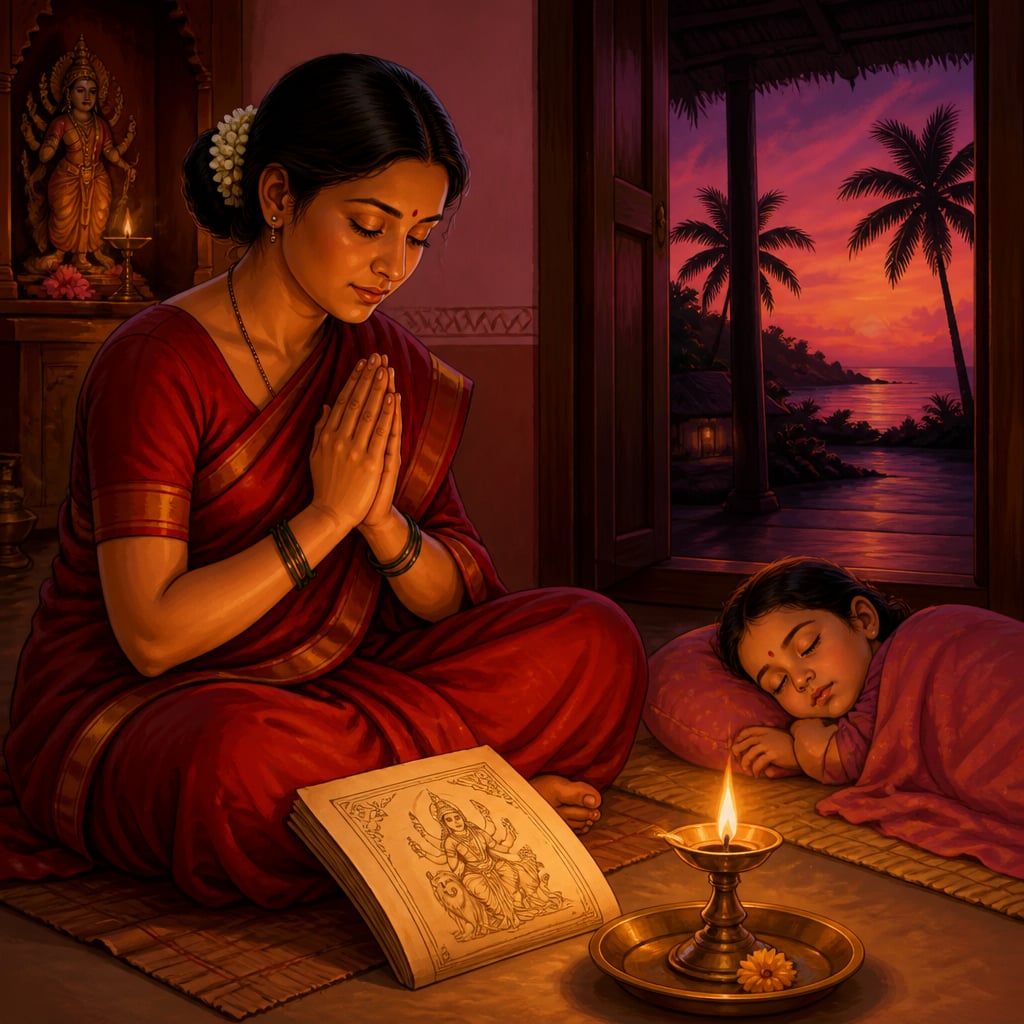
Long before body armour, and long after it, people walking into danger have reached for a different kind of protection. In a Konkan village before dawn, a woman sits while her son gets ready to leave, at first light, for work in a distant city. The floor is cold under her. A single wick burns. She cannot go with him. She cannot guard the road he will take. So she does the one thing her mother did before her: she sits and recites the Devi Kavacham, the armour of the Goddess. It names a protector for every part of a body that will soon be out of her reach.
She is not asking for magic. She is doing something the tradition has done for centuries, and the doing itself is the lesson. When you cannot control the danger, you can still gather your attention, part by part, and place each part under a protection larger than your fear.
What a Kavacha Is
Kavacha means armour, a coat of mail. The Devi Kavacham is a hymn recited before the main Saptashati, and its structure is unlike a normal prayer. It does not ask once, in general. It asks specifically, limb by limb, assigning a form of the Goddess to guard each one.
श्रृणु देवि प्रवक्ष्यामि कवचं सर्वसिद्धिदम्।
śṛṇu devi pravakṣyāmi kavacaṃ sarva-siddhi-dam |
Listen, O Goddess, I shall declare the armour that grants every accomplishment.
Devi Kavacham
The hymn then moves across the body like a hand laid on each part in turn. May this form of the Goddess guard the head; may that form guard the eyes, the throat, the heart, the feet. It calls on the Navadurga, the nine forms of Durga, and on the Mother-powers we met on the battlefield, stationing them at the front and back, above and below, until no direction and no limb is left uncovered.

ब्रह्माणी पूर्वतः पातु कौमारी अग्निदिशासु मे।
brahmāṇī pūrvataḥ pātu kaumārī agni-diśāsu me |
May Brahmani guard me from the east, and Kaumari from the southeast.
Devi Kavacham
Notice the method. The reciter does not hold a vague wish for safety. She names each direction and each part, and covers them one at a time. This deliberate placing has an old name, nyasa, the setting of a sacred presence onto the body, point by point, with full attention.
Why the Body, Part by Part
Why does the armour go limb by limb, instead of all at once? Because that is how attention actually protects.
Think about how fear works in you. It is never general for long. It settles somewhere specific: a tightness in the chest, a racing thought, a dread about one particular thing tomorrow. Vague reassurance does not reach it. What reaches it is the same thing the Kavacham does, attention brought to the exact place that is exposed.
- Fear scatters; the armour gathers, part by part.
- Worry is unlocated dread; the Kavacham locates, and covers what it locates.
- Panic loses the body; the recitation returns to it, limb by limb, and steadies it.
The hymn is, among other things, a discipline of attention under fear. To recite it is to stop being swept by a formless dread and to move through yourself methodically instead, placing each vulnerable part under a guard. The mother in the Konkan cannot armour her son's body. She can armour her own scattered mind, and in doing so meet the morning steady rather than undone.
Sacred, and Meant to Be Honoured
A word about how the tradition holds this hymn. The Kavacham is treated as sacred and powerful, not as a casual charm. It is taught with care, recited with cleanliness and attention, and honoured as a genuine protection, not a superstition to be explained away and not a trinket to be worn lightly.
You can revere it exactly as the tradition does without pretending it works by mechanisms it does not claim. What the Kavacham plainly does is real: it takes a person facing what they cannot control and gives them a way to gather themselves, to move through their own fear with order and dignity, and to stand under something larger than the small, frightened self. The raksha, the protection, begins there, in the reciter made steady.
That steadiness is the point of the whole recitation tradition, and the Kavacham is only its first layer. Before the seven hundred verses of the Goddess's story can be read, the tradition sets two more short hymns in place, a bolt and a pin that frame the reading and, the tradition says, unlock its fruit. Those, and the discipline of the full recitation, are the next lesson.
Living traditions
The Devi Kavacham is recited daily by countless devotees before the main Saptashati, and on its own as a protective hymn at moments of fear or departure. Its practice survives because its core work is real and needs no exaggeration: it gives a person facing what they cannot control a way to gather their attention, part by part, and stand steady under something larger than their fear.
- Kanaka Durga Temple: A major temple to the Goddess as Kanaka Durga, worshipped on Indrakeeladri hill as the fierce protector of the land. The Goddess here is the guarding form this lesson turns on, called on for protection and strength. During Navaratri the hill fills with pilgrims who seek her cover, echoing the Kavacham's plea for a protector stationed near. (The Shakti Peethas course maps the wider network of Goddess sites.)
Reflection
- The Kavacham covers the body limb by limb rather than all at once. When fear last gripped you, where exactly did it settle, and would meeting it there have steadied you more than vague reassurance?
- The mother could not guard her son's road, only gather her own mind. Where are you spending energy trying to control what you cannot, when gathering yourself is the protection actually available?
- The tradition honours the Kavacham as sacred without needing to inflate what it does. Where do you find it hard to hold something as meaningful without either dismissing it or overclaiming for it?