The Many Names of One Goddess
Durga, Chandi, Ambika, Kaushiki, Chamunda, Kali: who is who, and why one Goddess wears many. The many forms your one deepest self takes.
One Traveller, Many Names
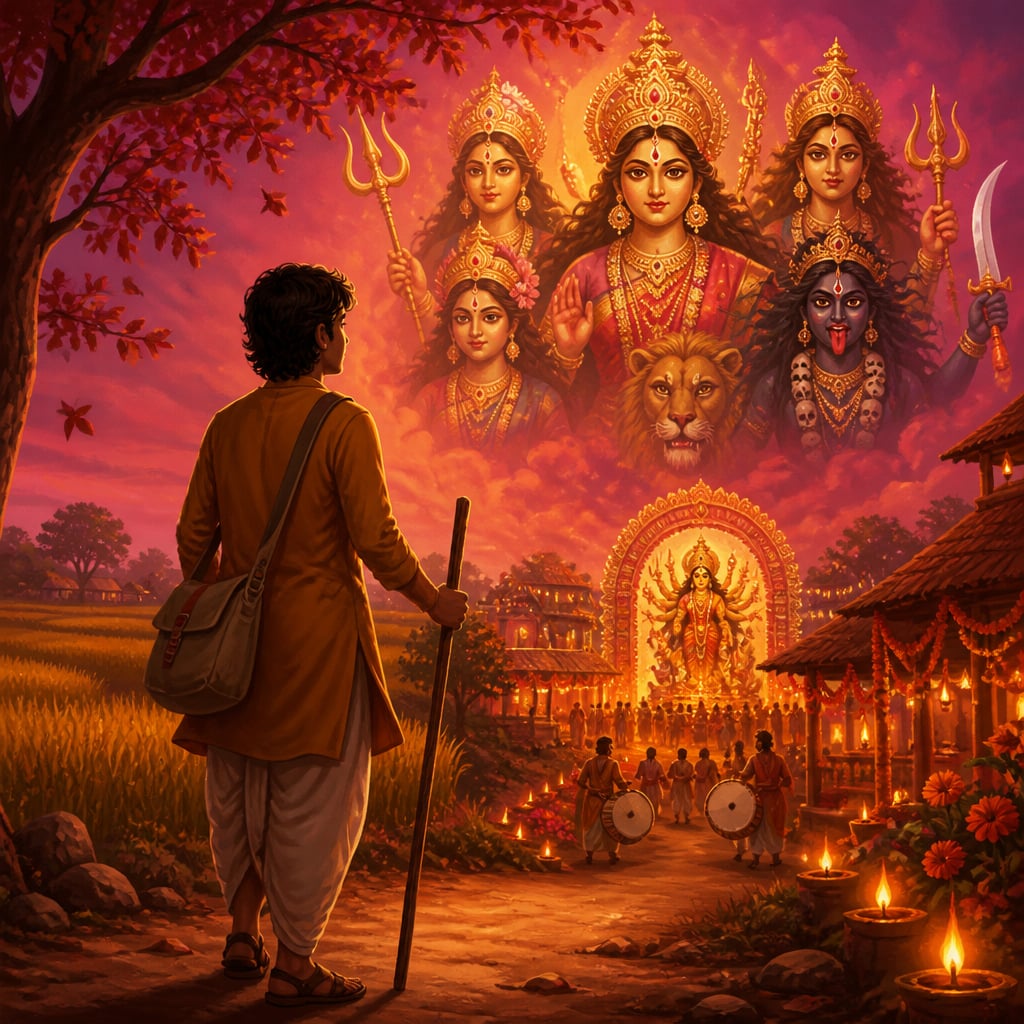
Imagine a traveller crossing India through a single autumn, arriving in a new region each week as the festival of the Goddess unfolds. In Bengal he stands before a vast image of Kali, dark and garlanded, tongue out, fierce beyond softening. In Gujarat the same weeks honour Amba, the gentle mother, danced to through the night. In the hills of Mysore the Goddess is Chamundeshwari, throned above the city. In the north she is Durga astride her lion, and in a Karnataka forest she is Mookambika, learning and power in one.
By the end of his journey the traveller is holding a genuine puzzle. Are these one Goddess or many? The images look nothing alike. The moods run from terror to tenderness. And yet everywhere he is told it is the same Devi. This lesson is the tradition's answer to his question, and the answer was given already, on a battlefield, in a single line.
Why One Wears Many
Return for a moment to the taunt of Shumbha and the reply it drew. He accused the Goddess of leaning on many helpers, and she drew every power back into herself and said, I alone am; who is there beside me? The many Shaktis were her own manifestations, sent out and called home. The many names work exactly the same way. Each name is the one Goddess, seen through one situation, wearing the face that situation calls for.
The Devi Mahatmyam itself keeps renaming her as the story turns:
| Name | What It Emphasises | Where It Arises |
|---|---|---|
| Durga | The unassailable, the fort none can breach | Slayer of the buffalo-demon |
| Chandika | The fierce, the wrathful | Throughout the battles |
| Ambika | The mother | The radiant form on the mountain |
| Kaushiki | The radiant, sheath-born | Emerging from Parvati |
| Chamunda | Slayer of Chanda and Munda | Kali's naming after the kill |
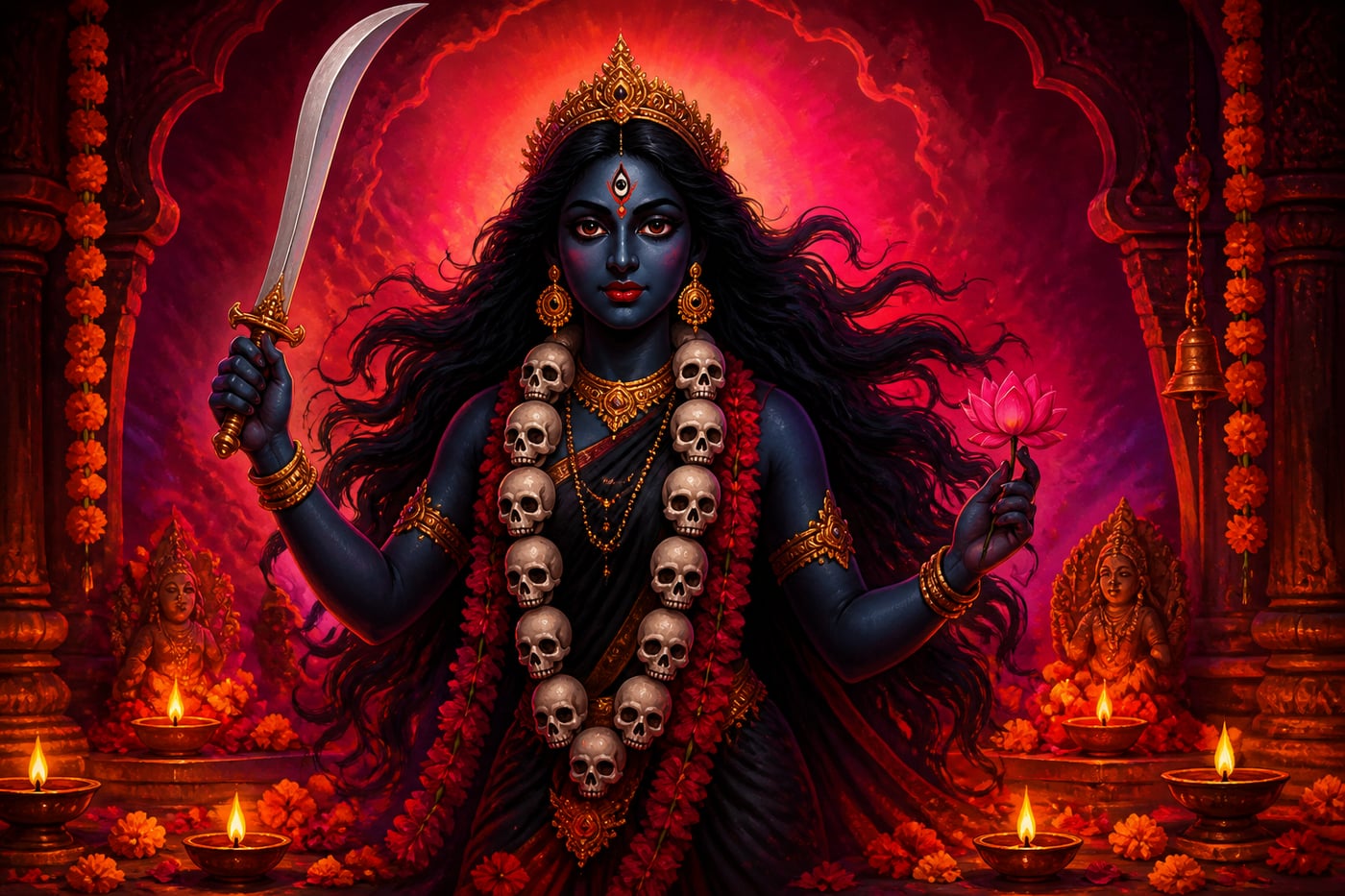
| Kali | The dark, time itself | Drinking Raktabija's blood |
Read down the column of names and notice something. They are not rival gods competing for worshippers. They are one power described by what it is doing. When she guards, she is Durga, the fort. When she rages, she is Chandika. When she mothers, she is Ambika. When she consumes at the root, she is Kali. The name changes because the need changes, not because the Goddess divides.
दुर्गे स्मृता हरसि भीतिमशेषजन्तोः।
durge smṛtā harasi bhītim aśeṣa-jantoḥ |
O Durga, when remembered, you take away the fear of every living being.
Devi Mahatmyam 4.17 (Shakradi Stuti)
The hymn calls her Durga in the very act of describing what she does, removing fear. The nama, the name, is not a label stuck on from outside. It rises from the deed. To learn the names is to learn the range of one power, not to keep a roster of separate deities.
The Many Forms of Your One Self
This closes a loop the whole course has been drawing. If the one Goddess wears many faces according to the need, so does the one self within you.
You are not the same in every situation, and this is not a failure of integrity. You are fierce when someone you love is threatened. You are tender with a frightened child. You are patient in one hour and cutting in the next, disciplined here and playful there. The untrained view treats these as a scattered, inconsistent self, many people crammed into one. The tradition offers the Goddess's own answer: the many faces are one deepest self, meeting many situations, wearing what each requires.

- The fierceness and the tenderness are not two selves. They are one power, rightly matched to two moments.
- The name for your softness and the name for your steel point to the same source.
- Integrity is not being identical everywhere. It is the one self, answering each situation with its right face.
This is why Shumbha's mistake was so exact and so costly. He looked at the many faces and saw division, weakness, a crowd to be scattered. He could not see the one behind them. To learn the names of the Goddess is to practise the opposite seeing: to look at all the forms, fierce and gentle, dark and radiant, and recognise the single power wearing them, in her and in yourself.
The traveller, by the end of his autumn, stops asking whether it is one Goddess or many. He has learned to see the one through the many, which is the whole art. And the tradition asks the same of the two ruined men who first heard this entire story told, a king and a merchant who came to the Goddess wanting two very different things. What they asked for, and what she granted, is the next lesson.
Living traditions
The many names of the one Goddess live on in the map of the land itself: Kali in Bengal, Amba in Gujarat and Kolhapur, Chamundeshwari at Mysore, Durga in the north, Mookambika in the Karnataka hills. Pilgrims and scholars alike hold them as faces of a single power, and the traveller's puzzle, one Goddess or many, is answered every autumn in the same way the Devi Mahatmyam answers it: I alone am, wearing all these forms.
- Mahalakshmi Temple (Ambabai), Kolhapur: One of the great Shakti seats, worshipped as Ambabai, the mother Amba, and honoured among the Shakti Peethas. Here the Goddess of many names is adored as the abundant mother, the same Devi who is fierce Kali elsewhere and unassailable Durga in the north. The temple is famed for the Kirnotsav, when the setting sun's rays fall directly on the image, light itself coming to honour her. (The Shakti Peethas course maps the wider network of Goddess sites.)
Reflection
- The Goddess is Durga when she guards, Chandika when she rages, Ambika when she mothers, one power named by its deed. Which faces do you wear in different situations, and can you see them as one self rather than a scattered several?
- When you feel inconsistent, fierce one hour and gentle the next, do you read it as a failure of integrity or as one self answering different needs? What changes if you see it the tradition's way?
- Shumbha saw the many faces and read only division and weakness, and it cost him everything. Where do you look at variety, in people or in yourself, and see a scattered crowd rather than one power wearing many forms?