Wings of Deliverance
Garuda Frees Rama and Lakshmana
In the vanara army's darkest hour, a divine presence descends from the heavens. Garuda, king of birds and ancient enemy of all serpents, arrives to free Rama and Lakshmana from their bonds. Hope returns - but so does the war's true fury.
The Darkest Hour
The night stretches endlessly for the vanara army.
Hanuman has not moved from Rama's side since sunset. He watches his lord's chest rise and fall in shallow, labored breaths. The serpent bonds glow faintly with malevolent light, their grip unyielding. Lakshmana lies equally trapped beside his brother, consciousness flickering like a candle in wind.
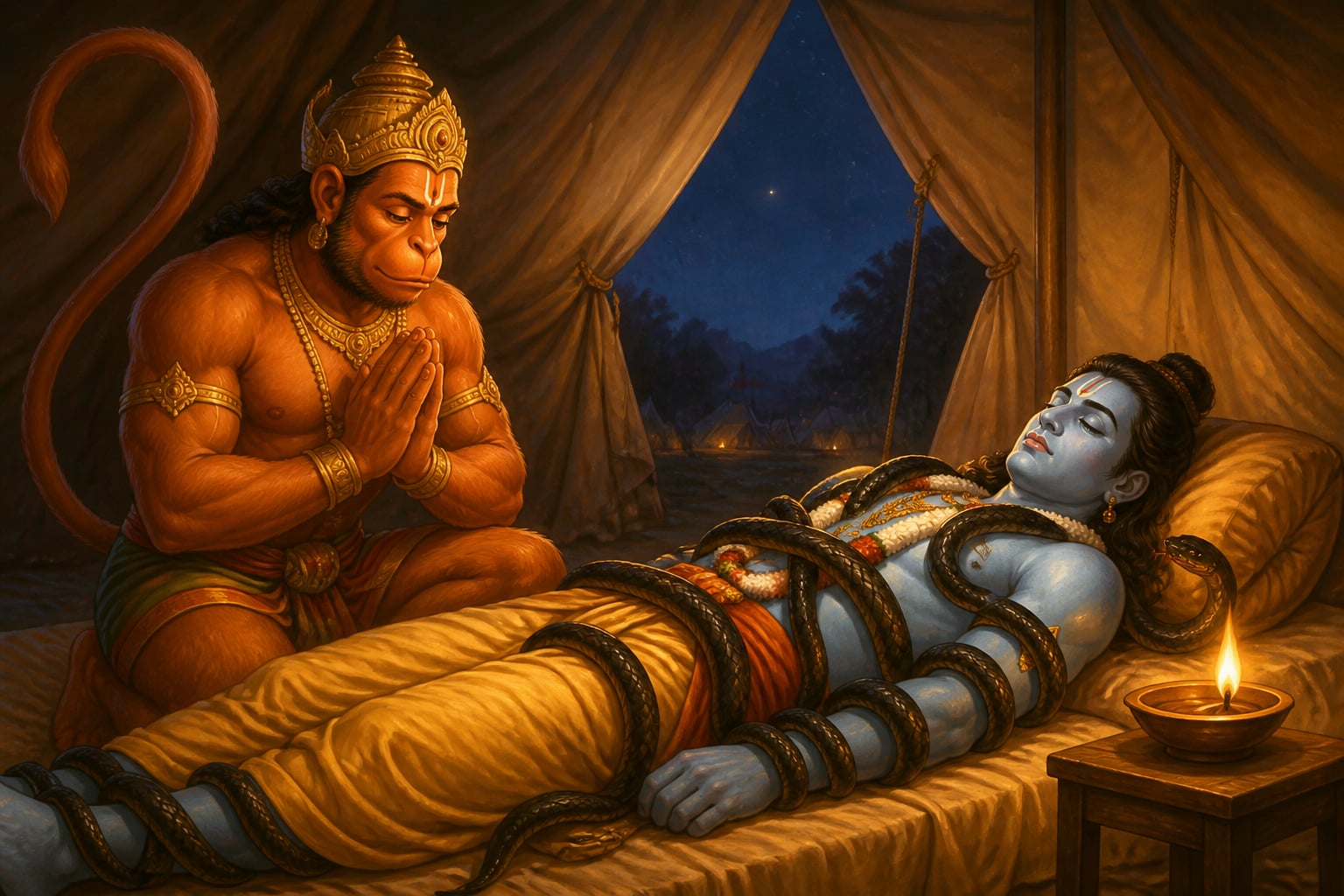
Around them, the army keeps silent vigil. No songs rise from the camp tonight. No boasts, no battle plans, no optimistic speeches. Only the sound of the ocean and the distant revelry from Lanka's towers.
Jambavan sits apart, his ancient eyes fixed on the stars. He has lived thousands of years. He has seen armies rise and fall, kingdoms bloom and wither. But never has he felt closer to defeat than this moment.
"You are praying," Sugriva says, settling beside the old bear.
"I am remembering," Jambavan replies. "Long ago, when the worlds were young, I witnessed something. The churning of the cosmic ocean. The emergence of wonders and terrors. And I saw Garuda born - bursting from his egg with light that blinded the gods themselves."
"Why do you remember this now?"
"Because I am asking the universe a question. I am asking if that light still exists. I am asking if it might shine here, tonight."
A Wind That Isn't Wind
Sometime in the deepest darkness before dawn, Hanuman feels something change.
The air itself seems to hold its breath. The ocean falls suddenly silent. Even the wind - his father's domain - goes utterly still. It is as if creation itself is making way for something.
Then Hanuman sees it.
A shape descends from the stars - not falling but choosing its path with absolute authority. Wings that span horizons block out constellations as it passes. Eyes that burn with golden fire pierce the darkness like twin suns. The creature is beautiful and terrible beyond mortal conception.
Garuda has come.
The King of Birds
The divine eagle lands beside Rama's bound form with a grace that belies his cosmic size. Up close, his presence is overwhelming - every feather radiates power, every movement speaks of ages beyond counting.
The serpent bonds react instantly. They writhe in terror, releasing their grip, trying desperately to flee. But there is nowhere to run from Garuda. His very existence is their antithesis, their doom, their ancient and eternal enemy.
One by one, the serpents dissolve - not destroyed but simply unmade, returned to the nothing from which the Nagastra summoned them. Within moments, both brothers lie free on the grass.

Rama's eyes open. He draws a deep breath - the first full breath in hours - and looks up at the magnificent being standing over him.
"Great Garuda," Rama says, rising slowly, "why have you come to us?"
Garuda's Words
The eagle king's voice resonates not in the air but directly in the minds of all who hear.
"I am Garuda, mount of Vishnu, eternal enemy of serpent-kind. I came because the universe called me. I came because dharma required my presence. I came..." he pauses, studying Rama's face with those burning eyes, "because something in you drew me, prince of Ayodhya. Something that reminds me of one I have served since before time had meaning."
Rama bows his head. "Whatever the reason, we are grateful beyond words."
"Gratitude is unnecessary. We are all instruments of the same purpose, you and I. But hear me, Rama - the Nagastra was only Indrajit's first weapon. He has others equally terrible. You cannot defeat him through strength alone. He must be faced by one who can match both his power and his cunning."
Garuda spreads his wings, preparing to depart. The motion creates a wind that bends trees and stirs the ocean below.
"The war you fight is not only for Sita. It is not only for dharma in the mortal realm. Forces beyond your vision watch this conflict. Win it, and the balance of ages will be restored. Lose it, and darkness will spread further than you can imagine."
With that, the king of birds rises into the sky. In moments, he is a speck against the stars. In moments more, he is gone entirely.
The Army Reborn
News of Rama's recovery spreads through the camp like fire through dry grass.
Vanaras who had resigned themselves to death moments ago now leap and howl with renewed hope. Rama lives! Lakshmana lives! The divine itself has intervened on their behalf. How can they lose when even Garuda comes to their aid?
Hanuman weeps openly - tears of joy replacing the tears of despair he had been suppressing all night. He prostrates himself before Rama.
"My lord, I thought we had lost you. I thought..."
Rama lifts his servant with gentle hands. "You never lost faith, Hanuman. Even in the darkest moment, you stayed by my side. That faith is why we still stand. Never doubt its power."
Sugriva and the generals gather, eager to discuss the next day's strategy. The army's morale has transformed completely. Where despair reigned hours ago, now fierce determination burns.
"Indrajit will not expect us to fight tomorrow," Vibhishana observes. "He thinks his victory complete. We can use that arrogance against him."
Dawn of Renewed War
When the sun rises, it illuminates an army ready to fight.
Rama stands before the gates of Lanka once more, bow in hand, Lakshmana at his side. Both brothers have been fully healed - Garuda's presence seems to have restored not just their freedom but their strength.
From Lanka's walls, watchers see something impossible. The princes they saw fallen, bound in unbreakable serpent coils, now stand whole and ready for war. Murmurs of fear ripple through the rakshasa ranks.
In his palace, Indrajit receives the news with disbelief. "That cannot be. The Nagastra is divine - nothing can counter it."
"Nothing mortal, my prince," his informant replies. "But witnesses speak of a creature descending from the sky. A great eagle, larger than mountains."
Indrajit's face hardens. "Garuda. They have the favor of Garuda." He is silent for a long moment. "No matter. I have other weapons. More weapons. This war is far from over."
The Message of Hope
Before battle resumes, Rama sends a message to Sita through Vibhishana's agents within the city.

"Tell her I am coming. Tell her the bonds that held me have broken. Tell her that nothing - no weapon, no demon, no force in all creation - will keep me from her. Tell her to hold on just a little longer."
In the Ashoka grove, Sita receives these words. She has heard of the vanara army's near-collapse, and her heart had frozen with fear. Now it beats again with fierce hope.
"He comes," she whispers to herself. "My Rama comes."
The war drums thunder on both sides. The gates of Lanka open once more. Fresh armies pour forth to replace yesterday's fallen. The vanaras surge forward to meet them.
The Battle of Lanka has only just begun. Garuda's intervention has won this round, but Indrajit still commands terrible powers. Other champions wait within Lanka's walls. Kumbhakarna sleeps, but Ravana can wake him. Ravana himself has not yet entered the fight.
Rama notches an arrow and draws his divine bow. Beside him, Lakshmana does the same. Together, they step forward into the chaos.
The war for dharma continues.
Living traditions
Garuda remains India's most recognized divine symbol internationally - from Indonesia's national emblem to Thailand's royal symbol to mascots across Asia. The Garuda Purana, a Hindu scripture, takes its name from him. In Indian Air Force tradition, several squadrons carry Garuda-related names and insignia, honoring the divine eagle's association with aerial supremacy and protection.
- Garuda Seva: In major Vishnu temples, the deity is carried in procession on a Garuda vahana (vehicle) during festivals. The practice honors Garuda's role as divine rescuer, echoing his appearance to save Rama.
- Garuda Stambha, Besnagar: Dating to 113 BCE, this is one of the earliest known Garuda pillars in India. The Heliodorus inscription on it records a Greek ambassador's devotion to Vishnu - evidence of Garuda worship spanning cultures.
- Garuda Temple, Kanchipuram: One of the rare standalone temples dedicated to Garuda, this 16th-century shrine celebrates the eagle-god independently rather than as Vishnu's vahana.
- Srirangam Ranganathaswamy Temple: The largest functioning Hindu temple in the world houses an enormous Garuda shrine. During festivals, the Garuda Sevai procession commemorates divine interventions like that at Lanka.
Reflection
- Have you ever received help from an unexpected source at a moment of despair? What made that help possible?
- Garuda said he came because 'something in Rama reminded him of one he served since before time.' What do you think he recognized?
- If Garuda could come unbidden, why did Rama have to suffer the Nagastra at all? What purpose did the ordeal serve?