The Serpent's Embrace

Indrajit's Nagastra Strikes

Ravana unleashes his greatest weapon - not a spell or army, but his son Indrajit, whose mastery of illusion and divine weapons is unmatched. The terrible Nagastra finds its marks in Rama and Lakshmana, and the vanara army faces its darkest hour.

The Crown Prince of Lanka

The battle enters its third day when everything changes.

From Lanka's highest tower, a figure descends - not walking but flying on a chariot that seems woven from shadow and thunder. The rakshasas below cheer wildly. The vanaras pause, uncertain. Even Vibhishana's face pales.
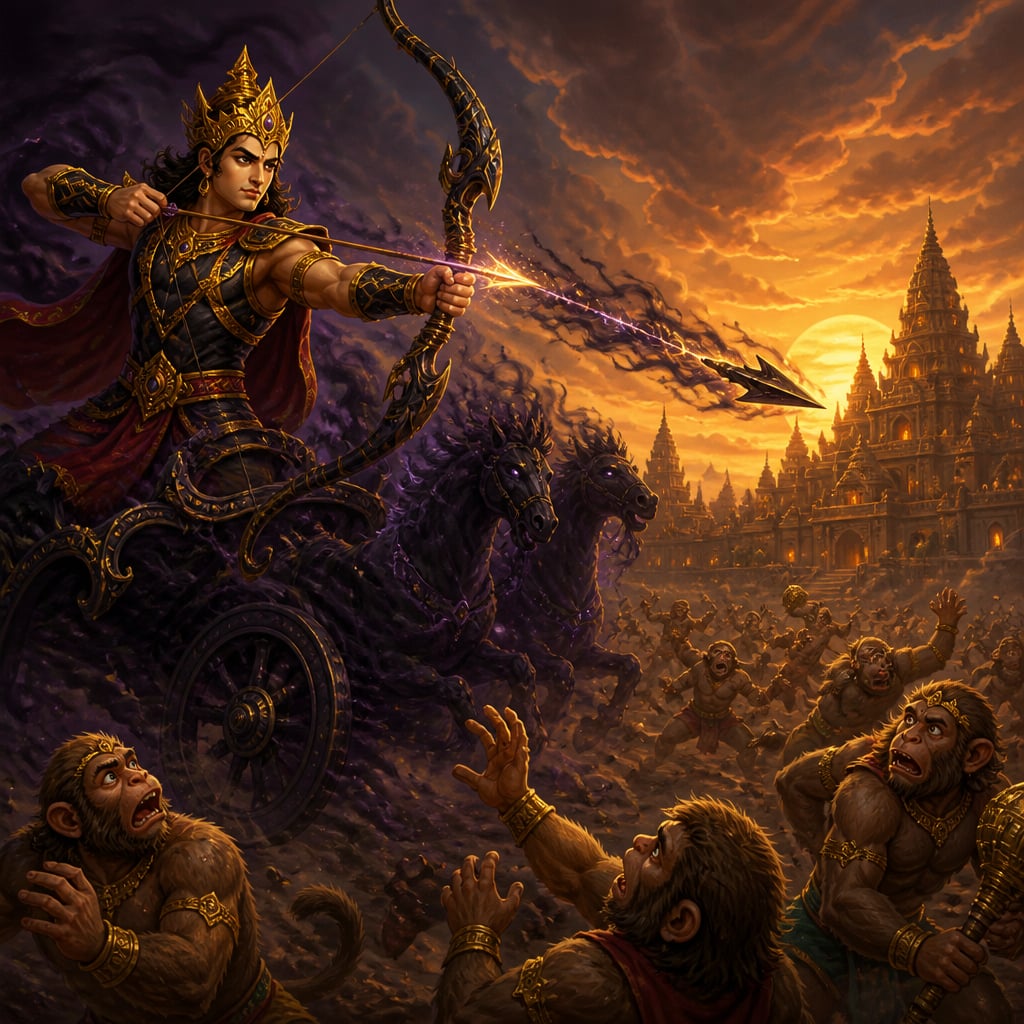
Indrajit rides his shadow and thunder chariot above the dusk battlefield, drawing a dark-glowing arrow as the vanaras below scatter in dismay.

"Indrajit," he breathes. "Ravana has sent Indrajit."

Rama turns to his ally. "Tell me of this warrior."

Vibhishana's voice is heavy with reluctant admiration. "He is Ravana's son, but his power may exceed even his father's. He earned his name - Indrajit, Conqueror of Indra - by actually defeating the king of gods in battle. He captured Indra and brought him to Lanka in chains. Only Brahma's intervention secured Indra's release."

"What makes him so dangerous?"

"Many things. He has mastered every divine weapon. He can become invisible at will. His chariot moves between dimensions. And he possesses weapons gifted by Brahma himself - weapons that never miss their targets."

The Shadow Warrior

Indrajit does not simply join the battle - he transforms it.

One moment he is visible, raining arrows from his aerial chariot. The next, he vanishes entirely, reappearing somewhere else on the battlefield to strike from an unexpected angle. The vanaras cannot track him. They cannot predict him. They cannot fight what they cannot see.

His arrows carry enchantments beyond normal warfare. Some induce sleep on contact. Others create paralyzing fear. Still others summon illusions that turn vanara against vanara, making allies appear as enemies.

Hanuman attempts to reach the invisible prince, using his divine sight to track Indrajit's movements. But even the son of the wind cannot catch the shadow warrior. Every time Hanuman closes in, Indrajit shifts to another plane of existence entirely.

"Face me fairly!" Hanuman roars into the empty air. "Stop hiding like a coward!"

Indrajit's laughter echoes from everywhere and nowhere. "Fairness is for fools. Victory is for the wise. Watch now, monkey - watch what happens to your precious princes."

The Nagastra Unleashed

Indrajit reaches into his quiver and draws forth an arrow unlike any other. Its shaft writhes with living serpent energy. Its head is formed from the fang of a cosmic snake. This is the Nagastra - the Serpent Weapon - granted to him by the nagas themselves.

He chants the words of invocation. The arrow multiplies - one becomes a hundred, a hundred becomes a thousand. Each arrow becomes a living serpent, and each serpent seeks the same targets: Rama and Lakshmana.

The brothers see the attack coming but cannot evade it. The serpents are too numerous, too fast, guided by divine will rather than mere physics. They strike from every direction simultaneously.

The Nagastra's serpents wrap around Rama and Lakshmana

Rama feels the first bite on his shoulder. Then his arm. Then his leg. The serpents don't wound with venom - they wrap and constrict, coiling around every limb, every joint. Within moments, the prince of Ayodhya is completely bound in writhing snake-coils.

Beside him, Lakshmana suffers the same fate. The brothers collapse to the ground, unable to move, barely able to breathe. The serpents tighten with every exhale, leaving no room for another breath.

The Army's Despair

The sight of Rama and Lakshmana fallen breaks something in the vanara army.

They have faced death, faced demons, faced impossible odds. But always, Rama stood among them - Rama the invincible, Rama whose arrows never missed, Rama who seemed touched by the gods themselves. If Rama can fall, what hope do any of them have?

Hanuman rushes to his lord's side. He tries to tear the serpents away, but they are not physical creatures anymore. They are the manifestation of a divine weapon, and no amount of strength can simply rip them apart.

"Lord Rama!" Hanuman cries, his voice breaking. "Please - speak to me. Tell me you live."

Rama's eyes flutter open. His voice is barely a whisper. "I live... for now. But I cannot move. Cannot fight. The Nagastra's power... exceeds my ability to counter."

The vanara generals gather, their faces ashen. Sugriva, Jambavan, Angada, Nila - all of them stare at their fallen leader with the same expression: despair.

"What do we do?" Angada asks. "Without Rama and Lakshmana, how can we win?"

Indrajit's voice floats down from his invisible chariot, dripping with contempt. "You cannot win, fool. You never could. Take your dying princes and flee back across your bridge. I give you until dawn. After that, I will hunt down every last one of you."

Vibhishana's Knowledge

As despair spreads through the ranks, Vibhishana kneels beside the fallen brothers. He examines the serpent bonds with the eye of one who has studied Lanka's weapons for centuries.

"The Nagastra is powerful," he murmurs, "but not absolute. There is one force that can counter it - a power older than the nagas themselves."

Jambavan's ancient eyes sharpen. "You speak of Garuda."

"Yes. The divine eagle, enemy of all serpents. The nagas flee at his approach. If Garuda himself could be summoned, his mere presence would dissolve these bonds."

Hanuman steps forward. "Where do I find him? I will fly to him immediately."

Vibhishana shakes his head. "No one knows where Garuda dwells. He moves between the worlds as he pleases, serving Vishnu when called but otherwise free. You cannot seek him - he must choose to come."

"Then how-"

"We pray," Jambavan says. "And we wait. And we hope that the universe has not abandoned dharma entirely."

The Long Night

The vanara army withdraws from the field, carrying Rama and Lakshmana's bound forms with infinite care. They make camp in defensive positions, but no one truly believes the defenses will matter if Indrajit attacks again.

Hanuman stays by Rama's side through the night, watching his lord's labored breathing, willing strength into him through proximity alone. The serpent bonds have not loosened. If anything, they seem tighter than before.

Across the darkness, Lanka celebrates. Indrajit's triumph has restored rakshasa confidence completely. Songs praising the crown prince echo from every tower. Ravana himself embraces his son before the assembled court.

"This is what I expected from you," Ravana says proudly. "Let them lick their wounds tonight. Tomorrow, finish them."

Indrajit bows. "With pleasure, father. By sunset tomorrow, their entire army will be destroyed."

But high above the mortal world, something stirs. In the spaces between stars, where cosmic forces dwell, a presence has taken notice. The Nagastra's invocation has sent ripples through the fabric of existence.

And something - something ancient, something winged, something that has hated serpents since the dawn of creation - begins to descend.

Help is coming. The question is whether it will arrive in time.

Living traditions

Indrajit's use of invisibility and asymmetric warfare tactics is studied in military strategy as an early literary example of guerrilla warfare concepts. His character has been rehabilitated in modern Indian literature and film as a tragic figure of duty, inspiring works exploring the perspective of 'the other side' in epics.

Reflection

More in Yuddha Kanda

All lessons in Yuddha Kanda ยท The Ramayana course