Indrajit's Dark Arts

The Illusion of Sita's Death

Indrajit abandons conventional warfare for psychological terror. Using his mastery of maya, he creates an illusion so cruel it nearly destroys the vanara army from within - the false murder of Sita before their very eyes.

The Master of Maya

Kumbhakarna's death has changed Indrajit.

The crown prince of Lanka watched his uncle fall, watched the warrior who once carried him on those massive shoulders reduced to a corpse on the battlefield. Grief has hardened into something colder, more calculating. If straightforward combat cannot defeat Rama, Indrajit will find another way.

He withdraws to his private chambers to prepare. His weapons are not merely steel and divine blessing - they are deception, illusion, the manipulation of reality itself. Indrajit is the greatest maya master Lanka has ever produced. He can make the false appear true and the true appear false. He can break minds as easily as his arrows break bodies.

"Rama fights for his wife," Indrajit muses. "His entire purpose is to rescue her. What happens to that purpose if she dies? What happens to his army's morale? What happens to his will to fight?"

A cruel smile crosses his face. He knows what he must do.

The Impossible Sight

The next morning, Indrajit takes to the skies above the battlefield - but this time, he is not alone.

Beside him in his chariot sits a figure the vanaras recognize instantly: Sita. She is bound, gagged, her eyes wide with terror. She wears the same clothes they remember from Hanuman's description. She bears the same features, the same grace even in captivity.

The vanara army freezes in shock. How has Indrajit obtained the princess? What does he intend?

Indrajit circles low enough for all to see clearly. His voice booms across the battlefield.

"Monkeys! Look upon your cause! Look upon the woman you fight to save!"

He draws his sword. The blade catches the morning sun.
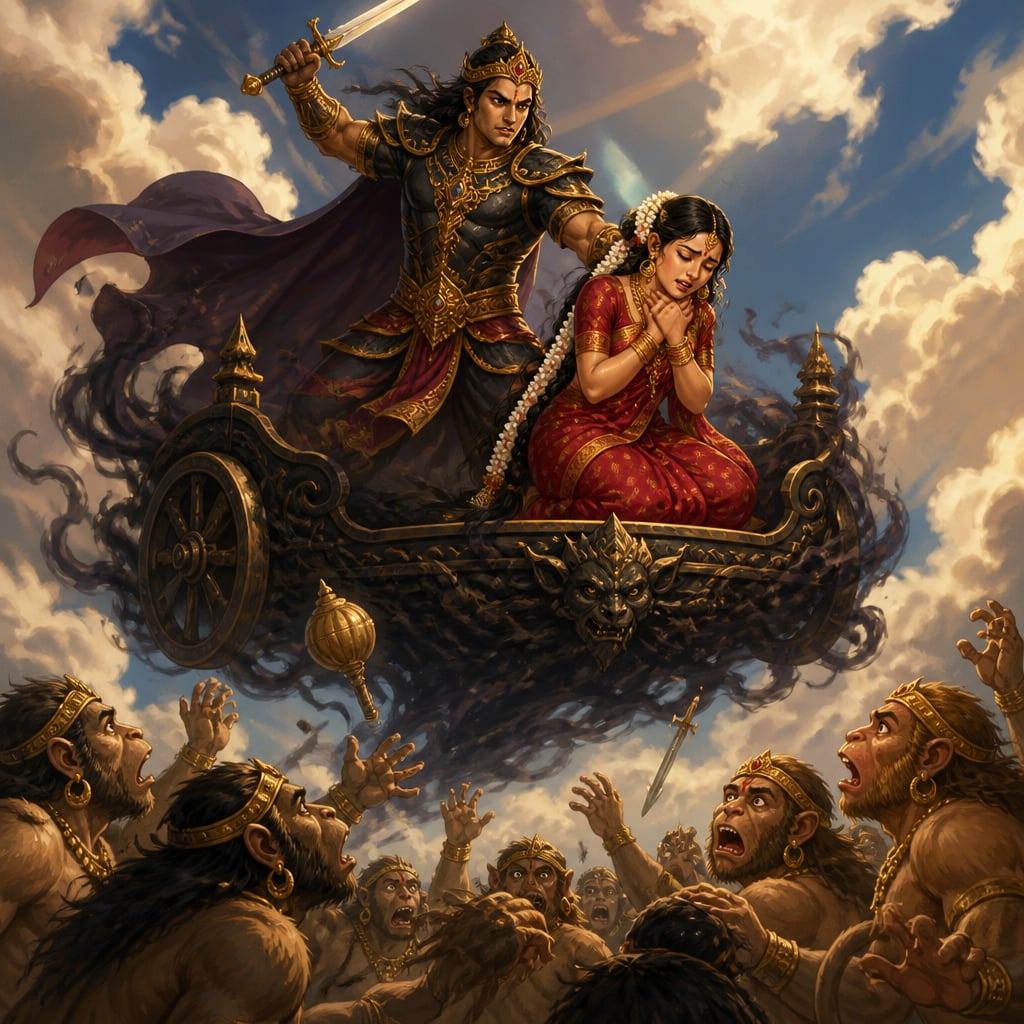
Indrajit raises his sword above the illusory Sita in his shadow chariot at midday as the vanara army below looks up in unified horror.

"Your war ends here!"

With a single stroke, he cuts Sita's throat. Blood sprays across the chariot. Her body crumples. Indrajit laughs triumphantly and throws her corpse from the chariot - it falls to earth before the horrified vanara host.

The Army Breaks

Pandemonium erupts.

Vanaras who have faced death without flinching now scream in despair. They fought for her - they suffered for her - and now she lies dead before them. What was the point? What is left to fight for?

Hanuman rushes to where the body fell. He has promised Rama - promised Sita herself - that he would see her freed. And now she lies broken on the ground, blood pooling beneath her still form.

"No," he whispers, falling to his knees. "No, no, no..."

Sugriva tries to maintain order, but his own voice shakes. The generals look to each other with hollow eyes. The war's entire purpose has just been murdered before them.

And Rama - Rama stands motionless, his bow hanging loose in his hand. His face has become a mask of emptiness. Lakshmana tries to speak to him, but Rama does not respond. He does not seem to see anything, hear anything, exist anymore.

The Poison of Despair

Indrajit does not press the attack. He understands psychological warfare better than that. Let the poison work. Let the despair sink deep into their hearts. Let them destroy themselves.

He returns to Lanka in triumph. Ravana embraces him with fierce pride.

"Brilliant!" the demon king exclaims. "Let them grieve themselves to death. By tomorrow, they will scatter back across the ocean like the animals they are."

Indrajit accepts the praise, but his mind is already planning the next phase. If this does not break them completely, he has other weapons ready.

In the vanara camp, night falls on a shattered army. No songs rise. No fires burn for cooking - no one has appetite for food. Warriors who faced giants without fear now weep like children.

Rama sits alone, staring at nothing. Lakshmana cannot reach him. Hanuman cannot reach him. The prince of Ayodhya, who has been unshakeable through every trial, has finally found a pain that breaks him.

Vibhishana's Wisdom

It is Vibhishana who notices what no one else sees.

Vibhishana inspects the false Sita and sees through the illusion

He approaches the place where "Sita's" body fell. He studies it carefully, ignoring the grief-stricken vanaras who tell him not to disturb her peace. Something is wrong. Something is different.

"Look at her ornaments," Vibhishana says quietly, but with growing certainty. "They are not the ones she wore when she was brought to Lanka. I know - I saw her myself. And her face... there is something too perfect, too artificial about the death-pallor."

He gestures Hanuman closer. "You met her in the Ashoka grove. You saw her true form. Look now - look past your grief - and tell me. Is this truly her?"

Hanuman forces himself to look - really look - at the body before him. Through his tears, through his anguish, he examines what lies there.

And slowly, recognition dawns.

"This is not her," he breathes. "The tilt of the eyes is wrong. The shape of the hands is wrong. This is... this is maya. An illusion."

The Truth Revealed

Vibhishana nods grimly. "Indrajit is the greatest illusionist alive. He can create phantoms indistinguishable from reality - to most observers. But illusion cannot perfectly replicate what it has never truly seen. Indrajit has never been allowed near Sita. His phantom is based on descriptions, not direct observation."

The word spreads through the camp like wildfire. The body is fake. Sita lives. Indrajit's cruelty was just a trick.

But the damage is done. The army's morale, though recovering, bears new scars. And Rama - Rama must be reached.

Hanuman approaches his lord with infinite gentleness. "My prince. My Rama. It was not real. Sita lives. The body was maya - a trick of Indrajit's sorcery. She is still in the Ashoka grove, still waiting for you."

For a long moment, Rama does not respond. Then, slowly, life returns to his eyes. His hands tighten on his bow.

"Indrajit." His voice is quiet but carries the weight of mountains. "He used my love against me. He used my hope as a weapon."

"Yes, my lord."

Rama rises. The emptiness in his eyes has been replaced by something new - not rage, not hatred, but a cold, implacable resolve.

"This changes nothing," he says. "Except one thing. When the time comes, it will be Lakshmana who faces Indrajit. My brother's arrow, not mine, will end that demon's life. He has earned this death through cruelty. Let him receive it from the one who suffered most beside me tonight."

Lakshmana steps forward, his own eyes hard. "It will be my honor, brother."

The War Continues

By morning, the vanara army has recovered enough to fight. Indrajit's trick has not broken them - it has only strengthened their hatred of Lanka's prince.

But Indrajit himself is not discouraged. He watches from Lanka's towers as the vanaras reform their lines.

"So they saw through it," he muses. "No matter. I have other illusions. I have other weapons. And soon enough, I will face them in person."

He looks toward where Lakshmana stands beside Rama. He has heard the reports. He knows that Rama's brother has sworn to kill him.

"Let him try," Indrajit whispers. "Let him try."

The battle for Lanka enters its most intense phase. Both sides have been wounded - the vanaras by despair, the rakshasas by loss. Both sides now fight with the fury of those who have nothing left to lose.

Somewhere ahead waits the final confrontation between Indrajit and Lakshmana. Somewhere ahead waits the ultimate battle between Rama and Ravana. But first, more blood must be spilled, more heroes must fall, and more tests must be endured.

The war is far from over.

Living traditions

The concept of Maya Sita has entered Indian vocabulary to describe fake news, disinformation, and deliberate deception. Media literacy programs in India sometimes reference this story to illustrate how emotional manipulation through false images can devastate communities - and how wisdom and critical thinking serve as protection. The lesson remains urgently relevant in the age of deepfakes and digital manipulation.

Reflection

More in Yuddha Kanda

All lessons in Yuddha Kanda ยท The Ramayana course