The Ocean's Challenge
Rama Faces the Impossible Crossing
With Hanuman's mission complete and Sita found, Rama's vast army reaches the southern shore. But the ocean stands between them and Lanka - one hundred yojanas of churning water with no way to cross. How will millions of vanaras reach the island fortress?
The Army at the Shore
The Yuddha Kanda - the Book of War - opens with an army facing the impossible.
Rama stands at the edge of the world. Behind him stretches the greatest army ever assembled - millions of vanaras and bears, warriors from every forest kingdom, united under one cause. Before him lies the ocean, vast and ancient, its waves crashing against rocks worn smooth by countless ages. Across that expanse, invisible on the horizon, Lanka waits.
Sugriva's forces have marched from Kishkindha with fire in their hearts. Hanuman's report has confirmed what they needed to know - Sita lives. She suffers in the Ashoka grove, but she lives. Now nothing stands between Rama and his beloved except this endless water.
The vanara generals survey the challenge with growing unease. Angada, young and impetuous, paces the shoreline. Nila studies the waves with an engineer's eye. Jambavan, ancient and wise, simply waits. They have conquered forests and mountains. But the ocean is different. The ocean does not yield to strength.
Vibhishana's Arrival
As Rama contemplates the crossing, a commotion rises from the ranks. Scouts rush forward with startling news - four rakshasas approach from the sky, claiming to seek sanctuary.
Sugriva's hackles rise immediately. "It's a trap," he warns. "Ravana sends spies disguised as defectors. We should capture them."
But Rama asks Hanuman to investigate. The wind god's son returns with his assessment - the leader of this group is no ordinary rakshasa. He is Vibhishana, Ravana's own brother.
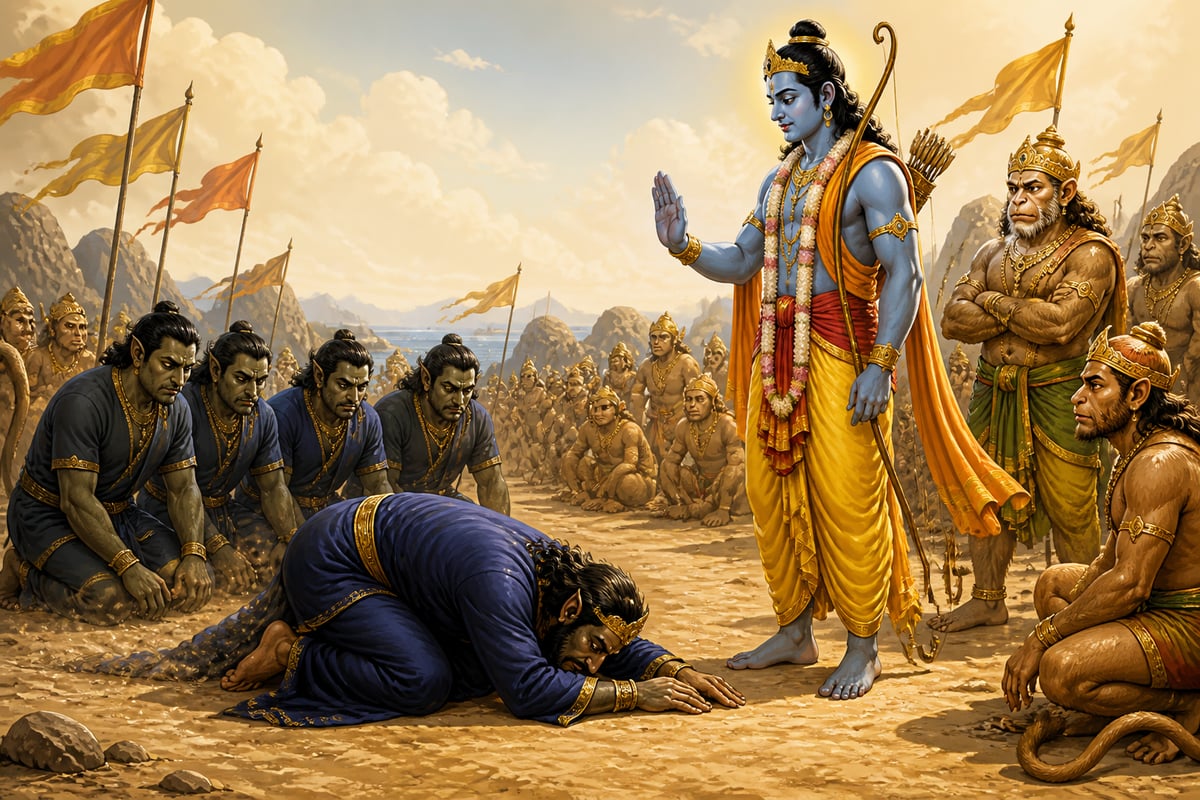
Vibhishana lands before Rama and prostrates himself in the dust. His form is rakshasa - towering, powerful, with the blood of demons in his veins. But his eyes hold something different. They hold anguish.
"Lord Rama," Vibhishana speaks, his voice heavy with sorrow, "I have tried for months to counsel my brother. I begged him to return Sita with honor, to avoid this war, to choose dharma over pride. He laughed at me. He called me a traitor to my race. He threw me from his court. I come to you not as Ravana's brother, but as one who can no longer watch adharma triumph."
The vanara chiefs debate heatedly. Can a rakshasa be trusted? Is this not the oldest trick in warfare - sending a defector to betray from within? Even Sugriva counsels caution.
Rama's Decision
Rama listens to every argument. Then he speaks words that will echo through the ages.
"Even if Vibhishana comes with deception in his heart, I will accept him. One who seeks refuge, even an enemy, must be protected. This is dharma. If Ravana himself came to me seeking shelter, I would grant it. Vibhishana has left everything - his kingdom, his family, his security - because his conscience demanded it. Such courage deserves reward, not suspicion."
Rama turns to Lakshmana. "Bring water from the ocean. We will crown Vibhishana king of Lanka here and now."
The vanaras gasp. Crown him king? But Lanka already has a king - Ravana, who commands armies of demons. Rama smiles at their confusion.
"Ravana's kingship ends the moment we defeat him. Why should Vibhishana wait? By crowning him now, we declare to all of Lanka that righteousness has a home, that those who choose dharma will be honored. Let the rakshasas of Lanka know - their next king stands with Rama."
Water from the ocean is sanctified. Hanuman and Sugriva witness the ceremony. Vibhishana, tears streaming down his face, receives the tilak of kingship. He is now Lanka's sovereign-in-exile, and his knowledge of Ravana's fortress will prove invaluable.
Three Days of Penance
With his counsel now complete, Rama faces the ocean itself. Vibhishana has confirmed there is no shallow passage, no hidden path. The ocean must be crossed, and there is no boat in existence that could carry this army.
Rama decides to petition Samudra, the ocean god himself. He spreads sacred kusha grass on the shore and sits in meditation, facing the endless water. His penance begins.
One day passes. The waves continue their eternal rhythm, indifferent.
Two days pass. The vanara army watches in silence, forbidden by Rama from disturbing his meditation.
Three days pass. Still the ocean gives no sign.
Rama rises on the fourth morning. His face, usually serene, shows rare anger. If the ocean will not respond to humility, perhaps it will respond to power. He turns to Lakshmana.
"Bring me my bow. If Samudra does not appear, I will dry this ocean with celestial weapons. I will turn these waters to steam. The army will walk across the exposed seabed to Lanka."
Lakshmana's eyes widen. He has never seen his brother like this. But he fetches the divine bow. Rama strings it - that bow which broke Shiva's bow, which no other man could even lift. He draws an arrow that blazes with fire, an arrow that could consume worlds.

The Ocean God Emerges
The moment Rama aims at the waves, the ocean reacts.
A tremendous churning begins. Waters part. From the depths rises Samudra himself - ancient beyond measure, crowned with foam, his form made of living water and sea creatures and the memory of every ship that ever sailed. He rises not in defiance but in desperate supplication.

"Forgive me, Lord Rama!" Samudra cries, prostrating his liquid form. "I did not ignore your penance from pride but from nature. I am the ocean - I cannot simply part at will. The laws that govern me are as old as creation. I cannot change my nature any more than fire can choose not to burn."
Rama's arrow remains notched. "Then how shall my army cross?"
Samudra rises higher, his form now shimmering with hope. "There is one among your forces - Nala, son of Vishwakarma, the divine architect. He has inherited his father's gift. Whatever he casts into my waters, I will support. Let him build a bridge, and I will bear its weight. I will calm my waves. I will hold back my creatures. The passage will be safe."
Rama lowers his bow but does not unstring it. "And this arrow that I have already invoked? Its power must go somewhere."
Samudra considers. "To the north lies a region called Drumatulya, where demons who threaten sages dwell. Turn your arrow there. The fire will purify that land."
Rama releases the arrow northward. It blazes across the sky, and distant lands feel its cleansing fire. The ocean god has found a solution that satisfies dharma without destroying creation.
The Promise of the Bridge
Nala steps forward, overwhelmed. He is an engineer, a builder - he never imagined his skills would serve such a purpose.
"Lord Rama," he says, his voice trembling with emotion, "I will build you a bridge. Give me stones and trees, give me the labor of this army, and I will create a causeway that will stand through the ages. Samudra has promised to support what I throw. I promise to throw true."
Rama places his hand on Nala's shoulder. "Begin tomorrow. Tonight, we celebrate - we have an ally in Vibhishana, a promise from the ocean, and an engineer blessed by the gods. Lanka's days are numbered."
Across the water, though none can see it, Lanka's lights glitter in the darkness. Ravana sits in his palace, still confident, still proud. He does not know that his own brother stands against him. He does not know that the ocean itself has betrayed him. He does not know that a bridge is coming.
The Yuddha Kanda has begun.
Living traditions
The NASA satellite images of the Ram Setu (Adam's Bridge) showing a 48 km chain of shoals sparked global interest in 2002. The Sethusamudram Shipping Canal Project debates continue to balance infrastructure needs with the site's religious significance. Rama's acceptance of Vibhishana remains a moral touchstone in Indian political discourse about defection and loyalty.
- Sharanagati Practice: The act of complete surrender to the divine, as Vibhishana did to Rama, remains central to Vaishnavite worship. Devotees formally declare 'I am yours' (tavāsmīti) during initiation ceremonies.
- Dhanushkodi: The southeastern tip of India where the Ram Setu bridge traditionally began. A ghost town since a 1964 cyclone, it remains a pilgrimage site where the submerged limestone chain toward Sri Lanka is visible at low tide.
- Ramanathaswamy Temple: One of the twelve Jyotirlingas, with the world's longest temple corridor (1,212 meters). Legend says Rama worshipped Shiva here before building the bridge.
- Kodandarama Temple, Dhanushkodi: Marks the spot where Vibhishana was crowned king of Lanka by Rama. The only structure to survive the 1964 cyclone, considered miraculous by devotees.
Reflection
- Have you ever had to trust someone others advised you against? What factors influenced your decision, and what was the outcome?
- Why do you think Rama crowned Vibhishana king of Lanka before the war was even won? What message did this send?
- Samudra claimed his svabhava (inherent nature) prevented him from parting. What are the limits of expecting others to change their fundamental nature?