Ravana's Fury
A King Broken by Grief
Indrajit's death shatters something in Ravana. His brother, his son - all taken by Rama's forces. Grief and rage war within the demon king as he prepares to enter the battlefield himself. But even now, voices plead with him to end this war.
A Father's Grief
The messenger who brings news of Indrajit's death does not survive his report.
Ravana's scream shakes the palace foundations. His twenty hands tear the throne room apart - pillars crumble, statues shatter, ornaments melt under the heat of his fury. Courtiers flee in terror. Even his most loyal generals retreat from the explosion of grief.
"My son!" Ravana roars into the destruction. "My beautiful boy! My conqueror of gods!"
He collapses amid the ruins of his throne room, the great demon king reduced to a weeping father. Indrajit was his pride, his legacy, the proof that Ravana's blood could produce warriors as mighty as himself. And now Indrajit lies dead in a sacred grove, killed by a human prince.
Hours pass. Ravana does not move, does not speak. His remaining generals dare not approach. His wives weep in distant chambers. Lanka itself seems to hold its breath, waiting to see what emerges from this crucible of sorrow.
Mandodari's Plea
When Ravana finally rises, his chief wife Mandodari waits for him.
Mandodari is not merely Ravana's queen - she is his conscience, the one voice he occasionally heeds. She has watched this war unfold with growing horror. She warned him when he first brought Sita to Lanka. She begged him to return her. He refused.
Now she tries once more.
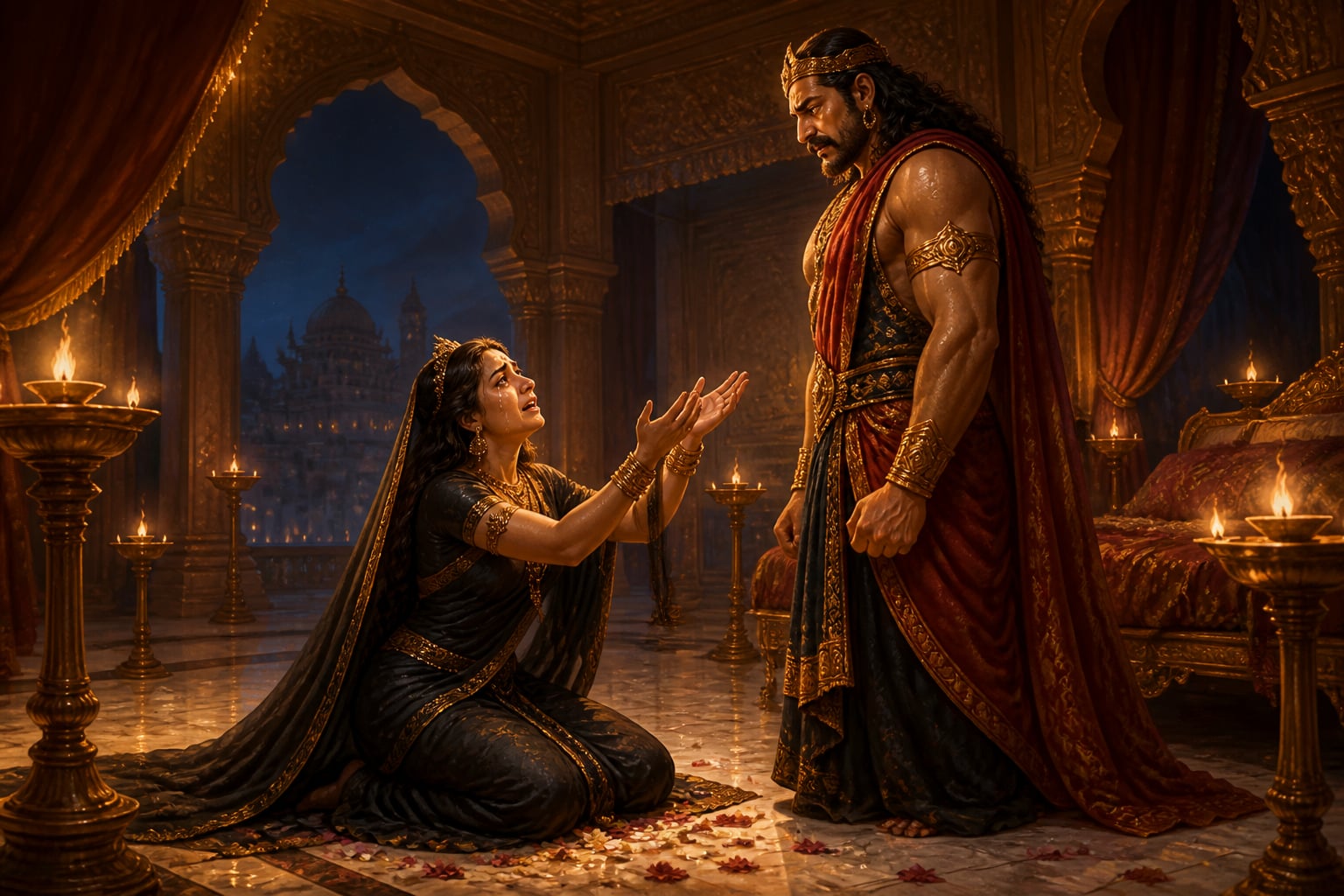
"My lord," she says, kneeling before him, "I share your grief for Indrajit. He was my son too. But his death does not have to be meaningless. You can still end this. Return Sita. Make peace with Rama. Save what remains of our kingdom."
Ravana's eyes blaze. "You ask me to surrender? After what they have done to our son?"
"I ask you to survive. I ask you to let our people survive. Indrajit died because of a war that never needed to happen. Kumbhakarna died for the same reason. How many more must fall before you see the truth?"
"The truth," Ravana snarls, "is that Rama has killed my brother and my son. The truth is that I will tear his heart from his chest and feed it to the crows. The truth is that I will make him watch as I destroy everything he loves before I end his miserable life."
Mandodari bows her head, tears falling. "Then I will mourn not only Indrajit but you as well, my lord. For the Ravana I married died somewhere along this path, and only his anger remains."
War Council of the Doomed
Ravana summons what remains of his war council. The chamber is notably emptier than before - too many generals have fallen, too many commanders lie dead on the battlefield.
Those who remain look at their king with a mixture of loyalty and fear. They have followed Ravana through countless conquests. They have believed in his invincibility. Now that belief wavers.
"Tomorrow," Ravana announces, "I enter the battlefield myself. No more delegating to others. No more watching from towers. Rama wants this war? I will give him war beyond his imagining."
A general named Malyavan, ancient even by rakshasa standards, dares to speak. "My king, wisdom suggests-"
"Wisdom?" Ravana whirls on him. "You speak to me of wisdom? My wisdom conquered the three worlds. My wisdom made Lanka the greatest power in creation. My wisdom-"
"Your wisdom," Malyavan interrupts quietly, "did not stop you from abducting another man's wife. Your wisdom did not prevent the deaths of Kumbhakarna and Indrajit. Perhaps, my king, your wisdom has... failed."
The silence that follows is absolute. Everyone waits for Ravana to kill the old general where he stands.
But Ravana merely laughs - a hollow, terrible sound.
"Failed? Perhaps. But I would rather fail fighting than succeed surrendering. If I am to die, let me die as Ravana, not as a coward who begged for mercy from a mortal prince. Prepare the army. We march at dawn."
The Last Night
That night, Lanka knows peace for the final time.

Ravana walks alone through his palace, past the treasures accumulated over millennia, past the paintings of his conquests, past the statues commemorating his glory. All of it means nothing now. All of it will burn if he falls tomorrow.
He visits Indrajit's chambers - empty now, but still filled with his son's presence. Weapons hang on walls that will never again feel their owner's grip. Books of sorcery lie open to pages that will never be finished.
"I should have listened to you," Ravana whispers to the empty room. "When you counseled caution. When you suggested alternatives. But I was your father - I was supposed to know better. And I knew nothing."
He visits Kumbhakarna's sealed chamber, empty since the giant's death. The massive bed where his brother slept away the decades. The simple possessions of a simple soul who deserved a better fate than dying for his brother's pride.
"You were right," Ravana admits to the darkness. "You were always right. I was wrong. And now I must face the consequences."
Dawn
The sun rises on what will be the final phase of the war.
Ravana emerges from the palace in full battle regalia. His armor gleams with enchantments. His weapons radiate divine power. His chariot is drawn by beasts bred for war across centuries. He looks every inch the conqueror of worlds he once was.

The rakshasa army, despite its losses, rallies at the sight of their king. Here stands Ravana himself - the one who defeated Indra, who made the gods tremble, who built Lanka from nothing into the mightiest kingdom ever known. If anyone can turn this war around, it is him.
From across the battlefield, Rama sees the demon king emerge. He has been waiting for this moment. All the other battles were preludes to this confrontation. Ravana and Rama - the kidnapper and the husband, the demon and the prince, darkness and light.
"He comes at last," Rama observes quietly.
Lakshmana grips his bow. "Let me fight beside you, brother."
"No. This is between Ravana and me. It has always been between us. Whatever happens today, the war ends here."
The Challenge
Ravana's chariot crosses the battlefield, his army parting before him like waves before a ship. He stops within shouting distance of Rama's position.
"Prince of Ayodhya!" Ravana's voice carries across the field like thunder. "You have killed my brother. You have killed my son. You have destroyed my army. Now face me yourself - if you dare."
Rama steps forward, bow in hand. "I have been waiting for you, Ravana. All of this death, all of this suffering - it ends today. Return Sita to me, and I will let you live. Refuse, and I will send you to join your brother and son."
Ravana's laughter is harsh, bitter. "Still offering mercy? Still pretending to be righteous? You are no better than me, prince. You came to my kingdom with an army. You slaughtered my people by the thousands. The only difference between us is that you hide your violence behind pretty words."
"The difference between us," Rama replies, "is that I fight to restore what was taken. You fight to keep what you stole. The universe knows who is just."
"Then let the universe judge!"
Ravana raises his bow. Rama raises his.
The final battle begins.
Living traditions
Mandodari has been rediscovered by feminist scholars as a complex female character who maintains agency within patriarchal constraints. Her repeated pleas to return Sita represent moral clarity that Ravana's pride couldn't hear. Modern retellings increasingly center her perspective, asking how history might have changed if her counsel had been followed. Grief-to-rage transformation depicted in this lesson informs trauma counseling approaches in India.
- Mandodari as Pativrata Model: Despite Ravana's failings, Mandodari remains devoted while still speaking truth. She is honored as a model of the wife who maintains duty while offering honest counsel - not silent submission but wise loyalty.
- Mandodari Temple: The name 'Mandore' is said to derive from Mandodari. Local tradition claims this was her birthplace. The ancient capital of Marwar contains cenotaphs and temples from the 6th century onward.
- Ravana Temple, Kakinada: One of the few temples that honors Ravana as a great scholar and devotee of Shiva. His grief over losing his family is acknowledged here as a humanizing tragedy.
Reflection
- When have you found grief transforming into anger, and how did you handle that transformation?
- Mandodari said she would mourn not only Indrajit but Ravana himself, because 'the Ravana I married died somewhere along this path.' What does it mean for someone to die while still living?
- Ravana said he would rather die fighting than live surrendering. Is this pride, courage, or something else entirely?