The Divine Chariot
Indra's Gift to Rama
Rama faces Ravana on foot while the demon king commands the skies in his flying war chariot. The disadvantage seems fatal until the heavens themselves intervene. Matali, charioteer of Indra, descends with divine wheels, and the battle achieves cosmic proportions.
The Unequal Contest
The first exchanges between Rama and Ravana reveal a critical problem.
Ravana rides his Pushpaka-style war chariot - a vehicle that flies, that maneuvers in three dimensions, that carries enough weapons for an army. He swoops and dives, attacking from angles impossible to defend against, retreating to safe distances before Rama can effectively respond.
Rama, on foot, fights brilliantly but at terrible disadvantage. His arrows reach Ravana, wound him even, but the demon king simply pulls back, recovers, and attacks again. Meanwhile, Rama cannot evade the barrage of weapons Ravana hurls from above.
The vanara army watches in growing despair. Their champion fights with skill beyond mortal measure, but physics favors his enemy. How can any warrior defeat a foe who controls the sky itself?
Vibhishana stands beside Lakshmana, his face grim. "This is why Ravana was invincible for so long. His chariot gives him every advantage. Even gods struggled against him from the ground."
"Then we must get Rama a chariot," Lakshmana says.
"There is none in the vanara army. And Lanka's chariots cannot match Ravana's."
Heaven Takes Notice
High above the mortal battlefield, the gods watch.
They have followed this war since its beginning - observing, hoping, but bound by cosmic laws from direct intervention. Ravana's boons protect him from divine attack. No god can strike him down. But nothing prevents them from evening the odds.
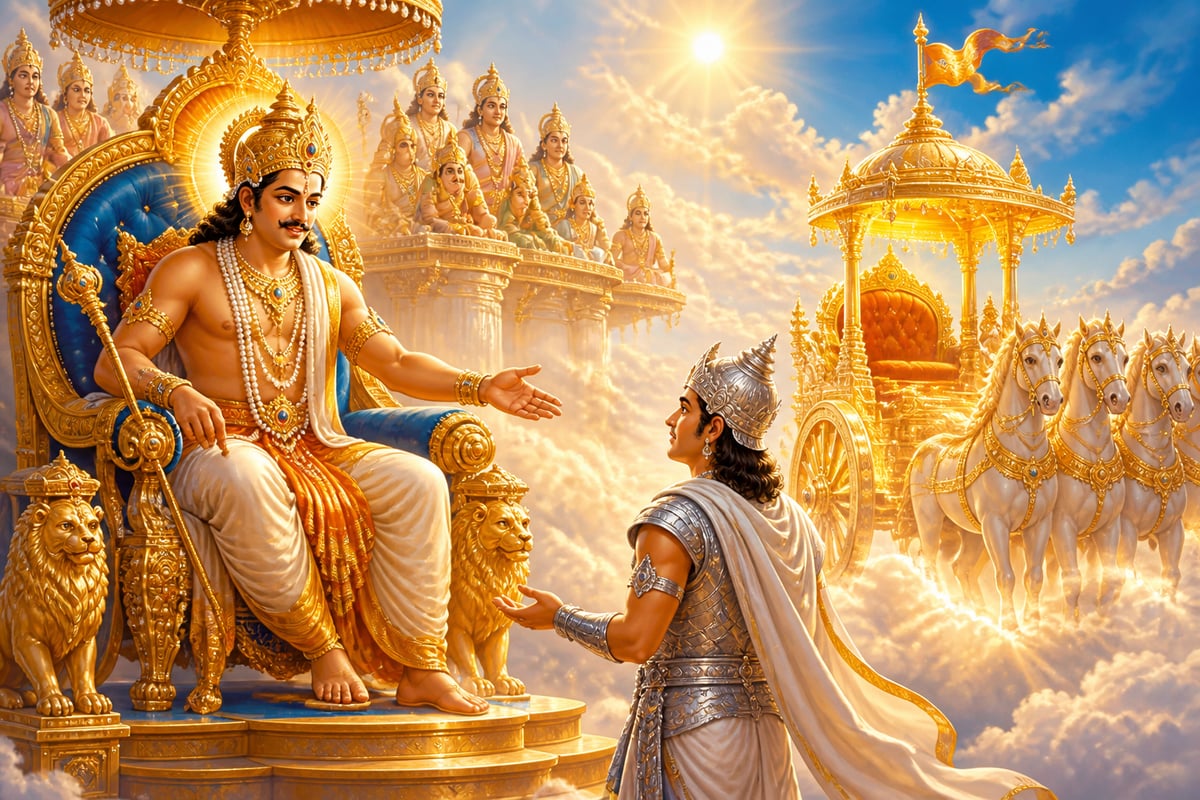
Indra, king of gods, speaks to his divine charioteer: "Matali, my friend. Do you see what unfolds below?"
Matali, who has driven Indra's chariot through countless celestial battles, nods gravely. "Rama fights as well as any warrior I have seen. But without a chariot, he cannot win."
"Then take him mine."
Matali's eyes widen. Indra's chariot is legendary - fashioned by Vishwakarma, pulled by divine horses, equipped with weapons that have defeated asuras since the dawn of time. No mortal has ever ridden it.
"My lord, the chariot is sacred to you. To give it to a human-"
"That human fights our battle," Indra interrupts. "Ravana humiliated me - defeated me, chained me, would have kept me prisoner if Brahma had not intervened. What I could not do myself, Rama does for all of us. The least I can offer is wheels."
The Descent
On the battlefield, Rama struggles to maintain his footing under Ravana's aerial assault.
Another volley of divine weapons rains down. Rama deflects some, dodges others, but one strikes his shoulder. Blood flows. The vanara army groans.
Ravana laughs from above. "Is this the champion who killed my brother? Who slew my son? You are nothing, prince. A mortal playing at godhood. Submit, and I may let you live as my slave."
Rama does not respond with words. He fires an arrow that strikes Ravana's chariot, damaging one of its steering mechanisms. The vehicle lurches, nearly throwing the demon king.
"You fight well," Ravana admits, steadying himself. "But fighting well and winning are different things."
He prepares another attack - and then stops. His eyes fix on something descending from the clouds.
A chariot falls from heaven.

Matali's Arrival
Indra's chariot lands beside Rama with a grace that belies its immense power. Golden wheels spin on axes of pure light. Horses that breathe cosmic fire stamp impatiently, eager for battle. Every surface gleams with enchantments layered by divine craftsmen.
Matali bows to Rama from the driver's seat. "Prince of Ayodhya, I am Matali, charioteer of Indra. My lord sends this vehicle for your use. He says to tell you: 'The enemy of the gods has been the enemy of dharma. Defeat him, and both heaven and earth will celebrate.'"
Rama stares at the impossible gift before him. Then, with the adaptability of a true warrior, he leaps aboard.
The chariot responds to him as if it had always been his. The horses surge forward. The wheels lift from the ground. Rama rises to meet Ravana at his own level.
"Now," Rama calls out, his voice carrying across the suddenly equalized battlefield, "let us see whose weapons are stronger."
Duel of Champions

What follows is a battle beyond mortal comprehension.
Two chariots wheel through the sky, their occupants unleashing arsenals of divine weapons. Astra meets astra - fire counters fire, wind battles wind, cosmic forces clash with impacts that shake the three worlds.
Ravana summons the Nagastra again - serpent arrows that seek their target with relentless hunger. Rama counters with the Garudastra, eagle-blessed missiles that devour the serpents before they can strike.
Rama launches the Vayuastra, weapon of wind that creates cyclones around Ravana's chariot. Ravana responds with the Parvatstra, mountain-weapon that crushes the wind under its weight.
Back and forth they fight, neither gaining decisive advantage. Both bleed from numerous wounds. Both show signs of exhaustion. But neither yields.
The armies below have stopped fighting entirely, watching their champions clash among the clouds. Rakshasa and vanara stand side by side in awed silence, witnesses to a duel that will be remembered until the end of time.
The Turning Point
Hours pass. The sun crosses the sky and begins to set. Still they fight.
Ravana's ten heads work in concert - some directing attacks, others managing defense, still others searching for weaknesses in Rama's strategy. It is like fighting ten warriors simultaneously, each one a master in his own right.
But Rama has something Ravana does not: Matali's counsel.
The divine charioteer has driven against Ravana before, during Indra's defeat. He knows the demon king's patterns, his habits, his blind spots.
"He favors attacks from his upper right," Matali murmurs as he maneuvers. "His third head reacts slowest - it handles long-range vision, not immediate combat. And his heart... his heart is protected by Brahma's blessing, but the blessing weakens if he overextends."
Rama absorbs this information, adapting his approach. He begins targeting specific heads, disrupting Ravana's coordination. He feints toward the weak third head, forcing other heads to compensate and creating openings elsewhere.
Ravana senses the change. His attacks become more desperate, more powerful but less controlled. He is being outmaneuvered for the first time in the battle.
"Who counsels you?" Ravana demands, rage building. "What voice whispers in your ear?"
"The voice of dharma," Rama replies. "Which has always spoken against you."
Night Falls
As darkness claims the sky, both chariots descend by unspoken agreement. Even divine warriors need rest. Even cosmic weapons need recharging.
Rama lands among his army to thunderous cheers. He has fought Ravana to a standstill - something no mortal has ever achieved. His wounds are many, but his spirit is unbroken.
Ravana returns to Lanka in silence. His generals wait for commands, but he has none to give. For the first time in his ancient life, Ravana faces an opponent who matches him weapon for weapon, strategy for strategy.
"Tomorrow," he finally says. "Tomorrow we end this. One way or another."
In the vanara camp, healers tend to Rama's wounds while Matali maintains the divine chariot. Lakshmana brings water and food, though Rama barely touches either.
"He is wounded," Lakshmana observes hopefully. "Many of your arrows found their marks."
"He heals faster than natural," Rama replies. "Brahma's blessing sustains him. I must find a way to strike a blow he cannot recover from. A blow aimed not just at his body but at whatever dark power sustains it."
He looks toward the horizon, where Lanka's towers glow in the darkness.
"Tomorrow. Tomorrow I will end this."
Living traditions
India's space program has drawn on chariot imagery - ISRO's vehicles 'carry' payloads heavenward much as Matali carried Rama to his destiny. The Pushpaka Vimana and Indra's chariot appear in Indian science fiction and aerospace branding. The idea that help can arrive from unexpected sources remains a powerful theme in Indian storytelling.
- Rath Yatra Traditions: Temple chariot festivals across India echo the divine chariot's descent. During Rath Yatra, deities 'ride' massive chariots pulled by devotees - symbolically recreating divine descent to aid the righteous.
- Konark Sun Temple: This UNESCO World Heritage site is designed as a massive chariot with 24 wheels - representing the sun god's vehicle. The architectural connection to divine chariots like Indra's reflects the epic traditions.
- Matali Shrine at Rameswaram: While Matali doesn't have major temples, his role is honored at certain shrines near Rameswaram where the final battle traditions are preserved.
Reflection
- When have you received unexpected help that equalized an unfair situation? How did you use that gift?
- Why do you think the gods could send Rama a chariot but could not fight Ravana themselves? What does this suggest about the nature of divine boons and cosmic law?
- Matali's counsel proved as valuable as the chariot itself. What does this suggest about the nature of help and the importance of wisdom alongside material aid?