The Trial of Fire
Sita's Agni Pariksha
The war is won but Sita faces her greatest trial. To silence doubts about her purity after captivity in Ravana's palace, she must enter fire itself. The Agni Pariksha becomes the most controversial - and most transcendent - moment of the Ramayana.
Words Like Weapons
Sita stands before her husband, joy turning to confusion, confusion to horror.
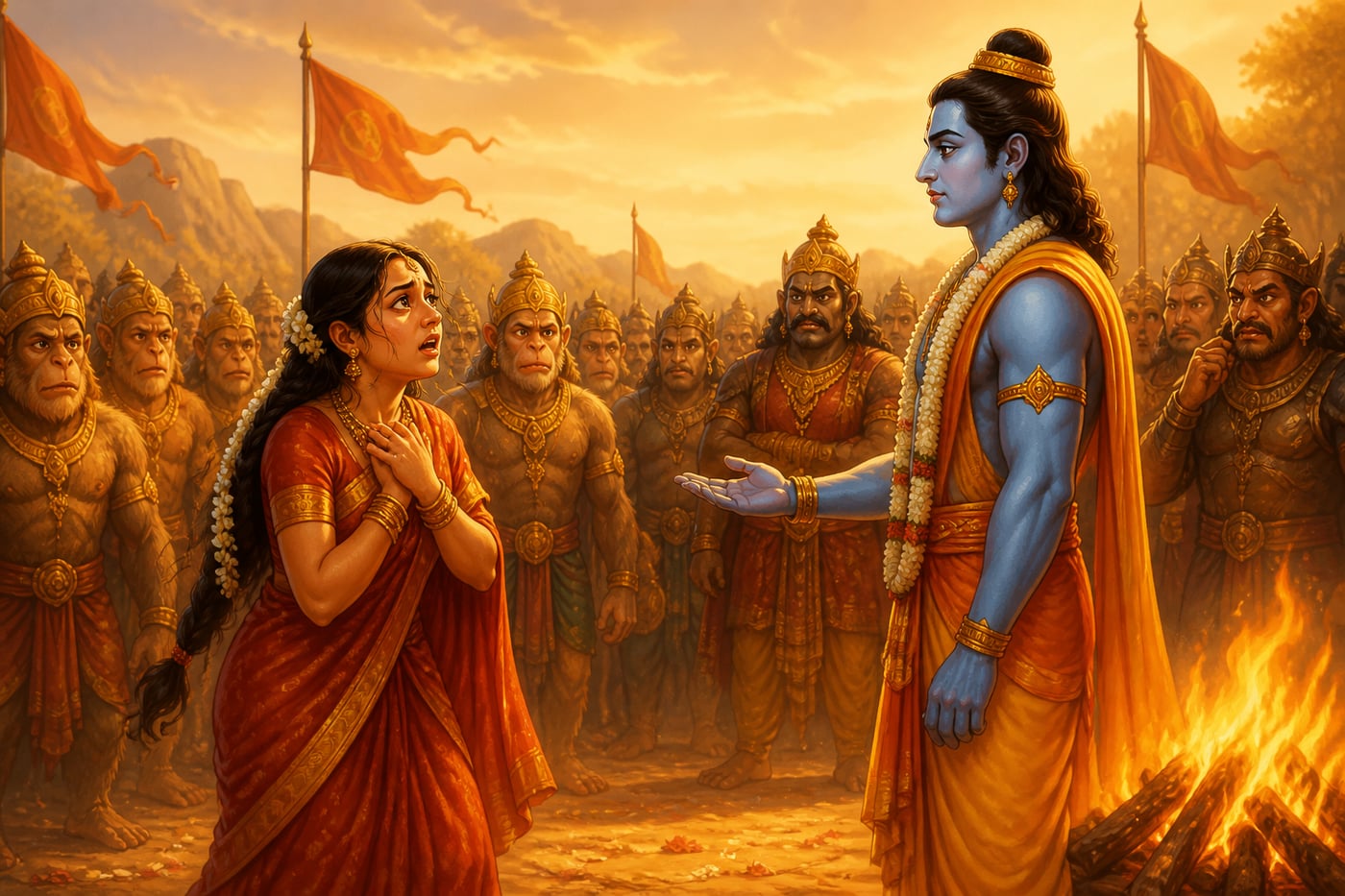
Rama speaks in the formal voice of a king, not the tender voice of a lover reunited. His words cut deeper than any weapon Ravana ever wielded.
"Sita, daughter of Janaka. I have fulfilled my duty. I have avenged your abduction and destroyed the demon who took you. Lanka lies defeated. My honor as a warrior is satisfied."
Sita waits for the words that should follow - welcome home, I missed you, I love you. They do not come.
"But as a king," Rama continues, each word deliberate and cold, "I cannot simply take you back. You have lived for months in another man's house. However innocent you may be, the world will talk. They will question. They will doubt."
The assembled armies stir uncomfortably. This is not the reunion they expected. This is not how heroes welcome rescued queens.
"A king cannot afford a wife whose reputation is questioned," Rama finishes. "I do not know how I can accept you."
Sita's Response
The silence that follows is absolute.
Sita stands frozen, processing words that seem to come from a stranger. This cannot be her Rama - the man who wept when she was taken, who crossed an ocean to reach her, who killed the unconquerable Ravana for her sake. Yet here he stands, speaking of reputation and doubt.
When she finds her voice, it carries not the tears they might expect but cold fury.
"Rama, prince of Ayodhya. Do you truly think me capable of betraying you? Do you believe that Ravana - that monster who tried every temptation and threat - could have touched my heart or my body? You insult not just me but yourself. You insult the love we shared."
Her voice rises. "I who followed you into exile without hesitation. I who gave up palaces for forests, luxury for hardship, because I could not bear to be separated from you. And this is my reward? Public humiliation before the armies that fought in my name?"
Rama's expression does not change. "I do not doubt you personally, Sita. But the world will doubt. A king must consider what his subjects think."
"Then let the world know the truth!" Sita declares. "If my word is not enough, if your knowledge of my heart is not enough, then let there be proof that none can question."
She turns to Lakshmana. "Build me a fire. A great fire. I will walk into it. If I am pure, the flames will not touch me. If I have been unfaithful even in thought, let them consume me."
The Fire Is Built
Lakshmana hesitates, looking to his brother for guidance. But Rama's face remains impassive. He makes no move to stop what Sita proposes.
With trembling hands, Lakshmana gathers wood. The vanara army helps, though their movements are reluctant, confused. They fought to save this woman. Now they prepare her possible execution?
The fire is built quickly - perhaps too quickly. Flames leap high, their heat pressing back the watching crowds. This is no cooking fire, no ceremonial blaze. This is a furnace capable of reducing bodies to ash in moments.
Sita approaches without hesitation. She circles the fire three times, as custom demands before any great action. Then she stops, facing the flames, and speaks her final words before the trial.
"Agni, god of fire, witness of all truth. You see into every heart. You know what lies hidden from mortal eyes. I call upon you now to judge me. If I have been faithful to Rama in thought, word, and deed, protect me from your flames. If I have failed in any way, take me."
Into the Flames
Sita steps into the fire.

The vanara army cries out. Hanuman moves to rush forward but is held back by Jambavan's ancient hand. Lakshmana turns away, unable to watch. Even Vibhishana, who has seen much in his long life, covers his eyes.
Only Rama watches, his face carved from stone.
The flames engulf Sita completely. She disappears into the heart of the fire, swallowed by light and heat. For one terrible moment, it seems she is gone - consumed, destroyed, sacrificed to satisfy the doubts of a world that did not deserve her.
Then the fire begins to change.
The flames that roared with hunger moments ago now pulse with different energy. Their color shifts from angry red to gentle gold. Their heat, which burned any who stood too close, becomes bearable, then comfortable, then cool.
A figure emerges from the transformed fire. Not burned, not touched, not harmed in any way. Sita walks out of the flames as if stepping through a doorway of light.
Agni Bears Witness

Behind her, the fire itself takes form.
Agni, god of fire, manifests in the flames - a radiant being whose presence makes even the gods pay attention. His voice carries across the battlefield, resonating with the authority of one who has witnessed truth since the beginning of creation.
"Rama, prince of Ayodhya. Hear my testimony, which none can question. Sita is pure - pure in body, pure in mind, pure in spirit. During her entire captivity, she never wavered. Ravana's temptations found no purchase. His threats produced only contempt. Her heart belonged to you always, as it belongs to you now."
Agni turns his blazing gaze upon the assembled armies.
"Let no one ever again question this woman's honor. I have tested her in the most absolute way possible. She has passed. Any who speak against her speak against the testimony of fire itself."
Reunion at Last
The mask falls from Rama's face.
Tears stream down his cheeks as he rushes to Sita, gathering her in his arms with a desperation that reveals what the formal words concealed. He knew. He always knew. But the world needed proof that he, as a king, could not provide.
"Forgive me," he whispers, holding her as if he will never let go. "Forgive me for what I put you through. I never doubted you - but I knew the whispers would never stop unless silenced by divine witness. You have proven yourself before all creation. No one can ever question you again."
Sita allows herself to be held, though her own feelings remain complex. The ordeal was real. The pain was real. The public humiliation was real. Even if the outcome was certain to Rama, it was not certain to her.
"You could have warned me," she says softly. "You could have explained."
"If I had, the trial would have meant nothing. The world needed to see your genuine response, your genuine courage. Only that could silence doubt forever."
"The world," Sita repeats. "Always the world. What about us, Rama? What about what we needed?"
Rama has no answer. He simply holds her tighter.
The Path Home
The vanara army erupts in celebration. Whatever confusion they felt moments ago dissolves in the joy of vindication. Sita is proven pure. Rama is reunited with his wife. The story can finally have its happy ending.
Hanuman weeps openly - tears of relief that the woman he swore to protect has emerged triumphant from this final test. Sugriva embraces Lakshmana, both of them laughing with the release of unbearable tension.
Vibhishana approaches Rama with the formal offer of Pushpaka Vimana - the flying chariot that once belonged to Kubera before Ravana stole it.
"Take it," Vibhishana says. "Use it to return home. You have been in exile long enough. Ayodhya waits for its king."
Rama accepts the gift with gratitude. The fourteen years of exile are complete. The demon who prolonged their hardship is dead. Nothing remains but the journey home.
Sita stands beside her husband, her hand in his. Whatever wounds this day inflicted, whatever questions remain about the necessity of her trial, one thing is certain: they face the future together.
The Pushpaka Vimana rises into the sky, carrying them toward Ayodhya. Below, Lanka cheers. Behind, the vanara army begins its own journey home. The war is truly over.
The final chapter awaits.
Living traditions
The Agni Pariksha has become a focal point for feminist rereadings of the Ramayana. Writers from Nabaneeta Dev Sen to Volga (Lalita Kumari) have retold this episode questioning why Sita needed to prove herself. These discussions have revitalized engagement with the epic, showing how ancient texts remain relevant to contemporary debates about gender, power, and justice.
- Sita Worship: Sita is venerated as the embodiment of wifely devotion, patience, and inner strength. The Agni Pariksha, rather than diminishing her, demonstrates her unassailable purity - fire itself could not harm her.
- Janaki Mandir: A magnificent temple dedicated to Sita at her birthplace. The temple honors her entire story, including her emergence from fire unharmed as proof of purity.
- Sita Samahit Sthal: Marks where Sita is believed to have been absorbed into the earth after leaving Rama. The site honors her entire journey - from fire test to final departure.
Reflection
- Have you ever had to prove something that should have been trusted? How did that experience affect your relationships?
- Do you think the Agni Pariksha was necessary, or was it a failure of trust that Rama should have avoided? What does your answer reveal about your values?
- The fire could not harm Sita because she was pure. What does this suggest about the relationship between inner truth and external circumstances?